
Benefits of a Sleeved Trisuit: Engineering Your Aerodynamic Advantage in 2026
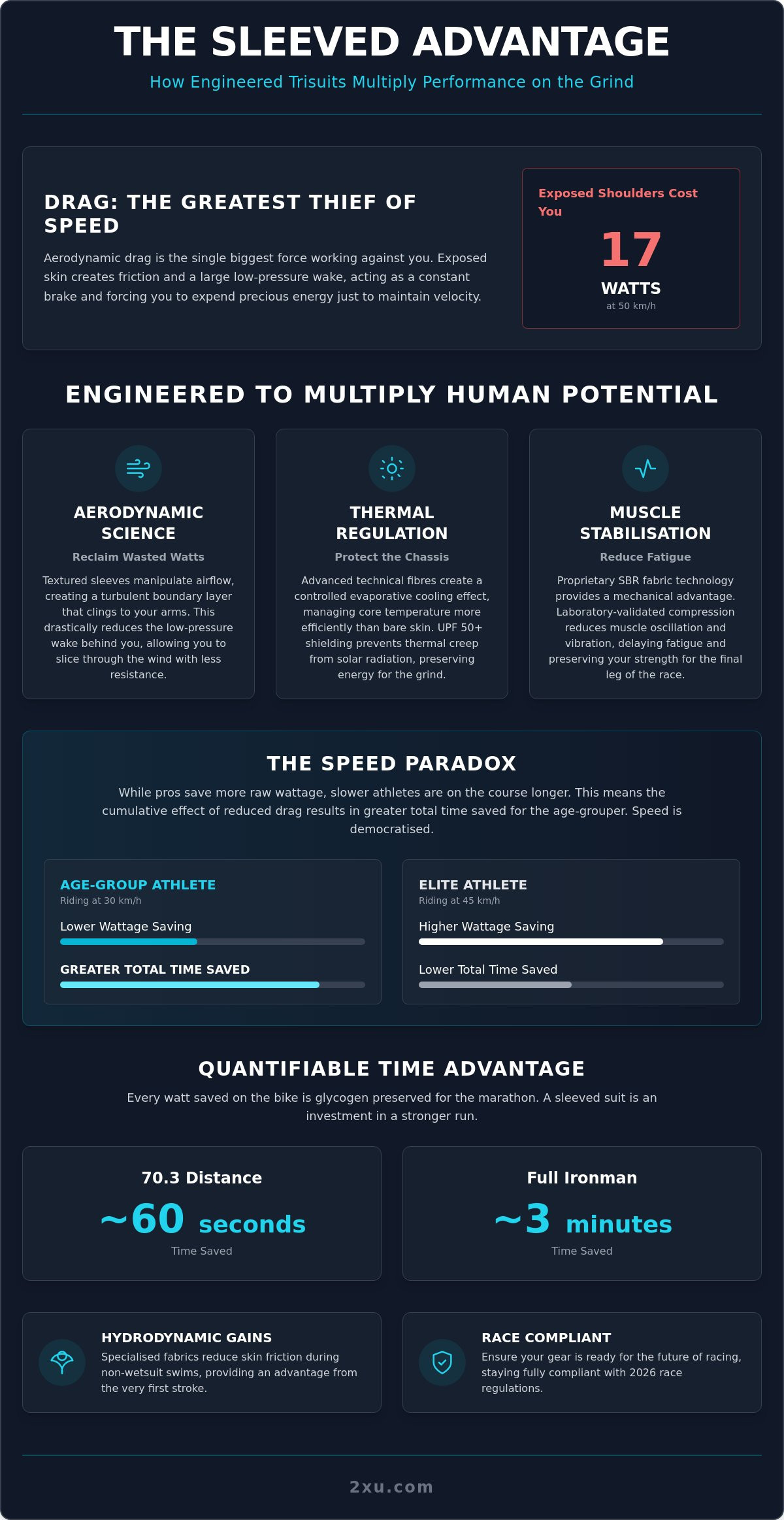
Did you know that leaving your shoulders exposed on the bike leg could be costing you up to 17 watts of power at 50 km/h? You've spent months grinding through brutal intervals and perfecting your nutrition, yet aerodynamic drag remains the single greatest thief of your hard-earned speed. It's a harsh reality that the wrong kit can sabotage your results. Understanding the technical benefits of a sleeved trisuit is the key to reclaiming that wasted energy and multiplying your physical potential during the race.
We agree that every second matters when you're pushing your limits on the course. This article promises to show you how to gain a quantifiable speed increase while managing the physiological stress of long-course events. We'll explore how advanced SBR fabric technology and laboratory-validated compression provide a mechanical advantage through superior aerodynamics, thermal regulation, and muscle stabilisation. You'll also discover how to stay fully compliant with 2026 race regulations, ensuring your gear is as ready for the grind as you are.
Key Takeaways
- Learn how textured sleeves manipulate the boundary layer to reduce pressure drag and reclaim wattage that is otherwise lost to bare skin.
- Understand the cooling mechanics of technical fibres that facilitate evaporative cooling to keep your core temperature stable under high-intensity loads.
- Explore the benefits of a sleeved trisuit for hydrodynamics, specifically how specialised fabrics reduce skin friction during non-wetsuit swims.
- Identify the optimal race scenarios for sleeved gear versus sleeveless options by weighing aerodynamic gains against transition speed requirements.
- Discover how proprietary SBR fabric technology provides a mechanical advantage by offering muscle stabilisation and reducing oscillation-related fatigue.
The Aerodynamic Science of Sleeved Trisuits: Reclaiming Wasted Watts
Human skin is an aerodynamic liability. While your body is a marvel of biological engineering, its surface is porous, uneven, and creates significant friction as you move through the air. When you are deep into the grind of a 180km bike leg, every square centimetre of exposed skin acts as a subtle brake. This is where the physics of high-performance apparel becomes your greatest ally. One of the primary benefits of a sleeved trisuit is its ability to replace inefficient skin with engineered technical fabrics that are mathematically proven to be faster.
The core of this advantage lies in boundary layer control. As air flows over a smooth surface like bare skin, it eventually detaches, creating a large "wake" of low-pressure air behind you. This wake pulls you backward, forcing you to expend more watts to maintain velocity. Textured sleeves are designed to "trip" the air into a thin layer of controlled turbulence. This turbulent boundary layer actually clings to the contours of your arms for longer, significantly reducing the size of the low-pressure wake and allowing you to slice through the wind with less resistance. A high-performance trisuit is no longer just a uniform; it is a piece of technical equipment designed to optimise your interaction with the environment.
There is a common misconception that aerodynamic gains are only for the elite. We call this the Speed Paradox. While a professional athlete riding at 45 km/h saves more raw wattage due to the exponential nature of drag, an age-group athlete riding at 30 km/h actually reclaims more total time. Because the slower athlete is on the course for a longer duration, the cumulative effect of reduced drag translates into a greater overall time saving over the full distance. One of the most overlooked benefits of a sleeved trisuit is this democratisation of speed. You don't have to be a pro to earn a mechanical advantage; you just have to be disciplined enough to choose the right gear.
Boundary Layer Control and Drag Reduction
Engineered fabric textures are critical for maintaining laminar flow across the complex geometry of the human shoulder. Standard sleeveless designs often create an "air-trap" at the shoulder joint, where the transition from skin to fabric causes immediate airflow separation. Sleeves eliminate this disruption by providing a continuous, aerodynamic surface. In triathlon apparel, the drag coefficient is a specific numerical value that quantifies how effectively a fabric reduces the air resistance encountered by an athlete's body at speed.
Quantifying the Time Advantage for Age-Groupers
The data is clear: a sleeved suit can save you approximately 60 seconds over a 70.3 distance and up to three minutes during a full Ironman. These aren't just vanity metrics. Every watt you save on the bike is a watt of glycogen preserved for the marathon. By reducing the physical toll of the bike leg, you set the stage for a superior run. For a deeper dive into kit selection, consult The Ultimate Triathlon Suit Guide: Engineering Your Fastest Race Day to ensure your chassis is ready for the heat of competition.
Thermal Regulation and UV Shielding: Protecting the Chassis
The misconception that sleeves lead to overheating in high-temperature races is a tactical error that ignores the physics of heat transfer. Many athletes mistakenly believe that bare skin is the most efficient way to stay cool. Scientific reality dictates otherwise. While bare skin relies on the erratic evaporation of sweat, technical fibres are engineered to facilitate a constant, controlled refrigeration effect. One of the primary benefits of a sleeved trisuit is its ability to manage your core temperature more effectively than an exposed limb ever could.
Thermal creep is the silent killer of performance. When your skin is exposed to direct solar radiation for hours, your body initiates an inflammatory response to combat the damage. This raises your core temperature and diverts blood flow away from the working muscles to the skin surface for cooling. By shielding the chassis with UPF 50+ materials, you preserve that biological energy for forward motion. While many athletes focus on the aerodynamic analysis of their kit to save watts, the thermal management provided by these fabrics is what prevents a late-race collapse.
When evaluating the benefits of a sleeved trisuit for long-course endurance, you must look beyond the wind tunnel. Protecting your skin reduces the overall physiological stress on your system. This allows you to maintain a lower heart rate at the same power output, keeping you in your optimal performance zone for longer. It's about protecting the machinery so it can continue to produce high-level output under the most demanding conditions.
The Evaporative Cooling Mechanism
Technical fibres multiply your body's natural cooling capacity. In high vapour pressure environments, bare skin becomes saturated and inefficient. Engineered sleeves wick this moisture to the outer surface of the fabric, where the airflow on the bike creates a sustained wind-chill effect. For a tactical advantage, douse your sleeves at aid stations; the fabric holds the moisture longer than skin, providing a refrigeration sensation that lasts for kilometres. This mechanical cooling is far more reliable than the body's autonomous systems.
UV Protection and Long-Course Endurance
Sunburn isn't just a cosmetic issue; it's a performance drain. It increases your heart rate and accelerates dehydration by compromising the skin's barrier function. A sleeved suit provides a consistent UPF 50+ shield that won't wash off during the swim or sweat away on the run. This protection ensures the mechanical stability of your largest organ, allowing you to maintain focus on the grind. Explore our range of high-performance trisuits to find your thermal advantage and keep your core temperature in check.
Mechanical Freedom and Hydrodynamics: The Swim-to-Bike Transition
The transition from water to land is the first major test of your equipment's versatility. While the aerodynamic gains on the bike are well-documented, the performance of your kit begins the moment you enter the water. A common objection among athletes is the fear of shoulder restriction during the swim catch and pull phases. However, modern engineering has rendered this concern obsolete. One of the most technically advanced benefits of a sleeved trisuit is its hydrodynamic performance in non-wetsuit races, where technical fabrics significantly reduce skin friction compared to bare skin.
In a non-wetsuit environment, your skin is a high-drag surface. Technical fabrics are designed with a lower coefficient of friction, allowing you to glide through the water with greater efficiency. This mechanical advantage is further enhanced by the suit's ability to maintain UV Shielding from the moment you exit the water, a critical factor validated by the CDC for long-term skin protection and thermal management. If the water temperature allows for more buoyancy, you should pair this tech with a Triathlon Wetsuit: A Performance-Driven Guide to Your Fastest Swim to maximise your aquatic velocity and energy conservation.
The grind doesn't start on the bike; it starts in the swell. Sleeved designs provide critical compression to the upper arms, which serves to reduce muscle oscillation during the swim. Every time your arm strikes the water, micro-vibrations cause tiny tears in the deltoid and tricep fibres. By stabilising these muscle groups, you reduce the rate of fatigue before you even touch your handlebars. This proprioceptive feedback also improves your feel for the water, allowing for a more disciplined and powerful stroke throughout the entire leg. It's about multiplying your output by ensuring no energy is wasted on unnecessary muscle vibration.
Engineering Zero-Restriction Shoulder Mobility
Achieving a full range of motion requires more than just thin fabric. It demands high-filament yarns and multi-directional stretch capabilities that mirror human anatomy. Our 2026 designs utilise strategic seam placement to ensure the suit moves in synchronisation with your rotator cuff. A precision fit is non-negotiable. If a suit is loose, it will parachute in the water, trapping liquid and creating massive drag. You need a second-skin fit that eliminates water ingress while allowing for an unrestricted reach. This tight fit is the foundation of aquatic speed.
Muscle Stabilisation and Fatigue Reduction
One of the primary benefits of a sleeved trisuit is the reduction of micro-tears in the upper body musculature. Compression sleeves on the arms act as a stabilising chassis, dampening the impact of every stroke. This reduction in muscle oscillation preserves your power for the bike and run legs. By protecting the muscles from the repetitive stress of the swim, you're not just moving faster; you're ensuring your body is ready for the hours of work that remain. Discipline in gear choice leads to resilience on the course.
Selecting Your Weapon: When to Go Sleeved vs. Sleeveless
Selecting your kit is a tactical decision based on mathematical probability, not aesthetic preference. While we have established the aerodynamic and thermal benefits of a sleeved trisuit, the application of this technology depends on the specific demands of your race day. You must weigh the seconds gained in transition against the minutes reclaimed on the bike leg. Every athlete must develop a gear strategy that respects the unique environmental variables of their target event.
In Sprint and Olympic distance events, transition speed (T1) is often the deciding factor in a podium finish. If you aren't wearing your suit under a wetsuit, the struggle to pull tight technical fabric over wet skin can cost you 30 seconds or more. On a 20km bike leg, the aerodynamic advantage might only reclaim 15 to 20 seconds. In this specific scenario, a sleeveless suit is often the superior weapon. However, once the bike leg exceeds 40km, the benefits of a sleeved trisuit become mathematically undeniable. For 70.3 and Ironman distances, the cumulative wattage savings and UV protection are non-negotiable requirements for sustained output.
Distance-Specific Gear Strategy
For long-course endurance, the 'T1 Strategy' is simple: wear the suit under your wetsuit. Modern high-filament yarns provide enough multi-directional stretch to ensure shoulder mobility isn't compromised during the swim. If you choose to pull the suit on in T1, you are sacrificing momentum for a dry start, which is rarely a winning trade. Discipline in your transition training ensures that you don't waste the mechanical advantage your gear provides. Test your setup during high-intensity bricks to confirm your kit moves as a single unit with your body.
Climate and Regulation Check
Environmental factors like humidity and wind speed also dictate your choice. High wind increases the drag penalty of bare skin, making sleeves essential. In high humidity, technical fabrics outperform skin by facilitating evaporative cooling through moisture wicking. You must also remain compliant with the latest rules. The 2026 WTC sleeve standard mandates that the uniform must not cover the arms beyond the elbow and must remain fully zipped during the final 100 metres of the race. Failing to respect these boundaries results in disqualification before you've even crossed the line. Ensure your kit is race-legal and performance-ready. Shop our range of high-performance trisuits to find the right tool for your next grind.
The 2XU Advantage: Multiplied Performance Through Advanced Engineering
The grind is a mathematical equation where effort meets engineering. To achieve breakthrough results in 2026, you need equipment that acts as a force multiplier. At 2XU, we don't just manufacture apparel; we engineer performance chassis designed to remove every possible distraction from your race day. Our Multiplication Promise is a commitment to exponentially enhancing your physical output by providing gear that is as disciplined as your training. One of the definitive benefits of a sleeved trisuit from our collection is the integration of proprietary SBR fabric technology, which represents the perfect intersection of aerodynamic speed and biological breathability.
Our design philosophy is grounded in laboratory validation and rigorous research. We collaborate with elite sports scientists and academic research teams to ensure every seam and fibre serves a purpose. This evidence-based approach has led to Red Dot award-winning designs and laboratory-validated compression levels that provide unmatched muscle stability. By following our tripartite athletic framework, we support your journey through every phase: Readiness, Action, and Recovery. The sleeved trisuit is the pinnacle of the 'Action' phase, ensuring your body remains a high-output machine from the starting gun to the finish line.
SBR Fabric: The Science of Speed
We explicitly reject average standards in textile manufacturing. Our SBR fabrics utilise high-gauge technical fibres engineered for maximum durability and minimum drag. We incorporate specialised dimpled textures on the sleeves to optimise the Reynolds number, a fluid dynamics calculation that determines how air flows over a surface. By manipulating this value, we ensure the boundary layer remains attached to your arms for longer, further reducing pressure drag. This level of technical detail is why 2XU gear provides a 17-watt power saving at 50 km/h, a metric validated through extensive wind tunnel testing.
Elite Performance, Earned Through Effort
Respecting the grind means wearing gear that can survive your most brutal training blocks and your fastest race days. While the science provides the advantage, the effort is entirely yours. There is a psychological edge to wearing world-class equipment; looking fast helps you maintain the mental discipline required to feel fast. When you choose 2XU, you're choosing a legacy of performance-obsessed engineering that has been proven at the highest levels of the sport. Don't leave your potential to chance. Shop the 2XU Sleeved Trisuit Collection and secure the mechanical advantage you've earned through your hard work.
Master the Mechanics of Speed
The 2026 race season demands more than just grit; it requires a calculated approach to your equipment. We have established that the aerodynamic advantage of engineered sleeves can yield a 17-watt power saving at 50 km/h, a figure validated through rigorous wind-tunnel testing. Beyond the bike, the UPF 50+ rating ensures your core temperature remains stable throughout the grind, protecting you from the debilitating effects of thermal creep. By integrating proprietary SBR fabric technology, you gain elite-level moisture management and muscle stabilisation that bare skin simply cannot provide.
Success on the course is the result of thousands of disciplined choices. Choosing to leverage the technical benefits of a sleeved trisuit is a decision to multiply your physical potential and remove the mechanical liabilities that slow you down. Every interval you've completed and every early morning you've endured has led to this moment. Don't let a sub-standard kit compromise your results. Engineer your fastest race day with 2XU Sleeved Trisuits. The course is waiting, and your best performance is within reach.
Frequently Asked Questions
Are sleeved trisuits faster than sleeveless for average triathletes?
Yes, average triathletes often see a greater total time saving than professionals because they are on the course for a longer duration. One of the primary benefits of a sleeved trisuit is that it democratises aerodynamic gains. While a pro saves more raw wattage, an age-grouper riding at 30-35 km/h reclaims more total minutes over the 180km bike leg due to the cumulative effect of reduced drag over time.
Do sleeved trisuits make you hotter during the run?
No, high-performance sleeved suits actually facilitate cooling through engineered moisture management. When technical fibres wick sweat to the surface, the airflow on the run creates a sustained wind-chill effect. This evaporative cooling mechanism is more efficient than bare skin, which can become saturated and lose its ability to regulate core temperature effectively in high humidity environments.
Can I wear a sleeved trisuit under my wetsuit?
Yes, you can and should wear your sleeved suit under your wetsuit to ensure a rapid transition. Modern technical fabrics utilise high-filament yarns that provide enough multi-directional stretch to maintain a full range of motion. This strategy prevents the struggle of pulling tight fabric over wet skin in T1, which is a common source of wasted time and frustration for undisciplined athletes.
Are sleeved trisuits legal in Ironman and 70.3 races in 2026?
Yes, sleeved trisuits are fully legal for the 2026 season provided they comply with specific coverage rules. According to World Triathlon and WTC regulations, sleeves must not extend past the elbow. You must also ensure the suit is fully zipped during the final 100 metres of the run to avoid a penalty. Always verify the specific athlete guide for your event to ensure total compliance.
Do sleeved trisuits restrict shoulder movement during the swim?
No, advanced engineering ensures that sleeves do not impede your stroke during the catch or pull phases. By using multi-directional stretch fabrics and anatomical seam placement, the suit moves in synchronisation with your rotator cuff. A precision fit is essential; a suit that is too loose will trap water, while a correctly sized suit provides a hydrodynamic advantage that reduces skin friction.
How should a sleeved trisuit fit for maximum aerodynamic benefit?
A sleeved suit must have a "second-skin" fit with zero bunching or fluttering in the wind. Any ripples in the fabric create turbulent air that negates the aerodynamic benefits of a sleeved trisuit. You should choose a size that feels tight but does not restrict your breathing or circulation. This compression also provides the mechanical stability needed to reduce muscle oscillation during the grind.
What is the best way to wash and maintain a technical sleeved trisuit?
Rinse your suit in cold water immediately after your race or training session to remove salt and chlorine. Use a mild detergent and avoid fabric softeners, as these can clog the technical fibres and ruin the moisture-wicking properties. Always air dry your kit in the shade. Never use a tumble dryer, as high heat will destroy the elastic integrity of the high-performance yarns.
How much time can I actually save with a sleeved trisuit over 180km?
You can expect to save approximately three minutes over a 180km Ironman-distance bike leg. This time saving is the result of a 10 to 17-watt power reduction at speeds between 40 and 50 km/h. These gains allow you to arrive at T2 with more glycogen preserved for the marathon, which is often the difference between a personal best and a late-race collapse.