
Is it Better to Run in Shorts or Tights? Engineering Your Stride for Peak Output
Your choice of apparel is not a fashion statement; it's a mechanical calculation. Whether you are attacking a vertical climb or grinding through a recovery session, the question of whether is it better to run in shorts or tights depends entirely on your physiological objective. You know the feeling of muscle oscillation draining your power during long-distance efforts or the frustration of skin irritation when you're pushing for a new personal best. These aren't just minor annoyances; they are measurable inefficiencies that compromise your total output.
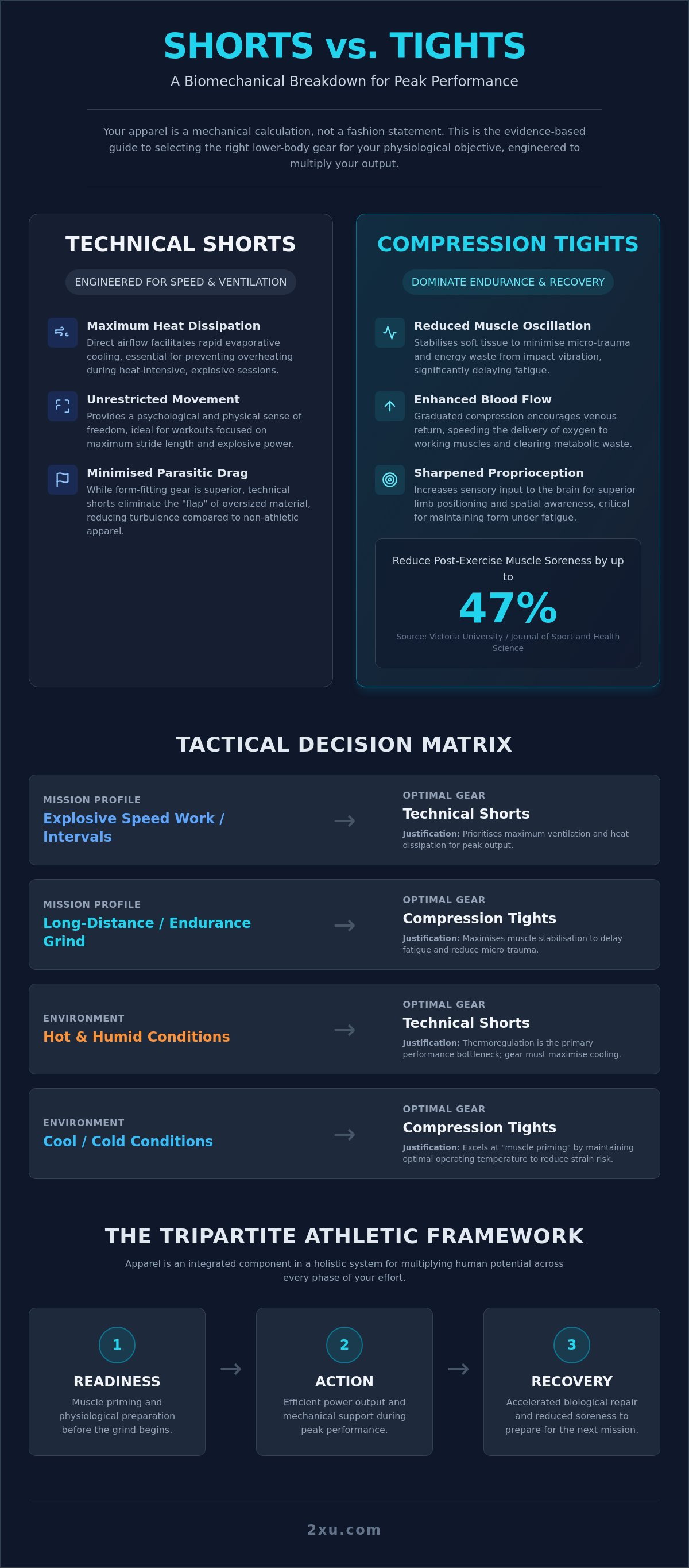
We've analysed the latest 2025 research from Victoria University and the Journal of Sport and Health Science to settle the debate. Discover the biomechanical and physiological evidence behind choosing the right lower-body gear to multiply your performance. This guide previews how graduated compression reduces muscle soreness by up to 47 percent and explains why technical shorts remain the superior choice for high-ventilation speed work. It's time to stop guessing and start engineering your stride for breakthrough results.
Key Takeaways
- Identify how compression technology mitigates muscle oscillation to reduce micro-trauma and delay fatigue during high-impact endurance sessions.
- Learn the physiological criteria to determine whether is it better to run in shorts or tights based on your specific thermoregulatory load and output goals.
- Discover why technical running shorts are the engineered choice for explosive speed work where heat dissipation is the primary performance bottleneck.
- Utilise a tactical decision matrix to select gear based on precise temperature benchmarks and environmental variables to maintain peak efficiency.
- Understand how the Tripartite Athletic Framework integrates apparel into a holistic system for readiness, action, and accelerated biological recovery.
The Biomechanical Dilemma: Defining "Better" in Running Apparel
Performance is not a matter of opinion. It's a measurable result of biological efficiency, mechanical protection, and power output. While casual runners might choose gear based on the morning's weather, elite athletes understand that every layer serves a tactical purpose. Determining whether is it better to run in shorts or tights requires moving beyond aesthetic preference into the data of human movement. Every choice you make before stepping onto the track either supports your output or creates a bottleneck.
Running shorts provide a psychological sense of freedom and maximum airflow, making them the standard for explosive sessions where heat dissipation is the primary concern. Conversely, a high-performance Compression garment offers mechanical support and heightened proprioceptive feedback that loose apparel cannot replicate. This tactile connection to your musculature allows for superior limb positioning and spatial awareness during high-intensity intervals. Your gear selection must align with the specific mission of the day: a low-intensity recovery run, a punishing interval session, or a long-distance endurance grind.
The Role of Aerodynamics and Drag
At higher velocities, air resistance becomes a tangible thief of energy. Form-fitting gear eliminates the parasitic drag caused by loose fabric. When you are performing sprint repeats or chasing a personal best, the constant "flap" of oversized material increases perceived exertion and creates unnecessary turbulence. Elite runners favour a streamlined profile because it minimises wind resistance. This ensures that every watt of power generated by your glutes and quads is directed toward forward propulsion rather than fighting environmental friction. In the world of elite performance, marginal gains in aerodynamics often dictate the gap between a podium finish and the rest of the pack.
Thermoregulation vs. Muscle Temperature
The debate over whether is it better to run in shorts or tights often centres on temperature, but the science is nuanced. Shorts facilitate rapid evaporative cooling through direct airflow, which is essential during heat-intensive sessions in peak summer. However, tights excel at "muscle priming." By maintaining primary movers like the hamstrings and quadriceps at optimal operating temperatures, you reduce the risk of soft tissue strain during the high-load phases of a workout. Modern apparel uses engineered yarns with advanced breathability to manage this balance. This technology ensures you don't overheat while keeping your muscles within their peak performance window. For those prioritising maximum ventilation for speed work, selecting highly technical running shorts remains a critical component of a professional training toolkit.
The Science of Compression: Why Tights Dominate Long-Distance Missions
Every foot strike during an endurance run sends a shockwave through your lower kinetic chain. This impact generates muscle oscillation, which refers to the microscopic vibrations that ripple through your soft tissue. While seemingly minor, these unchecked vibrations are a primary driver of premature fatigue and increased risk of soft tissue micro-trauma. When considering whether is it better to run in shorts or tights for a marathon or ultra-distance event, you must account for the energy tax paid by unstable muscles. High-performance compression tights act as a functional secondary skin, mechanically stabilising muscle groups to ensure your energy is used for propulsion rather than managing internal vibration.
Beyond stabilisation, the tactile feedback provided by form-fitting apparel sharpens your proprioception. This is your body's innate ability to sense movement and limb position in space. By increasing the sensory input to your brain, tights allow for more precise foot placement and mechanical alignment. This heightened awareness is critical when fatigue begins to compromise your form during the final stages of a race. You can explore the full range of compression clothing designed to provide this level of elite mechanical feedback.
Blood Flow and Oxygen Delivery
The engineering behind elite tights relies on graduated compression, which applies the highest pressure at the extremities and decreases toward the core. This pressure gradient encourages venous return, facilitating the movement of deoxygenated blood back to the heart. Research into the effect of graduated compression tights on performance suggests that this improved circulation can help maintain muscle power and accelerate the clearance of metabolic waste products like lactate. Graduated compression is a precision tool for multiplying circulatory efficiency. By optimising blood flow, you directly combat the physiological triggers of Delayed Onset Muscle Soreness (DOMS) before they take hold.
Mechanical Stability for the Grind
During "The Grind" of long-distance missions, your primary movers, the abductors, glutes, and quads, require constant support to maintain structural integrity. Compression apparel provides a firm wrap around these muscle groups, reducing the "heavy leg" sensation that often plagues runners after the thirty-kilometre mark. This support isn't just about the fabric on the limbs; it's about the entire construction. Technical waistbands are essential for preventing gear migration during high-impact movement. If your gear shifts, your focus shifts. Elite engineering ensures that your apparel stays locked in place, allowing you to remain laser-focused on the mechanics of your stride and the path ahead. This level of stability is why serious endurance athletes consistently choose tights for high-mileage blocks.
Technical Running Shorts: Engineered for Ventilation and Explosive Speed
When your training block shifts toward high-intensity intervals or hill repeats, the physiological demands on your body change. In these scenarios, heat dissipation becomes the primary performance bottleneck. While tights offer unparalleled stability, running shorts are designed to facilitate maximum evaporative cooling. This airflow is essential for maintaining a safe core temperature during explosive sessions. If you are debating whether is it better to run in shorts or tights for a track workout, the answer lies in your need for uninhibited range of motion and thermal regulation.
The evolution of the internal liner has transformed the modern running short from a basic garment into a piece of precision equipment. We have moved beyond simple mesh inserts to sophisticated, integrated support systems. These liners provide the necessary security for high-velocity movement without the weight of full-length apparel. By stripping away excess material, you achieve a psychological sense of freedom that is vital for hitting peak speeds during "The Grind."
Moisture Management Without Heavy Fabrics
Sweat is a cooling mechanism, but it can quickly become a performance liability. High-performance fibres are engineered to wick moisture away from the skin instantly. This prevents the gear from becoming water-logged and heavy. This "chafing weight" is a common cause of stride degradation. When your apparel gains weight from absorbed moisture, it alters your mechanics and increases friction against the skin. Technical yarns with quick-dry properties maintain their structural integrity even when wet. This ensures that your gear remains as light at the final kilometre as it was at the first.
The Hybrid Solution: Shorts with Compression Liners
Many elite athletes now utilise a hybrid approach to bridge the gap between ventilation and stability. The 2-in-1 design combines the modesty and airflow of a lightweight outer shell with the targeted support of a compression inner. This configuration allows you to reap the benefits of reduced muscle oscillation while maintaining the cooling advantages of traditional shorts. It is a versatile tool for varied training environments. Whether you are attacking a summer trail or a humid track session, this hybrid gear ensures your physical potential is multiplied through intelligent design. This dual-layer construction provides a practical answer for those who still wonder if is it better to run in shorts or tights, offering a tactical compromise that refuses to sacrifice power for comfort.
The Decision Matrix: Matching Gear to the Environment
Gear selection is not a matter of comfort; it is a tactical response to external variables and internal physiological goals. To maximise your output, you must deploy the right equipment for the specific conditions of the session. When athletes ask whether is it better to run in shorts or tights, they are looking for a formula to eliminate distraction. Respect the grind by choosing gear that allows you to focus entirely on your effort, rather than managing gear migration or thermal stress. Every decision should be a calculated move toward your next breakthrough result.
Environmental Variables
Temperature benchmarks provide a clear framework for apparel selection. When the mercury drops below 5°C, full-length tights are mandatory. At these temperatures, thermal protection is essential for maintaining muscle readiness and preventing the stiffening of soft tissues. In mild weather, typically between 5°C and 15°C, half tights or 2-in-1 shorts offer a balanced regulation of temperature and support. Once conditions exceed 15°C, performance shorts become the primary tool for maximum heat rejection. This ensures your core temperature remains within the optimal operating window for high-intensity output.
Workout Intensity and Duration
The 10km threshold often dictates gear choice. For distances under this mark, the cumulative impact of muscle oscillation is often manageable, allowing you to prioritise the explosive range of motion and cooling benefits provided by shorts. However, once your mission exceeds 10km, the mechanical support of tights becomes essential to delay the onset of fatigue. High-intensity, short-duration sessions like track intervals demand the uninhibited freedom of shorts. Conversely, low-intensity, long-duration grinds require the stabilisation of compression to protect your muscles from micro-trauma over thousands of repetitions.
Recovery sessions require a holistic approach to biological repair. Within the Tripartite Athletic Framework, the recovery phase is just as critical as the action. Utilise compression shirts and full-length tights to accelerate the repair process by improving blood flow and reducing swelling. This ensures you are ready for the next session without lingering soreness. Don't leave your performance to chance by wearing sub-standard equipment. Upgrade your training kit with professional-grade running apparel to ensure every session counts toward your ultimate goal.
2XU Engineering: Multiplying Human Potential Through Gear
At 2XU, we do not simply manufacture apparel; we engineer high-performance equipment designed to multiply your physical output. The persistent question of whether is it better to run in shorts or tights is often reduced to a matter of personal comfort, but we view it through the lens of biomechanical efficiency. Human potential is multiplied only when rigorous science meets the unwavering discipline of the pavement. By adopting our Tripartite Athletic Framework, you ensure that every phase of your journey, Readiness, Action, and Recovery, is supported by laboratory-validated technology. We invite you to join the elite who refuse to settle for average standards in their pursuit of a new personal best.
Many athletes focus exclusively on the "Action" phase, yet true breakthroughs are forged in the periods of preparation and recuperation. While competitors often ignore the physiological demands of the recovery phase, our engineering philosophy accounts for the total athletic lifecycle. Using graduated compression to facilitate biological repair is as critical as using technical shorts for heat dissipation during a sprint. This holistic understanding of human movement ensures that you are not just training harder, but training with greater mechanical precision. Every decision you make about your gear should be a tactical step toward your next breakthrough result.
Laboratory-Validated Performance
Our commitment to rigorous testing is the foundation of our authority. We partner with elite academic research teams to validate our claims using specialised laboratory instrumentation. Our proprietary fabrics differ fundamentally from standard high-street athletic wear because they are engineered for specific mechanical outcomes. The "Multiplication Promise" ensures that every stitch is designed to enhance your physical output by reducing muscle oscillation and optimising thermoregulation. We rely on data and proven results rather than lifestyle trends. This scientific rigour allows us to provide equipment that stands up to the most demanding coaching standards and the harshest training environments.
Equipping Your Journey
Whether your mission requires a specialised triathlon suit for race day or technical half tights for an endurance grind, our obsession with quality remains unyielding. Integrating 2XU gear into your existing training regimen is a declaration of intent. It shows you respect "The Grind" enough to equip yourself with gear that works as hard as you do. When you are deciding if is it better to run in shorts or tights for your next session, let the data be your guide. Choose the equipment that aligns with your physiological objectives. Earn your place among the top performers by investing in apparel that refuses to compromise on power, stability, or recovery. It is time to sharpen your focus and respect the grind with gear engineered for peak output.
Engineer Your Breakthrough
Our proprietary technology is scientifically proven to reduce muscle oscillation, protecting your soft tissue from micro-trauma and accelerating biological repair. Don't compromise your output with average standards. It's time to equip yourself with gear that works as hard as you do. Shop 2XU High-Performance Running Apparel to multiply your physical potential. Respect the grind, trust the data, and go earn your next personal best.
Frequently Asked Questions
Is it better to run in shorts or tights for weight loss?
Apparel choice does not directly dictate metabolic rate or fat oxidation. Weight loss is a result of a sustained caloric deficit and training consistency. For those seeking professional support to reach these milestones, check out 6X Training for expert fitness coaching. High-performance tights may indirectly support this goal by reducing muscle oscillation and micro-trauma, which allows you to maintain a higher training volume with less downtime. If your objective is to maximise "The Grind," choose the gear that enables you to push further and recover faster.
Should I wear underwear under my running tights or lined shorts?
You should not wear underwear under technical running tights or lined shorts. These garments are engineered with moisture-wicking yarns and flatlock seams to be worn directly against the skin to prevent chafing and bacterial buildup. Adding a layer of standard cotton or non-technical fabric introduces friction points and traps moisture. This compromises the garment's performance and your own comfort during high-intensity output.
Do compression tights actually help prevent running injuries?
Compression tights serve as a preventative tool by mechanically stabilising major muscle groups like the hamstrings and quadriceps. By reducing muscle oscillation, they mitigate the risk of soft tissue strains and micro-trauma caused by repetitive impact shockwaves. While they aren't a substitute for proper biomechanics, they provide the structural support necessary to maintain form when fatigue sets in. This mechanical stability is a core component of our Tripartite Athletic Framework.
What temperature is too hot for running in full-length tights?
Most athletes find that temperatures exceeding 15°C are too high for full-length tights during intense sessions. At this threshold, the body's need for evaporative cooling through direct airflow outweighs the benefits of muscle priming. When deciding if is it better to run in shorts or tights in humid conditions, prioritise heat rejection. Technical shorts or half tights are the superior tactical choice for maintaining a safe core temperature during summer training blocks.
Why do pro runners often wear half tights instead of shorts?
Professional runners utilise half tights because they offer a precise balance of aerodynamic efficiency and muscle stabilisation. Unlike loose shorts, half tights eliminate fabric drag and provide targeted support to the hamstrings and quads without the thermal load of full-length gear. This ensures that every watt of power is used for propulsion. It is a calculated decision to maximise speed while protecting the primary movers from vibration-induced fatigue during a race.
Can I wear my 2XU compression tights for post-run recovery only?
You can absolutely wear 2XU compression tights exclusively for recovery to accelerate biological repair after a session. Graduated compression is scientifically proven to enhance venous return and reduce lower limb swelling after a punishing run. Whether is it better to run in shorts or tights during the action, the recovery phase remains non-negotiable. Wearing them for 12 to 24 hours post-exercise can reduce muscle soreness by up to 47 percent, ensuring you are ready for the next session.