
Thermal Compression Tights: The 2026 Buying Guide to Engineered Winter Performance
Most athletes view sub-zero temperatures as a reason to retreat, yet for the elite, winter is a laboratory for mechanical advantage. You understand the frustration of cold starts where muscle stiffness hampers your natural running mechanics and the inevitable "sweat-chill" effect that follows high-intensity intervals. It is a common struggle to find gear that provides warmth without the suffocating bulk of traditional layers that restrict your movement.
This guide will show you how to master the science of thermoregulation and select the ultimate thermal compression tights to multiply your physical output. We have engineered this breakdown to help you maintain optimal muscle temperature and reduce vibration-induced fatigue through proprietary fabric technology. You will discover how to achieve a second-skin feel that provides both warmth and mechanical support; ensuring your training remains unyielding regardless of the forecast. We will examine the specific laboratory-validated features that allow you to push past standard limits and prove that the human potential is truly multiplied through superior engineering.
Key Takeaways
- Master the biological mechanics of thermoregulation and neutralise the "sweat-chill" effect that compromises your metabolic efficiency during high-output sessions.
- Determine when to deploy windproof membranes versus high-breathability fabrics when selecting your 2026 thermal compression tights for sub-zero output.
- Build a high-performance winter system by layering moisture-wicking foundations with specialised insulation for conditions dropping below 5°C.
- Preserve your mechanical advantage by adopting laboratory-standard gear care protocols that protect technical fibres and DWR coatings from degradation.
The Science of Thermal Compression: Why Performance Fibres Outperform Bulk
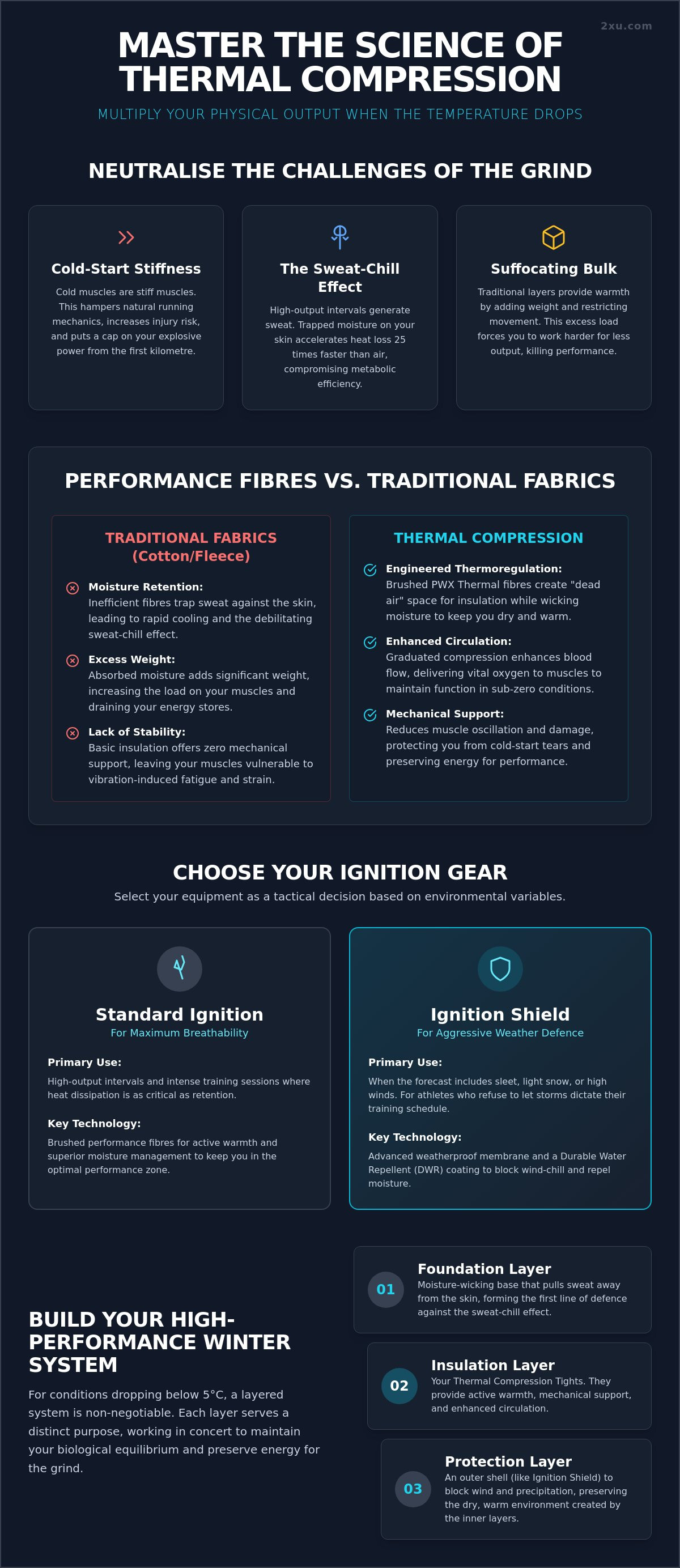
Winter training isn't about survival; it's about maintaining a precise biological equilibrium. Your body engages in a constant metabolic struggle to maintain a core temperature of 37°C while you push through the frost. When you settle for standard cotton or basic fleece, you're inviting failure. These materials absorb moisture and become heavy, leading to the "sweat-chill" effect where moisture on your skin accelerates heat loss 25 times faster than air. You don't need bulk; you need engineered thermoregulation.
A high-performance compression garment provides more than just a tight fit. By utilising graduated compression, these tools enhance peripheral circulation, ensuring that oxygenated blood reaches your extremities to keep them functional in sub-zero conditions. This mechanical advantage is why professional athletes prioritise thermal compression tights over traditional track pants. Standard fabrics fail the winter athlete for several key reasons:
- Moisture retention: Inefficient fibres trap sweat against the skin, causing rapid cooling.
- Excess weight: Absorbed moisture increases the load on your muscles, forcing you to work harder for less output.
- Lack of stability: Basic insulation offers no mechanical support for high-output movement.
Active Warmth vs. Passive Insulation
Passive insulation relies on thickness to trap heat, but for high-intensity athletes, being "too warm" is a performance killer. Excess heat leads to premature fatigue and inefficient cooling cycles. Shivering also carries a heavy metabolic cost, diverting energy away from your stride and into heat production. Active warmth is the balance between heat retention and vapour release. By managing this transition, you preserve your glycogen stores for the grind rather than wasting them on simple temperature maintenance. Engineered gear ensures you stay in the performance zone without the risk of overheating.
2XU PWX Thermal: The Engineering of Heat
The Ignition collection utilises brushed PWX Thermal fabrics to create "dead air" space. This microscopic layer of air acts as a powerful insulator against the external cold while the technical performance blends maintain 360-degree stretch. This flexibility is critical for natural running mechanics. Beyond heat, these thermal compression tights provide essential mechanical support to your muscle groups. This stability reduces the risk of "cold-start" muscle tears, protecting your fibres during those first explosive kilometres before your body is fully primed. Don't let the cold dictate your pace. Use science to sharpen your edge and prove that the human potential is truly multiplied through superior engineering.
Choosing Your Ignition Gear: Shield vs. Standard Thermal Compression
Selecting the right equipment is a tactical decision based on environmental variables. While standard thermal compression tights excel during high-output intervals where maximum breathability is paramount, certain conditions require a more aggressive defensive posture. The Ignition collection provides two distinct pathways to ensure your output remains uncompromised by the elements. You must choose between the absolute protection of a weather-proof membrane or the high-ventilation thermal regulation of brushed fabrics.
The Ignition Shield series is engineered for athletes who refuse to let storms dictate their training schedule. These garments feature advanced membrane technology designed to repel water and block wind-chill. In contrast, the standard Ignition range focuses on internal heat management through brushed fibres, making it the superior choice for high-intensity sessions where heat dissipation is just as critical as retention. Research highlights that the firm support provided by these tools is not just about comfort. A Systematic Scoping Review on Compression Garments confirms that graduated pressure reduces muscle oscillation and damage; a factor that is essential when cold temperatures increase the risk of strain and micro-tears.
When to Choose Ignition Shield
Prioritise the Ignition Shield Compression Tights (AUD 160.0) when the forecast includes sleet, light snow, or high winds. These tights utilise a Durable Water Repellent (DWR) coating that causes moisture to bead and roll off the surface rather than soaking into the material. This is vital for coastal runners or those training at high altitudes where wind-chill can drop muscle temperatures rapidly. The synergy between the waterproof outer panels and the stabilising compression inner creates a fortress for your lower limbs. You maintain mechanical stability while the storm-ready panels keep your temperature within the optimal performance window, ensuring your "human multiplied" potential isn't frozen by the environment.
The Versatility of the Ignition Grid Base
For a complete winter system, the foundation is as important as the outer layer. The Ignition Grid Base Layer (AUD 80.0) utilises hollow-core THERMOLITE technology to trap warm air within the material structure. This design provides exceptional warmth without adding unnecessary weight or bulk. It works in tandem with your thermal compression tights to manage moisture at the skin level, preventing the "sweat-chill" effect mentioned previously. You can learn more about how these technologies scale across your entire kit in our scientific guide to compression shirts. If you're ready to upgrade your winter arsenal, you can explore the full Ignition collection to find the exact tools for your specific environment.
Layering for the Grind: Building a Complete Winter System
Respecting the grind means preparing for the environment with mathematical precision. You cannot rely on a single piece of gear to handle the volatile shifts of a winter session; you need a cohesive system where each layer serves a specific mechanical purpose. Technical synergy is the objective. When your base, mid, and outer layers work in unison, you eliminate the friction and bunching that compromise your natural running mechanics. This system begins with your thermal compression tights as the engine for muscle stability and moves upward to manage your core temperature.
The foundation of any elite winter kit is the base layer. Whether you deploy the Ignition Wool or the Grid series, the primary objective is rapid moisture management. These fabrics pull sweat away from the skin instantly, preventing the rapid cooling effect that occurs when moisture is trapped against the body. Research into the Physiological Response to Compression Clothing shows that maintaining this dry microclimate is essential for sustaining power output in cold environments. Without this wicking foundation, even the most advanced outer shell will fail to protect your metabolic efficiency.
For total protection when the elements turn hostile, the Ignition Shield Waterproof Jacket (AUD 250.0) acts as your external fortress. It provides a 10k/10k barrier against wind and rain while allowing internal vapours to escape. This prevents the internal humidity that leads to overheating, ensuring your human multiplied potential remains intact even in the harshest conditions. By integrating these layers, you create a modular system that adapts to your output levels.
The Mid-Layer Powerhouse: Ignition Haptic
When the mercury drops below 5°C, insulation becomes a tactical necessity. The Ignition Haptic 1/4 Zip (AUD 110.0) utilises a 3D puff grid construction to create pockets of encapsulated air. This design provides significant warmth without the restrictive bulk of traditional heavy fleeces. The 1/4 zip allows for immediate manual ventilation as your metabolic heat increases during the warm-up phase. It's an efficient tool for maintaining the precise balance between heat retention and vapour release during high-intensity intervals.
Managing the Extremities
Your body is programmed to sacrifice blood flow to your hands and feet to protect your core organs in the cold. You must counteract this biological response through proper circulation and insulation. Beyond temperature, visibility is a safety requirement for the winter athlete. 360-degree reflectivity provides a psychological advantage on dark winter mornings, ensuring you are seen while you focus on your splits. For those transitioning between seasons or looking for advanced layering strategies, consult our ultimate guide to running shorts. Every piece of gear must earn its place in your system through proven performance and contribution to your total output.
Performance Breakdown: Standout Products in the Ignition Collection
Selecting individual components for your winter kit requires an understanding of how specific engineering solves environmental challenges. The Ignition collection isn't a generic range; it's a suite of precision instruments designed for the athlete who respects the grind. At the core of this arsenal are the thermal compression tights, specifically the Ignition Shield variant (AUD 160.0). These are your primary defensive tools when facing wet, high-wind scenarios. They provide the mechanical stability required to protect your muscle fibres while the storm-ready panels ensure your power output doesn't drop as the temperature does.
For sessions requiring maximum heat-trapping without the weight, the Ignition Grid 1/2 Zip Hoodie (AUD 140.0) is the standard. It utilises a grid-back fabric that creates channels for air to circulate while maintaining a thermal barrier. If your focus is on freedom of movement and intelligent warmth, the Ignition Haptic 1/4 Zip (AUD 110.0) provides the necessary flexibility for technical drills or speed work. Every piece in this range is built to ensure your training remains unyielding. You can shop the Ignition collection today to secure the tools necessary for your winter evolution.
The Wool Advantage
The Ignition Wool Long Sleeve (AUD 100.0) leverages a naturally soft bamboo-wool blend to achieve superior heat regulation. Unlike standard fabrics that can feel abrasive when wet, these natural fibres provide a superior skin-feel while maintaining the technical performance required for elite output. This blend is particularly effective for odour management. For the daily athlete, preventing the accumulation of bacteria is essential for gear longevity and personal discipline. It ensures your kit is ready for the next session as quickly as you are.
Shield Technology for the Upper Body
Protection must extend beyond the lower limbs. The Ignition Shield Waterproof Jacket (AUD 250.0) is engineered with a 10k/10k rating, meaning it can withstand 10,000mm of water pressure while allowing 10,000g of moisture vapour to escape per square metre. Breathability is just as important as waterproofness for endurance output; without it, you will compromise your core temperature through internal moisture buildup. A precise, athletic fit reduces wind-drag during high-speed training, ensuring that your energy is spent on forward propulsion rather than fighting loose fabric.
Maintaining Your Edge: Gear Care and the Performance Mindset
Winter is a filter. It separates the athletes who prioritise comfort from those who prioritise results. While the environment presents significant obstacles, your equipment is engineered to turn those challenges into mechanical advantages. However, the integrity of your thermal compression tights depends entirely on your maintenance protocol. If you treat your gear with the same discipline you apply to your split times, it will continue to multiply your output for seasons to come. Neglecting care instructions doesn't just ruin the fabric; it compromises the scientific properties that keep you in the performance zone.
Technical fibres require specific handling to maintain their moisture-wicking and heat-trapping capabilities. Fabric softeners are a primary performance killer. They leave a waxy residue that coats the fibres, effectively blocking the moisture-transfer channels and destroying the garment's ability to prevent the sweat-chill effect. Similarly, preserving the Durable Water Repellent (DWR) coating on your Shield garments requires a commitment to cold washing and air drying. High heat is the enemy of engineered performance fibres, as it breaks down the elasticity required for graduated compression.
Protecting Your Investment
Maintaining the compression profile of your 2026 gear requires a methodical approach to cleaning. Follow this protocol to ensure your equipment remains unyielding:
- Turn garments inside out: This protects the outer surface and DWR coatings from abrasive contact during the wash cycle.
- Use mild detergent: Avoid bleach, softeners, or heavy perfumes that can degrade technical bonds.
- Cold machine wash: Use a delicate cycle to prevent unnecessary mechanical stress on the fibres.
- Air dry only: Hang your gear in the shade. Never use a tumble dryer, as the heat will destroy the elastane responsible for muscle stability.
By following these steps, you ensure that your thermal compression tights provide the same level of mechanical support on day 500 as they did on day one. Mapping the Ignition collection to your local environment is the final step in your preparation. For temperatures above 5°C, the standard Ignition range provides sufficient thermoregulation. When the mercury drops below freezing, the Shield series becomes your essential defensive tool against wind-chill and sleet.
Human Multiplied: The Final Word
Respect the discipline required for winter training. The grind is not a burden; it's a laboratory where champions are engineered through consistency and superior preparation. When you eliminate the distractions of muscle stiffness and thermal loss, your focus remains entirely on the mechanics of achievement. The right gear turns environmental hostility into a competitive edge. This is the core of the "Human Multiplied" promise: providing you with the technical foundation to exceed your perceived limits. Equip yourself for the winter grind at the Ignition Collection and prove that your output is not dictated by the forecast.
Master the Elements through Superior Engineering
Winter training is the ultimate test of discipline and mechanical preparation. You now understand that effective thermoregulation isn't about bulk; it's about the scientific application of proprietary PWX Thermal fabric technology and graduated compression to maintain elite circulation. By building a cohesive system from the base layer up, you ensure your body remains in the optimal performance zone regardless of the external frost. You've learned to distinguish between the high-ventilation needs of interval training and the defensive requirements of the Shield series when facing coastal winds.
Shop the 2026 Ignition Collection: Multiply Your Winter Performance
Frequently Asked Questions
Are thermal compression tights warmer than regular thermal leggings?
Yes, because they provide engineered thermoregulation rather than simple passive insulation. While regular leggings rely on bulk to trap heat, thermal compression tights utilise brushed fibres to create dead air space while simultaneously improving peripheral circulation. This increased blood flow ensures your extremities remain functional and warm during high-output sessions in sub-zero conditions.
What temperature should I start wearing thermal compression for running?
You should transition to thermal gear once temperatures drop below 5°C. This is the threshold where your body’s metabolic heat production often fails to counteract environmental heat loss, leading to the "sweat-chill" effect. Wearing engineered compression at this stage prevents muscle stiffness and ensures your mechanical efficiency remains uncompromised by the cold.
Do I need to wear anything over my thermal compression tights?
Most athletes use these tights as a standalone layer because they are designed to provide both warmth and mechanical support. However, during extreme weather events involving heavy sleet or high wind-chill, you should layer a waterproof shell over them. The Ignition Shield series is specifically engineered with membranes to handle these defensive scenarios without requiring additional bulk.
How should thermal compression tights fit compared to standard gear?
The fit must be firm and act as a "second skin" to ensure the graduated compression functions correctly. Unlike standard training apparel that may have a relaxed profile, thermal compression tights must apply consistent pressure across the muscle groups. If the fabric bunches or slips, the circulatory benefits and muscle oscillation reduction are significantly diminished.
Can I use thermal compression for recovery after a cold-weather run?
Absolutely. Graduated compression is a critical tool for biological recovery because it facilitates the removal of metabolic waste and improves blood flow return. Using these garments after a session in the cold helps reduce delayed onset muscle soreness and repairs micro-tears caused by high-intensity output in harsh environments.
Will the DWR coating on my Ignition Shield gear wear off over time?
The Durable Water Repellent coating is a technical surface treatment that can degrade through friction and improper care. You can preserve its integrity by strictly following cold-wash protocols and avoiding fabric softeners. If the water-beading performance eventually declines, you can reactivate it or reapply technical treatments designed for high-performance fibres.
Is the Ignition Wool Long Sleeve better for layering than the Grid Base?
It depends on your specific performance requirements for the session. The Ignition Wool is superior for natural odour control and moisture buffering during long, steady-state efforts. The Grid Base Layer is engineered for maximum vapour transfer and is the better choice for the highest intensity intervals where sweat management is the primary concern.
How does compression help prevent injuries in the cold?
Compression provides mechanical stability that reduces muscle oscillation, which is a leading cause of fatigue and strain. In cold environments, muscle tissue is less pliable and more prone to tears during explosive movements. By keeping the muscle groups secure and maintaining an optimal functional temperature, compression gear minimises the risk of "cold-start" injuries.