
How to Increase Blood Circulation in Legs: The Science of High-Performance Recovery
Your heart is only the primary engine of a much larger, more complex circulatory system. To achieve peak output, you must master the mechanics of your peripheral heart, the calf muscles. You've likely experienced that heavy, leaden sensation in your lower limbs after an intense block of training or hours of static standing. This is not just fatigue; it's a failure of venous return. Understanding how to increase blood circulation in legs is the difference between a stalled recovery and a physiological breakthrough.
We agree that standard recovery is a baseline for the average, but for the elite, every minute of downtime is an opportunity for a competitive edge. This article promises to provide the precise mechanical and biological protocols required to optimise your vascular function and flush metabolic waste with surgical efficiency. You'll gain a data-backed framework for daily circulation management, ranging from the science of graduated compression to the specific movement breaks proven to reverse the damage of sedentary intervals.
Key Takeaways
- Master the "peripheral heart" mechanism by activating your calf muscles to overcome gravity and accelerate venous return.
- Implement high-frequency mobilisation exercises to flush metabolic waste and eliminate the heavy leg syndrome following high-intensity output.
- Discover the mechanical protocols for how to increase blood circulation in legs using precision-engineered graduated compression that targets the ankle.
- Optimise your blood plasma volume through strategic hydration and nutrition to ensure your circulatory delivery network remains efficient and fluid.
- Apply the tripartite athletic framework to transition seamlessly from maximum physical effort to high-speed biological recovery.
The Biological Engine: Understanding Venous Return and Leg Circulation
Circulation is the ultimate logistics network of the human body. It is a high-speed delivery system responsible for transporting oxygen and vital nutrients to active muscle tissue while simultaneously removing the metabolic waste that triggers fatigue. For the elite athlete, mastering The Biological Engine: Understanding Venous Return is the first step in engineering a superior physical output. Without efficient flow, your performance hits a hard ceiling. This isn't just biology; it is the foundation of the "Human Multiplied" philosophy, where we optimise internal systems to achieve exponential results.
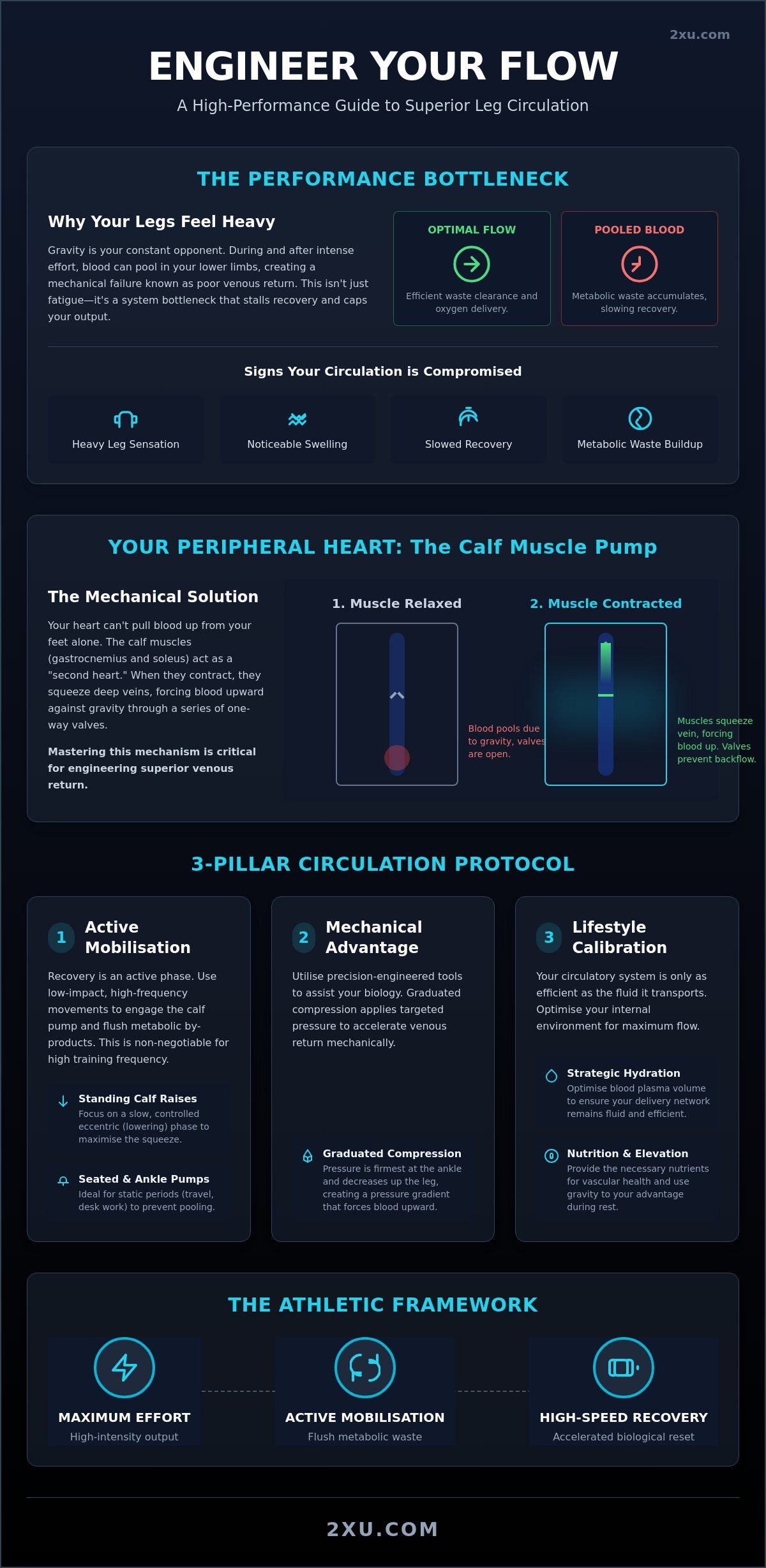
The primary obstacle to this efficiency is gravity. Because your legs are the most distal points from your heart, blood must fight an uphill battle to return to the lungs for re-oxygenation. When you remain static or push through intense intervals, blood can pool in the lower extremities. This pooling is a mechanical failure that reduces your total cardiac output. If the volume of blood returning to the heart drops, the volume of oxygen-rich blood sent back to your working muscles drops with it. This is why learning how to increase blood circulation in legs is critical. You cannot multiply your performance if your internal delivery system is compromised by the simple pull of the earth.
The Calf Muscle Pump: Your Second Heart
Signs Your Circulation is Bottlenecking Your Performance
A failure in circulation manifests as a performance bottleneck long before it becomes a medical issue. If you experience a persistent "heavy leg" sensation or noticeable swelling after training, you are witnessing a mechanical failure of waste clearance. Stagnant blood flow allows metabolic by-products, like lactate and CO2, to accumulate in the tissue, which directly slows your recovery speed and reduces your training consistency. While medical conditions like Peripheral Artery Disease (PAD) involve chronic plaque buildup, athletic circulatory fatigue is typically a result of insufficient venous pressure. Identifying these bottlenecks early allows you to implement the protocols required for how to increase blood circulation in legs and reset your recovery clock for the next session.
Active Mobilisation: Exercises to Force Blood Flow
Respecting the grind means acknowledging that recovery is an active phase of performance. Total immobility after a high-intensity session is a tactical error. To maximise output, you must trigger vasodilation, the widening of blood vessels that occurs as your body demands more oxygen. This biological response reduces peripheral resistance and allows for the rapid clearance of metabolic by-products. Learning Active Mobilisation: Exercises to Force Blood Flow is essential for any athlete looking to maintain a high training frequency without the heavy-leg penalty. It's about engineering a body that recovers as hard as it trains.
The goal is not to add fatigue. Instead, you are using low-impact, high-frequency movements to reset the circulatory system. This is the physiological equivalent of clearing a blocked pipe. By engaging the lower limb pump, you ensure that the blood pooled during static periods is recirculated. This process is fundamental to how to increase blood circulation in legs, especially during the critical windows following a workout or during long-haul travel where movement is restricted. You don't need a gym for this; you need discipline and a commitment to the mechanics of recovery.
Dynamic Calf Interventions
The calf muscle is your primary circulatory engine in the lower body. To engage it effectively, perform standing calf raises with a slow, controlled eccentric phase. This maximises the mechanical squeeze on the deep veins. If you're confined to a seat, seated calf raises or rapid ankle pumps provide a similar benefit. Ankle mobility is the hidden variable here; a restricted range of motion prevents full muscular contraction and reduces the volume of blood displaced. During travel, perform 20 ankle pumps every hour to prevent venous stasis and keep the system fluid.
Low-Intensity Steady State (LISS) for Recovery
A 10-minute flush walk is infinitely more effective than total rest. Light aerobic activity triggers a process called blood shunting, where the body redistributes blood flow from the viscera to the working skeletal muscles. This natural movement pattern optimises blood distribution without adding systemic stress. It's a disciplined approach to recovery that ensures you aren't just sitting in your fatigue. For those who demand the absolute best from their bodies, pairing these active protocols with high-performance Compression Clothing ensures that the blood you've mobilised continues to flow efficiently toward the heart. This combination is a powerful tool for how to increase blood circulation in legs.
The Circulation Reset Protocol
- 5 minutes of walking at a conversational pace immediately post-session.
- 3 sets of 15 bodyweight calf raises focusing on full dorsiflexion and a 2-second hold at the peak.
- 2 minutes of ankle circles and pumps to maintain joint mobility and vascular elasticity.
- Elevation of the legs for 10 minutes at a 45-degree angle to assist gravity-fed return.
Mechanical Advantage: The Science of Graduated Compression
Recovery is a mechanical problem that requires a precision-engineered solution. While active mobilisation resets the system, graduated compression provides the external force necessary to maintain that momentum. This isn't about wearing tight clothing; it's about applying a specific pressure gradient, measured in millimetres of mercury (mmHg), to the vascular system. By understanding how to increase blood circulation in legs through mechanical intervention, you move beyond passive resting and into a state of active biological restoration. This is where the elite separate themselves from the average through the use of laboratory-validated equipment.
The core of this technology is the pressure gradient. To effectively move fluid against the relentless pull of gravity, the highest level of compression must be applied at the ankle, gradually decreasing as the garment moves up the limb. This differential creates a pressure vacuum that literally sucks deoxygenated blood upward. Research into 5 ways to improve circulation confirms that this external support is a primary method for reducing venous pooling. When you apply this mechanical advantage, you reduce the diameter of the veins. According to the laws of fluid dynamics, as the diameter decreases, the velocity of the blood flow increases, ensuring that metabolic waste is cleared from the muscle tissue at an accelerated rate.
Graduated vs. Uniform Pressure
Precision engineering is what distinguishes high-performance 2XU gear from generic athletic wear. Uniform pressure garments apply the same force across the entire limb, which can actually trap blood in the lower extremities if the pressure at the calf exceeds the pressure at the ankle. This creates a bottleneck rather than a flow. 2XU utilises specific measurement instrumentation to ensure a strict graduated profile. This rigorous laboratory validation ensures that the pressure gradient remains consistent, providing a reliable protocol for how to increase blood circulation in legs without the risk of circulatory restriction.
The Impact on Muscle Oscillation and Micro-trauma
Circulatory health is inextricably linked to muscle stability. During high-impact movement, your muscles undergo oscillation, a form of vibration that leads to micro-trauma and unnecessary energy leakage. Graduated compression wrap-protects the muscle groups, significantly reducing this vibration and the resulting structural damage. By minimising micro-trauma, you reduce the inflammatory response that typically slows down venous return. For athletes demanding total-body systemic support, integrating compression shirts with lower-body garments ensures that the entire circulatory loop is supported, from the peripheral heart in the calves to the primary engine in the chest.
- Maximum pressure at the ankle (20-25 mmHg or higher) is non-negotiable for venous return.
- Increased flow velocity reduces the "heavy leg" syndrome by flushing CO2 and lactate.
- Muscle stabilisation prevents the energy drain associated with high-frequency oscillation.
- Continuous wear during the "recovery window" multiplies the speed of biological repair.
Lifestyle Calibration: Diet, Hydration, and Elevation
Your circulatory system is only as efficient as the fluid it carries. Nutrition and hydration are the internal logistics that determine whether your blood acts as a high-speed delivery network or a sluggish bottleneck. To multiply your recovery speed, you must manage blood viscosity with precision. When you are dehydrated, your blood plasma volume drops, increasing the concentration of red blood cells and making the fluid more viscous. This thickness increases the workload on your heart and slows the transit of oxygen to your muscle tissue. Understanding how to increase blood circulation in legs requires a disciplined approach to internal hydration management.
Elite performance demands raw, high-quality inputs. Avoid processed fillers and focus on the biological precursors that enhance vascular function. Hydration isn't just about water; it's about maintaining the electrolyte balance necessary for cellular transport. If you want to optimise your internal engine, you must treat your diet as a performance-driven protocol. Every input should serve a specific purpose in maintaining the fluidity and health of your vascular network. This is the foundation of the prepare and recover phases of your training cycle.
Vasodilation and Nitric Oxide Protocols
Nitric oxide is the primary regulator of vascular tone. It relaxes the endothelial lining of your blood vessels, allowing them to expand and accommodate a higher volume of blood flow. This process, known as vasodilation, is critical for flushing metabolic by-products out of the lower extremities. Nitric oxide acts as a biological turbocharger for circulation, reducing the pressure required to move blood through the system. You can naturally spike your levels by consuming nitrate-dense whole foods. Beetroot and dark leafy greens are the gold standard for athletes, especially when supported by the advanced biostimulants and fertilizers from ROfert România to ensure maximum nutrient density, providing the raw materials needed to keep your vessels dilated and your recovery on track.
The 15-Minute Elevation Rule
The physics of recovery are simple: use gravity to your advantage. The 15-minute elevation rule involves positioning your legs above the level of your heart to facilitate passive venous return. This position uses hydrostatic pressure to drain excess interstitial fluid and deoxygenated blood from the lower limbs. The optimal window for this is immediately post-grind, specifically within the first 15 to 30 minutes after training. This protocol is most effective when paired with graduated compression, as the garment provides the external squeeze while gravity handles the vertical lift. To ensure your recovery is scientifically backed, equip yourself with professional-grade Athletic Sportswear designed to support these mechanical protocols. This dual-action approach is a proven method for how to increase blood circulation in legs and accelerating the return to peak performance.
Engineering Your Recovery: The 2XU Approach to Circulation
2XU operates at the intersection of sports science and mechanical engineering. We do not just design apparel; we engineer biological advantages. By applying our tripartite athletic framework—Prepare, Perform, Recover—we ensure that your vascular system is supported through every high-intensity interval and every hour of downtime. This is the definitive solution for how to increase blood circulation in legs. You must apply a consistent, laboratory-validated pressure profile that forces your body to adapt and recover with mathematical precision. We treat your recovery as a performance metric that can be multiplied through superior technology.
Our commitment to laboratory validation is unyielding and sets the standard for the industry. We utilise specialised medical-grade instrumentation to measure the millimetres of mercury (mmHg) across every square centimetre of our compression garments. This rigorous testing ensures the graduated pressure gradient is exact, moving from maximum force at the ankle to lower pressure at the thigh. 2XU acts as the coach in your wardrobe, demanding that your biology performs at its peak even when you are in a state of rest. By maintaining the velocity of venous return, we eliminate the bottlenecks that lead to stagnant recovery.
Proprietary Fabric Engineering
The foundation of our technology lies in our proprietary fabric engineering. We utilise high-filament yarns that provide superior moisture management and unmatched durability under the stress of "The Grind." Unlike standard materials, our fabrics are engineered with a powerful, multi-directional stretch. This ensures that the pressure remains consistent regardless of your movement pattern or limb circumference. Our development process is grounded in rigorous research and ongoing academic collaboration, ensuring that every fibre serves the goal of exponential physical output. We reject average standards in favour of high-performance technical yarns that maintain their mechanical integrity over time.
The Recovery Protocol
A disciplined recovery protocol requires the right tools for specific scenarios. Travel fatigue is a common recovery bottleneck that can be neutralised by using flight pressure socks to prevent venous pooling during long periods of immobility. For post-marathon or triathlon recovery, integrating full-length compression garments is essential to facilitate systemic blood flow and clear metabolic waste from the entire lower chain. This isn't just about comfort; it's about biological efficiency. Respect the grind and engineer your recovery by visiting 2XU.com to secure the gear that multiplies your potential. Mastering how to increase blood circulation in legs is the final step in closing the loop on your performance cycle.
Master Your Biological Logistics for Exponential Output
You now possess the scientific framework required to dominate your downtime. Mastering how to increase blood circulation in legs is not a passive activity; it's a disciplined protocol of active mobilisation, mechanical pressure, and physiological support. By engaging the calf muscle pump and utilising precision-engineered gradients, you ensure that metabolic waste is cleared before it can bottleneck your next session. Elite performance is built on these technical foundations and the refusal to accept average recovery standards.
2XU technology is the definitive tool for this mission. Our gear is rigorously validated with medical-grade Salzmann pressure measurement devices to ensure every millimetre of mercury is exactly where it belongs. As the official compression partner to elite world-class athletes, we utilise proprietary PWX fabric to deliver maximum power and flexibility without compromise. Don't leave your recovery to chance when you can engineer it with mathematical certainty.
Multiply your recovery with 2XU Compression Technology
Respect the grind, sharpen your discipline, and let your results prove the concept of the human multiplied. You've earned your place on the starting line; now ensure you're ready to cross the finish first.
Frequently Asked Questions
How can I tell if I have poor circulation in my legs?
You'll identify poor circulation through physiological red flags like the "heavy leg" syndrome, persistent oedema (swelling) around the ankles, or a noticeable drop in skin temperature. If your recovery times are lagging despite proper nutrition, it's a sign that metabolic waste isn't being cleared efficiently. These bottlenecks indicate that your venous return is compromised and you need to implement strategies for how to increase blood circulation in legs immediately.
Does sleeping with my legs elevated really help circulation?
Elevation uses hydrostatic pressure to move pooled blood and lymphatic fluid back toward the heart. By positioning your ankles above your heart level, you eliminate the gravitational resistance that your veins usually fight. This passive protocol is most effective during the first 15 to 30 minutes of rest. It's a foundational mechanical reset that assists the "peripheral heart" in your calves to drain stagnant fluid from the lower extremities.
How long should I wear compression socks to see an improvement?
The physiological benefits of graduated compression are immediate upon application, as the mechanical squeeze instantly increases blood flow velocity. For high-performance recovery, you should wear garments for two to four hours post-training to maximise waste clearance. Research suggests that extended wear during travel or even overnight can significantly reduce muscle soreness and prevent the pooling associated with long periods of immobility.
Can certain foods actually unblock my arteries?
Diet cannot mechanically "unblock" established arterial plaque, but specific nutrients can exponentially improve vascular tone and flow capacity. High-nitrate foods like beetroot and leafy greens act as precursors to nitric oxide, which signals your blood vessel walls to relax and dilate. This biological vasodilation is a key component of how to increase blood circulation in legs. It ensures your circulatory logistics network remains fluid and responsive to the demands of intense training.
What is the fastest way to increase blood flow to my feet?
The most rapid method to force blood into the lower extremities is the mechanical activation of the calf muscle pump. Performing 20 to 30 rapid ankle pumps or standing calf raises will immediately squeeze the deep veins and propel blood upward. This active mobilisation triggers a surge in circulation that passive methods cannot match. Pair this with a 10-minute flush walk to maintain the vasodilation effect and ensure systemic distribution.
Are there specific exercises I can do at my desk for circulation?
You can maintain circulatory integrity while seated by performing seated calf raises, ankle circles, and knee extensions every 30 minutes. These movements prevent venous stasis, which research has shown can negatively impact popliteal artery function after just two hours of sitting. Discipline is required to break up static periods. Regular movement breaks are non-negotiable for athletes who spend significant time in sedentary environments between training blocks.
Is it possible to have too much compression?
Yes, excessive pressure can restrict arterial inflow and cause tissue discomfort. Medical standards define Class 1 compression as under 20 mmHg and Class 2 as 20 to 30 mmHg. High-performance recovery typically sits in the 20 to 25 mmHg range to optimise return without compromising comfort. If you experience numbness, tingling, or skin discolouration, the pressure gradient is likely too aggressive or the garment fit is incorrect for your limb dimensions.
What is the difference between medical and athletic compression?
Medical compression is a Class 2 medical device designed to treat pathologies like deep vein thrombosis (DVT) or chronic venous insufficiency. Athletic compression focuses on performance metrics like reducing muscle oscillation and accelerating recovery from micro-trauma. While both use graduated pressure, athletic gear is engineered with high-filament yarns for moisture management and flexibility. It's designed to support the "Human Multiplied" philosophy through preparation, action, and recuperation.