
What to Wear for a Triathlon: The Engineering of Elite Race-Day Performance
Your race-day kit is a mechanical system engineered to manage the brutal physics of three distinct environments. If you treat your apparel as an afterthought, you're choosing to fight against drag, skin irritation, and muscle fatigue rather than the competition. You've put in the hours of discipline and respected the grind of training, yet many athletes still find themselves slowed down by water-logged fabrics after T1 or debilitating oscillation during the marathon. Success requires more than just grit; it requires a specialised kit that works as hard as your cardiovascular system.
Mastering the technical requirements of what to wear for a triathlon is the key to eliminating these mechanical inefficiencies and ensuring your physical output is multiplied across every kilometre. We'll dissect the engineering of elite performance apparel, from the 5mm thickness limits of hydrodynamic wetsuits to the Muscle Containment Stamping technology that stabilises your power output. This guide previews how to prepare with the right thermoregulation, perform with reduced drag on the bike using Aero series technology, and recover through the active compression necessary for a faster final run leg.
Key Takeaways
- Understand why a trisuit is a singular, non-negotiable system designed to transition through all three disciplines without a clothing change.
- Learn how to select what to wear for a triathlon to maximise hydrodynamic efficiency and mechanical buoyancy during the swim leg.
- Discover the role of medical-grade compression in dampening muscle oscillation to prevent micro-trauma and delay physical exhaustion.
- Implement the tripartite performance framework to ensure your body is primed before the gun and recovers rapidly after the finish line.
Engineering Your Race: The Fundamentals of Triathlon Apparel
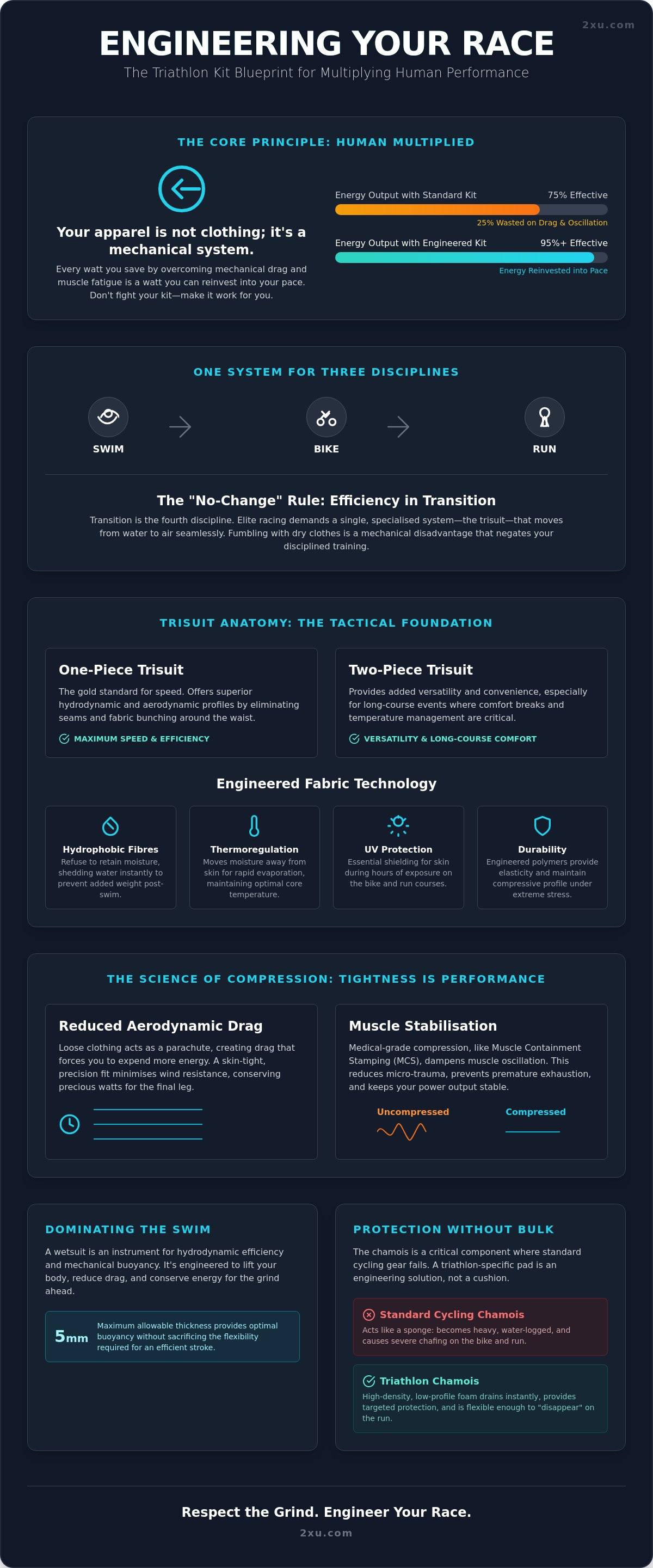
Your race isn't three separate events; it's one continuous output of energy. When deciding what to wear for a triathlon, you must view your apparel as a singular mechanical system rather than a collection of clothes. It's not about fashion or looking the part. It's about reducing the metabolic cost of movement. We call this the "Human Multiplied" concept. Every watt you save by overcoming mechanical drag is a watt you can reinvest into your pace. This starts with technical fibres that refuse to retain moisture, ensuring you never carry the weight of the swim into the final kilometres of the run. When you choose the right Triathlon equipment, you're choosing to protect your energy stores for when the grind truly begins.
The "No-Change" Rule: Efficiency in Transition
Transition is often called the "fourth discipline" for a reason. This is where races are won or lost. A common beginner misconception is the idea of changing clothes between legs. In elite racing, you don't change. You adapt. Attempting to pull on dry clothes while your heart rate is elevated and your skin is damp is a massive mechanical disadvantage. It wastes time and breaks your rhythm. Your kit must be engineered to manage the transition from water to air seamlessly. High-performance trisuits use specialised non-absorbent materials that shed water the moment you stand up. This allows you to mount your bike and begin the grind immediately without fumbling in the transition area. You've put in the work during training; don't let a slow T1 negate your discipline.
Why Tightness Equals Performance
Loose clothing is a liability. If your gear isn't skin-tight, it acts as a parachute. This "parachuting" effect creates significant aerodynamic drag, which is the primary obstacle on the bike leg. Beyond the physics of wind resistance, fabric tension serves a critical biological purpose. Tight, technical fabrics provide the necessary compression to stabilise your muscles against vibration and oscillation. When you're deciding what to wear for a triathlon, remember that a precision fit isn't for aesthetics. It's an engineering requirement. It keeps your muscles aligned and reduces the micro-trauma caused by every stride and pedal stroke. You earn your results through effort, but you protect them through gear that minimises wasted energy.
The engineering behind these garments focuses on moisture management and thermoregulation. Traditional fabrics soak up water, adding dead weight and causing skin irritation. Technical fibres used in elite trisuits are hydrophobic by design. They move moisture away from the skin to the surface where it can evaporate, cooling your core temperature as you move. This isn't just comfort; it's a performance multiplier. By keeping your body at an optimal temperature, you prevent the premature fatigue that ruins a podium finish. Respect the grind by choosing gear that respects your physiology.
The Trisuit: A Singular System for Three Disciplines
The trisuit is the tactical foundation of your race-day strategy. It's a specialised piece of equipment designed to survive the salt of the ocean, the friction of the saddle, and the repetitive impact of the run. When you're determining what to wear for a triathlon, you must choose between a one-piece or a two-piece configuration based on your distance and goals. One-piece suits offer superior hydrodynamics and aerodynamics. They're the gold standard for speed. For long-course endurance events, two-piece kits provide added versatility and easier transitions during the grind. Both options rely on engineered polymers that offer greater durability and elasticity than standard materials, ensuring the suit maintains its compressive profile under extreme stress. These technical garments also incorporate high-level UV protection, which is essential for protecting your skin during hours of exposure on the bike and run courses.
The Triathlon Chamois: Protection Without Bulk
A standard cycling chamois is a liability in a triathlon. These thick pads act like sponges, becoming heavy and water-logged the moment you enter the swim. This leads to severe chafing and a mechanical disadvantage during the ride. In contrast, a tri-specific pad is engineered with high-density, low-profile foam that drains water instantly upon exit from the water. It provides the necessary protection for the saddle without the bulk that hinders your stride. When you transition to the run, a high-quality chamois should essentially "disappear." It must be flexible enough to move with your hip flexion, ensuring you can maintain a high cadence without irritation. If you're serious about your results, explore our collection of technical trisuits to secure your race-day advantage.
Thermoregulation and Moisture Management
Performance drops the moment your core temperature spikes. Technical fabrics are designed to move sweat away from the skin through capillary action, facilitating rapid evaporative cooling. A scientific analysis of triathlon suit performance confirms that thermophysiological comfort is directly linked to the fabric's ability to manage moisture and heat. Elite suits feature breathable mesh zones in high-heat areas like the back and underarms to maximise airflow. This keeps your heart rate stable and your power output consistent. When considering what to wear for a triathlon in humid or high-heat conditions, these breathable zones are non-negotiable. For a deeper dive into the specific fabric science and weave patterns that drive these results, consult the Ultimate Triathlon Suit Guide. Respect the discipline of your training by wearing gear that manages the heat as effectively as you manage your pace.
Dominating the Swim: Wetsuits and Hydrodynamic Efficiency
Stop viewing a wetsuit as a mere thermal layer. In high-performance racing, a wetsuit is a buoyancy engine designed to manipulate your position in the water. When you're calculating what to wear for a triathlon, the swim leg requires a tool that actively corrects your posture. Your biggest enemy in the water is frontal drag. If your hips and legs sink, you're essentially dragging an anchor through the ocean. A technical wetsuit uses varying densities to lift your lower body, aligning you with the surface and significantly reducing the energy required to maintain momentum. This is mechanical efficiency in its purest form.
Surface friction is the second obstacle. Water creates resistance against standard fabrics, but elite wetsuits utilise specialised coatings to create a hydrophobic barrier. You must also avoid the amateur mistake of using a surfing wetsuit. Surfing gear is engineered for thermal protection and durability while sitting on a board; it lacks the complex panel architecture required for the 360-degree shoulder mobility of an elite crawl stroke. Using the wrong gear leads to premature shoulder fatigue and a slower transition into the bike leg. Respect the grind by using equipment that multiplies your output rather than hindering it.
Buoyancy and Body Positioning
The distribution of neoprene thickness is a deliberate engineering choice. Most elite suits use 5mm thickness in the core and upper legs to maximise lift, while tapering to 1.5mm or 2mm in the sleeves to preserve a natural stroke. This creates a "downhill" swimming sensation that preserves your glycogen stores for the later stages of the race. Many top-tier suits also feature Super Composite Skin (SCS) technology, a coating that reduces the coefficient of dynamic friction. For a detailed breakdown of how cell structure impacts your speed, read our guide on Neoprene Wetsuit Science. It’s the difference between fighting the water and cutting through it.
IRONMAN Legality and Race Rules
You must understand the regulatory landscape before you reach the start line. The 2026 IRONMAN Global Competition Rules enforce a strict 5mm thickness limit for all wetsuits to ensure competitive fairness. Additionally, races have specific temperature cut-offs. For age-group athletes, wetsuits are usually prohibited if the water temperature exceeds 24.5 degrees Celsius. If you're planning what to wear for a triathlon in warmer climates, you'll need a swimskin. These are non-buoyant, technical garments worn over your trisuit that reduce drag without providing thermal insulation. Always check the specific race briefing, as equipment specifications can change based on the venue and current conditions.
The Grind: Managing Muscle Fatigue and Oscillation
The final leg of a race is where the grind becomes a physiological tax. Every foot strike on the pavement sends a kinetic shockwave through your soft tissue, causing what sports scientists call muscle oscillation. This vibration is a primary driver of micro-trauma and premature fatigue. It forces your body to expend metabolic energy simply to stabilise the muscle mass. When you're deciding what to wear for a triathlon, your gear must act as a mechanical intervention. Medical-grade compression provides an external lattice that wraps the muscles, dampening this vibration and preserving your power output for the final kilometres.
Beyond stabilisation, graduated compression is essential for maintaining venous return. By applying specific pressure gradients, the fabric assists the heart in moving deoxygenated blood away from the extremities. This acceleration of blood flow ensures that your muscles receive a consistent supply of oxygenated fuel even when your heart rate is maxed out. Respecting the grind means acknowledging that your body will eventually want to quit; your gear is there to ensure your physiology doesn't give it a choice. It's about protecting the integrity of your stride when your mind is focused on the finish line.
Compression Technology on the Run
Quad and calf stabilisation are critical during the marathon leg. High-performance compression gear enhances proprioception, which is the body's subconscious awareness of its position in space. This sensory feedback allows you to maintain efficient running mechanics even as exhaustion sets in. While lower-body support is standard, don't ignore the importance of Compression Shirts for upper-body postural support. Keeping your chest open and your shoulders stable prevents the "slump" that restricts breathing and reduces lung capacity during the final push. To protect your muscles from the impact of the road, equip yourself with elite compression clothing designed for the long course.
Aerodynamics on the Bike Leg
On the bike, your primary mechanical obstacle is air resistance. Modern trisuits utilise dimpled fabric technology on the sleeves and shoulders to manipulate the boundary layer of air. This texture "trips" the air into a small amount of turbulence, which allows the airflow to stick to the body's contours longer, reducing the low-pressure wake behind you. Sleeved trisuits have become the gold standard for long-distance events because they offer significantly more aerodynamic surface area than sleeveless alternatives. When you're considering what to wear for a triathlon, remember that seamless construction is also vital. Every seam is a potential point of turbulence, so look for laser-cut edges and bonded seams to ensure a laminar flow over the skin surface. You've done the work in the wind tunnel of training; your gear should reflect that discipline.
Preparation and Recovery: The 2XU Performance Framework
Elite performance isn't a single moment of effort; it's a cycle. To truly multiply your physical output, you must adopt a tripartite framework: Prepare, Perform, and Recover. Most athletes focus exclusively on the "Perform" stage, yet the results you achieve on race day are dictated by how you primed your body and how quickly you can return to training. When you're determining what to wear for a triathlon, you aren't just selecting a race-day kit. You're choosing a system that manages your physiology across the entire athletic lifecycle. This is professional-grade technology engineered for every athlete who has the discipline to respect the grind.
The race doesn't end when you cross the timing mat. Earning your finisher's medal is only part of the equation. True mastery of the sport requires a commitment to the recovery phase. By applying high-power mechanical pressure to the limbs immediately after the event, you assist your body in clearing metabolic waste and reducing the inflammatory response. This isn't a luxury. It's a scientific requirement for anyone looking to push their limits consistently without succumbing to injury or overtraining. We provide the tech; you provide the discipline.
Post-Race Recovery Protocols
Post-race recovery is about accelerating the return to homeostasis. High-power compression garments are engineered to flush lactic acid and reduce the swelling that follows a full-distance event. If you're a destination athlete, the recovery process begins the moment you board the plane. Using Flight Pressure Socks is a critical protocol for combating travel fatigue and ensuring your circulatory system remains efficient after the extreme stress of competition. Mechanical pressure is a biological necessity for rapid tissue repair. Don't let your effort go to waste by ignoring the science of recuperation.
Selecting Your 2XU System
Your choice of what to wear for a triathlon should be dictated by the specific mechanical demands of your race distance. For a high-intensity Sprint or Olympic distance, focus on one-piece trisuits that prioritise maximum hydrodynamics and aerodynamics. For the long-course grind of a Full IRONMAN, versatility and thermoregulation become the primary concerns. Our fabrics are engineered to withstand the corrosive effects of chlorine and salt water, ensuring your gear maintains its compressive integrity over multiple seasons. You've put in the work; now equip yourself with the system that respects your ambition. Explore the 2XU Triathlon Collection to find the engineering that matches your discipline.
Master the Physics of Your Fastest Race
Your race-day performance is a mathematical outcome of your training discipline and your equipment's mechanical efficiency. You've seen how a singular system, from hydrodynamic wetsuits to compressive trisuits, manages the brutal physics of the swim, bike, and run legs. Mastering what to wear for a triathlon ensures that your physical output is multiplied rather than wasted on drag or muscle vibration. This is the "Human Multiplied" promise in action, providing you with the tools to maintain elite form when the grind becomes a psychological battle.
We don't settle for average standards, and neither should you. As the official compression partner of elite Australian sports institutes, we utilise proprietary PWX fabric technology to provide 360-degree stretch and durability. Our systems are rigorously tested in independent laboratories to ensure graduated pressure accuracy, helping you recover faster and perform longer. You've respected the discipline of the grind; now equip yourself with the engineering required to finish strong.
Engineering Your Fastest Race: Shop 2XU Triathlon Gear
Step onto the start line with the confidence of an athlete who has left nothing to chance. Your potential is waiting; go out and claim it.
Frequently Asked Questions
Do I wear underwear under my trisuit?
You don't wear underwear under a trisuit. These garments are engineered with an integrated chamois designed for direct skin contact to prevent moisture retention and friction. Adding a layer of non-technical fabric increases the risk of severe saddle sores and skin irritation. Respect the engineering of the kit and allow the moisture-wicking properties to function as intended for maximum comfort.
Can I use a surfing wetsuit for a triathlon?
You shouldn't use a surfing wetsuit for competitive racing. Surfing suits are built for durability and thermal protection while sitting on a board, whereas triathlon wetsuits are engineered for hydrodynamic efficiency and 360-degree shoulder flexibility. Using a surfing suit leads to premature shoulder fatigue due to resistance against your stroke. It also lacks the hydrophobic coatings required to reduce surface drag in the water.
What is the difference between a one-piece and two-piece trisuit?
A one-piece trisuit offers superior aerodynamics and hydrodynamics by eliminating the gap between the top and bottom. This is the optimal configuration for sprint and Olympic distances where every second counts. Two-piece kits are often preferred for long-course events because they allow for easier bathroom breaks and more flexibility in sizing. Both systems are essential components of what to wear for a triathlon depending on your specific race goals.
Should I wear socks for the bike and run legs?
Socks are recommended for long-distance events but are often skipped in sprint distances to save transition time. If you're racing a 70.3 or full IRONMAN, the risk of blisters and foot trauma outweighs the few seconds saved in T2. Use technical, moisture-wicking socks that don't retain water from the swim or sweat from the bike. Ensure your training involves testing your footwear with the exact socks you plan to race in.
How tight should my triathlon wetsuit be?
Your triathlon wetsuit should fit like a second skin with no folds or air pockets. It must be tight enough to prevent water from pooling inside, which creates massive drag, but it shouldn't restrict your lung expansion. A proper fit ensures the buoyancy panels stay correctly aligned with your core and hips. If the suit is easy to put on while dry, it's likely too large for elite performance.
What do I wear if the race is not wetsuit legal?
You wear a swimskin over your trisuit if the race is not wetsuit legal. Swimskins are non-buoyant, high-tech garments designed to reduce surface friction and protect your kit from drag in warm-water conditions. They're mandatory for athletes seeking a competitive edge when the 5mm neoprene limit is prohibited by race officials. Once you exit the water, the swimskin is removed in T1 to reveal your racing kit.
Can I wear a normal running shirt for a triathlon?
You shouldn't wear a standard running shirt for a triathlon. Standard shirts are not engineered for the hydrodynamics of the swim or the aerodynamics of the bike leg. They act as a parachute on the cycle and become heavy and water-logged after the swim. When deciding what to wear for a triathlon, stick to specialised trisuits that manage moisture and stay form-fitting across all three disciplines to maintain your power output.
For those looking to engage with the broader cycling community on a professional level, you can explore Advertising and Affiliate Marketing to connect with enthusiasts and industry leaders.
How do I prevent chafing during a long-distance triathlon?
Preventing chafing requires a combination of anti-chafe lubricant and high-quality, seamless apparel. Apply lubricant to the neck, underarms, and inner thighs before the swim. Ensure your trisuit or compression clothing has a precision fit to eliminate the fabric movement that causes skin irritation. High-performance fabrics are engineered to move with your body, reducing the friction that leads to debilitating skin trauma during the marathon.