
What to Wear for Open Water Swimming: Engineering the Ultimate Performance Advantage
Your ambition means nothing if your physiology fails you in 14-degree water. Deciding what to wear for open water swimming is not a matter of comfort; it is a tactical decision to engineer a hydrodynamic advantage that prevents the 20% drop in muscle power typically caused by core temperature fluctuations. You understand the relentless grind of a 5-kilometre set where every millimetre of drag feels like an anchor. You have felt the cold sap your explosive power and disrupt your stroke rhythm during peak training phases. Mediocrity has no place in the open water, and neither does gear that works against your total power output.
We are here to eliminate those variables and sharpen your competitive edge. By mastering the science of technical gear, you will learn to optimise hydrodynamics, manage thermoregulation, and multiply your performance in any environment. This guide provides a meticulous breakdown of race-legal equipment, proprietary buoyancy profiles, and the specific engineering required to achieve zero drag and faster recovery. Prepare to transform your gear from a simple layer into a high-performance tool that respects the effort you put into every session. Human performance, multiplied.
Key Takeaways
- Engineered hydrodynamics require more than generic gear; learn to select a specialised performance wetsuit to minimise drag and maximise buoyancy.
- Protect your extremities to maintain sensory clarity and core temperature, ensuring your focus remains on navigation rather than physiological distress.
- Master the transition to technical swimwear and understand exactly what to wear for open water swimming when conditions require specialised fabric-based solutions for high-temperature performance.
- Integrate high-visibility safety gear as a core performance requirement to ensure your discipline is never interrupted by external variables in shared waterways.
- Optimise your recovery by managing the afterdrop with immediate thermal layers, ensuring your body is primed to multiply your next session’s output.
The Foundation: Engineering Hydrodynamics with a Performance Wetsuit
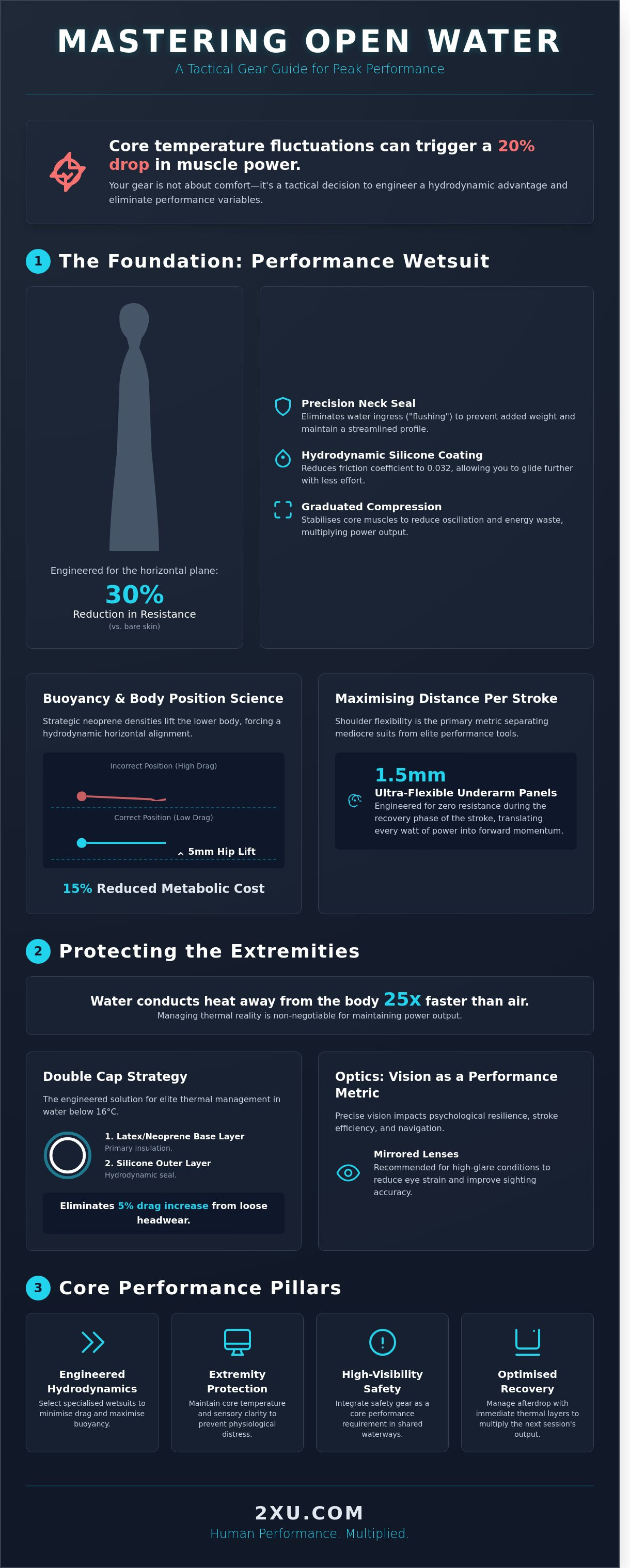
Deciding what to wear for open water swimming is the first step in mastering the environment. In the lab and in the swell, we don't view a wetsuit as a garment. It's a specialised tool engineered for hydrodynamics. While generic water sports gear is designed for vertical buoyancy and basic warmth, an elite swimming wetsuit is built for the horizontal plane. It's about reducing drag and maximising efficiency. We call this "Human Performance. Multiplied." By optimising your interaction with the water, you aren't just swimming; you're advancing with a 30% reduction in resistance compared to bare skin.
To achieve this, the suit must function as a second skin. If water enters the suit through the neck or cuffs, it creates "flushing," which kills your momentum. This internal water movement adds dead weight and breaks your streamlined profile. A precision fit ensures a thin layer of water is trapped and warmed by the body, maintaining a core temperature of 37 degrees Celsius without sacrificing speed. When you're considering what to wear for open water swimming, remember that a loose fit is a failing fit.
- Precision Neck Seal: Eliminates water ingress and prevents chafing during high-frequency sighting.
- Graduated Compression: Stabilises core muscle groups to reduce muscle oscillation and energy waste.
- Hydrodynamic Silicone Coating: Reduces the friction coefficient to 0.032, allowing you to glide further with less effort.
The sport of Open water swimming demands gear that respects the grind of long-distance endurance. Every seam and panel is a calculated decision in the pursuit of speed.
Buoyancy and Body Position Science
Elite performance relies on maintaining a high position in the water column. We use varying neoprene densities, such as 39 cell neoprene, to strategically lift the lower body. This creates up to a 5mm lift in the hips, forcing the athlete into a hydrodynamic horizontal alignment that reduces metabolic cost by 15%. Buoyancy compensates for leg fatigue in triathletes by keeping the lower body high in the water even when the kick is minimal to save power for the bike.
Maximising Distance Per Stroke
Shoulder flexibility is the primary metric that separates a mediocre suit from an elite one. We utilise 1.5mm underarm panels to ensure zero resistance during the recovery phase of the stroke. Rather than using simple textures, we apply advanced surface coatings to the material to slice through the water. You can explore the mechanics of these materials in our guide on neoprene wetsuit science, which details how proprietary technology ensures every watt of power translates into forward momentum.
Protecting the Extremities: Heat Retention and Sensory Performance
Water conducts heat away from the human body 25 times faster than air. In temperatures below 16 degrees, your physiology undergoes a rapid shift as blood shunts from the extremities to protect the core. This thermal reality demands high-performance gear. Deciding what to wear for open water swimming is about managing these physiological bottlenecks to maintain power output. Precision in your kit selection transforms a survival exercise into a focused performance session.
The Double Cap Strategy for Thermal Management
Thermal regulation is non-negotiable for serious athletes. When water temperatures drop below 16 degrees, a single cap is insufficient for heat retention. The double cap strategy is the engineered solution for elite endurance. Wear a latex or neoprene base layer to provide primary insulation. Position a silicone outer layer over the top to create a hydrodynamic seal. This configuration traps a thin layer of water that warms against the scalp while maintaining a streamlined profile. It eliminates the 5% drag increase often caused by the 'parachute' effects of loose-fitting headwear.
Optics: Vision as a Performance Metric
Navigation is a technical skill. Vision directly impacts psychological resilience and stroke efficiency. If you cannot sight the buoy accurately, your heart rate spikes and your line wavers. Choose mirrored lenses for high-glare morning sessions to block up to 90% of reflected light. Use clear or polarised lenses for overcast conditions to maximise contrast. Wide-angle peripheral vision allows for 180-degree awareness. This is essential for sighting without breaking your stroke rhythm. Engineered anti-fog coatings provide long-term clarity that temporary fixes cannot match. They ensure your vision remains sharp through 60 minutes of high-intensity exertion.
Salt water and choppy conditions test the limits of your equipment. Gear must withstand high salinity and UV exposure without losing elasticity or structural integrity. Before every entry, perform a systematic kit check. Inspect seams for fatigue and goggle seals for suction. Consult the Open Water Swimming Safety Advice to ensure your preparation matches the environment's volatility. Discipline in the transition area translates to dominance in the water. Respect the grind. Prepare for the conditions. Equip yourself with performance-driven gear to multiply your potential.
Beyond the Wetsuit: Trisuits and Technical Swimwear
When water temperatures exceed 24.5 degrees Celsius, wetsuits become a hindrance rather than a benefit. This threshold marks the transition from buoyancy-assisted swimming to the raw reality of the grind. Deciding what to wear for open water swimming in these conditions requires a shift from thermal protection to hydrodynamic efficiency. High-performance fabric-based suits are engineered to bridge this gap, providing the compression and surface tension needed to maintain speed without the risk of overheating. The triathlon suit serves as the primary interface between the athlete and the elements, designed to stay light while saturated and dry rapidly upon exit.
Engineering excellence in warm water means respecting the technical requirements of non-wetsuit legal races. In these environments, you rely on fabric density and muscle support to maintain form. While gear is essential, safety remains the baseline for performance; always review Open Water Safety Tips to ensure your preparation matches your ambition. Success in the water is earned through discipline and the refusal to accept mediocrity when the neoprene comes off.
Swimskins vs. Trisuits: The Speed Advantage
A swimskin is a specialised outer layer designed to be worn over your race kit during the swim leg. These garments use advanced hydrophobic coatings to repel water, ensuring the suit does not become heavy or drag-heavy. The science of fabric tension is critical here; by compressing the body and the underlying kit, swimskins significantly reduce frontal drag. This allows the athlete to move through the water with a profile that mimics the slickness of a wetsuit. Effective garments must also manage the moisture transition. A suit that holds water is a suit that slows you down. High-performance textiles ensure that once you hit the sand, the water sheds instantly, allowing for an efficient transition to the bike.
Compression in the Water
Compression is not just for recovery; it is a performance multiplier during the swim. 2XU utilises Muscle Containment Stamping (MCS) to provide targeted support to major muscle groups, reducing the muscle oscillation that leads to premature fatigue during long sets. This technology anchors the muscles, ensuring every ounce of energy is converted into forward propulsion. Advanced PWX fabrics provide this support through high-filament yarns that do not restrict the ribcage, allowing for full lung expansion during heavy exertion. Compression aids proprioception in turbulent water by providing consistent sensory feedback to the central nervous system, ensuring limb alignment stays locked even when visibility is zero. This mechanical advantage ensures that when you determine what to wear for open water swimming, you are choosing gear that supports your body's natural mechanics under pressure.
Safety Logistics: Gear for the Disciplined Athlete
Professionalism in the open water means leaving nothing to chance. For the disciplined athlete, safety gear isn't a burden; it's a performance requirement. Elite swimmers understand that a session cut short by a safety lapse is a wasted opportunity to build the engine. When deciding what to wear for open water swimming, visibility and skin integrity must be engineered into your kit list with the same precision as your stroke rate.
Treating safety as a performance metric allows you to push harder. You can't reach a flow state if you're constantly scanning for jet skis or worrying about a calf cramp in deep water. By integrating high-visibility tools and protective barriers, you create a controlled environment where the only variable is your own effort. This is the 'Prepare, Perform, Recover' framework in action. Preparation isn't just about the warm-up; it's about the logistics of survival and efficiency.
The Tow Float: Visibility and Emergency Buoyancy
A tow float is a non-negotiable tool for the solo athlete. It provides a vital visual marker for maritime traffic and emergency buoyancy if fatigue strikes. A 2022 study on maritime visibility showed that neon orange increases detection distance by up to 400% compared to dark colours. High-performance floats are designed with aerodynamic profiles to ensure the drag penalty remains below 0.01 percent. This means your power output isn't wasted on unnecessary resistance.
For endurance grinds exceeding 90 minutes, these units serve as essential storage for electrolyte gels and hydration. Maintaining peak metabolic function requires consistent fuelling. A tow float allows you to carry what you need without returning to shore, keeping your heart rate in the target zone for the duration of the set.
Anti-Chafe and Skin Protection
High-volume training blocks are often derailed by skin failure rather than muscle fatigue. Friction at the neck, armpits, and ankles can lead to dermal abrasions that invite infection and compromise your next session. Use non-petroleum lubricants to protect the technical integrity of your neoprene. Petroleum-based products are destructive; they degrade the cell structure of the suit and can reduce its lifespan by 50 percent over a single season.
- Apply lubricant to the back of the neck to prevent "wetsuit burn" during sighting.
- Focus on the inner armpits where high-frequency arm turnover creates heat.
- Coat the ankles to ensure a rapid transition and reduce friction during the kick phase.
The discipline of gear care is the final stage of the 'Recover' phase. Salt and minerals are corrosive. A disciplined athlete rinses their gear in fresh water immediately after every exit. This isn't just about hygiene; it's about maintaining the engineered flexibility of the suit. Respect the gear that supports your grind, and it will continue to multiply your performance.
The Final Layer: Recovery Gear to Multiply Your Next Session
The grind doesn't stop at the shoreline. Elite athletes understand that the transition from water to land is a critical window for physiological preservation. What you do in the first 20 minutes post-swim dictates your power output for tomorrow. Understanding what to wear for open water swimming extends beyond the goggles and wetsuit; it encompasses the technical layers that facilitate rapid recovery. If you neglect this phase, you are leaving performance on the table. Recovery is not a passive state; it is an active discipline that requires the right equipment to ensure your body is ready to go again at 100 per cent capacity.
Post-Swim Thermal Management
The afterdrop is a brutal reality of open water sessions. Even after you exit the water, your core temperature can continue to plummet for up to 45 minutes. This occurs as peripheral blood vessels dilate, allowing chilled blood from your limbs to circulate back to your vital organs. You must trap heat immediately to stop this decline. Ditch the wet gear and layer with engineered fibres that wick moisture while trapping a layer of warm air against the skin. An insulated parka is not a luxury; it is a tool to maintain core stability and prevent the shivering response that drains glycogen stores. By stabilising your temperature, you allow your body to shift from survival mode to repair mode instantly.
For swim teams and event organisers, providing high-quality wholesale rally towels is a practical way to help athletes dry off quickly and begin this critical thermal transition.
Compression for Accelerated Recovery
Discipline in the water must be matched by discipline in the lab. Medical-grade compression is the most effective way to flush metabolic waste and reduce delayed onset muscle soreness. By using compression shirts, you provide targeted support to the upper body muscle groups most taxed by the swim stroke. Graduated pressure profiles, validated by Salzmann testing devices, ensure that blood is forced back toward the heart, accelerating the delivery of oxygenated blood to damaged tissues. This process reduces muscle oscillation and micro-tears that occur during high-intensity sessions.
Performance is often compromised before the race even begins. If you are commuting 500 kilometres to a coastal event, your circulatory system is under siege from sedentary travel. Using flight pressure socks is a proven strategy to combat travel-induced oedema and DVT risks. These garments ensure that when you finally step into the water, your legs are light and your vascular system is primed. Respecting the recovery process is the only way to ensure that your next session is a multiplication of your potential. When you master what to wear for open water swimming from start to finish, you don't just finish the race; you prepare to dominate the next one.
For athletes who want to combine their pursuit of excellence with a world-class environment, consider taking your training to the Greek islands. You can learn more about YAL’OOU Exclusive Yachting & More to discover how a premier villa or yacht in Mykonos or Paros can serve as the ultimate recovery hub between your open water sets.
Engineering Your Competitive Edge in the Open Water
Open water swimming demands more than just grit; it requires a calculated approach to equipment. You've learned that the right kit isn't a luxury. It's a performance multiplier. From the foundation of a wetsuit featuring scientifically proven buoyancy technology to the essential recovery layers that prepare your muscles for the next session, every piece of gear serves a tactical purpose. When you're determining what to wear for open water swimming, you must prioritise hydrodynamics and thermal protection to maintain peak sensory performance in unpredictable conditions.
2XU gear is engineered for maximum shoulder flexibility, allowing for an uninhibited stroke that has been trusted by elite IRONMAN champions for over a decade. We don't believe in mediocrity. We believe in results backed by rigorous testing and the relentless pursuit of speed. Every session is an opportunity to sharpen your edge. Don't waste your effort on inferior equipment that can't keep pace with your ambition. Respect the grind, trust the data, and transform your potential into power.
Shop the 2XU Triathlon Collection and Multiply Your Performance
Get out there and earn your next breakthrough. The water is waiting.
Frequently Asked Questions
Can I wear a standard surfing wetsuit for open water swimming?
You must not use a surfing wetsuit for competitive swimming. Surfing suits are engineered for vertical buoyancy and abrasion resistance, featuring 5mm panels that restrict the range of motion required for an efficient stroke. Swimming-specific suits use 1.5mm to 2.0mm neoprene in the underarms to allow for maximum shoulder rotation and reduce drag by 15% through proprietary hydrodynamic coatings.
Is it necessary to wear two swim caps in cold water?
Wearing two swim caps is a proven strategy for heat retention in water temperatures below 15 degrees Celsius. A base layer of latex covered by a high-grade silicone cap creates a thermal barrier that reduces heat loss through the cranium by approximately 25%. For extreme conditions, a 3mm neoprene skull cap provides the ultimate thermal protection required to maintain core temperature during 2 hour endurance blocks.
How tight should an open water swimming wetsuit actually feel?
Your wetsuit must feel like a second skin with zero air pockets or folds. When dry, it'll feel restrictive around the chest; however, once submerged, the high-performance neoprene expands by 5% to 10% to provide a precision fit. If you have excess material in the small of your back or underarms, water will flush through the suit, increasing drag and decreasing thermal efficiency.
What should I wear for open water swimming if the water is warm?
When water temperatures exceed 24.5 degrees Celsius, you should opt for a swimskin or a FINA-approved trisuit. Knowing what to wear for open water swimming in warm conditions is critical to prevent overheating, which can spike your heart rate by 15 beats per minute. These garments use advanced hydrophobic fabrics that compress the muscles and reduce surface drag without the buoyancy of neoprene.
How do I prevent my goggles from fogging during a long swim?
Apply a dedicated anti-fog solution or use saliva to create a surfactant layer on the inner lens before water entry. Avoid touching the interior surface, as oils from your fingertips degrade the factory-applied coatings within 5 to 10 uses. For 5km or 10km marathon swims, ensure your goggles are fitted 15 minutes before the start to allow the internal air temperature to stabilise with your skin.
Do I need special socks or gloves for open water swimming?
You only need 2mm to 3mm neoprene booties and gloves when training in temperatures below 14 degrees Celsius. While these accessories provide necessary thermal protection for your extremities, they increase drag and alter your feel for the water. Elite athletes use them during the 12 week winter base phase but discard them for races to ensure maximum power output and stroke precision.
What is a swimskin and when should I use one instead of a wetsuit?
A swimskin is a high-performance, non-neoprene garment engineered for "wetsuit-illegal" races where water temperatures are above 24.5 degrees Celsius. It is constructed from high-density, hydrophobic textiles that provide 100% muscle containment and reduce surface friction. Use a swimskin to maintain a hydrodynamic profile and achieve a 2 to 3 second per 100 metre advantage over standard swimwear.
How do I care for my high-performance swimming gear to ensure it lasts?
Rinse your gear in fresh, cool water immediately after every session to remove chlorine and salt. Hang your wetsuit doubled over at the waist on a wide, plastic hanger in the shade to prevent the material from cracking or stretching under its own weight. Proper maintenance can extend the lifespan of your suit by 24 months, ensuring the proprietary coatings remain intact for peak performance.