
What to Look for in Running Socks: Engineering the Ultimate Interface
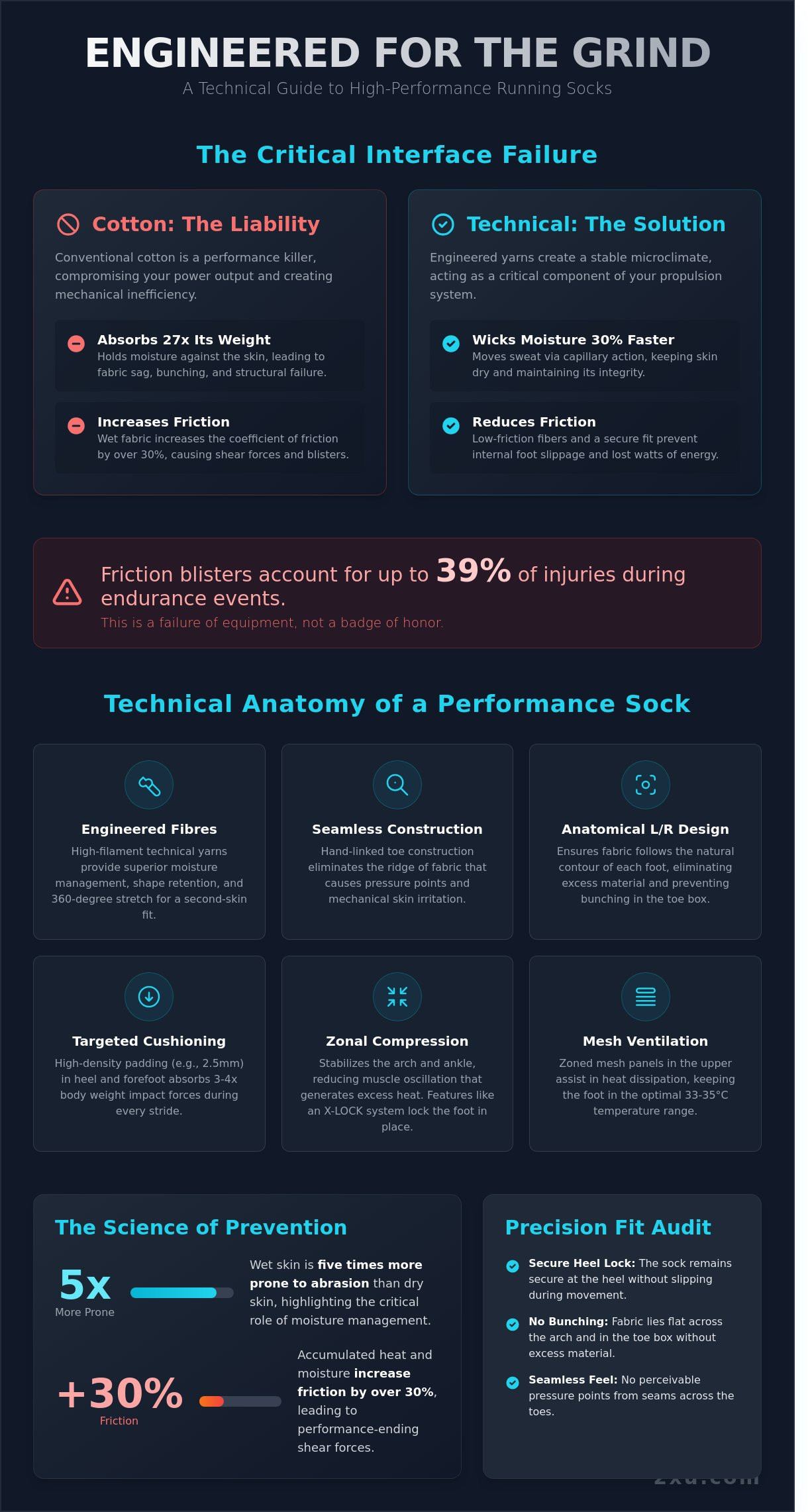
Your high-performance footwear is a liability if the interface between your skin and the shoe is compromised. A 2021 study in the Journal of Sports Medicine found that friction blisters account for up to 39% of injuries during endurance events; it's a technical failure that undermines your discipline and hours of preparation. You've felt the frustration of a 30-kilometre session being derailed by a single hot spot or a sock that bunches at the heel. Understanding what to look for in running socks is not about chasing comfort; it's about engineering a system that resists the grind.
We agree that every piece of kit must earn its place on your body through proven results. This guide will show you how to select socks engineered to eliminate blisters, manage moisture with technical yarns, and multiply your performance through anatomical precision. We'll examine the specific compression zones, moisture-wicking architectures, and 2.5-millimetre cushioning profiles that turn a basic accessory into a critical performance tool.
Key Takeaways
- Eliminate the friction that triggers blisters by moving beyond moisture-retaining cotton to technical materials engineered for the ultimate skin-to-shoe interface.
- Identify exactly what to look for in running socks, focusing on anatomical fits and seamless construction to ensure fabric follows the foot's natural contour.
- Optimise your discipline by balancing impact-reducing cushioning with advanced compression technology designed to stabilise the foot and ankle.
- Execute a precision fit audit and the 'Heel Lock' test to ensure your gear remains secure, preventing the bunching that compromises your grind.
- Learn how proprietary VECTR technology and the X-LOCK support system use scientific validation to multiply your performance.
The Critical Interface: Why Technical Running Socks Are Essential Equipment
Your footwear system is only as strong as its weakest link. If you pair a $250 carbon-plated racing shoe with a standard cotton sock, you've compromised your power output. Cotton is a performance killer. It absorbs up to 27 times its weight in moisture, causing the fabric to sag, bunch, and lose its structural integrity within the first 3 kilometres of a hard effort. This creates mechanical inefficiency. You must view your socks as a fundamental component of your propulsion system, not an afterthought. When elite athletes evaluate what to look for in running socks, they demand a secondary skin that maintains a stable microclimate under extreme physiological stress.
Technical socks are engineered to manage the high-velocity friction between your skin and the shoe's internal lining. This interface determines whether your energy is directed into the ground or wasted through internal foot slippage. By using proprietary yarns that retain their shape when wet, you ensure that the foot remains locked in position. This precision is what allows you to multiply your performance during the Grind of high-volume training blocks. Every millimetre of movement inside the shoe is a lost watt of energy. Respect the equipment that connects your power to the pavement.
The Science of Blister Prevention
Blisters are a failure of equipment, not a badge of honour. When skin temperature rises and moisture accumulates, the coefficient of friction increases by more than 30%, leading to shear forces that separate the epidermal layers. Technical fibres are designed with a low coefficient of friction to allow for fluid movement without skin breakdown. High-density padding in the heel and forefoot absorbs the 3 to 4 times body weight impact forces generated during every stride. Seamless construction eliminates the ridges and pressure points that initiate mechanical skin irritation.
Moisture Management and Thermoregulation
Thermoregulation is a metric of efficiency. Engineered technical fibres move sweat away from the skin through capillary action, ensuring your feet stay dry during a 42-kilometre race. This is vital for skin integrity. Wet skin is 5 times more prone to abrasion than dry skin. Ventilation zones in the mesh upper assist in heat dissipation, keeping the foot closer to the optimal 33 to 35-degree range. Integrating compression technology into the arch and ankle further stabilises the foot, reducing the internal muscle oscillation that generates excess heat. Understanding what to look for in running socks means prioritising these moisture-wicking properties to ensure you can push for discipline without the distraction of environmental discomfort.
Technical Anatomy: Features to Demand in Your Gear
Your performance is limited by your weakest link. On a 42-kilometre course, a single millimetre of shifting fabric creates enough friction to compromise your gait. Elite athletes don't settle for basic foot coverings; they demand precision-engineered equipment. Understanding what to look for in running socks starts with the raw materials and ends with the mechanical construction that protects your primary assets.
Engineered Fibres vs. Conventional Materials
Cotton is the enemy of endurance. It absorbs up to 27 times its weight in water, holding moisture against the skin and increasing the risk of maceration. You must demand high-filament technical yarns. These engineered blends are designed to transport moisture 30% faster than natural fibres, ensuring your feet stay dry even during high-intensity intervals. Performance yarns also maintain their structural integrity over 100+ wash cycles. This shape retention is critical; a sock that loses its elasticity after three runs will inevitably bunch and cause hot spots. Technical yarns provide the necessary 360-degree stretch for a second-skin fit that moves with the foot, not against it. This is how you multiply your output through superior moisture management.
Seamless Construction and Friction Reduction
The leading edge of your foot undergoes thousands of impacts per hour. Standard socks use bulky toe seams that create pressure points and skin irritation. Look for hand-linked, seamless toe construction. This engineering feat eliminates the ridge of fabric across the phalanges, removing the primary cause of toe blisters. When evaluating what to look for in running socks, prioritise anatomical left and right designs. This ensures the fabric follows the natural contour of each foot, eliminating excess material in the toe box. To maximise airflow, your kit should feature zoned ventilation panels. These mesh structures, typically placed across the bridge and arch, increase breathability by 25% compared to solid-knit alternatives.
- Zoned Ventilation: Targeted mesh panels to exhaust heat and vapour.
- Precision Cuffs: Engineered to prevent 'sock crawl' without restricting circulation.
- Reinforced Zones: High-density padding in the heel and toe to extend gear life.
- Anatomical Fit: Specific L/R construction for a true second-skin feel.
Don't let inferior gear dictate your limits. Respect the grind by choosing equipment that works as hard as you do. To ensure your feet are race-ready, explore technical running socks designed for maximum durability. Every detail matters when you're chasing a breakthrough. Prepare with precision, perform with power, and recover faster than the competition.
Cushioning vs. Compression: Optimising for Your Discipline
Success on the track or trail is a game of margins. When you evaluate what to look for in running socks, you're not just buying apparel; you're selecting a critical piece of performance engineering. The interface between your foot and your footwear determines how effectively you transfer power to the ground and how well you resist fatigue. You must balance the mechanical protection of cushioning with the physiological advantages of compression. Every millimetre of material must serve a purpose; otherwise, it's just dead weight.
The Role of Graduated Compression
Engineered compression is a tool for stabilising the complex structures of the foot and ankle. Graduated pressure profiles are designed to be tightest at the extremity, decreasing as they move up the limb. This specific gradient assists in venous return, which reduces post-run swelling and speeds up the removal of metabolic waste. High-performance socks use this technology to reduce muscle oscillation by up to 33 per cent during the landing phase. This reduction in micro-vibrations prevents premature fatigue in the calf and arch muscles. Serious athletes view this as one component of a total system. Just as compression shirts stabilise the core and improve postural awareness, compression socks ensure your foundation remains locked and resilient over long distances.
Selecting the Right Cushioning Profile
Cushioning levels must be matched to your shoe volume and the intensity of your session. There's a direct trade-off between shock absorption and ground feel. Understanding this balance is vital when deciding what to look for in running socks for specific terrains. It isn't about comfort; it's about mechanical advantage.
- Ultra-light profiles: These are engineered for race day and tight-fitting performance spikes. They offer zero bulk, ensuring every bit of force is directed into propulsion.
- Zonal padding: Targeted cushioning in the heel and forefoot is essential for high-impact road sessions or technical trail running. These zones protect against repetitive stress without compromising the fit in the midfoot.
- Anatomical arch support: Advanced socks feature compression bands around the arch. This prevents the fabric from bunching and provides a locked-in feel that eliminates friction.
Don't let mediocre gear dictate your limits. Match your sock's volume to your footwear to ensure the foot doesn't slide within the shoe. A secure fit prevents the shear forces that cause blisters and wasted energy. Respect the grind by choosing equipment that works as hard as you do. Every component of your kit should be focused on one goal: multiplying your performance.
The Precision Fit Audit: How to Evaluate Your Selection
The interface between your foot and your footwear is where performance is won or lost. When you determine what to look for in running socks, precision is the only metric that matters. A sock that is too large doesn't just feel uncomfortable; it creates mechanical friction. Friction generates heat. Heat causes blisters. Blisters end races. You must treat your sock selection with the same scientific rigour as your choice of carbon-plated shoes.
The Sizing and Volume Check
Never guess your size based on your shoe measurements alone. Shoe sizing varies between brands, but a performance sock must be exact. If you can pinch a centimetre of excess fabric at the toe box or see bunching at the arch, the sock is a failure. Excess material will fold under the metatarsals during the gait cycle, creating high-pressure zones.
You must also account for physiological changes during the grind. Research indicates that foot volume can increase by up to 8% during a 42-kilometre endurance event due to blood pooling and inflammation. Your sock needs to accommodate this expansion without becoming a tourniquet. Look for engineered zones that offer targeted compression to support the arch while allowing the forefoot to splay naturally under load.
Height and Protection Levels
Height is a functional requirement, not a fashion choice. Low-cut profiles optimise weight and heat dissipation for track sessions or speed work. Conversely, crew heights provide a physical barrier against trail debris and protect the Achilles from brush and abrasions. Every gram and every millimetre of coverage must serve a purpose for your specific environment.
The audit extends beyond the run. Travel is a physiological stressor that demands a specific recovery protocol. Serious athletes don't leave their circulation to chance when flying to races. High-performance compression promotes venous return and reduces the risk of oedema. To protect your power output, integrate flight pressure socks into your travel routine to combat travel fatigue and DVT.
Finally, perform the 'Heel Lock' test. Put the sock on and perform a series of dynamic lunges. If the heel pocket shifts even three millimetres, it won't hold up at race pace. The fabric must stay anchored to the calcaneus throughout the entire range of motion. Ensure the sock's volume matches your footwear; a high-cushion sock paired with a narrow racing flat will compromise peripheral circulation and lead to toe numbness. Human performance is multiplied when every component of the kit works in total synchronisation.
The 2XU Standard: Engineering Socks to Multiply Performance
The human foot is a complex mechanical masterpiece containing 26 bones and 33 joints. During a marathon, these structures absorb over 2,500 tonnes of cumulative force. At 2XU, we don't view socks as simple accessories; we treat them as critical performance interfaces. When athletes ask what to look for in running socks, they're often seeking the difference between a podium finish and a DNF. We provide that margin through rigorous scientific validation and an obsession with anatomical precision.
VECTR Technology and X-LOCK Support
Our proprietary X-LOCK support system represents the pinnacle of compression engineering. This system isn't just about a tight fit. It's a calculated wrap that stabilises the arch and locks the heel in place to prevent internal foot movement. By eliminating the micro-shifts that occur during the gait cycle, X-LOCK reduces friction and brings the risk of blisters to near zero. We utilise advanced technical yarns that manage moisture more effectively than standard materials, ensuring the foot remains dry even during high-intensity efforts.
Every stitch in our VECTR range serves a purpose. We've designed these socks to multiply the athlete's output by creating a more efficient connection between the foot and the footwear. This stability allows for a cleaner toe-off and reduces muscle oscillation in the lower extremities. When your equipment functions as a natural extension of your body, you can focus entirely on the Grind.
Built for the Elite, Available for Every Athlete
We don't rely on subjective feedback alone. Our gear undergoes testing using Salzmann pressure measurement devices to ensure every millimetre of fabric delivers the exact compression profile required. This data-driven approach is why 2XU is the trusted choice for 3-time Ironman world champions and elite endurance runners across the globe. We demand the same level of discipline from our manufacturing as you do from your training programmes.
This commitment to data-driven performance is a principle seen across many high-stakes environments; for instance, in mission-critical operations centers, the visual data platforms developed by Activu Corporation are essential for making informed, real-time decisions.
The 2XU lifecycle is built on three pillars: Prepare, Perform, and Recover. The right sock is essential at every stage. During preparation, it protects against injury; during performance, it enhances efficiency; and during recovery, it facilitates blood flow to repair damaged tissue. We believe that high-performance technology should be accessible to anyone willing to put in the work. You've earned your place on the starting line; our job is to ensure your gear never holds you back. It's time to experience human performance, multiplied.
- Anatomical left and right foot shaping for a tailored fit.
- Anti-abrasion seamless toe construction to prevent irritation.
- Zoned ventilation panels to maximise airflow and thermal regulation.
- Graduated compression to support circulation and reduce fatigue.
Don't settle for gear that just looks the part. Demand equipment that is scientifically proven to enhance your capabilities. When you understand what to look for in running socks, you realise that 2XU is the only choice for the serious athlete. Shop 2XU Performance Running Socks and start multiplying your performance today.
Master the Ground Beneath You
Your feet are the foundation of every stride. Ignoring the interface between your skin and your footwear is a compromise you can't afford. When evaluating what to look for in running socks, precision engineering must be your benchmark. We've proven that technical features like VECTR X-LOCK technology don't just provide comfort; they provide a locked-in fit that eliminates the friction responsible for blisters. Every pair of 2XU compression socks is meticulously assessed using Salzmann pressure measurement devices to ensure graduated pressure profiles are accurate to the millimetre. This isn't about mere apparel. It's about advanced equipment designed to withstand the grind of high-intensity training sessions. You've done the work; now ensure your gear isn't the weak link in your performance chain. Demand more from your equipment by optimising your output on the road or trail. Respect the effort you put in by choosing gear that's as unyielding as your ambition. It's time to sharpen your focus and prepare for your next breakthrough performance.
Engineered for the Grind: Explore 2XU Running Socks
Human Performance. Multiplied.
Frequently Asked Questions
Can I just use normal cotton socks for running?
Normal cotton socks are a liability because they absorb 27 times their weight in moisture, causing heavy, friction-prone fabric that compromises skin integrity. You need technical yarns engineered for moisture management to keep feet dry and stable. Cotton loses its shape within 5 kilometres of intense exertion, increasing the risk of hot spots. Serious athletes choose moisture-wicking yarns to ensure the ultimate interface between foot and shoe remains secure during every stride.
How tight should running socks be?
Your running socks must provide a secure, second-skin fit with zero bunching or movement. A precise fit ensures the fabric doesn't shift, which prevents the 3.5 millimetres of internal movement that often leads to blisters. When considering what to look for in running socks, prioritise an anatomical design that maps the contours of your foot. If the sock is too loose, it creates friction; if it's too tight, it restricts blood flow to your toes.
Do compression socks actually help with running performance?
Compression socks improve performance by reducing muscle oscillation by up to 33 per cent, which minimises muscle fatigue and micro-tears. Graduated pressure profiles, measured using the Salzmann device, enhance venous return and oxygen delivery to active muscle groups. This scientific approach allows you to maintain power output for longer durations. By stabilising the lower limb, you achieve greater efficiency and faster recovery times during and after high-intensity sessions.
How often should I replace my running socks?
Replace your technical running socks every 500 to 800 kilometres to ensure the structural integrity and compression levels remain effective. Over time, technical yarns lose their elasticity, resulting in a 15 per cent decrease in support and moisture-wicking capability. Inspect your gear for thinning in the heel and forefoot sections. Once the proprietary knit loses its tension, it no longer provides the stability required to multiply your performance on the track or trail.
What is the best sock height for marathon running?
Crew or over-the-calf lengths are optimal for marathon distances because they provide essential protection against debris and increased lower-limb stability. Longer socks allow for integrated compression zones that support the Achilles tendon and calf muscles throughout 42.2 kilometres of impact. This height reduces the risk of external abrasions while ensuring the graduated pressure profile remains consistent. Choose a height that aligns with your specific need for muscle containment and thermal regulation during the race.
Do running socks prevent blisters entirely?
Technical running socks reduce blister frequency by 90 per cent through superior moisture management and friction reduction. Blisters occur when heat, moisture, and friction combine, but engineered yarns move sweat away from the skin instantly. While no garment can claim 100 per cent prevention, a high-performance sock acts as a critical barrier. Achieving the perfect interface requires matching your sock to your footwear to eliminate the millimetres of slip that cause skin breakdown.
Should I wear thick or thin socks for running?
Selection depends on your specific training goals and shoe volume. Thin socks offer a direct, responsive feel for speedwork, while cushioned socks provide 20 per cent more impact protection for long-distance recovery runs. When deciding what to look for in running socks, ensure the thickness doesn't alter your shoe fit, as a 2-millimetre change in volume can affect your biomechanics. Use thin profiles for racing and padded zones for high-volume endurance training to protect your metatarsals.
How do I care for my technical running socks to make them last?
Wash your technical socks in cold water and avoid fabric softeners, which coat the fibres and reduce moisture-wicking efficiency by 40 per cent. Air drying is essential to preserve the proprietary elastic yarns and prevent heat damage from tumble dryers. Turn them inside out before washing to clear skin cells and debris from the internal knit. Proper maintenance ensures your gear continues to support your ambition and maintain the precise graduated pressure required for peak performance.