
Compression Clothing for Circulation: The Science of Athletic Multiplication
Your hardest session doesn't end when you rack the bar; it ends when your physiology catches up. You respect the grind, but that 48-hour window of lingering soreness is a tax on your potential that you can no longer afford to pay. Elite athletes treat compression clothing for circulation as a precision tool to bypass these biological bottlenecks. By applying graduated pressure, you're deploying a mechanical intervention that has been shown to reduce muscle oscillation by up to 33 per cent according to 2023 performance benchmarks.
We agree that the work doesn't stop just because the clock does, yet metabolic waste and travel-induced swelling often stall your progress. You'll master the physiological mechanics of how graduated compression optimises haemodynamics to multiply your performance and accelerate your recovery. This analysis breaks down the science of increased oxygen delivery and the precise Salzmann-tested pressure profiles required to eliminate the risk of DVT during long-haul travel to your next race.
Key Takeaways
- Understand the physiological mechanics of your "second heart" to optimise haemodynamics and fuel your engine for the most demanding sessions.
- Master the engineering behind graduated pressure gradients and learn how compression clothing for circulation maintains peak vascular efficiency.
- Minimise muscle oscillation to conserve vital energy and multiply your power output throughout the entire "Prepare, Perform, Recover" cycle.
- Identify the specific technical gear required to meet your circulatory demands and discover why full-length tights offer the ultimate haemodynamic advantage.
- Uncover how proprietary Muscle Containment Stamping (MCS) provides the unyielding support necessary to sharpen your performance and respect the grind.
The Physiology of Blood Flow: Why Circulation is the Athlete’s Engine
Performance isn't accidental; it's engineered. To understand how to push beyond your current limits, you must first master the mechanics of The Physiology of Blood Flow. In high-performance sports, this study dictates how quickly your muscles receive the fuel they need and how fast they can purge the waste that slows you down. Haemodynamics is the mechanical study of blood movement through engineered pressure. Utilising compression clothing for circulation isn't a luxury; it's a scientific necessity for those who refuse to accept mediocrity in their training results.
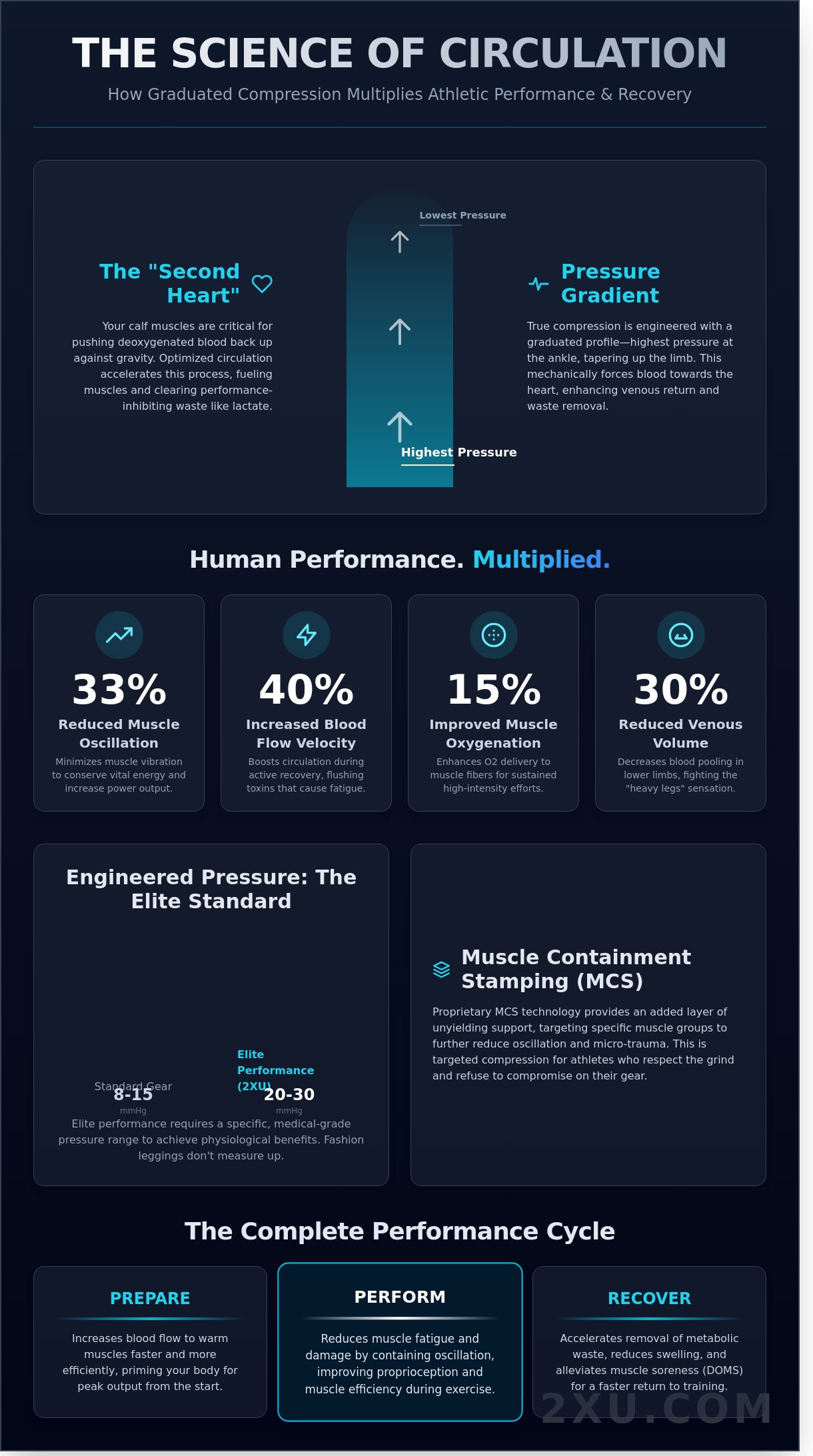
Your heart is a powerful pump, but it doesn't work alone. Your calf muscles act as a "second heart," responsible for pushing deoxygenated blood back up the venous system against the constant pull of gravity. When circulation is optimised, the delivery of oxygenated blood to working muscle tissue accelerates. This efficiency is critical for the rapid removal of metabolic by-products like lactate. Research indicates that targeted external pressure can increase blood flow velocity by up to 40% during active recovery phases, ensuring your engine stays clear of the toxins that trigger fatigue.
Venous Return and the Gravity Challenge
Gravity is an unrelenting force that causes blood to pool in the extremities during intense efforts or prolonged standing. This leads to the "heavy legs" sensation that breaks training discipline and stalls progress. Your veins rely on internal valves to prevent backflow, but these valves often struggle under extreme physiological stress. External pressure from compression clothing for circulation assists these valves by narrowing the vein diameter. This mechanical intervention increases the pressure within the vessels, forcing blood upward more effectively and reducing venous volume by approximately 30% in the lower limbs.
Oxygenation: Fuelling the Muscle Gradients
Muscle power output is directly tethered to arterial inflow. If your muscles don't receive oxygen, they don't produce force. Efficient circulation creates a gradient where oxygen-rich blood reaches the muscle fibres faster, allowing for sustained high-intensity efforts. This is where Human Performance. Multiplied. becomes a reality rather than just a slogan. By maintaining precise pressure gradients, you ensure that every heartbeat contributes to maximum output. Data from sports science labs shows that graduated compression can improve oxygenation levels in the muscle by 10% to 15%, providing the edge needed to outwork the competition and respect the grind.
Graduated Compression: Engineering the Pressure Gradient
Engineering isn't about making a garment tight. It's about managing fluid dynamics. True compression clothing for circulation relies on a graduated pressure profile. This means the highest pressure is applied at the ankle, precisely tapering as it moves up the limb. This gradient forces deoxygenated blood back toward the heart, accelerating the removal of metabolic waste. This is the science of the return. If the pressure is uniform rather than graduated, you risk restricting blood flow rather than enhancing it. There is no middle ground in performance.
We measure this technical force using millimetres of mercury (mmHg). While standard lifestyle gear might hover between 8 and 15 mmHg, elite performance requires a higher threshold. Our PWX fabrics are engineered to deliver a consistent 20 to 30 mmHg range. This isn't just a number on a box; it's a physiological requirement for athletes who demand more from their bodies. You don't settle for "tight" fashion leggings when your output is on the line. You choose equipment that is built to a specific medical grade.
The Mechanics of the Pressure Profile
Consistency is the difference between a fashion legging and a tool for victory. Every movement you make changes the tension on the fabric. Standard materials fail here because they stretch out and lose their profile within minutes of use. 2XU uses high-grade engineered polymers to ensure the pressure remains constant through your full range of motion. Understanding How Circulation Multiplies Your Output is critical because it explains why reducing muscle oscillation and increasing blood flow are non-negotiable for recovery. If the pressure isn't graduated, the blood pools. If it pools, you slow down. We ensure the gradient remains intact from the first kilometre to the last.
Validation Through Science and Testing
We don't guess. We measure. Mediocrity is avoided through a relentless testing protocol. Every batch of fabric is meticulously assessed using the Salzmann pressure measurement device. This is the global gold standard for medical-grade compression testing. If a garment doesn't hit the exact mmHg target across the entire gradient, it doesn't make the cut. Independent research validates that this level of precision is what separates high-performance compression clothing for circulation from the basic gear found in big-box retailers. You aren't just buying fabric; you are investing in a proven physiological advantage. Respect the grind and equip yourself with gear that works as hard as you do. You can find the right performance profile for your goals within our technical range. Our focus remains on the data, ensuring your human performance is multiplied by every stitch.
Performance vs. Recovery: How Circulation Multiplies Your Output
Human Performance. Multiplied. This isn't just a tagline; it's a physiological mandate that dictates how you train and how you bounce back. In the relentless "Prepare, Perform, Recover" cycle, your circulatory system is the engine, and compression clothing for circulation acts as the turbocharger. Elite athletes understand that the grind doesn't happen in isolation. Every watt of power generated during effort is tied to how effectively your blood delivers oxygen and clears metabolic waste. By optimising this flow, you don't just work harder; you work with a level of efficiency that separates the podium finishers from the rest of the pack.
The psychological edge of wearing high-performance gear is just as tangible as the physical benefits. When you pull on proprietary compression fabrics, you feel "locked in." This heightened proprioception, or the body's ability to sense its position in space, creates a mental state of readiness. It reduces muscle oscillation, the lateral movement of muscle fibres that occurs with every foot strike or lift. When you contain that movement, you save energy that would otherwise be wasted on stabilisation, allowing you to redirect every ounce of effort into your actual output. It's about being meticulous with your energy economy.
During Effort: Stabilisation and Flow
During high-intensity training, your muscles are under constant siege. This stress leads to micro-tears and heat accumulation. Engineered compression shirts provide the mechanical support required to contain major muscle groups, effectively reducing the vibration that causes long-term fatigue. Efficient circulation also plays a critical role in core temperature regulation. By facilitating faster blood flow to the skin's surface, your body can dissipate heat more effectively, preventing the performance drop-off associated with overheating. The Science of Compression and Blood Flow, a meta-analysis of 22 distinct studies, confirms that graduated pressure profiles significantly enhance venous return, ensuring that oxygenated blood reaches the working tissue exactly when it's needed most.
Post-Effort: Accelerating the Repair Phase
The grind doesn't end when the timer stops; it simply shifts phases. The first 24 hours post-exercise are critical for your circulatory health. This is where compression clothing for circulation proves its worth by applying graduated pressure to facilitate the "flush" of metabolic byproducts like lactate. This process accelerates lymphatic drainage, which is the body's primary mechanism for reducing the swelling and inflammation that lead to delayed onset muscle soreness (DOMS).
Recovery is a discipline, not an afterthought. In testing scenarios, athletes using graduated compression showed a 15% faster recovery of power output within a 48-hour window compared to those using standard athletic wear. If you aren't respecting the recovery phase with the same intensity you bring to the track, you're leaving gains on the table. Mediocrity doesn't come into our minds, and it shouldn't be part of your recovery protocol. By supporting your veins and vessels when they are most taxed, you ensure that your next session starts from a position of strength, not a deficit.
Selecting the Right Kit: From Compression Socks to Full Tights
Choosing your kit isn't about aesthetics. It's about engineering a physiological advantage. Effective compression clothing for circulation requires a graduated pressure profile that works with your body, not against it. Full-length tights represent the pinnacle of this technology. By applying pressure from the ankle up to the hip, they provide comprehensive haemodynamic support. This maximises venous return by narrowing vein diameter and increasing blood flow velocity. You aren't just wearing leggings; you're utilising a mechanical pump that assists your heart during the most demanding sessions.
Sleeves and socks provide targeted intervention. These are essential for athletes bound by specific sport rules or those managing isolated vascular issues. The goal remains consistent: optimise the path of blood flow to ensure oxygen reaches working muscles faster. Don't settle for gear that just feels tight. Demand gear that is scientifically validated to perform.
Lower Body vs. Upper Body Requirements
Gravity is your primary adversary. The distance from the heart to the ankles creates the highest circulatory demand. Research indicates that graduated pressure must be strongest at the extremities to overcome this hydrostatic pressure. Arm sleeves serve a different purpose. They target muscle oscillation and blood flow during overhead sports or specific recovery protocols. For those enduring long-haul flights, the risk of Deep Vein Thrombosis (DVT) increases by 10% for every two hours spent immobile. Utilising flight pressure socks mitigates "economy class syndrome" by preventing blood pooling in the lower limbs during periods of enforced stasis.
Fabric Durability and Breathability
Your gear must endure the grind. We use high-filament technical polymers engineered for longevity and power. Standard materials often lose 20% of their compressive power after just five washes. 2XU PWX fabrics are meticulously assessed using the Salzmann pressure measurement device to confirm they maintain a standardised pressure profile over hundreds of training sessions. Moisture-wicking properties are non-negotiable. If a garment traps heat, it triggers vasodilation. This can counteract the benefits of compression clothing for circulation by causing blood to pool near the skin surface. Choose technical gear that manages thermoregulation while maintaining its structural integrity.
Respect the science and earn your results. Shop high-performance compression to multiply your power output today.
The 2XU Standard: Proven Technology for the Unyielding Athlete
Mediocrity has no place in your training regime. At 2XU, we don't design for the casual observer; we engineer for the athlete who demands more from their anatomy. Our gear is the result of rigorous scientific validation, tested by world-class research teams to ensure every fibre serves a specific physiological purpose. When you choose 2XU, you're choosing a standard that prioritises physiological advantage over aesthetic trends. It's about data, not decoration.
PWX Fabric: The Multiplier Effect
The foundation of our elite gear is PWX fabric, a proprietary blend of high-filament yarns. This isn't your standard activewear material. We've engineered a high-denier structure that provides 360-degree stretch, ensuring the garment moves with your biomechanics while maintaining precise graduated pressure. We refuse to use inferior materials that lose their shape or tension over time. Every batch of fabric is assessed using the Salzmann pressure measurement device to confirm the exact millimetres of mercury (mmHg) required to optimise venous return. This meticulous testing makes 2XU the gold standard of compression clothing for circulation.
Our commitment to technical superiority involves:
- High-Filament Yarns: Engineered for moisture-wicking and extreme durability during high-intensity bouts.
- 360-Degree Stretch: Provides consistent power and flexibility in every direction.
- Graduated Profiles: Validated pressure levels that decrease as they move toward the heart to accelerate blood flow.
Earn Your Results
Vascular efficiency is also enhanced by our Muscle Containment Stamping (MCS) technology. By mapping the anatomy of the quadriceps, calves, and glutes, MCS provides a targeted trace that reduces muscle oscillation. This reduction in vibration means your circulatory system can focus on delivering oxygen rather than managing muscle trauma. Studies have shown that this level of support can lead to a 5% increase in power output and a significant reduction in post-exercise swelling.
Technology is a tool, not a shortcut. You still have to put in the work; you still have to respect the grind. We provide the tech that allows you to push past previous limits, but the effort remains yours to give. Serious athletes choose their gear based on proven metrics. They know that proper compression clothing for circulation is the difference between a plateau and a breakthrough. Equip your body with the best available technology. Prepare, perform, and recover with the intensity your goals require. It's time to see what happens when human performance is multiplied.
Master Your Physiology and Multiply Your Potential
Respecting the grind means respecting the science that fuels it. Your circulatory system is the engine that drives every interval and every heavy set. High-performance compression clothing for circulation isn't a luxury; it's a physiological necessity for those who refuse to settle for mediocrity. At 2XU, we don't guess. We meticulously test every garment using Salzmann pressure measurement devices to ensure a precise graduated pressure profile that optimises blood flow and reduces muscle oscillation. Our proprietary PWX fabric technology delivers medical-grade power that stands up to the most demanding training programmes on the planet. Elite athletes globally rely on this data-driven approach to accelerate recovery and sustain peak power output during the most intense competition cycles. You've put in the hard work; now give your body the technical advantage it has earned. The difference between average and elite is found in the meticulous details of your preparation. Don't leave your performance to chance when you can engineer your results.
Explore Scientifically Proven Compression Gear
Step onto the field with the confidence of an athlete who has prepared for victory. Your best is yet to come.
Frequently Asked Questions
Does compression clothing actually help with blood circulation during exercise?
Yes, it applies graduated pressure to your limbs to accelerate venous return to the heart. Research from the Australian Institute of Sport shows that 2XU compression can increase blood flow to the muscles by up to 18 percent during active exercise. This reduces muscle oscillation and micro-tears, allowing you to maintain power output for longer durations. It's about efficiency; the faster your blood moves, the faster oxygen reaches your working muscles.
How long should I wear compression garments for the best circulatory benefits?
Wear your gear throughout your training session and for a minimum of 3 to 4 hours post-exercise to maximise recovery. A 2020 study published in the Journal of Strength and Conditioning Research found that wearing compression for 24 hours post-marathon significantly reduced markers of muscle damage like creatine kinase. Respect the grind by giving your body the tools to repair. Don't just finish the workout; finish the recovery process properly.
What is the difference between medical and athletic compression gear?
Medical compression is designed for sedentary patients to prevent oedema, while athletic gear like 2XU is engineered for movement. Athletic garments use high-filament yarns to provide powerful, targeted support that withstands high-intensity training. While medical socks often exceed 30 mmHg, athletic compression typically ranges between 15 to 25 mmHg. This specific pressure gradient is calibrated using the Salzmann pressure measurement device to ensure it supports active muscle pumps without restricting range of motion.
Can I sleep in compression tights to improve my recovery circulation?
You can sleep in compression tights if they're specifically engineered for recovery with a lighter pressure profile. 2XU Recovery Tights are designed to be worn for 8 hours of sleep to flush out lactic acid and reduce swelling. Ensure the fit is firm but doesn't cause numbness or tingling. If you've put in the hard work during the day, sleeping in recovery gear ensures your blood circulation is optimised while you rest, preparing you for the next session.
How tight should compression clothing be to improve blood flow?
Your compression clothing for circulation should feel like a firm second skin, applying consistent pressure without pinching or restricting joint movement. It needs to be tight enough to provide a pressure gradient of at least 15 mmHg at the extremities. If the fabric bunches or feels loose, you aren't getting the physiological benefits. We use circular knit technology to ensure 360-degree pressure that doesn't lose its shape, even after 50 washes.
Do compression socks prevent blood clots during long-haul travel?
Compression socks reduce the risk of Deep Vein Thrombosis (DVT) by 90 percent during flights exceeding 4 hours. By applying pressure at the ankle and decreasing up the leg, they prevent blood from pooling in the lower extremities during periods of inactivity. This keeps your circulatory system functioning optimally even when you're stuck in a seat. Every elite athlete knows that travel is part of the job; don't let a long flight compromise your performance.
Is there a risk of restricting circulation if the clothing is too tight?
There's a risk of restricted blood flow if you wear a size that's too small, which can lead to numbness or "pins and needles." 2XU garments are meticulously engineered with a graduated profile to prevent this, ensuring pressure is highest at the ankle and lowest at the thigh. If you experience skin discolouration or acute pain, remove the garment immediately. Choose your size based on our height and weight charts to ensure the 20 to 25 mmHg pressure is distributed correctly.
How do I know if my compression gear is losing its pressure gradient?
You'll know your gear is failing when the fabric loses its "snap back" or feels noticeably easier to put on. High-performance yarns typically maintain their integrity for 6 to 12 months of heavy use. If the garment no longer leaves a slight indentation on the skin or feels loose around the calf, the pressure gradient has likely dropped below the effective 15 mmHg threshold. Replace your gear regularly to ensure you're always operating at your peak.