
Triathlon Wetsuit vs Surfing Wetsuit: The Science of Speed
The suit you use for a casual weekend at the beach will actively sabotage your performance on race day. Choosing a surfing suit for a competitive swim might seem like a practical shortcut, but it acts as a technical anchor that drains your power before you even touch the bike. You have put in the hours in the pool and the grit on the road. You understand that every second counts when you're fighting for a personal best. This breakdown of the triathlon wetsuit vs surfing wetsuit debate reveals how specific engineering ensures your gear multiplies your output rather than hindering it.
Surfing gear is built for survival and durability, but triathlon equipment is engineered for propulsion. We will examine how hydrodynamic coatings and 5mm buoyancy panels, the maximum thickness allowed by World Triathlon and Ironman regulations in 2026, optimise your body position in open water. You will discover why the Propel series, ranging from $250 to over $500, utilises specialised shoulder zones to eliminate the restriction that causes premature fatigue. Stop fighting your equipment and start using the science of speed to dominate the water and respect the grind.
Key Takeaways
- Understand the engineering gap between a triathlon wetsuit vs surfing wetsuit to ensure your gear supports your ambition rather than anchoring your progress.
- Identify how hydrodynamic coatings and buoyancy panels lift your hips to eliminate drag and conserve critical energy for the bike leg.
- Prioritise 360-degree shoulder flexibility to ensure every stroke is efficient and free from the physical restriction found in standard surfing suits.
- Navigate the 2026 race regulations with gear that meets the 5mm thickness limit while offering rapid-release features for faster transition splits.
- Leverage the technical ROI of Yamamoto neoprene to multiply your output and prove that elite performance is earned through discipline and superior engineering.
The Neoprene Divide: Why Your Choice Defines Your Performance
Your gear is a direct extension of your discipline. If you treat your equipment as an afterthought, you are actively sabotaging the hours you have spent grinding in the pool. The fundamental difference in the triathlon wetsuit vs surfing wetsuit debate is engineering intent. One is a garment designed for survival in a volatile ocean environment. The other is a precision-engineered tool designed to multiply your velocity. While both garments utilise neoprene, the manufacturing processes and cell densities differ to serve opposing athletic goals.
Understanding The Science of Neoprene reveals how density impacts performance. Surfing suits use a higher-density foam to resist the crushing pressure of waves and the constant abrasion of a board. Triathlon suits use advanced, nitrogen-blown rubber with a higher gas cell count. This increases buoyancy and flexibility without adding bulk. It is the difference between wearing a protective shield and a performance-enhancing second skin. When you choose the right tool, you achieve performance multiplication. You don't just swim; you dominate the water column.
Surfing Wetsuits: Built for Durability and Survival
A surfing suit is engineered to keep you alive and warm during long periods of inactivity. Surfers spend roughly 50 per cent of their time waiting for sets or sitting vertically in the water. These suits prioritise thermal retention and impact resistance. The seams are reinforced and robust to withstand the friction of the surfboard deck and the impact of crashing waves. While they keep you warm, the heavy construction and uniform thickness create a drag profile that will bludgeon your swim split. They are built for longevity, not for the clock.
Triathlon Wetsuits: Precision Tools for the Grind
Triathlon-specific suits are designed for the relentless mechanics of the swim stroke. Every panel is engineered to support a horizontal body position. This prevents "draggy" legs from sinking and draining your energy before you reach the transition. These suits allow for maximum oxygen intake by using thinner, more flexible rubber across the chest. This ensures your lungs can expand fully without fighting the resistance of the suit. You aren't just staying warm; you are reducing the energy cost of every metre. This is how you earn your place at the front of the pack through discipline and superior tech.
Hydrodynamics and Buoyancy: The Physics of a Faster Swim
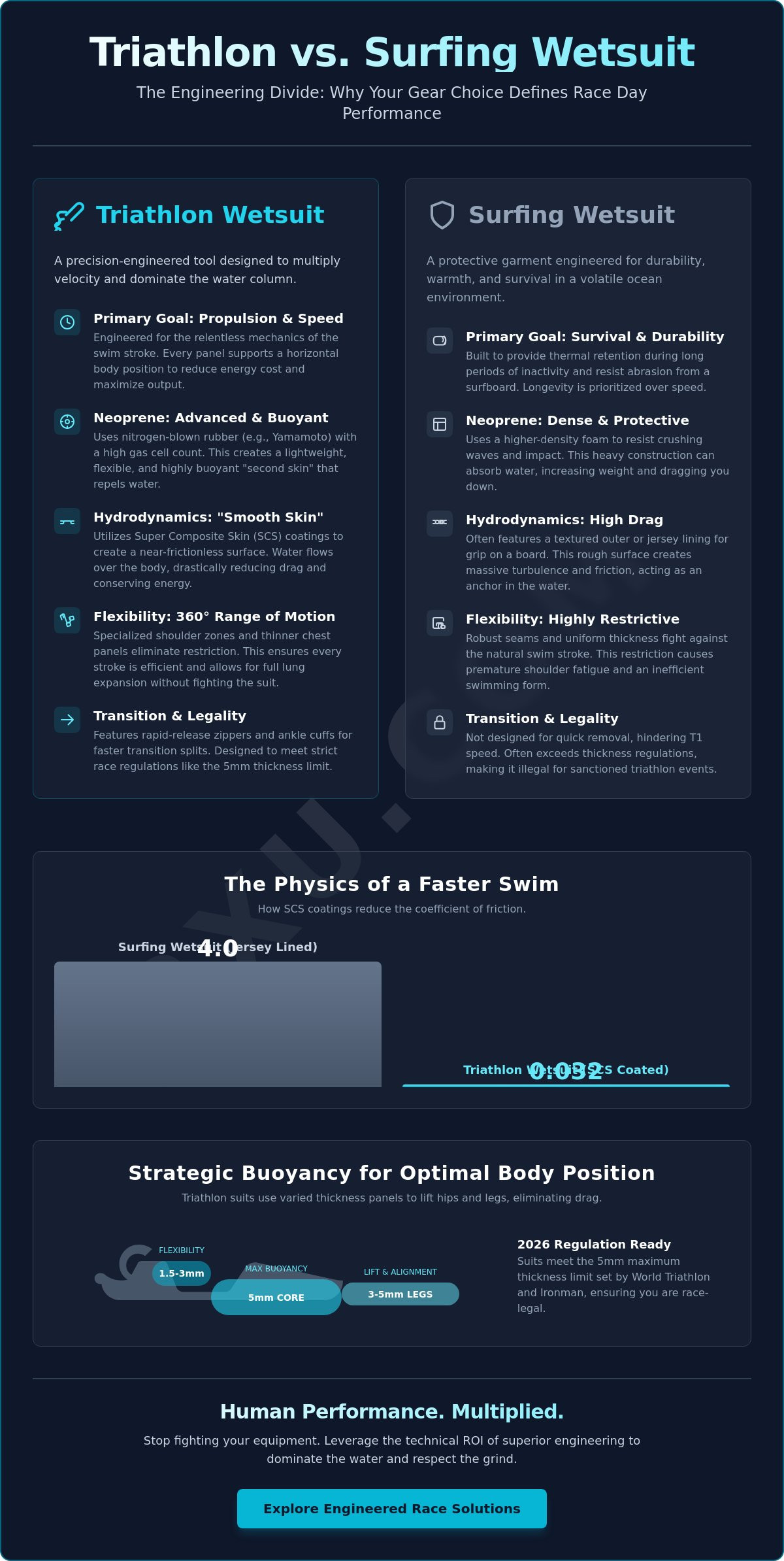
Physics does not negotiate. In the water, drag is the absolute enemy of speed. Every square centimetre of surface area that creates resistance is a tax on your power output. When comparing a triathlon wetsuit vs surfing wetsuit, the most significant technical divergence is how each garment manages fluid dynamics. A surfing suit is designed with a textured outer or a jersey lining to provide grip on a board. This texture creates massive turbulence in the water. Conversely, elite triathlon gear is engineered to be as hydrophobic as possible, ensuring you glide through the water rather than pushing against it.
The difference in water absorption is another critical factor. Standard neoprene used in surfing can absorb significant amounts of water, increasing the suit's weight and dragging your body lower in the water column. Triathlon-specific rubber is engineered with a closed-cell structure that repels water. This ensures the suit remains light and fast from the first stroke to the final exit. By reducing your drag coefficient, you save critical watts. This energy isn't just for the swim; it's the fuel you'll need to attack the bike leg and finish the run with strength. You can explore engineered race solutions that prioritise these physics-based gains.
Surface Resistance and SCS Coatings
Surface resistance is managed through advanced polymer technology. Most high-performance triathlon suits utilize Super Composite Skin (SCS) coatings to create a barrier between the neoprene and the water. SCS coating is a proprietary polymer layer that reduces drag to near-zero levels. While a surfing suit's rough exterior creates friction, the "smooth skin" of a tri suit allows water to flow over the body with minimal disruption. This reduces the coefficient of friction from 4.0 to as low as 0.032 in some professional-grade models. It's not just about feeling fast; it's about the mathematical reduction of resistance.
Buoyancy Profiles and Body Alignment
Body position is the foundation of a fast swim split. When your legs sink, your frontal surface area increases, creating resistance that forces your heart and lungs to work significantly harder. Elite triathlon suits solve this through graduated buoyancy profiles.
- Lower Body: 5mm panels (the maximum allowed by 2026 race rules) are placed in the legs and core to lift the hips.
- Upper Body: Thinner 1.5mm to 2mm panels are used in the chest and arms to allow for natural rotation.
Flexibility and Range of Motion: Earning Your Swim Split
Efficiency is the currency of endurance. Every time your arm recovers over the water, you are either moving with your gear or fighting against it. A common misconception suggests that "paddling flexibility" in a surf suit is sufficient for the demands of a race. This is a fundamental misunderstanding of biomechanics. While a surfer paddles with a relatively stable torso, a triathlete relies on high-cadence, 360-degree shoulder rotation and significant body roll. The triathlon wetsuit vs surfing wetsuit distinction is most evident here; one allows for a natural stroke, while the other imposes a physical tax on every movement.
The Grind is made unnecessarily brutal when you use non-specialised equipment. Thick rubber designed for warmth creates a constant resistance that fatigues the deltoids and lats prematurely. Elite triathlon gear utilises advanced inner liners that allow the suit to move with your skin rather than creating friction against it. This frictionless interface ensures that your energy is directed toward propulsion, not overcoming the internal tension of the garment. By the time you reach the 1.5km or 3.8km mark, the cumulative energy saved through superior flexibility can be the difference between a strong transition and a depleted bike leg.
Shoulder Mechanics and Neoprene Thickness
Precision engineering dictates that the shoulder and underarm gussets of a triathlon suit must be significantly thinner than the core panels. While the legs may use 5mm for lift, the shoulder zones often drop to 1.5mm or 2mm. This allows for an unrestricted "reach and catch" phase of the stroke. 2XU engineers these panels to facilitate maximum extension without the rubber snapping back and shortening your stroke. If you are fighting the suit for 40 minutes, you are wasting power that should have been reserved for the road. High-performance gear ensures your range of motion remains uncompromised from the first dive to the final exit.
Chest Expansion and Breathing Efficiency
Breathing is not just a physiological requirement; it's a psychological anchor during the chaos of a swim start. Surfing suits are often constructed with a uniform, tight compression to trap heat. This can restrict the ribcage and limit your VO2 capacity. Triathlon-specific suits are engineered to allow the chest to expand fully.
- Maximum Oxygen Intake: Flexible chest panels allow for deep, rhythmic breathing under load.
- Panic Reduction: Eliminating the feeling of chest constriction helps maintain a calm, focused mindset in open water.
- Optimised Recovery: Better oxygenation during the swim speeds up your recovery for the subsequent legs of the race.
Transition Speed and Race Legality: Navigating the Rules
Transition is the fourth discipline. It is where a hard-earned lead in the water can evaporate through poor preparation and inferior gear. If you have spent months grinding in the pool to shave seconds off your pace, don't throw that effort away by fighting your equipment in T1. The triathlon wetsuit vs surfing wetsuit debate reaches its climax on the timing mats. Surfing suits are designed to stay on during high-impact wipeouts; they are intentionally difficult to remove. Triathlon suits are precision-engineered to be stripped in seconds, ensuring your heart rate stays controlled as you move to the bike.
The difference in exit speed is a result of specific mechanical engineering. Surfing gear often features tight, reinforced cuffs and standard zippers that lack the "breakaway" functionality required for racing. Triathlon-specific designs utilise hydrodynamic wrist and ankle cuffs that expand easily over the hands and feet. Race-day success is often determined by the efficiency of the transition, not just the swim split. You can consult The Ultimate Triathlon Suit Guide: Engineering Your Fastest Race Day to understand how to integrate these technical advantages into your race strategy.
T1 Mechanics: The Hidden Time Saver
Struggling with a heavy, water-logged surf suit causes unnecessary heart rate spikes and psychological stress. Elite triathlon suits use advanced interior linings with high-slip properties that allow the rubber to slide over wet skin instantly.
- Quick-Release Zippers: Engineered with specific tooth-alignment patterns for a single-motion disengagement.
- Slippery Internal Coatings: Reduces friction against the skin, allowing the suit to be kicked off the legs in two movements.
- Tapered Cuffs: Thinner rubber at the extremities ensures the suit doesn't get caught on your sports watch or timing chip.
Regulatory Compliance for the Elite Athlete
Discipline includes a total command of the rules. IRONMAN and World Triathlon regulations for 2026 are explicit: wetsuits must not exceed 5mm in thickness. This rule is non-negotiable. Many cold-water surfing suits, particularly those designed for winter conditions, utilise 6mm or thicker neoprene in the core to maximise heat retention. If you show up to a sanctioned race with a prohibited suit, you face immediate disqualification at the gear check. Triathlon-specific gear is engineered to hit the 5mm limit exactly where you need the lift, ensuring you remain compliant while maximising your buoyancy ROI. Get race ready with equipment that respects the standards of the sport.
Human Performance Multiplied: The 2XU Engineering Advantage
At 2XU, we don't build gear for the casual observer. We build it for the athlete who respects the grind and demands a measurable return on their effort. The fundamental engineering gap in the triathlon wetsuit vs surfing wetsuit debate is closed by our obsession with data. We believe that human performance can be multiplied through the application of rigorous science. Every stitch and panel in our Propel series is meticulously assessed to ensure it serves the athlete's ambition to be faster, stronger, and more resilient. You aren't just buying a suit; you are investing in a technical advantage that has been proven in the lab and on the course.
Our design philosophy follows a strict "Prepare, Perform, Recover" framework. This holistic approach ensures that your equipment supports your physiology through every phase of the race. By integrating advanced materials that reduce muscle oscillation and optimise body alignment, we ensure that your power output is preserved for the bike and run. This is the technical ROI of choosing gear designed specifically for the demands of multisport competition. To master your equipment selection, consult our Triathlon Wetsuit: A Performance-Driven Guide to Your Fastest Swim.
Yamamoto Neoprene: The Gold Standard
Yamamoto neoprene is the undisputed pinnacle of aquatic engineering. Unlike traditional oil-based rubbers, Yamamoto utilises limestone-based neoprene to achieve a superior buoyancy-to-weight ratio. We employ 39-cell and 40-cell neoprene structures to provide unparalleled flexibility and lift. These specific cell counts represent the density of nitrogen bubbles within the rubber; a higher count translates to more trapped air and less weight. This ensures you never settle for mediocrity when the clock is running. The limestone structure also offers 99.7 per cent water impermeability, meaning your suit stays light and fast while standard surfing suits become heavy and waterlogged.
Engineered for the Elite, Available for All
We bring world-class hydrodynamics to every athlete who is willing to put in the work. Our commitment to scientific testing involves the use of advanced performance measurement devices, including Instron tensile testers, to confirm that our garments deliver tangible results. 2XU gear is not exclusive; it is aspirational. It is built for anyone who has the discipline to show up and earn their place.
- Scientific Validation: Every material is assessed for graduated pressure and hydrodynamic efficiency.
- Proprietary Lexicon: Features like Muscle Containment Stamping (MCS) are engineered to reduce fatigue.
- Unyielding Quality: We refuse to compromise on the technical specifications that drive elite performance.
Master the Water: Multiply Your Performance
The technical distinction in the triathlon wetsuit vs surfing wetsuit debate is the difference between surviving the ocean and conquering the clock. You've seen how specific buoyancy profiles lift the hips to reduce drag and how 360-degree shoulder flexibility preserves your power output for the bike leg. Choosing gear engineered for hydrodynamics isn't a luxury; it's a non-negotiable requirement for anyone serious about the grind.
Our Propel series is the result of rigorous scientific testing and is trusted by elite IRONMAN champions to deliver breakthrough results. By utilising Yamamoto 39 and 40 cell neoprene technology combined with our proprietary SCS hydrodynamic coating, we ensure your natural potential is multiplied. Don't let inferior equipment dictate your finish time. Shop the 2XU Triathlon Wetsuit Collection today and equip yourself with the world's most advanced technical rubber.
The road to the podium is paved with discipline. Put in the work, trust the science, and earn your place.
Frequently Asked Questions
Can I use a surfing wetsuit for an IRONMAN triathlon?
You can technically use a surfing suit provided the neoprene thickness does not exceed the 5mm limit mandated by IRONMAN and World Triathlon rules for 2026. However, doing so is a significant performance handicap. You will fight the resistance of non-specialised rubber for 3.8km, wasting critical kilojoules that are required for the 180km bike leg and the marathon run.
Will a triathlon wetsuit keep me as warm as a surfing wetsuit?
Triathlon suits provide excellent thermal protection but achieve it through different engineering. While surfing suits use bulkier neoprene to trap heat during periods of inactivity, a triathlon suit uses tight seals and SCS coatings to maintain a thin, warm layer of water against the skin. This ensures you stay warm while maintaining the streamlined profile necessary for high-velocity swimming.
Why are triathlon wetsuits more expensive than surfing wetsuits?
The price reflects the cost of advanced materials like Yamamoto 39 and 40 cell limestone rubber. While mid-range surfing suits are priced between $150 and $300, triathlon suits require complex manufacturing to integrate variable thickness panels. Engineering a suit with 1.5mm shoulders and 5mm buoyancy zones requires precision bonding that standard surfing garments do not possess.
How do I know if my surfing wetsuit is too thick for race rules?
Check the manufacturer's specification stamp usually located on the internal wrist or neck flap. If the suit is labelled as a 5/4mm or 6/5mm, the core thickness likely exceeds the 5mm limit allowed in sanctioned races. In 2026, race officials at major events use callipers to verify thickness, and any violation results in immediate disqualification at the gear check.
Do I really need a triathlon-specific wetsuit for my first race?
You don't need one to finish, but you need one to perform at your potential. Choosing a triathlon wetsuit vs surfing wetsuit for your debut reduces swim fatigue by approximately 15 per cent. This energy conservation is vital for beginners who often struggle with the transition to the bike. Investing in the right gear from day one respects the discipline required for the sport.
How much faster is a triathlon wetsuit compared to a surf suit?
Empirical data suggests a speed advantage of 5 to 10 seconds per 100 metres when using triathlon-specific gear. Over a 1.5km Olympic distance swim, this translates to a 75 to 150 second gain. This improvement is driven by the reduction in the coefficient of friction and the lifted hip position that eliminates the drag caused by sinking legs.
Is it harder to breathe in a surfing wetsuit while swimming?
Yes, because surfing suits are designed with uniform compression to prioritise heat retention over lung expansion. Triathlon suits are engineered with thinner, high-stretch panels across the chest to allow the ribcage to expand fully. This ensures you can maintain maximum oxygen intake and a stable heart rate during the high-intensity environment of an open water swim start.
Can I use my triathlon wetsuit for surfing after the race?
You should avoid using your race suit for surfing because the delicate SCS coating is not designed for abrasion. Contact with surfboard wax, sand, and the friction of paddling will tear the smooth skin surface. These nicks compromise the suit's hydrodynamics and durability, effectively destroying the technical ROI of your high-performance equipment.