
How Long to Wear Compression for Recovery: The Athlete’s Protocol
Recovery is not a passive state of rest; it is an active physiological discipline that dictates your next win. If you've ever struggled through back-to-back training sessions with heavy, leaden legs, you know that grit alone isn't enough to overcome metabolic fatigue. The confusion surrounding how long to wear compression for recovery often keeps athletes from reaching their full potential. You've put in the work. Now you must respect the grind by giving your muscles the scientific support they require to repair.
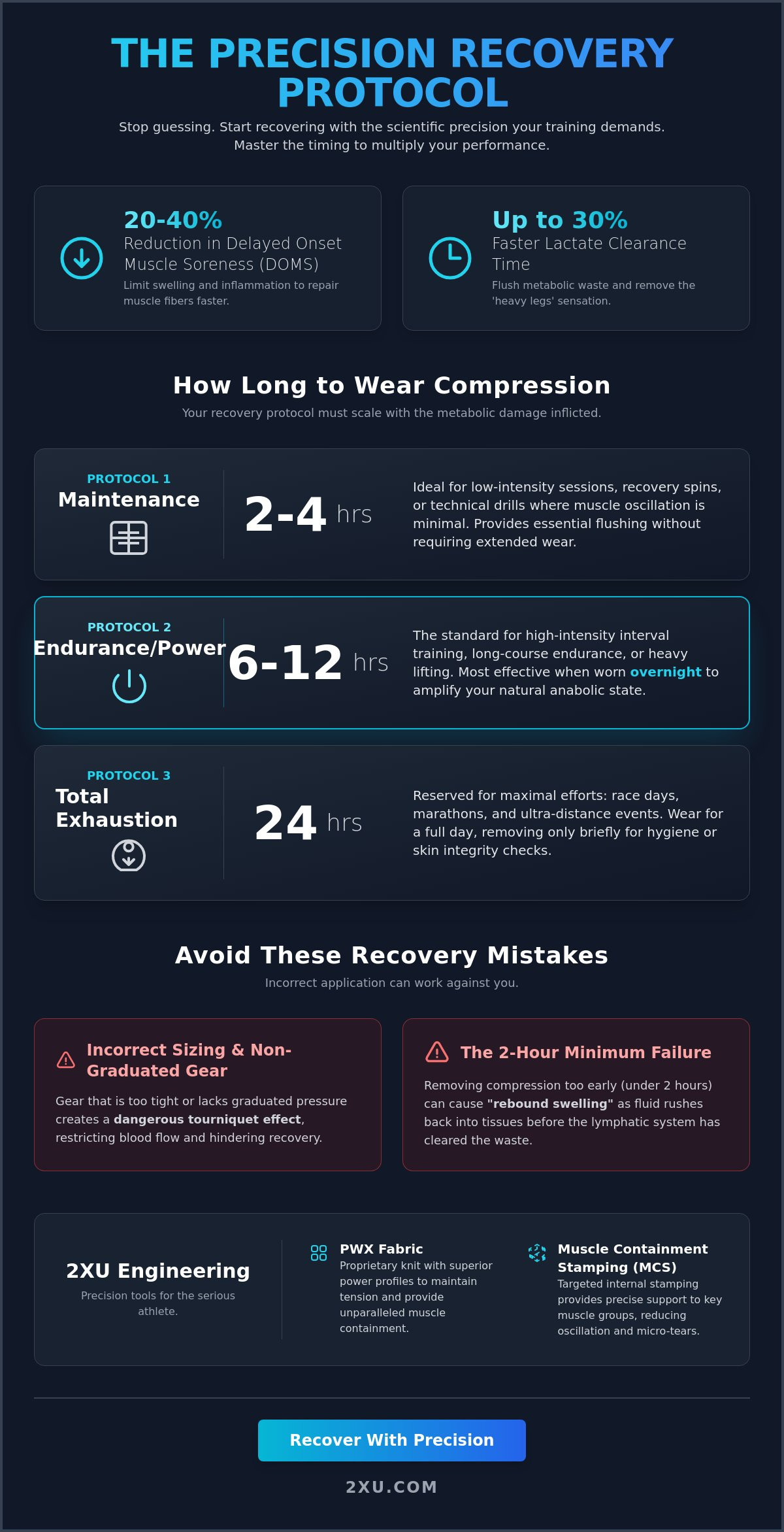
We're here to replace guesswork with data. This protocol reveals how to use graduated pressure to reduce the severity of Delayed Onset Muscle Soreness (DOMS) by 20 to 40 percent and slash lactate clearance time by up to 30 percent. You'll master the precise 12 to 24 hour timing window required to optimise muscle repair, reduce downtime between sessions, and ensure your performance is multiplied every time you lace up. It's time to stop guessing and start recovering with the precision your training demands.
Key Takeaways
- Master the science of metabolic clearance to flush lactate and reduce intramuscular oedema after high-intensity training.
- Implement precise protocols to determine how long to wear compression for recovery based on the metabolic damage of your specific session.
- Unlock the benefits of overnight compression to amplify your natural anabolic state and wake up ready for the next grind.
- Identify and eliminate common pitfalls like incorrect sizing and the dangerous tourniquet effect of non-graduated gear.
- Utilise engineered PWX fabric and Muscle Containment Stamping (MCS) to provide targeted support to the muscle groups that need it most.
The Science of Metabolic Clearance: Why Duration Matters
Recovery is the mechanical flushing of waste. After you finish the grind, your body becomes a site of metabolic debris. Lactate, carbon dioxide, and intramuscular oedema pool in the lower extremities, creating the heavy legs sensation that kills performance. The Science of Compression confirms that graduated pressure acts as a secondary, mechanical pump for your venous system. It accelerates the return of deoxygenated blood to the heart, which is vital for clearing metabolic by-products. This process isn't just about comfort; it's about performance multiplication. By stabilising the muscle, you reduce post-exercise muscle oscillation. These micro-vibrations can cause additional micro-tears long after your session ends. The 72-hour window following a peak effort is the critical zone where your next race is won or lost. Mastering how long to wear compression for recovery during this timeframe is what separates elite athletes from the mediocre.
The Role of Lymphatic Drainage in Muscle Repair
The lymphatic system lacks a central pump like the heart. It relies on muscle contraction and external pressure to move waste-filled fluid. While an active cooldown is a start, passive compression provides the sustained force required for deep waste removal. Research indicates that compression can reduce lactate clearance time by up to 30 percent compared to passive methods. You must realise that 15 minutes of wear is insufficient for deep tissue repair. You need prolonged application to move fluid through the dense network of lymphatic vessels and back into the circulatory system for excretion.
Reducing Delayed Onset Muscle Soreness (DOMS)
DOMS is the physiological result of inflammation and fluid buildup within the muscle sheath. When you apply sustained, graduated pressure, you limit the physical space available for this swelling to occur. This isn't a suggestion; it's a biological requirement for faster turnaround. 2XU engineered fabrics are designed with proprietary power profiles that maintain tension where standard knits fail. Our garments provide superior containment, reducing DOMS severity by 20 to 40 percent. By controlling inflammation immediately, you ensure that your muscle fibres can begin the repair process without being strangled by excess fluid. This is how you earn your place back on the track tomorrow.
The 2XU Recovery Protocol: How Long to Wear Your Gear
Generic advice is the enemy of progress. If you're following a standard 20-minute recovery window, you're leaving performance on the table. Determining exactly how long to wear compression for recovery depends entirely on the volume of the grind you just endured. Your protocol must scale with the metabolic damage inflicted. We categorise these into three distinct tiers of intensity to ensure you're never under-recovered for the next session.
- Protocol 1: Maintenance (2–4 hours). Use this for low-intensity sessions or recovery spins where muscle oscillation was minimal.
- Protocol 2: Endurance and Power (6–12 hours). This is the standard for high-intensity interval training or long-course endurance blocks. This duration is often most effective when worn overnight.
- Protocol 3: Total Exhaustion (24 hours). Reserved for race days, marathons, or ultra-distance events. Wear the gear for a full day, removing it only for short hygiene breaks or to check skin integrity.
The 2-Hour Minimum: Why Short Bursts Fail
Blood flow does not stabilise the moment you stop moving. It takes time for the heart rate to drop and for venous return to normalise. While Harvard Medical School guidance provides a foundational look at circulation, the athletic requirement for waste clearance is far more demanding. Taking off your gear too early causes "rebound swelling," where fluid rushes back into the muscle tissues before the lymphatic system can process it. Beyond the physiology, the compression ritual builds discipline. It marks the transition from performance to repair, forcing you to respect the recovery phase with the same rigour you apply to the track.
Scaling Duration to Training Load
Triathletes finishing a 5-hour saddle session require a different approach than a sprinter finishing a block of explosive starts. For the endurance athlete, the focus is on systemic waste removal and oedema control over 12 hours. For the power athlete, the goal is to dampen muscle oscillation and inflammatory responses immediately after the session for at least 4 hours. To achieve a total physiological reset, you must address the upper body as well. Integrate compression shirts into your protocol to manage metabolic clearance in the lats and pectorals after heavy lifting or swimming. Consistency in these timings is how you multiply your output. If you want to see the results of your hard work, you must give your body the time to rebuild. Invest in the right tools to ensure your recovery matches your ambition.
Overnight Compression: The Ultimate Performance Multiplier
Sleep is your body's primary anabolic state. It's the only time your system focuses exclusively on repair without the interference of external stressors or movement. By extending how long to wear compression for recovery into your sleep cycle, you amplify these natural biological processes. While some sources warn against sleeping in compression gear, these concerns usually stem from a lack of understanding of technical engineering. There is a massive difference between a medical stocking designed for post-surgical patients and a garment engineered for athletic physiology.
The distinction lies in "Resting Pressure" versus "Active Pressure." When you are horizontal, your heart doesn't have to fight gravity to move blood from your ankles. 2XU garments are meticulously assessed using the Salzmann pressure measurement device to ensure the graduated profile remains effective but safe during periods of inactivity. This precision eliminates the risk of restricted arterial flow while maintaining the mechanical pump required to flush metabolic waste. You don't wake up with "heavy legs" because the waste was cleared while you slept. It's the difference between waking up stiff and waking up ready to attack the next session.
Passive Recovery vs. Active Performance
The data is clear. Athletes who utilise overnight compression report significantly higher perceived recovery scores and improved heart rate variability (HRV) the following morning. In a typical 8-hour sleep cycle, passive recovery alone allows fluid to settle in the muscle tissues. Adding 2XU compression transforms those 8 hours into an active recovery block. By maintaining a consistent 12 to 24 hour protocol through the night, you ensure that morning stiffness is replaced by readiness. Studies show that this level of sustained application can improve ankle dorsiflexion range of motion by an average of 8 to 12 percent within 24 hours. You earn your performance multiplication while you dream.
Optimising the Sleep Environment
Comfort is a performance metric. If you overheat, your sleep quality drops and your recovery stalls. This is why our recovery gear features X-VENT technology and advanced moisture-wicking properties. These features ensure that body temperature is regulated even under bed covers. While some athletes try to use running shorts with liners for recovery, they are not a substitute for dedicated recovery tights. Shorts lack the graduated pressure profile necessary to assist venous return from the lower limbs. Respect the grind by using the correct tool for the job. Dedicated recovery tights provide the containment your muscles need to rebuild for tomorrow's session.
Common Pitfalls: When Compression Works Against You
Discipline without precision is just wasted effort. If you have mastered the timing of your protocol but failed on the mechanics of the fit, you're sabotaging your own repair. Mediocrity has no place in your recovery kit. The most common error athletes make is assuming that tight equals effective. This misconception leads to the tourniquet effect, where non-graduated pressure actually traps metabolic waste in the extremities rather than flushing it toward the heart. When considering how long to wear compression for recovery, you must first ensure that the garment is engineered to support, not strangle, your physiology.
Incorrect sizing is the fastest way to turn a performance multiplier into a liability. A garment that is too loose provides zero mechanical advantage for venous return, rendering your recovery session useless. Conversely, a garment that is too tight can restrict arterial flow, preventing oxygen-rich blood from reaching the very muscles you are trying to heal. You must also remember that compression is a tool, not a cure-all. Relying on gear while ignoring hydration and nutrition is a failure of discipline. Your body needs water and nutrients to process the waste that compression is helping to move. Without them, you're just circulating sludge.
The Tourniquet Trap: Recognising Poor Engineering
True graduated compression is a masterpiece of textile physics. It must be tightest at the ankle and precisely ease in pressure as it moves up the limb toward the heart. If you experience numbness, tingling, or cold toes, your gear is impeding circulation. This is a failure of engineering. At 2XU, we reject the tight clothing label. Every batch of technical fabric undergoes rigorous tension testing using the Salzmann pressure measurement device to ensure the pressure profile remains consistent. Without this specific gradient, you aren't recovering; you're just wearing restrictive fabric that works against your circulatory system.
Skin Health and Fabric Care
Sustaining a 12 to 24 hour recovery block requires a focus on hygiene that many athletes overlook. Moisture trapped against the skin for extended periods can lead to irritation or dermatitis. This is why we use high-quality, breathable materials designed to move sweat away from the body. The performance of your gear also relies on the integrity of the power-mesh. Washing your garments after every use isn't just about hygiene; it's about restoring the snap of the fibres. Salt and sweat degrade elasticity over time, reducing the effective pressure. If the fabric doesn't snap back to its original state, it isn't doing the work. Respect your equipment if you want it to respect your performance. Find your precision fit in our recovery range to ensure every minute of your protocol counts.
2XU Engineering: Precision Tools for the Serious Athlete
Engineering is the foundation of 2XU. We don't just make clothing; we build precision tools designed to multiply your performance. Our proprietary PWX fabric is engineered to provide the ultimate balance of power, weight, and flexibility. This is not a standard knit. It's a high-performance material that withstands the rigours of daily training. To enhance this, we developed Muscle Containment Stamping (MCS). This targeted support system traces key muscle groups to dampen oscillation and reduce damage during the recovery phase. It provides an extra layer of containment that standard garments cannot match.
Our commitment to data is unyielding. Every garment is validated using the Salzmann pressure measurement device to confirm the correct graduated profile. We also use Instron machines to test the tensile strength and durability of our fabrics. This ensures that the pressure you feel on day one is the same pressure you feel after a year of use. For the multi-sport athlete, this engineering is vital. After stripping off your triathlon wetsuit and finishing the race, your body enters a state of high metabolic stress. Implementing the correct protocol for how long to wear compression for recovery at this exact moment determines how quickly you return to peak output. You have done the work. Now, let the science finish the job.
Human Performance Multiplied
The "Two Times You" philosophy is simple. We believe that through better preparation and recovery, you can become twice the athlete you are today. This is not about shortcuts; it's about respecting the grind with better science. Elite coaches and research teams globally choose 2XU because our gear maintains its medical-grade pressure through hundreds of wash cycles. While other brands lose their elasticity, our garments remain a constant in your recovery programme. You earn your place through hard work. We provide the tools to ensure that work isn't wasted by poor recovery.
Your Next Step in the Recovery Discipline
Choosing the right tool is the first step in your discipline. For a full-body reset, our recovery tights are the gold standard. If your schedule involves heavy travel between sessions, flight pressure socks are essential for combating travel fatigue and deep vein thrombosis. Remember that understanding how long to wear compression for recovery is only effective if the equipment can sustain the necessary pressure. Mediocrity doesn't come into our minds, and it shouldn't come into yours. Commit to the protocol. Shop the 2XU Recovery Collection and start multiplying your performance today.
Master the Recovery Discipline
Recovery is the final stage of performance. You've pushed through the grind; now you must respect the science of repair. By mastering exactly how long to wear compression for recovery, you ensure that metabolic waste is flushed and muscle oscillation is contained during that critical 72-hour window. Our gear isn't just clothing. It's a precision tool tested by world-leading research teams and validated by Salzmann devices to provide scientifically proven graduated pressure. With Muscle Containment Stamping (MCS) technology, you're not just resting; you're actively preparing for your next breakthrough.
Don't settle for mediocrity in your kit when your ambition demands elite results. Take control of your physiological reset and bridge the gap between your current self and your potential. Multiply your recovery with 2XU Engineered Compression and wake up ready to dominate. The work you do now defines the power you output tomorrow. Stay disciplined, respect the process, and earn your next win.
Frequently Asked Questions
Can I wear compression tights for 24 hours straight?
Yes, wearing compression for 24 hours is recommended following total exhaustion events like marathons or ultra-endurance races. You must ensure the garment is engineered with a graduated pressure profile to prevent blood pooling. Remove the gear briefly for hygiene or skin checks; otherwise, sustained wear for a full day accelerates metabolic waste removal and reduces oedema. This protocol is the gold standard for elite athletes during the critical post-race window.
Is it better to wear compression during or after a workout for recovery?
Both are essential but serve distinct physiological roles. During a workout, compression reduces muscle oscillation and oscillation-induced micro-tears. After the session, the focus shifts to metabolic clearance. To optimise your results, you should use both: performance gear to protect the muscle during the grind and recovery gear to flush lactate and reduce swelling. The total duration of how long to wear compression for recovery depends on the intensity of the performance.
Should I wear compression socks to sleep after a marathon?
You should wear graduated compression socks to sleep after a marathon to maximise the body's natural anabolic repair state. Sleep is when the heart rate is lowest, making the mechanical assistance of a graduated profile even more effective for venous return. Ensure your gear is specifically engineered for recovery rather than high-intensity performance to maintain a safe resting pressure. This practice reduces the 8 to 12 percent range of motion loss often seen after extreme endurance events.
How tight should my recovery compression be?
Your recovery gear should feel firm and supportive, specifically at the extremities. It must never cause numbness, tingling, or skin discolouration, as these are indicators of restricted arterial flow. True recovery garments are assessed using the Salzmann device to ensure they are tightest at the ankle and ease toward the heart. If the garment feels like a uniform tourniquet rather than a graduated pump, it is a failure of engineering and will hinder your repair.
Can I wear compression sleeves instead of full tights for recovery?
You can use sleeves for targeted muscle support, but full tights are superior for systemic recovery. Sleeves only address specific zones like the calves or quads, which can lead to fluid pooling at the joints or ankles. Tights provide a continuous graduated profile from the ankle to the hip, ensuring that metabolic waste is moved efficiently through the entire lower limb. For total performance multiplication, full-length containment is the professional choice.
Does wearing compression for too long cause muscle laziness?
No evidence suggests that wearing compression causes muscle laziness or atrophy. Compression is a mechanical aid designed to assist the venous and lymphatic systems, not to replace the structural function of your muscles. It reduces the 20 to 40 percent DOMS severity by managing inflammation, allowing you to return to training sooner. It sharpens your discipline by ensuring your muscles are repaired and ready for the next session without compromising natural strength.
What is the difference between active performance and recovery compression?
Active performance gear is engineered to handle high-impact muscle oscillation and provide maximum containment during movement. Recovery compression is designed with a specific graduated profile to maximise venous return while the body is at rest. Recovery garments often feature a softer feel for extended wear while maintaining the scientific pressure required to flush waste. Understanding how long to wear compression for recovery involves recognising that recovery gear is built for the 12 to 24 hour repair window.
How soon after my workout should I put on my recovery gear?
Put on your recovery gear immediately after your cooldown and shower. The first few hours post-exercise are the most critical for managing the inflammatory response and preventing fluid buildup. Research shows that applying compression within the first 2 hours of finishing a session significantly reduces the severity of DOMS. Respect the grind by making the transition to recovery gear an instant, non-negotiable part of your post-training ritual.