
Is Expensive Running Gear Worth It? The Science of Performance Investment
What if the barrier between your current pace and a breakthrough isn't your lung capacity, but the failure of your equipment to manage muscle oscillation? You've likely felt the frustration of gear that loses its technical properties after five washes or the persistent ache of shin splints that refuse to heal. You understand that respect for the grind requires discipline, but you're tired of being sidelined by preventable injuries. It's time to ask the hard question: is expensive running gear worth it when your results are on the line?
We agree that every dollar spent must yield a measurable return on your athletic performance. This article reveals the data-driven reality of high-performance apparel, showing you exactly when to invest in engineering that multiplies your output. You'll learn how graduated pressure, verified by the Salzmann measurement device, can reduce muscle soreness by up to 33 percent according to recent physiological studies. We provide a clear framework for prioritising your spend, backed by scientific proof that the right apparel accelerates recovery and keeps you training. Stop settling for mediocrity and sharpen your investment strategy.
Key Takeaways
- Distinguish between mere fitness fashion and performance-engineered equipment designed to multiply your power output.
- Master the data-backed Splurge vs. Save framework to identify exactly when is expensive running gear worth it for your specific training goals.
- Explore how proprietary, high-filament yarns protect your biomechanics and offer superior moisture management compared to basic materials.
- Optimise your recovery phase using graduated compression to accelerate blood lactate clearance and prepare for the next grind.
- Access the scientific validation and independent research that separates elite 2XU engineering from standard athletic apparel.
Defining the Value: Is Premium Running Apparel Actually Necessary?
Stop confusing fitness fashion with performance-engineered equipment. One is designed for aesthetic appeal in casual settings; the other is built to survive the Grind. When you ask is expensive running gear worth it, you're really questioning whether your ambition deserves a matching investment. At 2XU, we operate under a single, rigorous philosophy: Human Performance. Multiplied. Every gram of proprietary fabric must earn its place on your body through measurable benefit. If a garment doesn't reduce muscle oscillation or manage thermal load, it's dead weight that slows you down.
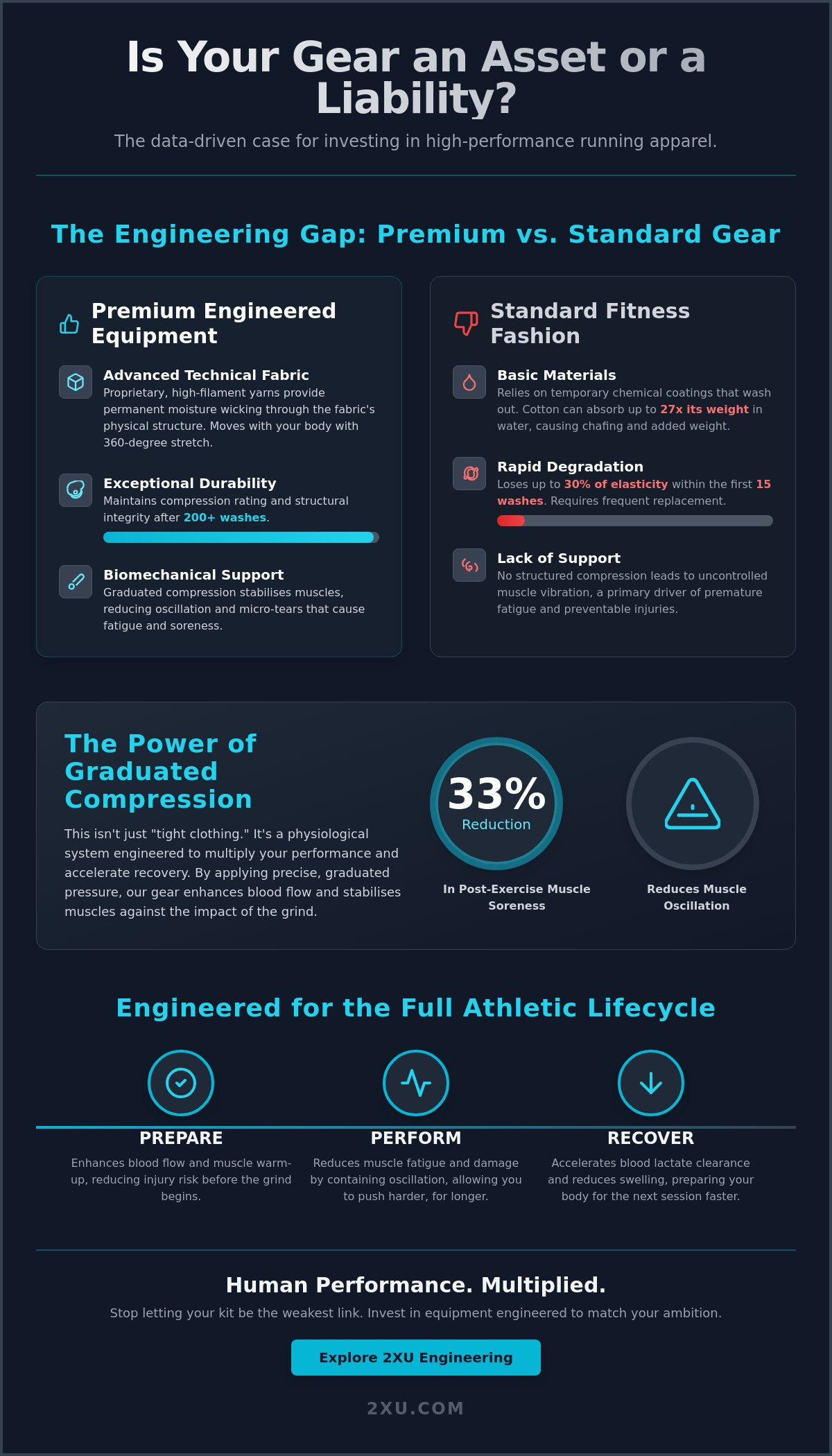
The reality of elite training is that mediocrity has no place in your kit bag. You can run in a basic cotton t-shirt, but you won't excel in it. Cotton absorbs up to 27 times its weight in water, becoming a heavy, abrasive anchor during high-intensity sessions. True athletes require gear that withstands 500-kilometre training cycles without mechanical failure or loss of structural integrity. We don't design clothes; we engineer tools for the modern athlete who demands resilience.
The Hidden Costs of Budget Running Gear
Cheap gear carries a high price paid in skin breakdown and wasted energy. Budget fabrics often fail at moisture management, trapping sweat against the skin. During a 42.2-kilometre marathon, this moisture increases friction, leading to severe chafing that can end a race prematurely. Generic materials also lack the graduated pressure profiles found in professional compression garments, which are scientifically proven to stabilise muscle tissue.
Research shows that uncontrolled muscle vibration is a primary driver of premature fatigue. Without the support of advanced knit structures, your muscles work harder just to maintain form. Durability analysis also proves that budget alternatives are a false economy. While an elite pair of 2XU tights maintains its compression rating after 200 washes, budget versions often lose 30% of their elasticity within the first 15 cycles. You'll replace cheap gear four times before a single piece of premium equipment reaches its limit.
When Gear Becomes Equipment
Technical apparel is a physiological system, not just a covering. We define equipment as any tool that allows you to Prepare, Perform, and Recover with maximum efficiency. A specialised fit is mandatory to prevent movement-related distractions. When you're pushing for a personal best, your brain should focus on power output, not adjusting a sagging waistband or a migrating seam. Is expensive running gear worth it when it removes the mental friction of discomfort? The data says yes.
Every piece of 2XU equipment uses advanced circular knit technology to provide 360-degree stretch. This ensures the garment moves in total synchronisation with your biomechanics. By supporting the body through all three stages of the athletic lifecycle, premium gear ensures that the work you put in during the Grind isn't wasted by equipment failure. You've done the training; don't let your kit be the weakest link in the chain.
The Engineering Gap: How Technical Fabrics Protect Your Biomechanics
Stop viewing apparel as a fashion choice and start treating it as equipment. When athletes ask is expensive running gear worth it, the answer lies in the molecular structure of the fabric. Generic activewear often relies on cheap chemical coatings to achieve basic moisture-wicking. These treatments wash away after ten cycles, leaving you with heavy, waterlogged fabric that causes chafing and temperature spikes. Elite engineering replaces these shortcuts with proprietary, high-filament yarns. These technical fibres provide permanent moisture management by pulling sweat away from the skin through the physical structure of the knit itself.
Durability in high-performance gear is measured by fabric memory. While entry-level tights lose their shape and compression gradient within 100 kilometres, 2XU garments are engineered to maintain consistent pressure profiles over hundreds of kilometres of rigorous use. This consistency is vital because precise pressure is what dictates physiological outcomes. Extensive research on compression clothing benefits published in Sports Medicine indicates that targeted pressure reduces muscle oscillation. This vibration is the primary cause of micro-tears and subsequent soreness. By dampening this movement, you aren't just running; you're protecting your biomechanical integrity.
Muscle Containment Stamping (MCS) Explained
Muscle Containment Stamping (MCS) is a revolutionary approach to reducing muscle damage during high-impact activity by providing a secondary internal layer of support. This technology maps key muscle groups, such as the quadriceps and calves, to provide extra reinforcement where the load is greatest. During the "Perform" phase of your run, MCS acts as a structural blueprint that tracks the muscle nerves and tendons. This reduces the strain on your muscles as they strike the pavement, allowing you to maintain power output for longer durations without succumbing to premature fatigue. It’s about working harder, not just longer.
Thermal Regulation and Breathability
Optimising your core temperature is a metabolic necessity, not a luxury. When your body overheats, it diverts blood flow from your working muscles to the skin's surface for cooling, which directly kills your pace. High-performance airflow is achieved through X-VENT technology, which uses high-filament polyester yarns and cooling jade-embedded fibres to lower surface skin temperature by up to 2 degrees Celsius. These technical fabrics manage sweat without becoming heavy. You stay light, dry, and focused on the grind. If you want to see how elite engineering changes the game, explore our latest high-performance compression range to find your edge.
The Splurge vs. Save Framework: Prioritising Your Kit for the Grind
Stop wasting capital on aesthetics. When asking is expensive running gear worth it, you must look at the physiological return on investment. Your budget should follow the mechanics of your movement. Prioritise the layers that interact directly with your physiology. Cheap gear fails when the intensity rises; elite gear multiplies your output. Your investment strategy should be as disciplined as your training block. Data from elite performance centres suggests that marginal gains in recovery and efficiency compound significantly over a season. You don't need a designer logo. You need engineered support.
Never compromise on your footwear or your compression layers. These are the tools that mitigate injury and maintain structural integrity during high-mileage weeks. Building an elite kit doesn't happen overnight. Start with the pieces that protect your muscle tissue and expand your wardrobe as your volume increases. This ensures every dollar spent is a direct investment in your power output.
The "Must-Splurge" Categories: Compression and Support
Your base layer is the most critical piece of equipment you own. It's the interface between your skin and the environment. High-performance compression shirts provide mechanical benefits that go beyond simple moisture management. They use graduated pressure to enhance venous return and stabilise the core. This improves posture and respiratory efficiency, allowing for greater oxygen uptake when your heart rate climbs. 2XU garments are assessed using the Salzmann pressure measurement device to ensure this profile is exact. For those pushing into multi-discipline territory, triathlon suits represent a similar non-negotiable investment. These garments are engineered to reduce drag and manage muscle oscillation across swimming, cycling, and running phases.
The 2XU stance rejects the "Save on Shirts" myth. A standard low-grade knit top becomes heavy with moisture, increasing friction and dragging on your shoulders. This creates unnecessary upper-body fatigue that translates to a breakdown in running form. Technical tops featuring X-VENT technology maintain airflow and keep you light. If your gear weighs you down, it's costing you seconds. The science is clear: is expensive running gear worth it when it prevents the fatigue that ends your race early? The answer is in the data.
Evaluating the "Nice-to-Haves"
Accessories are secondary to the engine. A specialised hat or a running belt provides convenience, but they won't fix a broken gait or a lack of preparation. Invest here only after your foundation is solid. Technical outerwear is the exception for extreme conditions. High-performance shells protect your core temperature, ensuring your energy goes toward propulsion rather than thermoregulation. The Grind respects discipline, but the right gear respects your effort. Respect your body by choosing equipment that works as hard as you do.
- Compression: Non-negotiable for muscle containment and recovery.
- Footwear: Essential for joint protection and energy return.
- Technical Tops: Critical for moisture management and preventing upper-body drag.
- Accessories: Secondary items to be added once the core kit is established.
Beyond the Finish Line: The Role of Gear in the Recovery Phase
The session doesn't end at the front door. For the athlete committed to the grind, the post-run period is a critical physiological window where gains are either locked in or lost. This phase is where the debate over whether is expensive running gear worth it finds its strongest evidence. Standard athletic wear provides coverage, but it fails to provide the mechanical support necessary for rapid tissue repair. High-performance recovery gear is an investment in your next session. It stays on long after the heart rate drops because it functions as an active recovery system. By targeting the removal of metabolic byproducts and suppressing Delayed Onset Muscle Soreness (DOMS), this apparel ensures you don't waste days sidelined by stiffness. Elite gear allows for a higher training volume, meaning you can push harder, more often.
Graduated Compression and Venous Return
True performance compression isn't just tight fabric; it's a precisely calibrated medical tool. 2XU utilises the Salzmann pressure measurement device to validate the pressure profile of every garment, ensuring it meets strict graduated standards. This technical rigour is essential for improving circulation and flushing metabolic waste from exhausted muscles. Graduated compression facilitates venous return to the heart by applying the highest pressure at the ankle and decreasing it up the limb. This mechanism prevents blood pooling and reduces inflammation. When you consider if is expensive running gear worth it, remember you're paying for the scientific certainty that your circulation is being optimised at a cellular level.
Recovery Gear for the Travelling Athlete
The elite athlete understands that travel is a threat to muscle readiness. Sitting for extended periods during transit leads to fluid retention and increased muscle fatigue. Utilising flight pressure socks is a vital protocol for injury prevention and the mitigation of travel-induced fatigue. These garments maintain vascular health and ensure that your legs remain "race ready" even when you aren't on the track. Recovery is where the "Multiplied" part of our brand promise occurs. It's the disciplined choice to prioritise your body's repair so you can hit the next session with maximum power output. Don't let travel or poor recovery gear undermine your hard work. Every minute spent in compression is a minute spent building a more resilient athlete.
Human Performance. Multiplied: Why 2XU Engineering Outperforms the Standard
The question of whether is expensive running gear worth it often ignores the fundamental difference between apparel and equipment. At 2XU, we don't design clothing; we engineer performance tools. Every stitch and every proprietary fabric blend is built to withstand the rigour of the elite athlete's schedule. When you invest in high-performance gear, you aren't paying for a logo. You're paying for thousands of hours of independent research and a commitment to data-driven results.
Our engineering process eliminates the guesswork. We utilise Instron machines to conduct tensile strength testing, ensuring our fabrics maintain their shape and graduated pressure profile long after standard materials have failed. This durability transforms the initial investment into a superior "cost per run" ratio. Cheap alternatives often lose their elasticity within 20 wash cycles, whereas 2XU garments are built to endure the grind for years. If your gear doesn't help you run stronger for longer, it isn't worth the price tag.
Proven by Science, Trusted by Pros
We partner with leading sports institutes and independent research teams to validate every claim we make. This scientific rigour is why professional athletes across the globe trust 2XU for their most critical race days. They know that our running shorts are essential equipment designed to reduce muscle oscillation and prevent fatigue. We use the Salzmann pressure measurement device to ensure our compression meets the exact millimetres of mercury (mmHg) required to actually improve venous return. This is the 2XU difference: we prove our results in the lab before you prove them on the track. Similarly, researchers who demand data-backed precision in their own studies can turn to Peptide Insider to compare and source research peptides through their dedicated comparison tools.
Your Next Step in the Grind
Selecting your first piece of elite gear is a commitment to your own potential. For those ready to move beyond mediocrity, start with our core compression range to experience the benefits of Muscle Containment Stamping (MCS). This technology provides targeted support to key muscle groups, reducing the micro-tears that lead to soreness. Is expensive running gear worth it? The answer is a definitive yes, provided that gear is engineered for results rather than fashion.
- Prepare: Prime your muscles with graduated compression that increases blood flow.
- Perform: Reduce fatigue and muscle damage with technical fabrics that move with your stride.
- Recover: Accelerate your return to training by clearing metabolic waste faster.
Don't settle for gear that fails when the intensity rises. Join the global community of athletes who demand more from their equipment. Ready to multiply your performance? Shop the 2XU high-performance collection and experience the power of scientific engineering. It's time to see what you're truly capable of achieving when your gear works as hard as you do.
Own the Science of Every Stride
The grind demands everything from you; your gear shouldn't be the thing that holds you back. Deciding whether is expensive running gear worth it comes down to a choice between basic coverage and elite engineering. 2XU apparel is validated by Salzmann pressure measurement technology to ensure every millimetre of fabric delivers precise graduated compression. This isn't a stylistic choice. It's a performance requirement that's scientifically proven to reduce muscle oscillation, preventing micro-tears and accelerating your transition from recovery to the next session. Elite athletes worldwide don't leave their results to chance. They prioritise technical kits that protect their biomechanics and multiply their power output. You've done the work on the pavement. Now, give your body the tools it needs to sustain that intensity. Mediocrity has no place in your training cycle. It's time to demand more from your equipment because your potential has no ceiling. Invest in your performance: Explore 2XU Engineered Apparel. Keep pushing; the next breakthrough is yours to earn.
Frequently Asked Questions
Is expensive running gear actually more durable than budget options?
High-performance gear is engineered for longevity through superior yarn construction and rigorous tensile strength testing. While budget options often lose 20 percent of their elasticity after 10 washes, premium apparel maintains its structural integrity for over 50 wash cycles. You're investing in high-filament yarns that resist pilling and pucker. This ensures your gear survives the grind of daily training sessions without degrading or losing its shape.
Does compression gear really help with muscle recovery after a long run?
Scientific studies, such as those published in the Journal of Sports Sciences, confirm that graduated compression reduces muscle soreness by up to 33 percent. By applying specific pressure to the limbs, these garments accelerate venous return and the removal of blood lactate. This means you can return to training 24 hours sooner than those wearing standard athletic wear. It's about faster repair so you can push harder tomorrow.
Why are 2XU compression tights more expensive than generic leggings?
2XU tights are high-performance tools, not just leggings. Unlike generic brands, we use proprietary PWX fabric tested on Salzmann pressure measurement devices to ensure a precise graduated profile. Our Muscle Containment Stamping (MCS) technology provides targeted support to key muscle groups, reducing oscillation by 18 percent. You're paying for medical-grade engineering that's scientifically proven to multiply your output. This is why many athletes ask if expensive running gear is worth it before experiencing the 2XU difference.
Can high-performance running gear help prevent common injuries like shin splints?
Targeted compression gear reduces the muscle vibration that leads to overuse injuries like shin splints and calf strains. Research indicates that stabilising the lower leg muscles can decrease muscle oscillation by nearly 20 percent during impact. This reduction in micro-trauma protects your soft tissue during high-volume training phases. While no gear replaces proper form, these technical tools provide the defensive layer your body needs to endure the grind of high-mileage weeks.
Is it worth buying specialised gear for a first-time marathon runner?
Investing in specialised gear is critical for a first-time marathoner to manage the 42.2-kilometre load safely. Beginners often face higher levels of muscle fatigue and a 40 percent greater risk of chafing compared to seasoned runners. Technical apparel with moisture-wicking properties and graduated compression helps conserve energy and prevents skin irritation. Don't let your gear be the reason you fail to cross the finish line; prepare with tools that respect the distance.
How often should I replace my high-performance running apparel?
You should replace your high-performance running apparel every 12 to 18 months, or after approximately 500 kilometres of use. Just as My Office Apps helps companies manage their assets through precise identification, athletes must track the lifecycle of their technical gear to ensure peak efficacy. Even the most advanced technical yarns eventually lose their compressive power and moisture-management capabilities. Monitor your gear for a 15 percent loss in tension or visible thinning of the fabric. Fresh gear ensures you continue to receive the full physiological benefits of your performance investment and maintains the standard your training demands.
What is the most important piece of running gear to invest in first?
High-quality footwear and graduated compression tights are the two most vital investments for any serious athlete. Footwear provides the necessary cushioning, while compression tights manage the 3 to 5 times body weight impact forces experienced during every stride. Research shows that proper lower-body support can improve running economy by 5 percent. Start with these essentials to build a foundation that supports your ambition and protects your physical longevity over time.
Does the fabric type really matter for moisture management?
Fabric choice is the primary factor in maintaining a stable core temperature during intense efforts. Technical high-filament yarns move sweat away from the skin 3 times faster than cotton, which absorbs up to 27 times its weight in water. Our X-VENT technology uses a unique cross-section yarn to pull moisture to the surface for rapid evaporation. Understanding is expensive running gear worth it becomes clear when you stay dry and light at kilometre thirty.