
Triathlon Clothing for Women Over 50: The Performance Engineering Guide
Why settle for gear that merely fits when you can wear equipment that actively multiplies your mechanical efficiency? You understand that the grind doesn't get easier; you just get more disciplined. However, at this stage of your athletic career, reduced muscle elasticity and extended recovery periods are objective data points that cannot be ignored. High-performance triathlon clothing for women over 50 acts as a critical interface between your ambition and your biology. It is a necessary tool for the master athlete who refuses to accept average standards.
You likely agree that the physiological tax on your output has increased, making thermoregulation and skin sensitivity more than just minor inconveniences. This guide reveals how advanced compression and engineered fabrics multiply your physical potential while slashing recovery times. We will examine the laboratory-validated technology that reduces delayed onset muscle soreness and provides superior UV protection. By utilising specialised textiles instead of standard materials, you can ensure your physical output remains unyielding. Prepare to discover how the right technical apparel provides the mechanical stability required to dominate the race course with absolute confidence in your equipment.
Key Takeaways
- Identify how the unique biological requirements of master athletes necessitate a shift from standard gear to engineered apparel that addresses reduced muscle density.
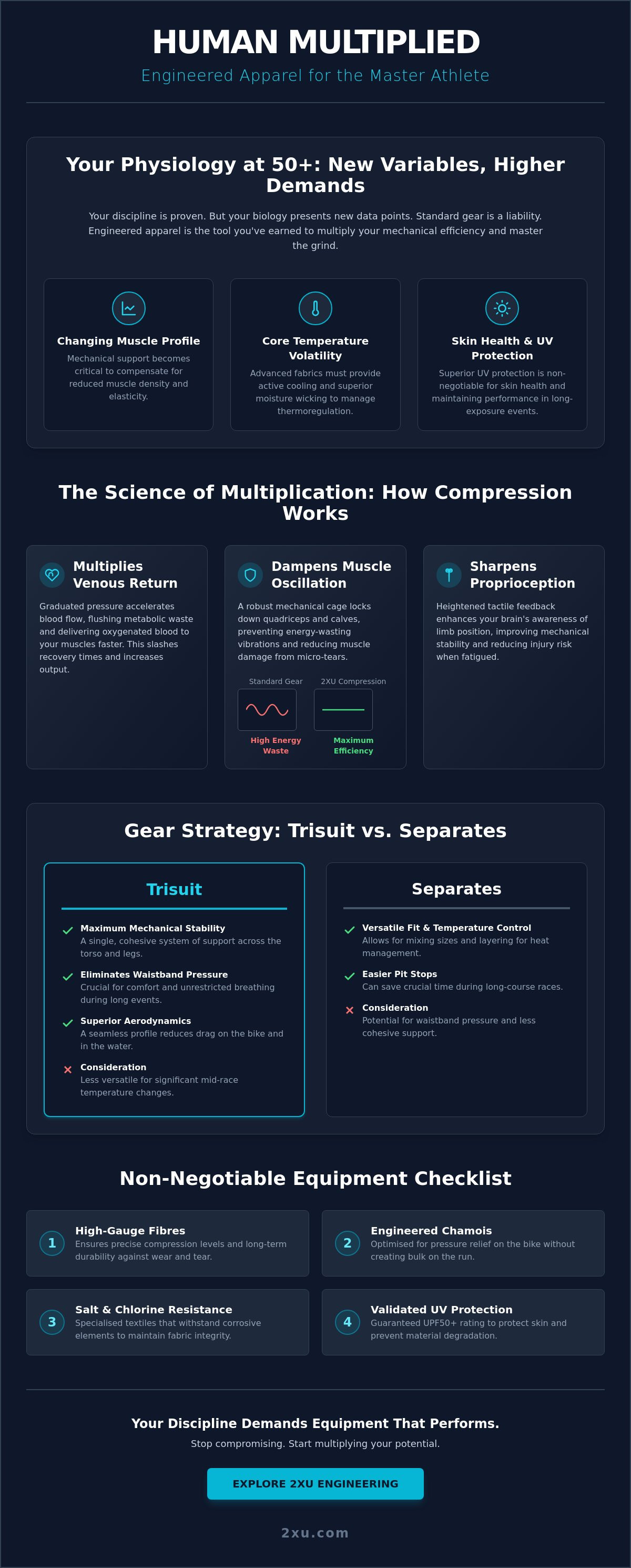
- Discover the role of graduated compression in multiplying venous return and dampening muscle oscillation to prevent micro-tears and fatigue.
- Evaluate the mechanical stability of trisuits versus separates to find the optimal triathlon clothing for women over 50 that eliminates waistband pressure.
- Master the technical checklist for high-gauge fibres and chamois engineering to ensure your equipment withstands the corrosive effects of salt and chlorine.
- Leverage laboratory-validated data to select performance gear that accelerates biological recovery and maintains your competitive edge during the grind.
Mastering the Grind: Why Age 50+ Demands Specialised Triathlon Apparel
The term "Master Athlete" isn't about age; it's about the discipline you've forged over decades. At 50, your physiology presents new data points that cannot be ignored. Reduced muscle density and changing skin elasticity aren't excuses; they're variables that require better engineering. Standard gear often ignores these biological shifts, providing inadequate tension for a changing frame. High-performance triathlon clothing for women over 50 must act as a mechanical extension of your body. It is a necessary tool for the athlete who refuses to let her equipment be the weak link in her performance chain.
Understanding What is a triathlon? means respecting the multi-discipline load placed on your frame during the grind. Standard apparel fails to provide the structural support needed to stabilise muscles and prevent overuse injuries. At 2XU, we believe elite engineering is earned through effort, not dictated by age. We don't compromise on quality because we know you don't compromise on your training. Every athlete who commits to the pavement deserves gear that matches her work ethic.
The Biological Shift: Beyond the Finish Line
Core temperature management becomes more volatile as sweat rates and thermoregulation efficiency change. Technical fabrics must work harder to wick moisture and prevent heat storage during intense sessions. Superior UV protection is also critical for maintaining performance and protecting skin health during long-exposure events. These requirements demand textiles that go beyond basic moisture management to provide active cooling. You need gear that works as hard as you do to maintain a stable internal environment.
Mechanical Efficiency vs. Simple Comfort
Stop confusing "gym wear" with engineered tools. Comfort is a baseline requirement, but mechanical efficiency is what keeps you competitive during the final kilometres. Professional-grade equipment provides a psychological edge by ensuring your gear won't fail when the intensity peaks. Use your apparel as a force multiplier to ensure your physical output remains unyielding. This is about sharpening your edge and proving that your potential is multiplied by the discipline you bring to the start line.
The Science of Compression: Supporting the Master Athlete’s Physiology
Elite performance is a game of margins. For the master triathlete, these margins are increasingly defined by physiological efficiency. Graduated compression is not a stylistic choice; it is a vascular intervention. By applying specific pressure gradients that are highest at the extremities and decrease toward the heart, engineered apparel facilitates superior venous return. This process ensures that oxygenated blood reaches working muscles faster while deoxygenated blood and metabolic byproducts are cleared with greater vigour. The Science of Compression confirms that these mechanical pressures can significantly alter the physiological cost of endurance exercise, particularly as the body’s natural elasticity begins to wane.
Proprioception is another critical factor in triathlon clothing for women over 50. As you age, your sensory feedback loops can become less precise. High-gauge technical fabrics provide constant tactile feedback to the brain, enhancing your awareness of limb position and body mechanics. This heightened state of mechanical stability allows for more precise movement patterns; it reduces the risk of injury during the transition from the bike to the run when fatigue is at its peak. You don't just wear this gear. You use it to sharpen your biological connection to the pavement.
Reducing Muscle Oscillation for Endurance
Muscle oscillation is the involuntary, multi-directional vibration of muscle tissue that occurs every time your foot strikes the ground during the run. This vibration is a primary cause of energy wastage and muscle damage because it forces the body to expend additional energy just to stabilise the tissue. 2XU fabrics are engineered to provide a robust mechanical cage for the quadriceps and calves, locking them in place to minimise these micro-traumas. Muscle oscillation is an often-overlooked catalyst for endurance fatigue that can be mathematically reduced through the application of precise, laboratory-validated compression. By dampening this movement, you preserve your power for the final kilometres of the grind.
Accelerating Recovery Post-Race
The "recapitulation" phase, the period immediately following intense exertion, is where the master athlete is most vulnerable. Biological recovery times naturally lengthen after age 50, making the clearance of metabolic waste a top priority. High-pressure compression garments bridge the gap between your effort and your readiness for the next session. They work by maintaining elevated blood flow even at rest, which prevents blood pooling and reduces delayed onset muscle soreness (DOMS). To understand how this science applies to the rest of your kit, explore our guide on compression shirts for upper body recovery. Investing in this level of recovery technology ensures that your discipline isn't undermined by your biology. If you are ready to upgrade your recovery protocol, consider our range of high-performance compression clothing to maintain your competitive edge.
Trisuits vs. Separates: Optimising Transitions and Mechanical Stability
Choosing between a one-piece trisuit and separates is a strategic decision that directly impacts your mechanical stability. For many, this choice determines the level of core support and aerodynamic efficiency maintained throughout the grind. When selecting triathlon clothing for women over 50, you must prioritise how the garment architecture interacts with your body during the transition from a horizontal swimming position to a vertical running gait. Standard separates can often lead to fabric bunching or a loss of compression at the midsection, which compromises both speed and focus. Every piece of equipment must serve a purpose; it's either helping you move faster or it's in your way.
A one-piece trisuit offers a superior aerodynamic profile by eliminating the gap between the top and bottom. This integrated design also addresses the "waistband issue" common among master athletes. As skin elasticity changes, traditional waistbands can create pressure points or cause chafing that distracts from your power output. A seamless one-piece provides a uniform compression profile across the torso. This stabilises the core and reduces drag in the water and on the bike, ensuring your energy is spent on forward motion rather than adjusting your gear.
Sleeved designs have become the industry standard for those seeking maximum output. They offer superior UV protection for the shoulders and upper arms, which is critical for maintaining skin health over long distances. While sleeveless options provide more perceived shoulder mobility, modern high-gauge fabrics in sleeved suits are engineered to offer zero resistance during the swim stroke. Every second saved in T1 and T2 by not having to adjust shifting layers is a second closer to your personal best. Discipline in gear selection is just as important as discipline in training.
The Case for the One-Piece Trisuit
The primary advantage of an all-in-one suit is the total elimination of chafing zones. By removing the seam at the waist, you ensure that the garment moves as a single unit with your body. Integrated chamois technology is also more stable in a one-piece, preventing the "nappy" feel during the run. For a deeper analysis of the engineering involved, consult the ultimate triathlon suit guide to see how we optimise race-day equipment. This level of integration is essential for maintaining mechanical efficiency during the final leg of the race.
The Versatility of Tri-Separates
Separates remain a viable tool for athletes with non-standard sizing requirements where a different top and bottom size are necessary to maintain proper compression levels. They also offer practical advantages during long-distance events like an IRONMAN, where "pit stops" are a logistical reality. However, if you choose separates, you must ensure they feature a high-tension waistband. This is essential to prevent the top from riding up and to maintain the mechanical stability required for triathlon clothing for women over 50. Your gear should never be the reason you lose focus on the pavement.
The Essential Performance Checklist: Features That Multiply Your Output
Do not mistake marketing jargon for performance data. When selecting triathlon clothing for women over 50, you must evaluate the equipment based on its ability to withstand the corrosive nature of the grind while maintaining its mechanical properties. Generic apparel often relies on low-grade elastics that lose their tensile strength after exposure to chlorine and salt. High-performance gear utilises high-gauge technical fibres that provide a consistent compression profile throughout the entire race season. This ensures your investment continues to multiply your output rather than degrading into a liability.
The interface between your body and the bike saddle is a critical failure point for the master athlete. You need a chamois that provides high-density protection for the bike leg but remains low-profile enough to prevent chafing during the run. This balance is achieved through anatomical shaping and the use of moisture-wicking engineered polymers. Additionally, flatlock stitching is mandatory. By overlapping fabric layers and sewing them flat, we eliminate the raised seams that cause friction on sensitive skin. Your checklist for elite gear should also include:
- Zero-Bounce Storage: Engineered pockets designed to secure nutrition close to the body, eliminating drag and mechanical disruption.
- Advanced Cooling: The integration of specialised polymers that actively lower skin temperature through rapid moisture evaporation.
- High-Gauge Integrity: Dense knit structures that provide superior coverage and maintain compression levels under extreme tension.
Advanced Fibre Integrity
Textile engineering is defined by the power-weight ratio. A fabric must be powerful enough to provide medical-grade compression while remaining light enough to prevent waterlogging. Low-quality technical fabrics fail because their internal structures break down under heat and tension. We utilise technical fibres that retain their "memory" after hundreds of hours of use, ensuring that the mechanical support you feel on day one is the same support you feel on race day. This unyielding quality is what separates elite engineering from disposable fitness wear.
Aerodynamics and Hydrodynamics
Fabric texture is not an aesthetic choice; it is a hydrodynamic necessity. In both water and air, the surface of your suit determines how fluid moves across your body. The boundary layer effect occurs when a thin layer of fluid sticks to the surface of the fabric, creating a "trip" that reduces overall pressure drag. For those focused on the swim leg, understanding neoprene wetsuit science is the next step in your performance audit. If you are ready to secure your edge, explore our range of elite trisuits designed for maximum mechanical efficiency.
Engineered for the Endurance: How 2XU Multiplies the Master Athlete
2XU is obsessed with the mechanics of achievement. We understand that for the master triathlete, every percentage point of efficiency is a hard-won victory. Our mission is to deliver the Multiplication Promise: a commitment to doubling your recovery speed and multiplying your mechanical output through superior textile engineering. We don't design for the casual participant. We design for the athlete who views the grind as a necessary path to self-improvement. By choosing triathlon clothing for women over 50 that is built on a foundation of data, you're ensuring that your biological limitations are met with a mathematical solution.
The specialized engineering teams at 2XU focus specifically on the physiological requirements of the master demographic. We recognise that your needs for mechanical stability and vascular support are higher than those of a twenty-year-old. Our gear functions as an external musculoskeletal system, providing the tension and support that your body requires to maintain elite form over long distances. This isn't just apparel; it's a performance intervention designed to help you stay unyielding when the pavement begins to bite back.
Laboratory Proven, Race-Day Ready
We don't rely on subjective "feel" to validate our equipment. 2XU utilises the Salzmann pressure measurement device, an industry-leading instrument, to ensure that every garment delivers the precise millimetres of mercury (mmHg) required for effective graduated compression. This rigorous testing protocol is conducted in collaboration with elite sports institutes to guarantee that our technical fibres perform under the most extreme conditions. Our gear is built to survive multiple seasons of high-intensity racing. The high-gauge knit structures we employ don't sag or lose their tensile strength after exposure to salt and heat; they remain as demanding as the athletes who wear them.
Earning Your Place
Age is a metric of experience and a testament to your discipline. It isn't a limitation unless you allow your equipment to fail you. To maintain your edge, you must invest in gear that matches your work ethic. The master athlete understands that shortcuts don't exist; only better preparation and superior tools. It's time to align your equipment with your ambition. Join the elite ranks of competitors who refuse to settle for average standards and respect the grind as the ultimate proving ground. Secure your mechanical advantage and Shop 2XU Women’s Triathlon Gear to start multiplying your potential today.
Secure Your Mechanical Advantage
The transition from a recreational participant to a master athlete is defined by your respect for the grind. You've seen how mechanical stability and vascular support are not luxuries but essential interventions for maintaining elite output. Choosing the right triathlon clothing for women over 50 means moving beyond generic fitness wear and adopting equipment that actively clears metabolic waste. By dampening muscle oscillation and regulating core temperature, you ensure your biology doesn't dictate your finish time. Every second saved in transition and every watt preserved on the bike is a result of meticulous preparation.
Our commitment to your performance is validated in the laboratory. We utilise Salzmann-validated graduated compression and proprietary high-gauge technical fibres to ensure your gear remains unyielding through every season. This is the same technology trusted by IRONMAN world champions to multiply their physical potential and accelerate biological recovery. Don't let your equipment be the weak link in your training protocol. It's time to align your gear with the discipline you've already proven on the pavement.
Multiply your performance with 2XU Women’s Triathlon Gear. Your best results are still ahead of you if you have the tools to earn them.
Frequently Asked Questions
Do I really need compression gear for triathlon if I am over 50?
You absolutely require compression gear to manage the physiological changes that occur after age 50. As muscle elasticity decreases, graduated compression provides the mechanical support needed to stabilise tissue and enhance blood circulation. This isn't about aesthetics; it's about clearing metabolic waste and reducing micro-tears during the grind. It ensures your biological recovery starts the moment you cross the finish line.
How should a triathlon suit fit a woman over 50?
A triathlon suit must fit like a second skin with zero fabric bunching or rippling. For women over 50, a firm fit is essential to maintain the integrity of the compression profile across the quadriceps and core. Ensure there is no constriction at the neck or armholes that might impede your breathing or stroke mechanics. If the fabric ripples, you're losing the aerodynamic and hydrodynamic advantages you've earned through your training.
Can I wear my triathlon suit under my wetsuit?
You should always wear your triathlon suit under your wetsuit to ensure maximum efficiency during T1. Modern trisuits are engineered with low-profile seams and moisture-wicking technical fibres that sit comfortably beneath neoprene without causing friction. This integrated approach allows you to move directly from the swim to the bike without the mechanical disruption of changing clothes. It's a proven strategy for saving critical seconds during the race.
What is the best way to manage menopause symptoms like hot flushes during a race?
Managing thermoregulation challenges requires technical fabrics that utilise advanced cooling polymers. When choosing triathlon clothing for women over 50, prioritise gear that facilitates rapid evaporative cooling to mitigate the impact of hot flushes. High-gauge fibres work to pull moisture away from the skin instantly, helping to stabilise your core temperature during intense physical exertion. Discipline in hydration and electrolyte management remains your secondary line of defence.
Should I choose a sleeved or sleeveless trisuit for sun protection?
Sleeved trisuits are the superior choice for both sun protection and aerodynamic efficiency. Master athletes often have increased skin sensitivity, making the UPF protection of sleeved designs a critical component of their race-day equipment. Beyond protection, the textured fabric on the sleeves reduces pressure drag on the bike leg. Choose a design that offers full shoulder mobility to ensure your swim stroke remains unyielding.
How do I care for my high-performance triathlon clothing to ensure it lasts?
Protect your investment by rinsing your gear in cold, fresh water immediately after every session to remove salt and chlorine. Never use a tumble dryer or expose the technical fibres to direct heat, as this compromises the elastic memory of the garment. Air dry your apparel in the shade to maintain the integrity of the compression profile. Respect your equipment with the same discipline you apply to your training sessions.
Is there a difference between running compression and triathlon compression?
Triathlon-specific compression is engineered to perform across three distinct environments and varying moisture levels. While running compression focuses primarily on muscle oscillation, triathlon clothing for women over 50 must also be hydrodynamic and exceptionally quick-drying. The internal architecture includes a specialised, low-profile chamois that provides bike comfort without creating drag or a heavy feel during the run. Investing in sport-specific gear ensures you have the mechanical stability required for all three disciplines.
How much compression is "too much" for a master athlete?
Compression is only excessive if it restricts your range of motion or interferes with deep diaphragmatic breathing. We utilise Salzmann-validated pressure gradients to ensure our gear provides maximum support without compromising your safety. A master athlete requires firm, graduated pressure to facilitate venous return; however, the garment should never cause numbness or deep skin indentation. Trust the laboratory-validated data to find the optimal balance between power and comfort.