
Do Compression Tights Help with Knee Pain? The Science of Mechanical Stability
Your knee joint is the mechanical pivot of your entire physical performance, yet it is frequently the first point of failure under the relentless pressure of the grind. You have likely experienced that persistent dull ache during high-impact sets or an unsettling sensation of instability during explosive lateral movements, leading you to question: do compression tights help with knee pain? Ignoring these physiological signals is not a mark of discipline; it is a tactical error that results in unnecessary inflammation and compromised power output.
We believe in multiplying human capability through rigorous engineering and data-driven results. You'll discover how medical-grade compression technology acts as a precise external scaffold to stabilise the patella and enhance your proprioceptive feedback. This briefing details the scientific mechanisms used to dampen tissue-damaging muscle oscillation and accelerate your transition from peak exertion to biological recovery. By understanding the mechanics of joint support, you can protect your anatomy and ensure your training remains unyielding.
Key Takeaways
- Stabilise the patella and eliminate joint oscillation through the application of medical-grade mechanical support.
- Resolve the question "do compression tights help with knee pain" by examining the laboratory-validated science of patellar tracking.
- Accelerate biological recovery and reduce post-grind oedema by facilitating superior venous return.
- Select the optimal armour for your anatomy by comparing targeted sleeves with the holistic benefits of full-length compression clothing.
- Multiply your physical potential using proprietary yarn technology engineered to withstand the rigours of elite performance.
The Biomechanics of Knee Compression: More Than Just a Tight Fit
Biomechanics isn't about guesswork; it's about the physics of movement and the strategic management of kinetic energy. Medical-grade graduated compression isn't just a tight layer of fabric. It's an engineered system that applies precise pressure gradients from the extremity upwards to ensure optimal physiological function. In the context of knee health, this means providing a consistent external scaffold that reinforces the joint's structural integrity. To answer the question do compression tights help with knee pain, we must look at how these garments manage the forces acting on the joint during intense load. Unlike standard athletic wear, high-performance Compression garments utilise technical fibres that maintain structural integrity under extreme tension.
These technical garments provide four specific mechanical advantages:
- Patellar Stabilisation: Maintaining the kneecap in its proper tracking groove.
- Structural Reinforcement: Providing a secondary layer of support to the surrounding ligaments.
- Lymphatic Support: Assisting the body in flushing joint effusion and metabolic waste.
- Flexion Consistency: Ensuring uniform pressure is maintained throughout the entire range of motion.
Proprioception: The Neurological Advantage
Mechanical support is only half the equation. The neurological feedback provided by constant skin pressure is what truly multiplies your stability during the grind. This is proprioception, your brain's ability to sense the position and movement of your limbs without visual confirmation. When you are deep into a high-intensity session, fatigue blunts this awareness. High-power compression increases sensory input to the nervous system, sharpening your joint position awareness and refining your motor control. This heightened state prevents the micro-missteps that frequently lead to ligament strains or meniscus irritation. It's a direct, measurable link between external physical pressure and a significant reduction in injury risk.
Dampening Muscle Oscillation
Every foot strike sends a shockwave through your lower limbs. This is muscle oscillation, the micro-vibrations that occur when your soft tissue absorbs ground impact energy. These vibrations are a primary driver of micro-trauma in the tendons surrounding the knee joint. Over time, this cumulative stress manifests as persistent pain and inflammation. If you are asking do compression tights help with knee pain, the answer is found in the physical anchoring of the muscle and connective tissue. High-denier technical yarns act as a protective armour, physically dampening these vibrations and preventing tissue displacement. By reducing this mechanical "noise," you eliminate the primary cause of post-exercise soreness and protect your joint from long-term wear.
Managing Patellofemoral Pain During High-Impact Training
High-impact training demands more than just grit; it requires a precise understanding of your body's mechanical thresholds. Whether you're training on commercial-grade equipment from Gym Pros or hitting the pavement, one of the most frequent barriers to consistent output is Patellofemoral pain syndrome, commonly known as "Runners Knee." This condition occurs when the patella fails to track correctly within the femoral groove, leading to friction and inflammation. When athletes ask, do compression tights help with knee pain, they are searching for a solution to this repetitive mechanical failure. High-power compression provides the necessary lateral tension to keep the patella aligned, ensuring that every stride or squat follows a biomechanically sound path.
The Kinetic Chain: Why Hips and Calves Matter
Isolated knee sleeves often fail because they ignore the kinetic chain. Your knee joint is a slave to the mechanics of your hips and calves. If your glutes are fatigued or your calves are tight, the resulting lateral pull creates an uneven force on the knee. Unlike a simple sleeve, full-length compression clothing stabilises these distal and proximal power centres simultaneously. This holistic approach ensures that the forces acting on your knee are balanced and controlled. For high-temperature sessions where full coverage isn't preferred, understanding how to select a Running Shorts: The Ultimate Guide can help you maintain performance without compromising on essential muscle containment.
Reducing Load on the Patellar Tendon
Fatigue is the enemy of form. As your quadriceps tire during a long set, your ability to absorb impact diminishes, leading to "heavy" landings that place excessive load on the patellar tendon. High-denier technical yarns provide a mechanical assist that reduces muscle fatigue by containing the quadricep group. This containment ensures you maintain a "soft" landing profile even at the end of the grind. Patellar tracking is the anatomical alignment of the kneecap within the femoral groove during joint flexion and extension. By managing the forces of the IT band and quads, our Compression Clothing ensures this tracking remains precise under load. This isn't about comfort; it's about the mathematical reduction of joint stress to ensure your training remains uninterrupted. So, do compression tights help with knee pain? If you value mechanical longevity, the data suggests they are an essential part of your armoury.
Accelerating Biological Recovery: Post-Grind Knee Care
Recovery is not an absence of training; it's a continuation of it. Elite athletes don't just "rest." They employ specific protocols to ensure their anatomy is ready for the next load. The physiological necessity of venous return cannot be overstated when it comes to joint repair. After long endurance sets, gravity and reduced muscle pump activity lead to the pooling of fluid, or oedema, around the knee joint. This fluid contains metabolic byproducts that, if left stagnant, prolong inflammation and delay tissue repair. If you stop moving and expect your body to reset automatically, you're leaving performance on the table.
Our approach follows a Tripartite Athletic Framework: Readiness, Action, and Recuperation. Each stage is critical. While previous sections focused on the mechanical stability required during the "Action" phase, your equipment must also serve you during "Recuperation." When asking do compression tights help with knee pain, you must consider the post-exercise window. By applying graduated pressure, you mechanically assist the body in moving deoxygenated blood back toward the heart. This facilitates a faster turnover of the oxygen and nutrients required for ligament and tendon health.
Flushing Metabolic Waste
The morning-after stiffness you feel in your knees isn't just "part of the game." It's a sign of poor metabolic clearance. During intense sessions, lactic acid and other metabolites accumulate in the muscle and joint space. High-performance research on compression garments confirms that graduated pressure significantly aids in the removal of these waste products. By increasing the velocity of blood flow, you flush the knee area more efficiently. This reduces the chemical irritation that causes persistent aching and allows you to return to the grind with a fresh system.
Managing Inflammation and Swelling
Inflammation is a necessary biological response, but excessive swelling is counterproductive. Compression clothing provides a physical barrier that restricts the interstitial space available for inflammatory fluid build-up. Simple rest allows fluid to settle; active compression forces it out. This mechanical regulation of swelling is why athletes who use medical-grade garments report a faster transition back to peak output. If you are serious about holistic recovery, understanding the mechanics of Compression Shirts: The Scientific Guide can help you apply these same principles to your upper body. Do compression tights help with knee pain? They do, provided you view recovery as a deliberate, data-driven action rather than a passive state.
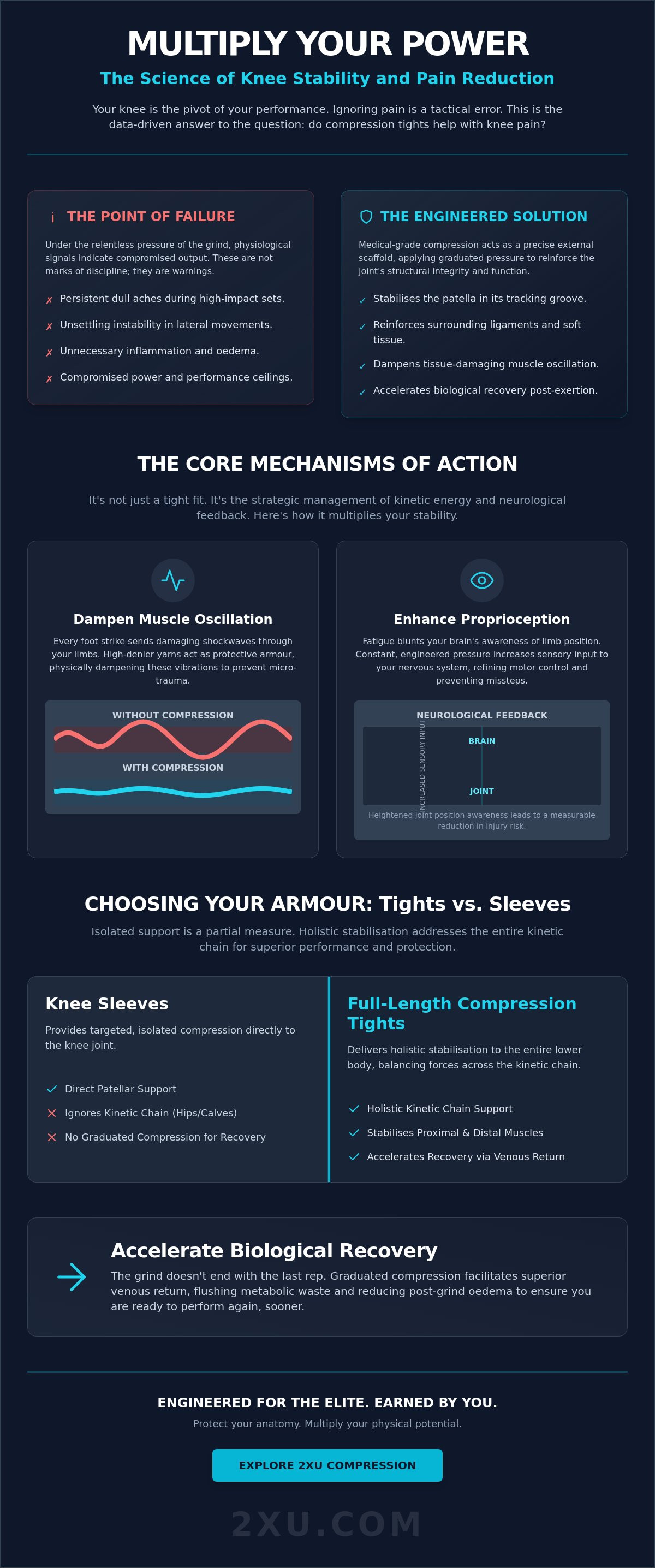
Compression Tights vs. Knee Sleeves: Choosing Your Armour
The "slippage" factor is a primary failure point for many athletes. During high-intensity sessions or explosive lateral movements, specialised sleeves frequently migrate, requiring constant adjustment that breaks your focus and reduces the consistency of the pressure. Engineered waistbands and multidirectional stretch fabrics ensure that your armour stays exactly where it is needed. This secure fit is not just about comfort; it is about maintaining a constant, laboratory-validated pressure gradient across the patella and surrounding connective tissues.
When to Choose Full-Length Tights
Full-length tights are the superior choice for multi-sport athletes and long-distance runners who require total leg stabilisation. As established in previous sections, knee pain is rarely a localised issue; it is often the result of fatigue in the hips or calves. Tights address these power centres simultaneously. They provide the added advantages of superior moisture-wicking properties and essential sun protection for long-duration outdoor sets. If your goal is to transition seamlessly from peak action to biological recovery, the full-leg format is your most effective tool. It ensures that the venous return process is optimised from the ankle up, preventing the metabolic pooling that leads to post-grind stiffness.
When a Specialised Sleeve Might Suffice
Sleeves have a specific, albeit limited, role in a performance protocol. They are often appropriate for acute, localised orthopaedic issues where a medical professional has recommended focused compression for a specific injury. However, you must be aware of the "tourniquet" risk. Poorly fitted sleeves can restrict circulation at the distal and proximal edges, potentially hindering the very venous return you are trying to improve. For severe ligament damage or structural instability, always consult a sports physician before self-prescribing any support. For those looking to multiply their output and protect their joints during the daily grind, we recommend upgrading to medical-grade Compression Clothing to ensure your anatomy is fully supported. Do compression tights help with knee pain better than sleeves? When you consider the mechanics of the entire leg, the answer is a resounding yes.
Engineered for the Elite: The 2XU Multiplication Promise
Average gear produces average results. You don't subject yourself to the rigour of the grind to settle for mediocrity. Our mission is built on a single, mathematical certainty: the multiplication of human capability. We don't just manufacture apparel; we engineer physiological solutions designed to extend your mechanical limits. To truly answer the question do compression tights help with knee pain, you must look beyond the surface and examine the technical architecture of the garment itself. If the fabric cannot maintain consistent, graduated pressure under the explosive forces of a sprint or a heavy lift, it is failing your anatomy.
The Science of the Fabric
Precision is non-negotiable in elite performance. Our proprietary construction utilises high-filament engineered technical fibres that provide unparalleled durability and moisture management. Unlike standard athletic wear, our circular knit technology ensures 360-degree uniform pressure across the entire lower limb. This specific construction method is critical for maintaining patellar stability. It creates a high-power wrap that contains the muscle groups and connective tissues, preventing the energy-leaking lateral movements that lead to joint irritation. By using high-denier yarns, we ensure the garment provides a consistent mechanical scaffold that does not degrade over time or through repetitive wash cycles. This is the difference between a garment that merely feels tight and one that provides a legitimate medical-grade external structure.
Laboratory Tested, Athlete Proven
We do not rely on anecdotal evidence or marketing trends. Every claim of increased power output or accelerated recovery is grounded in rigorous scientific validation. We collaborate extensively with world-leading sports science institutes to verify the efficacy of our graduated pressure profiles. Our garments undergo exhaustive evaluation using specialised testing machinery to ensure that the pressure is precisely distributed to optimise venous return and joint stabilisation. This data-driven approach ensures that when we promise a reduction in muscle oscillation, we have the laboratory proof to back it up. Do compression tights help with knee pain? When they are engineered to these exacting standards, the results are mathematically visible in your recovery times and performance consistency.
The podium is reserved for those who respect the mechanics of their body and invest in the tools required to protect it. You have done the work. You have embraced the discipline. Now, ensure your gear works as hard as you do. It's time to stop managing pain and start multiplying your potential. Shop the full 2XU Compression range and secure the mechanical advantage your training deserves.
Secure Your Mechanical Longevity
You now understand that joint health is a matter of precise engineering. It's not just about managing a temporary ache; it's about reinforcing the entire kinetic chain from the hip to the ankle. By dampening muscle oscillation and ensuring precise patellar tracking, you eliminate the micro-trauma that threatens to derail your progress. So, do compression tights help with knee pain? The science confirms that medical-grade pressure is a critical component of any elite training protocol, providing both mechanical support and neurological sharpening.
Our gear utilises proprietary circular knit technology for 360-degree support that remains consistent throughout the grind. Endorsed by world-class triathletes and endurance runners, our apparel is scientifically proven to reduce muscle oscillation and fatigue. Don't let inflammation dictate your training schedule. Take control of your recovery and ensure your body is ready for the next peak exertion. You've earned your place through hard work; now protect it with the best armour available.
Multiply your performance and protect your knees with 2XU Compression
Frequently Asked Questions
How long should I wear compression tights for knee pain after a workout?
Wear your garments for 2 to 4 hours immediately following peak exertion to maximise venous return. This specific window is critical for flushing the metabolic waste and inflammatory markers that accumulate in the joint space. While you can wear them longer, the most significant biological repair and reduction in oedema occur during this initial post-grind period. Discipline in your recovery protocol ensures you return to the track faster.
Can I sleep in compression tights to help my knees recover faster?
Sleeping in high-power compression is generally not recommended for elite recovery. Your circulatory system operates efficiently when horizontal because gravity no longer opposes blood flow from the lower limbs. Unless you're using a garment specifically engineered with a lower pressure profile for sleep, the intensity of standard compression may cause unnecessary discomfort or minor circulatory restriction during the night. Focus on active recovery windows instead.
Will compression tights help with arthritis-related knee pain?
Compression technology provides a non-invasive method to manage arthritis-related discomfort by increasing local joint warmth and providing an external scaffold. While it doesn't reverse structural joint wear, it significantly improves proprioception and reduces the perception of instability. When considering do compression tights help with knee pain caused by arthritis, the primary benefit is the mechanical dampening of vibrations that would otherwise irritate sensitive joint tissues.
Do compression tights restrict blood flow if they feel too tight?
Engineered compression clothing is designed to optimise blood flow through graduated pressure gradients. The garment is tightest at the ankle and decreases in pressure as it moves up the leg, physically assisting the heart. If you experience numbness, tingling, or skin discolouration, your sizing is incorrect. A proper fit should feel intensely firm and supportive, but it must never compromise your vascular health or neurological function.
Should I wear compression tights during a marathon to prevent knee fatigue?
Wearing compression during a marathon is a proven strategy to reduce muscle oscillation over thousands of repetitive foot strikes. By containing the quadriceps and calves, you minimise the micro-trauma that leads to joint fatigue in the final stages of the race. Many endurance athletes confirm that do compression tights help with knee pain by ensuring the patella remains in its correct tracking groove throughout the entire 42.2-kilometre effort.
How do I know if my compression tights are the right size for joint support?
You have the correct size when the garment applies uniform, high-power pressure without bunching behind the knee or migrating at the waistband. Perform a deep squat test; the fabric must move as a secondary skin without restricting your natural range of motion. If the tights are effortless to put on, they lack the necessary denier to provide genuine mechanical stability for your joints during high-impact sessions.