
One Piece vs Two Piece Trisuit: The Definitive Performance Engineering Guide
If you're prioritising convenience over the mathematical reality of aerodynamic drag, you've already conceded precious seconds to the clock. In elite triathlon, every watt saved is a step closer to the podium. You understand the grind of the long-course event, where the friction of a poorly fitted suit or a slow transition bathroom break can derail months of disciplined training. The choice between a one piece vs two piece trisuit isn't merely a matter of style; it's a critical engineering decision that dictates your biomechanical efficiency and thermal regulation.
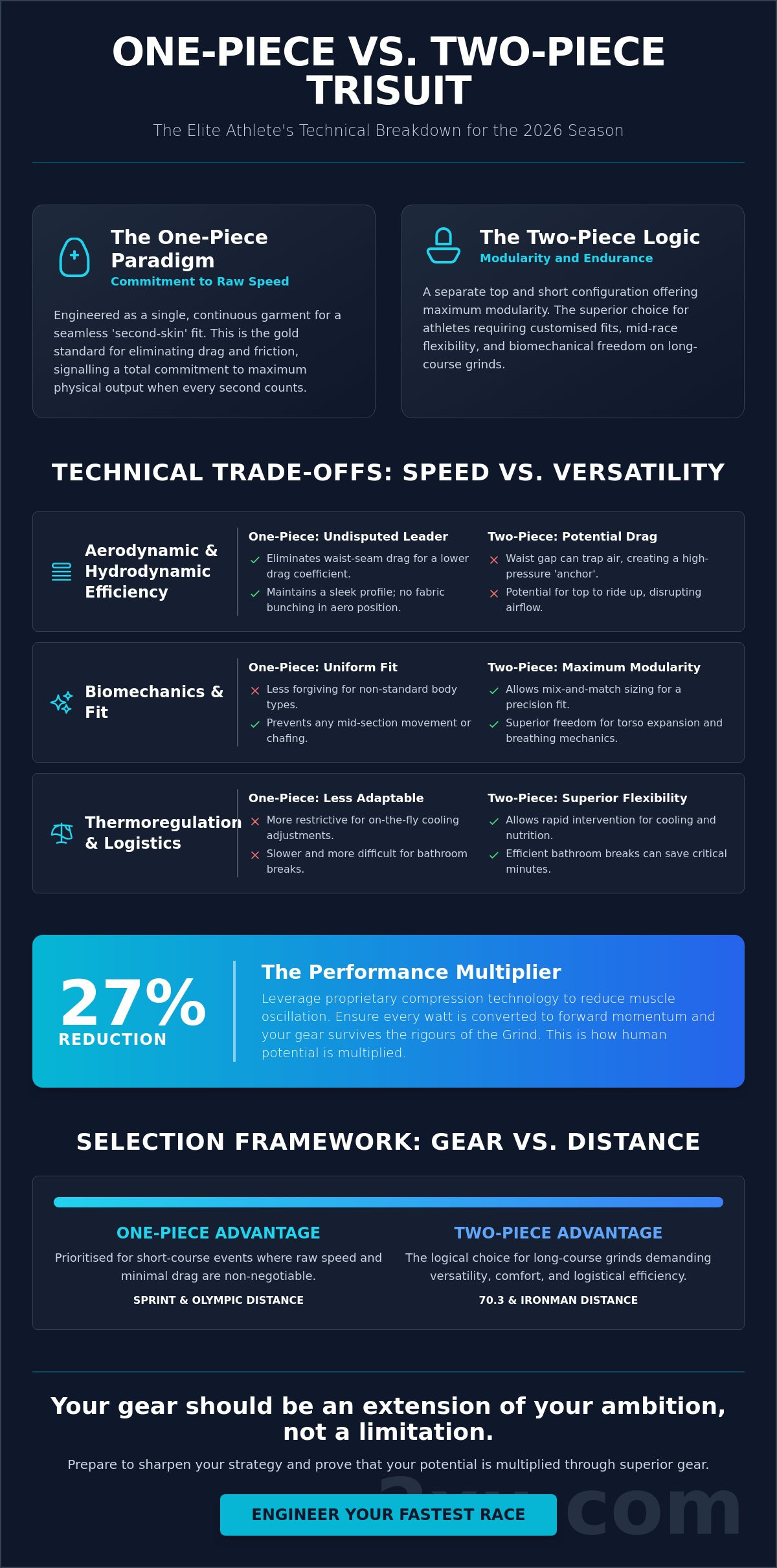
We agree that your gear should be an extension of your ambition, not a limitation. This guide provides a definitive analysis of the technical trade-offs between speed and versatility to help you optimise your 2026 race season kit. We'll examine how specific fabric configurations reduce muscle oscillation by up to 27 per cent and how the latest 2026 rule updates regarding zipper penalties and draft zones influence your selection. Prepare to sharpen your strategy and prove that your potential is multiplied through superior gear.
Key Takeaways
- Analyse how trisuit architecture dictates your hydrodynamic efficiency and physiological thermoregulation during the transition from water to land.
- Master the technical trade-offs of a one piece vs two piece trisuit to optimise your aerodynamic profile and eliminate waist-seam drag on the bike leg.
- Prioritise biomechanical freedom for long-course events where torso expansion and independent heat dissipation are critical for marathon performance.
- Select the optimal configuration based on race distance, using one-piece suits for short-course speed and two-piece options for 70.3 and IRONMAN versatility.
- Leverage proprietary compression technology to reduce muscle oscillation by up to 27 per cent, ensuring your gear survives the rigours of elite training.
The Fundamentals of Trisuit Architecture: Why the Choice Matters
A trisuit is a precision-engineered instrument designed to endure the rigours of the swim, bike, and run without a single change of kit. In the pursuit of elite performance, choosing between a one piece vs two piece trisuit is one of the most consequential decisions you will make for your 2026 race season. This choice directly dictates your aerodynamic efficiency, hydrodynamic drag, and physiological thermoregulation. In a sport where podiums are decided by fractions of a per cent, meticulous gear selection is a non-negotiable part of the Grind. Every second saved in transition or on the road is the direct result of technical discipline.
Modern 2026 engineering has significantly narrowed the performance gap that once existed between these two architectures. High-performance Triathlon equipment now utilises advanced fabric technologies that provide elite-level compression and moisture management across both formats. Consequently, your decision should be driven by individual biomechanics and the specific demands of your race distance rather than outdated assumptions. Whether you are fighting for a PB or a professional slot, the goal remains the same: to multiply your physical output through mechanical advantage.
The One-Piece Paradigm
The one-piece trisuit is constructed as a single, continuous garment to eliminate the waist-line drag inherent in multi-part kits. It provides a seamless 'second-skin' fit that prevents fabric bunching when you are tucked into a deep aero position on the bike. This configuration is the gold standard for reducing surface friction during non-wetsuit swims. Beyond the data, there is a psychological shift involved. Zipping into a one-piece suit signals a transition into 'race mode'. It represents a total commitment to physical output and a rejection of anything that might compromise your speed. For the athlete who demands the absolute fastest bike split, the aerodynamic profile of the one-piece is the logical choice.
The Two-Piece Logic
The two-piece configuration offers maximum modularity by pairing separate tri-shorts with a tri-top. This is the superior choice for athletes with non-standard builds who require different sizing for the upper and lower body to maintain mechanical stability. It also provides superior flexibility for mid-race logistics. If you need to adjust your cooling or manage nutrition on the fly, the two-piece allows for rapid intervention without the restrictive nature of a full-body suit. During long-course events, the ability to manage bathroom breaks efficiently can save minutes. This architecture respects the reality of the marathon leg, where torso expansion and breathing mechanics are paramount. When the debate of one piece vs two piece trisuit arises for the IRONMAN distance, the two-piece often wins on the grounds of biomechanical sustainability.
Aerodynamic and Hydrodynamic Efficiency: The One-Piece Advantage
Aerodynamics isn't a suggestion; it's a mathematical requirement for speed. When you evaluate a one piece vs two piece trisuit, you're deciding how your body interacts with the fluid dynamics of air and water. The one-piece configuration is the undisputed leader in raw velocity because it eliminates the physical seam at the waist. This design choice isn't for aesthetics. It's a calculated engineering requirement to prevent the disruption of airflow across the torso. By removing the waist gap, we ensure that the boundary layer of air stays attached to the body for longer, significantly reducing the drag coefficient during the bike leg.
The integration of specialised fabrics across the shoulders and back further manages airflow separation. These textiles are engineered to maintain laminar flow even at high velocities, ensuring that every watt you generate is converted into forward momentum. This sleek profile is maintained through the bike-to-run transition, as the single-piece construction prevents the top from 'riding up' or bunching. This stability is critical for maintaining mechanical efficiency when fatigue begins to set in. Invest in professional-grade Trisuits to ensure your gear survives the rigours of your most intense race-day efforts.
Slicing Through the Air on the Bike
In a tucked aero position, the lack of a waist gap is vital for performance. Two-piece sets can allow air to become trapped against the lower back, creating a high-pressure pocket that acts as an invisible anchor. One-piece suits eliminate this turbulence. We use specific textures on the sleeves and shoulders to trip the air into a turbulent boundary layer, which actually reduces the overall pressure drag. Elite athletes prioritising Olympic and 70.3 distances choose this architecture for the measurable watt savings it provides over the course of 40 to 90 kilometres. It's about respecting the Grind and choosing the gear that multiplies your output.
Hydrodynamics and the Non-Wetsuit Swim
Water ingress is the enemy of hydrodynamic speed. In a non-wetsuit swim, the waistband of a two-piece suit often acts like a parachute, catching water and increasing both mass and surface friction. One-piece suits utilise proprietary coatings to repel water, keeping the kit light and fast from the moment you dive in. This water-repellent nature indirectly supports the thermoregulatory processes of the body by preventing water-logged fabrics from disrupting your core temperature. While Neoprene Wetsuit Science is essential for cold-water performance, the one-piece suit is the ultimate weapon for warm-water efficiency, ensuring you exit the water with a physiological advantage.
Biomechanics and Thermoregulation: The Case for Two-Piece Suits
Aerodynamic efficiency is a mathematical requirement, but it remains secondary to physiological sustainability if your core temperature spikes or your diaphragm is restricted. When evaluating a one piece vs two piece trisuit, the biomechanical freedom of a separate top and bottom becomes a strategic advantage during the run leg. A two-piece configuration facilitates unrestricted diaphragm movement and torso expansion. This is critical during the final stages of a race when breathing mechanics must remain efficient to maintain oxygen delivery to fatigued muscles. For taller athletes, this modularity eliminates the shoulder pull often felt in one-piece suits, reducing upper-body tension and allowing for a more natural, efficient running posture.
Managing the Heat on the Run
Heat dissipation is a primary factor in endurance performance. Two-piece suits allow you to manipulate the gap between the top and bottom to increase airflow directly to the core. This passive cooling effect is a performance multiplier in humid or high-temperature environments. At aid stations, the modular design makes it easier to use ice or cooling sponges effectively against the skin. Technical yarns are engineered to pull moisture away from high-heat zones, ensuring that evaporative cooling remains efficient even as the intensity increases. Discipline in training requires gear that adapts. Mixing and matching pieces from our Training Apparel range based on the day's specific focus ensures you are always optimised for the task at hand.
Logistics and Long-Course Strategy
In long-course events like an IRONMAN, the technical trade-offs of a one piece vs two piece trisuit extend to logistics. Bathroom breaks are a reality of the marathon leg. A two-piece design reduces transition stress and time lost, keeping your momentum intact. Pocket configurations are often more accessible in these designs, allowing for simplified nutrition storage and retrieval without breaking your stride.
Precision fit is where human is multiplied. By selecting independent sizes for your top and shorts, you ensure mechanical stability that matches your unique proportions. This is not about compromise. It's about selecting the right tool for the rigours of a 226-kilometre journey. When your gear fits perfectly, you can focus entirely on the Grind rather than adjusting bunching fabric or managing chafing.
Selection Framework: Matching Gear to Race Distance and Body Type
Selecting your kit requires a clinical assessment of your race objectives. For the 2026 season, the decision between a one piece vs two piece trisuit should be viewed through a distance-specific lens. You aren't just buying clothes; you are selecting the interface between your physiology and the environment. Raw speed is the priority for short-course events, while biomechanical sustainability dictates success over 226 kilometres. Discipline in your gear selection ensures that your physical output isn't throttled by mechanical constraints.
Environmental factors also play a decisive role in your selection framework. Extreme heat favours the ventilation and modularity of a two-piece, whereas high-wind scenarios favour the laminar flow and aerodynamic attachment of a one-piece. Make the choice that aligns with the mathematical reality of your race day. Don't leave your performance to chance. Respect the Grind by matching the tool to the task.
The Distance vs. Suit Matrix
- Sprint and Olympic Distances: These events are defined by high intensity and rapid transitions. The one-piece is the undisputed king here. It provides a superior aerodynamic profile and eliminates the risk of fabric catching during a fast T1 or T2.
- 70.3 Middle Distance: This is the middle ground where your choice depends on aero-position stability and personal comfort. If you can maintain a deep tuck without restriction, the one-piece offers measurable watt savings over the 90-kilometre bike leg.
- IRONMAN: Long-course racing demands a focus on digestion, thermoregulation, and bathroom logistics. A two-piece suit is a strategic powerhouse for the marathon leg, allowing for easier cooling and reduced stress during necessary stops.
Fit and Fabric Integrity
Body type is a critical variable that many athletes overlook. Taller athletes or those with disproportionately long torsos often find more discipline in a two-piece. A one-piece that is too short in the torso creates vertical tension, leading to shoulder fatigue and lower back strain during the bike leg. You must test your gear during a high-intensity brick workout. Check for 'sausage leg', or excessive compression at the thigh, and ensure the chamois remains positioned correctly for both the aggressive bike posture and the upright run stride. For deeper sizing rigour and laboratory-validated fit advice, consult The Ultimate Triathlon Suit Guide.
Your gear must be an asset, not a liability. When the fit is precise, your potential is multiplied. Secure your 2026 race kit today and ensure you are equipped for the rigours of elite competition.
The 2XU Performance Multiplier: Engineering Your Fastest Race
While the architectural debate between a one piece vs two piece trisuit often focuses on geometry, the primary performance differentiator lies in the material engineering. At 2XU, we don't just manufacture apparel; we build technical systems designed to multiply your physical potential. Every garment is a product of rigorous laboratory validation and feedback from elite athletes who live the Grind every day. Regardless of the configuration you select for your 2026 season, our suits utilise proprietary compression technology to ensure your body remains an efficient machine from the first dive to the final sprint.
We reject average standards. Our engineering process involves specialised measurement instrumentation to validate every claim, ensuring that your gear provides a tangible mechanical advantage. By integrating advanced fabric technologies, we address the physiological demands of triathlon, allowing you to maintain peak output when your competitors begin to fade. This is where the multiplication of human capability becomes a reality.
The Science of Muscle Stability
Our proprietary PWX compression fabric is engineered to support major muscle groups during the repetitive impact of the run leg. This graduated pressure increases blood flow and oxygen delivery to the working muscles, accelerating biological recovery even while you are in motion. Muscle oscillation is the uncontrolled lateral movement of muscle tissue during impact that leads to micro-trauma and is a primary driver of endurance fatigue. By reducing this oscillation by up to 27 per cent, 2XU suits delay the onset of muscle soreness and maintain your mechanical stability. This isn't just clothing; it is a structural support system for your physiology.
Built for the Rigours of the Grind
Durability is a non-negotiable requirement for professional-grade gear. Our high-filament technical fibres provide unparalleled sun protection and are designed to survive the degrading effects of chlorine, salt water, and intense UV exposure. We utilise flatlock stitching across all seams to eliminate chafing, allowing you to focus entirely on your output rather than your outfit. Whether you prioritise the aerodynamic profile of a one-piece or the modularity of a two-piece, your kit must endure the most punishing training cycles. Explore the 2XU Triathlon Collection and find the gear that multiplies your potential.
Engineer Your Mechanical Advantage
The decision between a one piece vs two piece trisuit is the final variable in your performance equation. You've analysed the aerodynamic profile required for sprint velocity and the biomechanical modularity needed to survive an IRONMAN marathon. Now, you must execute. Whether you prioritise the seamless second-skin fit of a one-piece or the superior heat dissipation of a two-piece, your gear must be as disciplined as your training. Average standards have no place on the starting line.
2XU equipment is Australian engineered for the toughest conditions and trusted by World Champions to deliver results when the pressure is highest. By utilising proprietary compression technology, we ensure your potential is multiplied through reduced muscle oscillation and enhanced biological recovery. This is professional-grade gear designed to survive the rigours of your most intense training cycles. Don't let your equipment be the bottleneck in your pursuit of a new personal best.
Shop the 2XU Triathlon Range: Engineered for Peak Performance
You've put in the hours and respected the Grind. Now, equip yourself with the scientific advantage required to dominate your 2026 race season. Your hard work has earned you the right to be fast.
Frequently Asked Questions
Is a one-piece trisuit faster than a two-piece?
A one-piece suit is mathematically faster due to its superior aerodynamic profile and the elimination of waist-seam drag. It maintains a tighter, second-skin fit that prevents air from becoming trapped against the lower back during the bike leg. While a two-piece offers other advantages, the one-piece is the undisputed king of raw velocity for short-course events where every second dictates your rank.
How do I go to the bathroom in a one-piece trisuit during an IRONMAN?
You must unzip the front and pull the top half of the garment down to use the bathroom. While this requires more effort than a two-piece, modern front-zip designs have simplified the process for long-course athletes. Effective 2026, IRONMAN rule updates state that a zipper not being connected at the bottom results in a warning and time penalty rather than disqualification, so ensure you re-secure your kit before exiting the portal.
Can I wear a two-piece trisuit under a wetsuit?
You can wear a two-piece trisuit under your wetsuit, but you must ensure the top is tucked into the shorts to prevent bunching. This prevents water from entering the waistband and creating unwanted drag if the wetsuit shifts during your stroke. High-performance technical fabrics ensure that the two-piece remains stable and doesn't compromise your hydrodynamic profile during the swim leg.
Should I size up or down for a triathlon suit?
You should prioritise a second-skin fit that provides compression without restricting your diaphragm or breathing mechanics. A suit that is too loose will catch air and water, while one that is too tight will cause shoulder fatigue and biomechanical instability. When deciding on a one piece vs two piece trisuit, taller athletes often find that sizing is more precise with separate pieces to accommodate a longer torso.
Do I wear underwear under my trisuit?
You do not wear underwear under a trisuit. The integrated chamois is designed to sit directly against your skin to provide padding and prevent chafing. Adding a layer of cotton or other non-technical material will trap moisture, increase friction, and lead to severe skin irritation during the marathon leg. Trust the engineering of the suit to manage moisture and protect your skin from the Grind.
How long should a high-quality trisuit last?
A professional-grade trisuit typically lasts for one to two full race seasons, depending on your training volume and kit maintenance. Constant exposure to chlorine, salt water, and UV rays will eventually degrade the elasticity of technical yarns. To maximise the lifespan of your gear, rinse it in fresh water immediately after every session and avoid high-heat drying which destroys the proprietary compression fibres.
What is the best trisuit for a beginner?
The best kit for a beginner is often a two-piece trisuit due to its modularity and ease of fit across different body types. However, if you are prioritising raw speed for your first Olympic distance, a core-series one-piece provides a cost-effective entry into aerodynamic performance. Focus on finding a suit that offers reliable compression to ensure your first race is defined by your discipline, not gear failure.
Does a trisuit provide sun protection?
High-performance trisuits provide significant sun protection by using high-filament technical fibres that block UV radiation. Sleeved versions are particularly effective at protecting the shoulders and upper arms during the hours spent on the bike leg. Our engineering ensures that these fabrics remain breathable and lightweight, allowing you to maintain thermal regulation while shielding your skin from the rigours of extreme race environments.