
Benefits of Compression Sleeves for Running: An Elite Performance Buying Guide
Every millimetre of muscle oscillation during a high-intensity stride represents a literal leak in your power output. You understand the physical cost of "the Grind" when muscle fatigue sets in during the final kilometres or when lingering soreness threatens to derail your training cycle. It is a reality every serious athlete faces. However, the difference between plateaus and breakthroughs often lies in how you manage mechanical efficiency and biological recovery.
This elite guide explores the technical benefits of compression sleeves for running, moving beyond basic comfort to focus on laboratory-validated performance. We will master the science of graduated compression to ensure you understand how targeted pressure accelerates venous return and dampens energy-sapping vibration. By the end of this analysis, you will know exactly how to select the precise 15 to 30 mmHg profile required to multiply your physical output and effectively mitigate muscle oscillation discomfort. We are here to sharpen your gear selection and optimise every session through rigorous, data-driven engineering.
Key Takeaways
- Master the mechanics of graduated compression to eliminate muscle oscillation and ensure your energy is directed solely into forward propulsion.
- Discover the physiological benefits of compression sleeves for running, including accelerated venous return and enhanced proprioception for a sharper, more disciplined stride.
- Identify the technical specifications, such as denier and pressure ratings, that distinguish elite engineered gear from generic athletic wear.
- Explore how the X-LOCK collection provides critical arch and plantar fascia support to stabilise your foundation during high-impact sessions.
- Apply the "Coach’s Rule" for sizing to ensure your apparel provides a medical-grade fit that actually delivers on its performance promises.
The Science of Performance: Why Runners Need Compression Sleeves
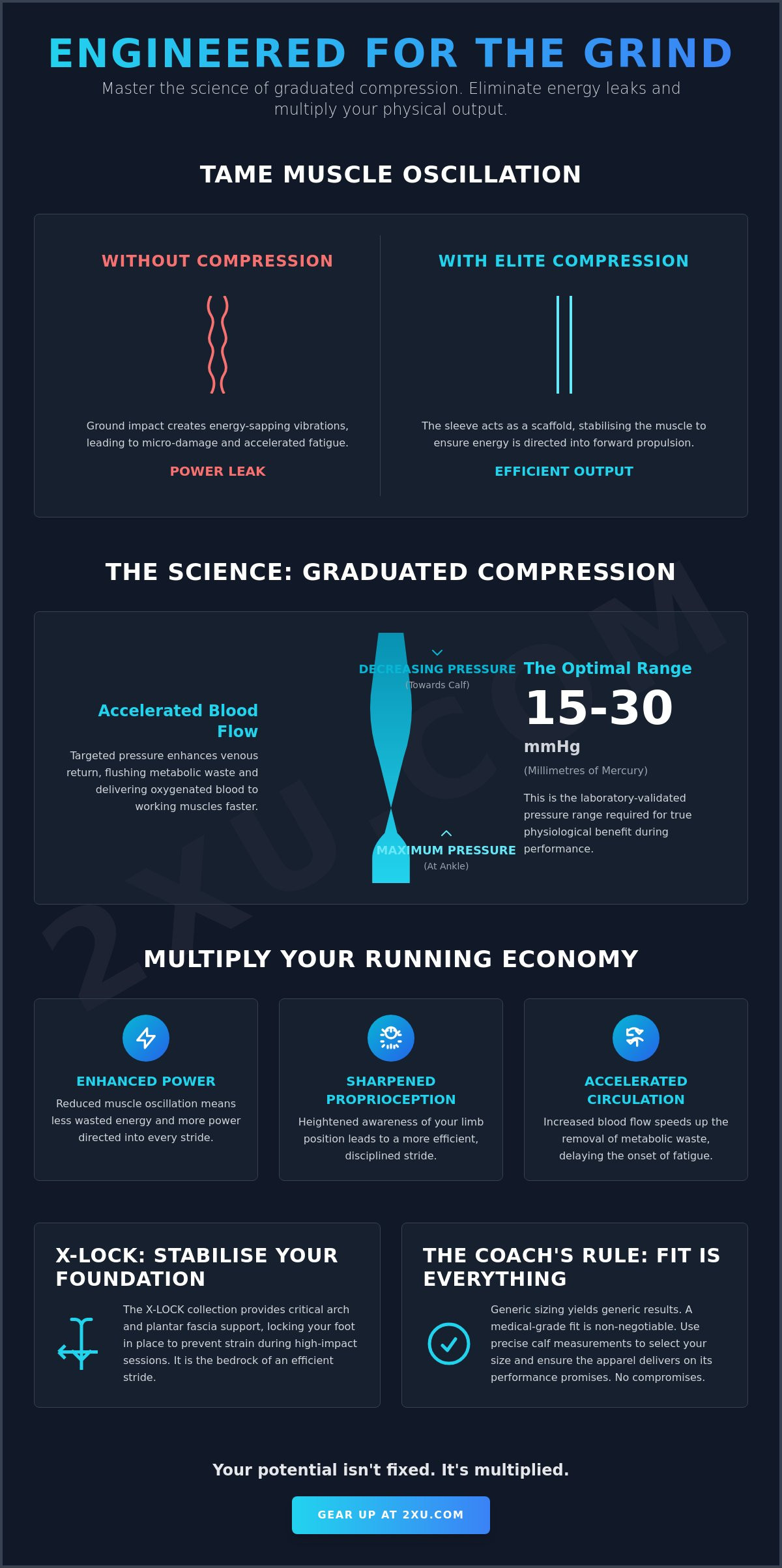
Performance isn't accidental; it's engineered. Graduated compression isn't merely a tight fit. It is a specialised engineering approach designed to optimise blood flow and mechanical efficiency. By applying a specific pressure gradient that is tightest at the ankle and decreases as it moves up the leg, these sleeves facilitate the movement of deoxygenated blood back to the heart. This is the foundation of the "Human Multiplied" concept. Every joule of energy saved from resisting gravity or managing muscle vibration is a joule you can redirect into your pace. When you eliminate energy leaks, your physical potential expands exponentially.
When you respect "the Grind," you accept that high-intensity sessions demand more from your equipment than standard apparel can provide. One of the primary benefits of compression sleeves for running is the ability to maintain output when biological fatigue usually dictates a slowdown. Elite performance sleeves are laboratory-validated tools. They distinguish themselves from recovery-specific gear by providing the necessary tension to support active muscle contractions during movement. While recovery gear focuses on passive circulation, performance sleeves are built for the heat of the session.
Beyond the Fabric: The Biological Mechanism
The core of this technology lies in enhancing venous return. As you run, your calf muscles act as a secondary pump for your circulatory system. Technical Compression Garments assist this process by narrowing the diameter of the veins; this increases the velocity of blood flow. This rapid circulation accelerates the removal of metabolic waste products like lactic acid from the muscle tissue. Research indicates that maintaining a pressure range between 15 to 30 mmHg is critical for these results. Without these validated pressure ratings, you are simply wearing tight fabric with no physiological advantage.
Mechanical Stability and Muscle Oscillation
Every time your foot strikes the pavement, a shockwave travels through your limb. This causes muscle oscillation, which are micro-vibrations that lead to energy waste and soft tissue damage. Compression sleeves act as an external scaffold for the gastrocnemius and soleus muscles. By stabilising these tissues, the sleeves reduce the mechanical stress that often leads to shin splints and calf strains. This stability allows you to prolong endurance during the most demanding phases of your training. You aren't just running; you are protecting your mechanical integrity and ensuring every stride is as efficient as the first.
Primary Benefits: How Graduated Compression Multiplies Your Running Economy
Running economy is the ultimate metric for endurance athletes. It measures the efficiency with which you use oxygen at a given pace. One of the primary benefits of compression sleeves for running is the immediate enhancement of this efficiency. By providing a firm, supportive wrap around the lower limb, you achieve a "locked-in" sensation. This is not just a psychological comfort. It serves as a constant tactile reminder to maintain form and discipline when the kilometres start to stack up and fatigue threatens your technique. To truly dominate your training, you must explore our full range of Compression Clothing to upgrade your kit.
Advanced performance yarns also provide critical thermoregulation and lymphatic benefits. These technical fibres manage moisture and temperature across diverse climates, keeping you cool in the heat and warm in the cold without sacrificing the necessary pressure gradient. Additionally, compression aids in lymphatic drainage. This process prevents the swelling and heavy-leg sensation often experienced during ultra-endurance events or long training blocks. By managing these biological factors, you can focus entirely on the execution of your session.
Enhancing Running Economy and Power
Proprioception is your body's ability to sense its position and movement in space. High-performance sleeves improve this brain-muscle connection, leading to a more efficient stride and reduced wasted movement. We use specialised fibres that allow for maximum airflow while maintaining medical-grade pressure. You don't have to choose between staying cool and staying supported. Unlike basic apparel that loses its elasticity after a few washes, our engineering ensures the pressure remains consistent throughout the life of the garment. This reliability is what allows you to push through the hardest parts of your training cycle with confidence.
Accelerated Recovery: The Post-Run Protocol
The work doesn't end when you stop running. Wearing sleeves post-session is a critical part of the elite athlete's protocol. It reduces Delayed Onset Muscle Soreness (DOMS) by continuing to flush metabolic waste and reducing inflammation in the muscle tissue. This isn't a passive process; it's an active investment in your next session. To understand how to apply this logic to your entire body, read our science of compression shirts guide. Consistent compression is the key to backing up your efforts day after day and respecting the demands you place on your body.
Choosing Your Arsenal: What to Look for in Elite Compression Sleeves
Selecting your gear is a tactical decision. To unlock the full benefits of compression sleeves for running, you must look past the marketing gloss and demand laboratory-validated specifications. Elite equipment is defined by its denier, which refers to the weight and strength of the yarn, and its specific pressure rating. If a garment doesn't specify its mmHg rating, it isn't compression; it's just tight clothing. Generic apparel often lacks the graduated pressure gradient required to actually influence venous return or stabilise muscle tissue. It provides a false sense of security while offering zero mathematical improvement to your output.
Construction matters for the athlete who respects "the Grind." Circular knit technology is the gold standard for performance sleeves. It provides a seamless, uniform pressure that flat knit alternatives cannot match. This construction ensures the garment retains its tensile strength over hundreds of kilometres. Additionally, your arsenal must include UV protection and antibacterial treatments. These are not luxuries. They are essential features that protect your skin and maintain garment hygiene during high-intensity training sessions. Discipline in training requires discipline in gear selection.
Proprietary Tech: X-LOCK and MCS Explained
We don't just wrap the limb; we map it. Muscle Containment Stamping (MCS) is a targeted support system that traces the key muscle groups of the lower leg. By applying extra pressure to the gastrocnemius and soleus, MCS further reduces muscle oscillation beyond what standard compression can achieve. This is complemented by X-LOCK technology. This feature provides a specialised fit to ensure the sleeve never slips or bunches during your stride. This level of performance engineering shares a common DNA with neoprene wetsuit science, where every millimetre of material is optimised to multiply human capability. When your gear stays in place, your focus stays on the pace.
Material Integrity: Why 2XU Rejects Average Standards
Average standards lead to average results. We reject low-grade materials and the generic labels used by mass-market competitors. Instead, we utilise precision-engineered elastomeric fibres and high-filament performance yarns. These materials are chosen for their superior moisture management and long-term durability. Every batch of fabric undergoes rigorous testing on industrial rigs to ensure 360-degree stretch and immediate recovery. This means the sleeve moves with you, not against you. It maintains its medical-grade pressure session after session. This ensures your investment in performance isn't lost after the first wash. You earn your results through hard work; your gear should be just as resilient.
The X-LOCK Collection: Engineering Stability and Support
The X-LOCK collection represents the apex of 2XU compression engineering. It's designed for athletes who refuse to let mechanical instability dictate their performance limits. While previous sections detailed the circulatory benefits of compression sleeves for running, the X-LOCK system introduces a revolutionary hybrid approach. It integrates arch and plantar fascia support directly into the structure of the garment. This creates a secure, locked-in foundation that stabilises the foot during every high-impact strike. This engineering reduces the strain on the plantar fascia, a common failure point during "the Grind." Whether you're a marathon runner, a triathlete, or a high-intensity gym-goer, this collection provides the mechanical scaffolding required to maintain your output. You can explore the full X-LOCK range to find the specific tool for your next mission.
To truly capitalise on the benefits of compression sleeves for running, you must understand the specific mechanics of your discipline. The X-LOCK collection is versatile enough to transition from the pavement to the weight room. It provides consistent support across multi-directional movements. This isn't just apparel; it's a performance multiplier that ensures your body remains structurally sound under extreme loads. By managing the forces acting on your foot and lower leg, you can push further into the fatigue zone without compromising your form or safety.
Calf Sleeves vs. Compression Socks
Your choice between a sleeve and a full sock should be tactical. Sleeves offer the advantage of versatility. You can pair them with your preferred performance socks or wear them under a wetsuit for rapid transitions in a triathlon. This flexibility is essential when you've already found the perfect fit in your running shorts and footwear. However, for the traveling athlete, the full coverage of flight pressure socks is non-negotiable for combating travel fatigue. Choose the sleeve for the session and the sock for the journey. Both tools are necessary for a holistic approach to athletic longevity.
Arm Sleeves: More Than Just Temperature Control
Don't overlook the power of the upper body. Arm compression is about more than just managing the chill during early morning starts. These sleeves provide essential upper body stability and facilitate venous return from the extremities, which is critical during long-distance efforts. They also serve as a protective barrier against sun exposure and abrasions during high-impact sports or trail runs. X-LOCK arm sleeves use the same precision-engineered elastomeric fibres to ensure the garment stays in place, regardless of the intensity of your movement. You earn your place at the elite level through discipline; ensure your gear matches your ambition by choosing high-performance Training Apparel that doesn't compromise.
Fit and Maintenance: Protecting Your Investment in Performance
Precision engineering requires precision care. You have selected your gear based on data and a commitment to "the Grind," so you must ensure that equipment continues to perform at its laboratory-validated peak. To truly capitalise on the benefits of compression sleeves for running, the fit must be medical-grade. This is not a casual fitness accessory; it is a technical tool that relies on a specific pressure gradient to function. If the fit is compromised, the physiological advantages of accelerated venous return and muscle stabilisation vanish. Respect the science behind the fabric by following a strict protocol for both sizing and upkeep.
Adhere to the "Coach’s Rule" when evaluating your gear: if a sleeve is easy to put on, it isn't providing compression. Real graduated pressure should feel challenging to apply. It requires a deliberate effort to pull the garment over the heel and into position on the calf. This resistance is the physical evidence of the tensile strength required to dampen muscle oscillation. If the garment slides on like a standard sock, it has either lost its elastomeric integrity or was never engineered for elite performance in the first place.
The Precision Fit Protocol
Sizing is the most critical variable in your performance equation. Do not rely on your height or weight alone. Follow this step-by-step guide to ensure a definitive fit:
- Measure the widest point: Use a soft tape measure to find the circumference of your calf at the thickest part of the gastrocnemius.
- Check for "The Slip": A sleeve that migrates down the leg during a session is too large and provides zero mechanical support.
- Monitor for Numbness: While the fit must be firm, any tingling or loss of sensation indicates the pressure is too high and is restricting arterial flow.
Re-evaluate the fit after your first 50km of use. High-performance yarns will settle into their operational shape after a few sessions, and you must ensure the pressure remains within the 15 to 30 mmHg range required for maximum efficacy.
Maintenance for Longevity
Heat is the primary enemy of performance apparel. High temperatures destroy the molecular bonds in precision-engineered elastomeric fibres, leading to permanent loss of tension. You must wash your sleeves in cold water using a mild detergent. Avoid fabric softeners at all costs; these chemicals coat the fibres and destroy the moisture-wicking capabilities that keep you cool during high-intensity blocks. The "Air Dry Only" mandate is non-negotiable. Never place your compression gear in a dryer. Hang them in the shade to preserve the material's ability to snap back to its original dimensions.
Even with meticulous care, compression gear has a finite lifespan. For the athlete training five or more days a week, expect to replace your sleeves every six to twelve months. Once the fabric loses its "snap," it can no longer multiply your output. Don't settle for diminished returns. When your current gear fails the Coach's Rule, it is time to Upgrade your kit with X-LOCK technology to maintain your competitive edge.
Dominate Your Next Session with Engineered Precision
You now possess the technical blueprint required to optimise your lower limb mechanics. You understand that managing muscle oscillation is a prerequisite for elite performance, not a luxury. By integrating equipment validated by elite sports scientists, you ensure that your body remains structurally sound even during the most punishing phases of your training cycle. Realising the full benefits of compression sleeves for running requires moving beyond basic apparel and demanding gear built for "the Grind."
The X-LOCK range utilises Muscle Containment Stamping (MCS) technology to provide targeted support where you need it most. Our circular knit construction ensures a consistent 360-degree stretch that maintains its medical-grade pressure session after session. Don't let mechanical inefficiency dictate your limits. It's time to equip yourself with tools that respect your ambition and multiply your physical output. Every stride is an opportunity to prove your discipline.
Shop the X-LOCK Collection: Engineered for Elite Stability
The road to your next breakthrough is earned through hard work and superior preparation. Get to work.
Frequently Asked Questions
How long should I wear compression sleeves after running?
Wear your sleeves for a minimum of two to four hours immediately following your session to maximise the biological benefits. This duration allows the graduated pressure to facilitate the removal of metabolic waste and reduce the onset of inflammation. For high-intensity sessions or ultra-endurance events, extending this period to six hours ensures the circulatory system remains supported during the most critical recovery window after the session ends.
Can compression sleeves help with shin splints?
Compression sleeves mitigate the mechanical causes of shin splints by dampening muscle oscillation during the landing phase of your stride. By acting as an external scaffold for the gastrocnemius and soleus, they reduce the strain on the periosteum. While they are a vital tool for management, they must be paired with proper load management and technical discipline to fully resolve chronic issues caused by high-impact repetitive loading.
Is it better to run in compression socks or sleeves?
Choose sleeves if you have a preferred performance sock or require rapid transitions, such as in triathlon. Sleeves allow for more versatility in your kit selection. Conversely, full compression socks are superior if you require integrated arch support and consistent pressure across the entire foot and ankle complex. Both options deliver the core benefits of compression sleeves for running when engineered with laboratory-validated pressure gradients.
Should I wear compression sleeves during a marathon?
You should wear compression sleeves during a marathon to manage the cumulative effects of muscle vibration and biological fatigue over 42.2 kilometres. The reduction in mechanical waste and the enhancement of proprioception can significantly improve your running economy during the final stages of the race. Ensure you have tested your gear during long training runs to confirm the fit remains secure and comfortable under sustained high-intensity loads.
Do compression sleeves lose their tightness over time?
High-performance elastomeric fibres eventually experience material fatigue and lose their tensile strength through repeated use and washing. For the dedicated athlete, your sleeves will typically reach their operational limit after six to twelve months of consistent use. Once the garment no longer requires a deliberate effort to put on, the pressure gradient is likely compromised, and it is time to upgrade your arsenal to maintain peak efficacy.
Can I sleep in my compression sleeves for better recovery?
Sleeping in active performance sleeves is generally discouraged because the pressure ratings are designed for an upright, active body. When you are horizontal, your circulatory system requires less assistance, and high-pressure sleeves can potentially impede blood flow over several hours. If you require overnight support, select specialised recovery-grade garments with a lower, more gentle pressure profile specifically engineered for rest rather than active output.
How do I know what size compression sleeve to buy?
Size selection must be based on the circumference of your calf at its widest point rather than your height or weight. Use a tape measure to get a precise reading and consult the specific size chart for the garment to ensure a medical-grade fit. If your measurement falls between two sizes, choose the smaller size to ensure the pressure gradient remains effective enough to deliver the physiological benefits of compression sleeves for running.
What is the difference between 2XU MCS and regular compression?
Muscle Containment Stamping (MCS) is a proprietary advancement that provides targeted support to specific muscle groups, such as the gastrocnemius. While regular compression applies a uniform gradient, MCS utilises an internal stamping system to follow the exact muscle structure. This provides an extra layer of stability that further reduces muscle oscillation and micro-trauma, representing the absolute pinnacle of current performance engineering for serious athletes.