
Flexible Wetsuits for Better Shoulder Mobility: The Science of the Unrestricted Stroke
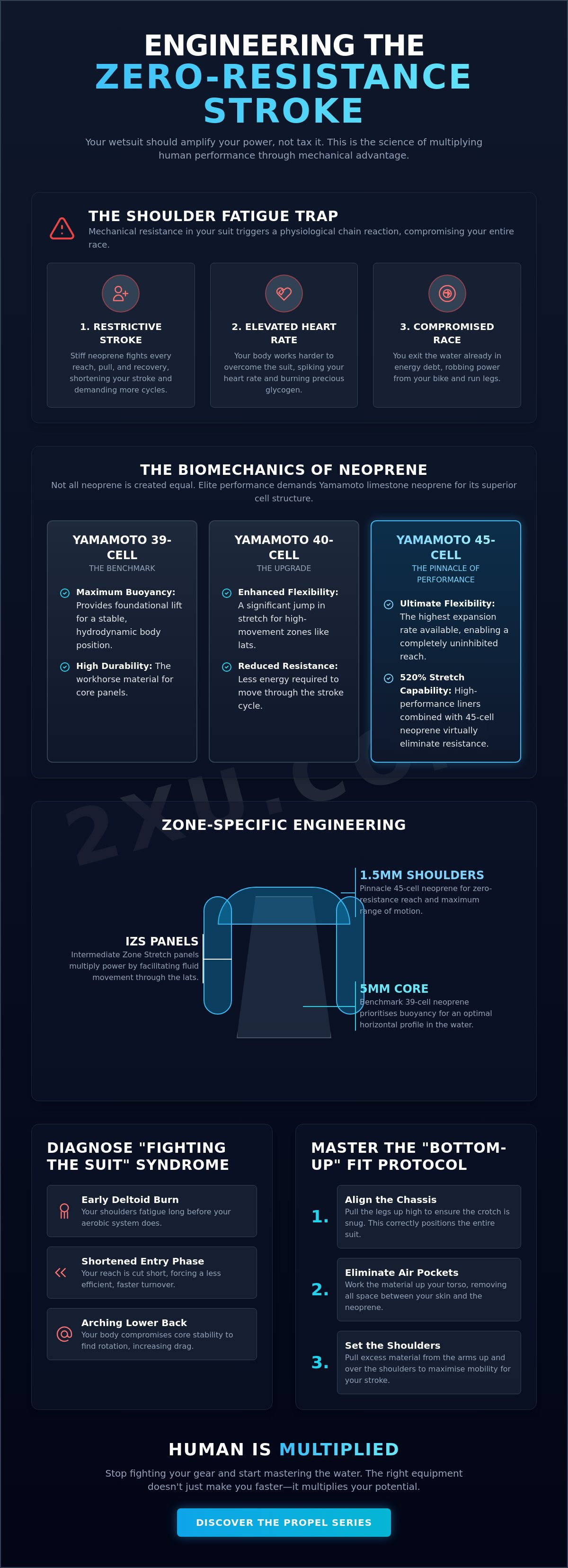
Every centimetre of resistance in your stroke is a direct tax on your power output. If you are fighting your neoprene after the first 500 metres, you aren't just tired; you're mechanically inefficient. Most triathletes mistake shoulder fatigue for a lack of conditioning when it is actually a failure of gear integration. You know the sensation of your reach being cut short during the catch phase or the grinding effort required to pull through the water. It is a common frustration, but it is one that elite engineering has already solved.
Securing a flexible wetsuit for better shoulder mobility is the most direct way to reclaim your energy for the bike and run legs. This article explores the science of the unrestricted stroke, focusing on how high-performance materials like Yamamoto cell neoprene and liners with 520 per cent stretch capability eliminate the resistance found in standard suits. We will break down the precise panel architecture and material science required to achieve a zero-resistance stroke. This guide provides the technical roadmap to multiply your efficiency and slash your swim splits through pure mechanical advantage.
Key Takeaways
- Identify how mechanical resistance in the water triggers the "Shoulder Fatigue Trap," elevating your heart rate and compromising your overall race pace.
- Learn why selecting a flexible wetsuit for better shoulder mobility requires high-grade Yamamoto 45-cell neoprene to achieve a near-zero resistance stroke.
- Understand the engineering behind variable thickness panels, which prioritise 1.5mm flexibility in the shoulders while maintaining 5mm buoyancy in the core for an optimal horizontal profile.
- Master the "Bottom-Up" fitting protocol to ensure the suit chassis is correctly aligned, preventing mechanical drag and maximising your range of motion.
- Discover how proprietary Intermediate Zone Stretch (IZS) panels in the Propel series multiply your power output by facilitating fluid movement through every phase of the stroke.
Why Shoulder Mobility is the Deciding Factor in Your Swim Split
Precision in the water is the difference between an elite split and mid-pack stagnation. Shoulder mobility governs the four critical phases of your stroke: the reach, the catch, the pull, and the recovery. When you wear a restrictive suit, you are effectively performing thousands of resisted repetitions against the material's elastic memory. This mechanical resistance curtails your reach, forcing a shorter stroke length that requires more cycles to cover the same distance. By integrating a flexible wetsuit for better shoulder mobility, you remove the biological ceiling on your performance. You transition from fighting the medium to mastering it. This is where the concept that human is multiplied becomes reality; your output is no longer throttled by your equipment.
The "Shoulder Fatigue Trap" is a physiological chain reaction. As your muscles work harder to overcome the stiffness of the neoprene, your heart rate climbs to meet the increased oxygen demand. This isn't just a muscular issue; it is a cardiovascular drain that begins within the first 400 metres of the swim. This premature spike in intensity robs you of the aerobic capacity needed for the transition and the bike leg. True efficiency requires a suit that mimics your natural range of motion, ensuring that every watt of power you generate translates into forward propulsion rather than overcoming internal friction.
The Metabolic Cost of Resistance
Every millimetre of material thickness adds a measurable tax to your energy reserves. Fighting stiff neoprene burns glycogen at an accelerated rate, leaving your tank empty before you even reach T1. Understanding the Science of Wetsuit Construction reveals the critical distinction between static stretch and active flexibility. While many suits feel "stretchy" on land, they fail to provide active flexibility during the dynamic high-elbow catch. Reducing shoulder thickness from 2mm to 1mm can shift your entire power curve, allowing for a more fluid entry and a deeper, more powerful pull without the associated metabolic cost.
Identifying the "Fighting the Suit" Syndrome
You can diagnose a mobility deficit by monitoring specific technical failures during your swim. Early deltoid burn, a shortened entry phase, and a persistent arching in the lower back are primary indicators that your gear is working against you. When the shoulders are restricted, the body instinctively seeks rotation elsewhere, often compromising the core and increasing drag. While some athletes consider sleeveless options to find relief, this is a sub-optimal compromise for elite performance. A sleeveless suit sacrifices the buoyancy and hydrodynamic surface area provided by advanced neoprene. The solution is not to remove the sleeves, but to demand a chassis engineered for zero-resistance motion.
The Biomechanics of Neoprene: Engineering Zero Resistance
Engineering a zero-resistance stroke requires a fundamental understanding of polymer science. Standard neoprene often relies on heavy fillers that provide buoyancy but stifle movement. Elite performance demands Yamamoto limestone neoprene, a material defined by its closed-cell structure. Unlike lower-grade options, these technical polymers use nitrogen-filled cells to achieve a high air-to-rubber ratio. This specific composition dictates the modulus of elasticity, determining how much force is required to stretch the material during the recovery phase of your stroke. When every millimetre of movement counts, the chemical makeup of your suit is the primary variable in your performance equation.
The industry categorises these materials by cell density to define their performance characteristics. Yamamoto 39-cell is the benchmark for durability and lift, providing the foundational buoyancy required for a stable body position. 40-cell neoprene offers a significant jump in flexibility, typically utilised in high-movement areas like the lats and underarms. However, 45-cell neoprene represents the absolute pinnacle of current technology. It provides the highest expansion rate available, making it the critical component in a flexible wetsuit for better shoulder mobility. By utilising 45-cell panels in the shoulder girdle, the mechanical resistance against your deltoids is virtually eliminated, allowing for a natural, uninhibited reach.
Cell Structure and Expansion
The nitrogen-filled cells within the polymer act as microscopic springs. In high-grade Yamamoto, these cells are uniform and densely packed, allowing the suit to provide maximum lift with minimal mass. This internal architecture is critical because it manages the tension across the shoulder joint. Research into Swimming Kinematics and Wetsuit Styles confirms that material stiffness directly alters the athlete's natural movement patterns. By optimising the air-to-rubber ratio, we ensure the suit moves with the body rather than against it. This level of precision is only possible with pure technical polymers, ensuring that your energy is spent on propulsion rather than fighting the material's elastic memory.
Internal Linings and Kinetic Flow
A common engineering failure occurs when a flexible outer skin is bonded to a restrictive inner lining. To maintain kinetic flow, the internal jersey must exceed the stretch capacity of the neoprene itself. Advanced 2XU engineering utilises specialised linings with a 520 per cent stretch rating. This ensures that as your arm reaches full extension, the lining expands without creating a restrictive "snap-back" effect. These technical fabrics also manage moisture absorption. By preventing the lining from holding excess water, the suit maintains its lightweight, high-performance profile throughout the entire duration of the swim. This synergy between the outer skin and the inner lining is what creates a truly flexible wetsuit for better shoulder mobility.
Finally, surface tension must be addressed to achieve total efficiency. Specialised coatings like Super Composite Skin (SCS) reduce the drag coefficient by minimising the friction between the suit and the water. This hydrophobic layer allows the suit to glide, further reducing the effort required for each stroke cycle. When you combine 45-cell neoprene with high-stretch linings and SCS coatings, you achieve a level of mechanical efficiency that multiplies your natural capability in the water.
Zone-Specific Engineering: Flexibility Where It Matters
Elite performance is never the result of compromise. It is the result of precision. A standard wetsuit treats the human torso as a single, uniform block. This is a fundamental engineering error. Your core requires maximum buoyancy to maintain a horizontal profile, while your shoulders require absolute freedom to execute a high-elbow catch. 2XU solves this through variable thickness across the suit chassis. We utilise 5mm neoprene in the core and upper legs to provide the necessary lift, while the shoulder and underarm panels are reduced to as little as 1.5mm. This strategic distribution ensures you aren't carrying unnecessary mass where you need movement. Achieving a flexible wetsuit for better shoulder mobility is about placing the right material in the right zone, not simply making the whole suit thinner.
Common advice found on forums often suggests that athletes with muscular builds should "size up" to avoid restriction. This is a failure of gear integration. Sizing up leads to water flushing and increased drag, which actively destroys your efficiency. A correctly engineered suit uses seamless shoulder panels to eliminate friction points entirely. By removing seams from high-movement areas, we reduce the risk of chafing and mechanical failure. This approach respects the Tripartite Athletic Framework: preparing the body for readiness, enabling peak action, and facilitating faster recovery by reducing the physical toll of the swim.
The 360-Degree Stretch Zone
The underarm gusset is the engine room of your stroke. It must facilitate 360-degree motion without resistance. Vertical stretch is just as critical as horizontal stretch, especially for tall athletes who need to maintain a long, clean reach. Traditional stitching creates a rigid line that acts as a tether. To solve this, we employ specialised bonding techniques that maintain the elastic integrity of the technical polymers. This ensures that during the catch phase, the suit expands in every direction, mirroring the natural The Biomechanics of Neoprene and allowing for a full range of motion without the "snap-back" effect common in lower-tier suits.
Buoyancy vs. Mobility: The Elite Balance
Stability is the foundation of speed. While the arms must be free, the core must remain locked. 2XU integrates a proprietary Rollbar into the suit's architecture. This feature enhances core buoyancy and improves body rotation, preventing the "leg sink" that plagues exhausted swimmers. By isolating the buoyancy panels to the centre of the suit, we free the torso for lateral movement. This balance ensures you stay high in the water without feeling like you are encased in a rigid shell. For a deeper analysis of how lift translates to speed, explore our technical guide on Neoprene Wetsuit Science. Precision engineering means you no longer have to choose between a stable core and a flexible wetsuit for better shoulder mobility.
Mastering the Fit: How to Eliminate Mechanical Drag
Performance is binary: your gear either facilitates your output or it throttles it. Even the most advanced flexible wetsuit for better shoulder mobility will fail if the chassis is incorrectly aligned on your body. Most athletes lose significant time not because of a lack of fitness, but because they are fighting a suit that is improperly seated. Mechanical drag occurs when the neoprene is stretched too thin over the joints, creating a constant tension that resists every movement. To eliminate this, you must master the systematic fitting protocol that ensures the material works with your biomechanics rather than against them.
The "Bottom-Up" Rule is the foundation of a professional fit. If the suit is not fully seated in the crotch and hips, the entire torso will be pulled downward, creating a restrictive anchor on your shoulders. This tension manifests as a heavy pull on the neck and a shortened reach. You cannot fix a shoulder restriction by pulling on the sleeves alone; you must ensure the suit is high enough in the legs and waist to provide the necessary slack for the upper body. Before you even consider the arms, the suit's internal architecture must be perfectly aligned with your midsection.
The Professional Fitting Protocol
- Step 1: Pull the legs as high as possible. Ensure the bottom of the suit sits several centimetres above the ankle bone to ensure the crotch is flush against your body.
- Step 2: Work the torso material upward toward the neck. Use the pads of your fingers to migrate the neoprene from the waist to the chest before you insert your arms into the sleeves.
- Step 3: Execute the "Arm-Bunch" technique. Pull the sleeves from the wrist toward the shoulder to create a surplus of neoprene in the deltoid and underarm zones.
Once the suit is on, perform the reach test. Extend your arms fully overhead as if in the middle of a stroke recovery. If you feel any resistance or "tugging" at the wrists or shoulders, you have not migrated enough material upward. A truly performance-engineered triathlon wetsuit should allow for a full, uninhibited extension without the material snapping back against your joints. This surplus of material is what allows for the high-elbow catch discussed in previous sections.
Troubleshooting Common Restriction Points
Many swimmers misidentify "Neck Tug" as a sign that the collar is too tight. In reality, this sensation is almost always caused by the suit being too low in the hips, which creates a vertical tension that pulls the neck seal downward. If you feel pressure on your windpipe, reset the suit from the legs up. Additionally, use the "Water Reset" once you are submerged. Pull the neck seal open to allow a small amount of water to enter. This breaks the vacuum seal between your skin and the lining, allowing the suit to shift into its optimal position. For precise measurements and to ensure you have the correct chassis for your frame, consult our Triathlon Wetsuit Guide and sizing charts.
The 2XU Propel Series: Multiplied Performance Through Unrestricted Motion
The Propel series represents the final evolution of aquatic engineering. We have engineered the Propel:1, Propel:2, and Propel Pro (Propel:3) to serve as the definitive solution for athletes demanding a flexible wetsuit for better shoulder mobility. These suits are not mere apparel; they are precision instruments designed to facilitate a zero-resistance stroke. By integrating Intermediate Zone Stretch (IZS) panels, we have created a chassis that allows for fluid movement across the entire shoulder girdle. This technology ensures that your mechanical output is never restricted by material tension, allowing you to maintain peak velocity from the first buoy to the final transition.
Power in the water is useless if it cannot be applied effectively. The Propel series features a Concave Water Entrapment Zone (CWEZ) on the forearm, which significantly increases the surface area of your pull. This feature works in tandem with the unrestricted shoulder mobility to maximise your distance per stroke. While your competitors are fighting their suits, you are leveraging a mechanical advantage that multiplies your natural strength. This is the difference between surviving the swim and dominating it. You have done the work in the pool; your gear must now prove it is worthy of your effort.
Propel Technology Breakdown
Success in triathlon is a game of marginal gains and drag reduction. Every Propel suit utilises a Nano Super Composite Skin (SCS) coating to minimise surface tension and increase hydrodynamic speed. This specialised layer allows the water to glide over the neoprene, reducing friction and allowing for a more efficient glide phase. Frontal Buoyancy panels are strategically placed to elevate the hips and legs, keeping you in the fastest horizontal plane possible without compromising torso rotation. To ensure your performance continues onto the land, we have integrated transition liners that facilitate the fastest T1 exit in the industry. Every second saved in the water and during the strip is a second earned on the bike leg.
The 2XU Advantage
We do not rely on anecdotal evidence or marketing fluff. Every feature of the Propel series has undergone rigorous laboratory validation and elite athlete testing to ensure it meets our unyielding standards. This suit is designed to function as part of a total performance system, integrating seamlessly with our advanced Triathlon Suits to manage thermoregulation and muscle stability across all three disciplines. When you choose a flexible wetsuit for better shoulder mobility from our collection, you are investing in a proven mathematical improvement to your results. Respect the grind. Discipline your training. Secure your advantage by exploring the full 2XU Wetsuit Collection today. Your fastest split is waiting.
Secure Your Mechanical Advantage in the Water
Efficiency in the open water is a mathematical certainty when you eliminate mechanical resistance. We've established that variable thickness and a precise fit are the only ways to prevent the shoulder fatigue trap from compromising your race split. By transitioning from standard neoprene to high-grade technical polymers, you reclaim the energy previously wasted on fighting the elastic memory of your gear. Your focus remains on the catch and pull, not the resistance of the suit.
Investing in a flexible wetsuit for better shoulder mobility is the final step in your performance preparation. The 2XU Propel series leverages Yamamoto 45-cell neoprene technology to deliver the unrestricted motion that world-champion triathletes demand. This Red Dot Design Award-winning engineering is built to multiply your natural capability, ensuring every watt of power translates into forward propulsion. You've put in the hours of training; now it's time to ensure your gear is worthy of your discipline.
Shop the 2XU Propel Wetsuit Collection
The grind doesn't stop at the water's edge. Sharpen your edge, trust the science, and earn the split you've worked for.
Frequently Asked Questions
How can I tell if my wetsuit is too tight in the shoulders?
You are too tight if you experience a burning sensation in your deltoids within the first 500 metres of your swim. Perform a dry-land reach test by extending your arms fully overhead; if the material snaps back or restricts your extension, the chassis is misaligned or too small. This mechanical tension forces your muscles to work against the neoprene's elastic memory, which compromises your power output and heart rate stability.
Does a thinner wetsuit always mean more flexibility?
Thickness is only one variable in the flexibility equation. While a 1.5mm panel is thinner than a 3mm panel, the grade of the technical polymer dictates the true expansion rate. Yamamoto 45-cell neoprene provides significantly more stretch than lower-grade 39-cell material of the same thickness. Always prioritise the cell grade and internal lining stretch rating over thickness alone when selecting a flexible wetsuit for better shoulder mobility.
Can I improve the shoulder mobility of my current wetsuit?
You can improve mobility by migrating excess material from the waist and sleeves toward the shoulder girdle. Use the "Arm-Bunch" technique to pull the neoprene from the wrist toward the shoulder, creating a surplus of material in the underarm area. This extra slack allows for a full range of motion during the recovery phase, reducing the mechanical drag that leads to premature fatigue and technical breakdown.
Is a sleeveless wetsuit better for shoulder mobility than a full-sleeve?
A sleeveless suit eliminates shoulder resistance but is a sub-optimal choice for elite performance. You lose the buoyancy provided by the arm panels and the hydrodynamic efficiency of the SCS coating on the sleeves. A high-performance full-sleeve suit engineered with 45-cell neoprene provides the same range of motion while maintaining the horizontal body position required for faster swim splits and better energy conservation.
What is the best neoprene thickness for maximum shoulder flexibility?
The industry standard for elite flexibility is 1.5mm or less in the shoulder and underarm panels. High-performance suits utilise this specific thickness to ensure the material moves with your natural biomechanics. This allows the core to maintain 5mm of buoyancy for lift while the arms remain completely unrestricted for a high-elbow catch. This precise distribution is the foundation of a flexible wetsuit for better shoulder mobility.
How do I prevent shoulder chafing in a high-performance wetsuit?
Chafing is usually caused by a suit that is too loose or improperly seated, allowing the material to rub against the skin during the stroke cycle. Ensure the suit is pulled high in the crotch and waist to lock the chassis in place. Using a body-safe lubricant on the neck and underarms can provide an extra layer of protection, but a correct fit is the primary defence against friction.
Does the internal lining of a wetsuit affect my stroke mobility?
The internal lining is often the hidden bottleneck in wetsuit flexibility. Even the most flexible outer skin will feel restrictive if the inner jersey lacks a high stretch rating. Look for linings with a 520 per cent stretch capability; these allow the suit to expand fully during the reach phase without creating a restrictive snap-back effect. This ensures your kinetic flow remains uninterrupted through every phase of the stroke.
How often should I replace my wetsuit to maintain its flexibility?
Technical polymers naturally lose their elasticity over time due to salt, chlorine, and UV exposure. To maintain peak performance, most elite athletes replace their primary race suit every two to three seasons. Proper maintenance, such as rinsing with fresh water after every session and avoiding direct sunlight during drying, will extend the life of the nitrogen-filled cells and preserve the material's modulus of elasticity.