
Running Gear for Rainy Days: Engineering Performance Through the Grind
Rain is not a deterrent; it is a technical variable that demands precision engineering to maintain peak athletic output. Most runners view a downpour as a reason to retreat, but elite athletes recognise it as the ultimate proving ground for discipline and resilience. You understand the frustration of heavy, water-logged fabrics that cause chafing and blisters, or the rapid muscle cooling that leads to a measurable loss of power. Selecting the right running gear for rainy days is not about comfort; it is about maintaining mechanical stability and biological efficiency when the environment turns hostile.
This guide promises to help you master the variables of wet-weather training by utilising gear engineered to stabilise your gait and optimise thermoregulation. We will analyse how high-performance technical fabrics with waterproof ratings of up to 28,000mm provide a barrier against the elements while ensuring the breathability required for high-intensity output. You will discover how advanced compression clothing maintains core temperature and prevents the mechanical failures that compromise your stride. We are moving beyond basic protection to explore the tripartite athletic framework of readiness, action, and recovery in the wet, proving that your potential is multiplied even through the grind.
Key Takeaways
- Identify how wet skin accelerates heat loss and decreases muscle contractile force, turning a standard session into a significant metabolic drain.
- Master the technical layering architecture by selecting high-performance running gear for rainy days that prioritises moisture-wicking engineered fibres over absorbents.
- Stabilise your gait on slick surfaces with compression apparel designed to reduce muscle oscillation and enhance proprioception during high-intensity output.
- Maximise your safety and prevent skin maceration through elite visibility protocols and specialised technical socks that protect against blisters.
- Multiply your physical output during the grind by using gear engineered for weightless protection and maximum aerodynamic efficiency in heavy rain.
The Physiology of Wet-Weather Performance: Why Gear Matters
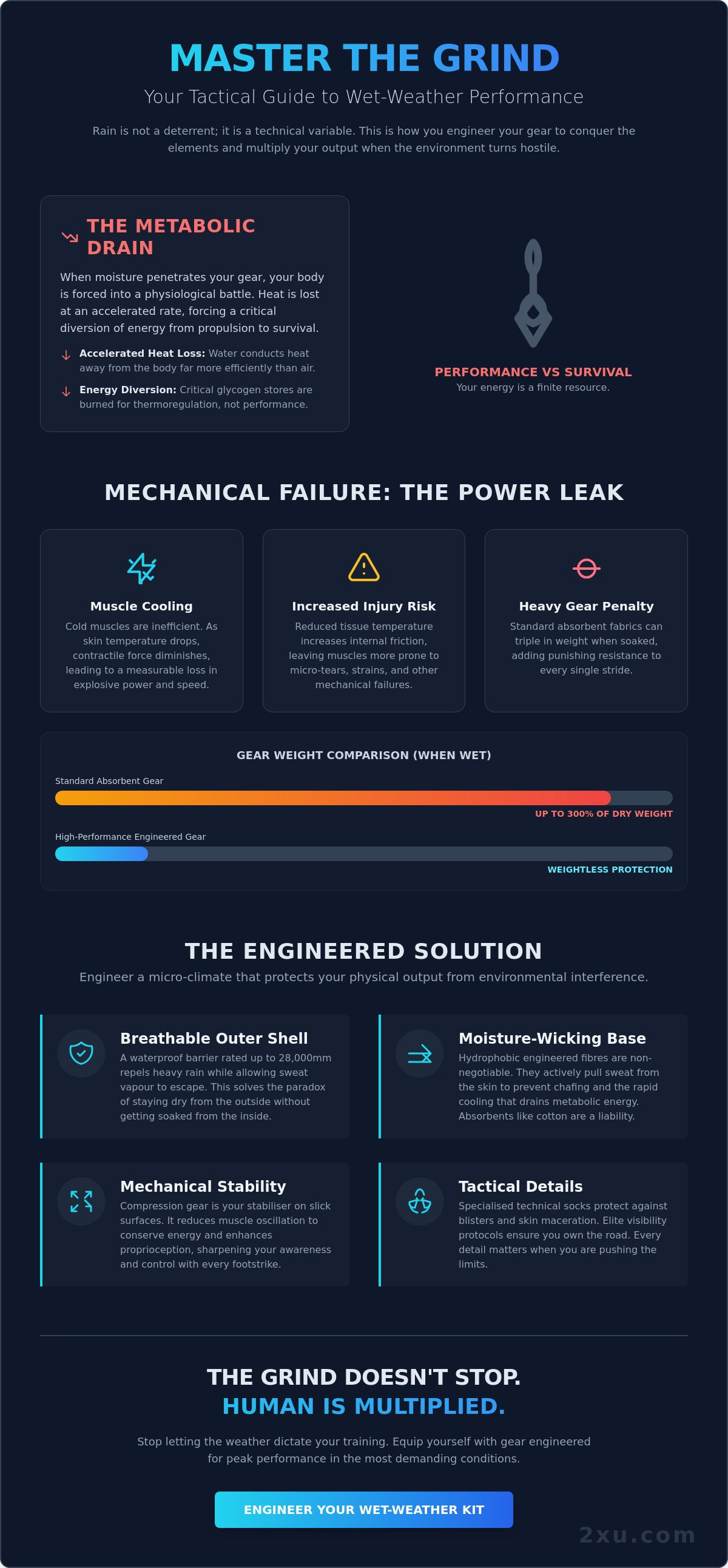
The Grind does not stop for a storm. While the average runner retreats to the treadmill, the elite athlete understands that rain is a technical variable to be solved. Training in the wet is a physiological battle against the "Metabolic Drain." When moisture penetrates your outer layers, heat loss occurs through conduction at a rate significantly higher than in dry air. This process forces your body to divert critical energy reserves away from movement and toward heat production. Choosing the right running gear for rainy days is the only way to ensure your glycogen stores are used for propulsion rather than survival.
Muscle cooling is a direct threat to your power output. As your skin temperature drops, the contractile force of your muscles diminishes, leading to a measurable decrease in explosive power and speed. Maintaining steady-state endurance requires absolute moisture management. Without it, the weight of water-logged fabrics increases your perceived exertion, forcing you to work harder for the same pace. Respecting the Grind means equipping yourself with the tools to stay light, warm, and efficient when the environment turns hostile.
Thermoregulation and Energy Expenditure
When you are wet and cold, your body initiates a survival protocol. It prioritises the core by constricting peripheral blood vessels, which reduces the delivery of oxygenated blood to your working muscles. This trade-off is a biological tax on your performance. Every watt of energy spent on shivering or maintaining core heat is a watt taken away from your cadence. Thermoregulation is the biological process of maintaining internal temperature despite external rain variables. By utilising engineered fabrics that manage this process, you ensure that your metabolic output is focused entirely on the road ahead. This is how the concept of "human is multiplied" becomes a reality in the field.
The Risk of Muscle Fatigue in Cold Rain
Cold muscles are inefficient muscles. Reduced tissue temperature increases internal friction and leaves you more prone to micro-tears and strain injuries. Technical fabrics (never the low-grade alternatives found in mass-market apparel) are designed to trap a thin layer of warm air against the skin, creating a micro-climate that sustains muscle elasticity. The historical study of the Physiology of Wet-Weather Performance demonstrates the severe impact of prolonged moisture exposure on human tissue. Beyond the biological risk, there is the "heavy gear" penalty. Standard clothing can triple in weight when soaked, adding unnecessary resistance to every stride. High-performance running gear for rainy days uses advanced polymers to repel water, ensuring your kit remains as light at the finish line as it was at the start.
The Layering Architecture: Engineering Your Outer Shell
Precision is the difference between a breakthrough and a breakdown. When training in the rain, your apparel must function as an integrated system rather than a collection of individual pieces. This layering architecture is designed to manage the specific variables of moisture, temperature, and movement. Success requires a strategic selection of running gear for rainy days that prioritises technical performance over aesthetic appeal. You aren't just getting dressed; you're engineering a micro-climate that protects your physical output from environmental interference.
Selecting Technical Base Layers
The base layer is your first line of defence against the metabolic drain. You must prioritise hydrophobic engineered fibres that move sweat away from the skin instantly. Natural absorbents like cotton are a liability in the rain; they trap moisture, increase weight, and accelerate heat loss. Elite performance demands materials that maintain a dry interface between the fabric and the dermis. Chafing is a mechanical failure that can be avoided through the use of flatlock seams and high-performance compression shirts. These garments provide the necessary proprioceptive feedback while ensuring that friction is minimised in high-movement zones. By stabilising the core and managing moisture at the source, you set the foundation for sustained endurance through the grind.
Breathable Waterproofing: The Paradox Solved
The primary challenge of wet-weather gear is the paradox of keeping water out while letting vapour escape. High-performance outer shells solve this through microporous membranes. These advanced technical polymers feature pores that are 20,000 times smaller than a water droplet but 700 times larger than a molecule of water vapour. This allows your sweat to evaporate while blocking external precipitation. When evaluating an outer shell, look for a hydrostatic head rating of at least 10,000mm, though 20,000mm is the benchmark for serious endurance in heavy storms.
Engineering details matter. Seam-sealing is non-negotiable for high-output running, as it prevents water from oscillating through the stitch lines. Strategic ventilation zones, often laser-cut or protected by storm flaps, ensure that airflow remains consistent without compromising the waterproof barrier. According to expert advice on Tactical Logistics and Safety, dressing for the weather is a critical component of maintaining training consistency. Ensure your jacket features adjustable hoods and cuffs to seal out the elements at every entry point. If you want to maintain your pace when the clouds burst, you can explore technical running apparel designed to withstand the most demanding conditions. This level of preparation ensures that your potential is multiplied, regardless of the forecast.
Mechanical Stability: Compression Gear for Slippery Surfaces
Mechanical stability is the foundation of pace when the pavement becomes a slip hazard. While footwear provides the initial contact, your musculoskeletal system must manage the micro-slips and lateral shifts that occur on slick surfaces. Standard apparel fails here; it offers no structural support. High-performance running gear for rainy days must include compression to reduce muscle oscillation. When your foot strikes a wet surface, the resulting vibration travels up the kinetic chain, causing energy-wasting muscle movement. Compression garments act as an external scaffold, dampening these vibrations and preserving your power for forward propulsion.
The Grind demands that you maintain efficiency when the environment is working against you. Beyond dampening vibration, compression apparel prevents the "heavy leg" syndrome that often plagues long sessions in the cold. By facilitating venous return and reducing the buildup of metabolic waste, you can sustain a higher output for longer durations. This is not about comfort. It is about the biological and mechanical precision required to dominate the elements.
Muscle Containment Stamping (MCS) in the Rain
Elite performance requires targeted intervention. 2XU utilises Muscle Containment Stamping (MCS) technology to provide a secondary skin that traces key muscle groups, such as the quadriceps and calves. This engineering is vital when running through puddles or over mud, where the risk of vibration-induced fatigue is highest. By reinforcing the muscle structure, MCS reduces the micro-tears that lead to premature exhaustion. It ensures your kinetic chain remains stable even when the surface friction is compromised, allowing you to push through the rain with unyielding force.
Proprioceptive Feedback and Gait Efficiency
Rain obscures terrain and alters surface feedback. To maintain a consistent stride, your brain needs immediate data from your limbs. Skin-tight compression gear increases sensory input, heightening your proprioception, which is the awareness of your body's position in space. This brain-to-muscle connection allows for rapid, subconscious adjustments to your gait when you encounter a slick patch or uneven ground.
Following expert advice on running in the rain involves more than just staying dry; it requires maintaining mechanical integrity. You can integrate this support by selecting running shorts with integrated compression liners to stabilise the hip and groin area. This setup ensures that your gait remains efficient and your stride length stays consistent, regardless of variable traction. The restoration process begins the moment the run ends. By wearing compression gear post-session, you accelerate the restoration of muscle tissue, ensuring you are ready to face the next challenge. This is how human potential is multiplied through the Grind.
Tactical Logistics: Safety and Post-Run Restoration
Success in the rain requires more than just a waterproof shell; it requires a tactical protocol that extends from preparation to restoration. Your selection of running gear for rainy days must address the logistical challenges of low visibility and the physiological demands of post-run recovery. The Grind is won by the athlete who manages these variables with scientific precision. If you neglect the logistics, you compromise your consistency. Performance doesn't end when the watch stops; it continues until your body reaches homeostasis.
Visibility and Environmental Awareness
Visibility in a low-light storm is about more than just bright colours. High-performance engineering utilises 360-degree reflectivity placed strategically on moving limbs to leverage biomotion. This allows motorists to recognise human movement instantly. Biomotion is key. Beyond visibility, you must manage the interface between your feet and the ground. While waterproof shoes block external moisture, they often trap sweat and water that enters via the ankle. Technical socks made from high-density engineered fibres are essential to prevent maceration, which is the softening and breaking down of skin due to prolonged moisture exposure.
Before heading out into high-wind conditions, execute this safety checklist:
- Verify all reflective patterns are unobstructed by packs or layers.
- Check that your outer shell's DWR (Durable Water Repellent) coating is still beading water; if not, it requires technical restoration.
- Ensure your technical socks provide a lock-down fit to prevent blister-causing friction.
The Recovery Phase: Restoration and Readiness
The "Golden Hour" is the critical window immediately following your run. When you stop moving in wet conditions, your core temperature can plummet rapidly as moisture evaporates from your skin. You must transition to dry, specialised recovery gear instantly to maintain homeostasis. This is the time to utilise graduated compression to flush metabolic waste and reduce delayed onset muscle soreness. For athletes who travel between training sites, using flight pressure socks can provide essential circulation support that maintains tissue health.
Maintaining your gear is equally vital. Avoid standard fabric softeners; they clog the pores of technical membranes and destroy DWR coatings. Use neutral detergents to preserve the engineering of your kit. To ensure you have the right tools for every stage of the journey, you can shop athletic accessories designed for elite performance. Just as you maintain your gear, professional home system care is essential; First Choice Plus Plumbing & Air provides expert restoration and maintenance services to ensure your home environment remains as resilient as your discipline.
Multiplying Your Potential: The 2XU Rainy Day Kit
Rainy training sessions are the ultimate filter. They separate the casual runner from the dedicated athlete who understands that consistency is earned through the grind. While we have established the physiological and mechanical demands of wet-weather performance, the final variable is the equipment itself. Your running gear for rainy days must be more than just protective; it must be a force multiplier. The 2XU kit is engineered to ensure that environmental resistance never dictates your physical output. When you step into a storm, you aren't just enduring the weather. You are dominating it.
The Light Speed collection represents the pinnacle of visibility and elite weightlessness. These garments utilise advanced technical fibres that repel water while providing 360-degree reflectivity, ensuring you remain visible to motorists during the darkest storms. For those facing high-velocity winds and head-on rain, the Aero Jackets provide the necessary aerodynamic efficiency. These jackets are designed with a streamlined silhouette to reduce drag, ensuring that your energy is spent on propulsion rather than fighting air resistance. Combined with MCS Run Compression, which provides the mechanical stability discussed in previous sections, this kit forms a complete performance system.
The 2XU Performance Advantage
Every piece of 2XU apparel is grounded in laboratory-validated technology. We don't rely on generalized claims; we rely on data. Our fabrics are tested for durability against the abrasive nature of wet grit and salt, ensuring that your gear maintains its integrity through hundreds of high-intensity sessions. This commitment to quality is why elite athletes trust our engineering to protect their power output. The "Human Multiplied" promise is not a marketing slogan. It is a technical reality achieved when your biological potential is supported by the world’s most advanced technical polymers. By removing the limitations of the environment, we allow your discipline to take full effect.
Final Readiness Checklist
To master the grind, you must follow the Tripartite Athletic Framework: Readiness, Action, and Recovery. Before you head out, ensure your kit meets the technical requirements for the 2026 season. This framework ensures that your performance is holistic, addressing every stage of the athlete's journey. Use this checklist to verify your equipment:
- Readiness: Verify DWR integrity on your Aero Jacket and ensure base layers are moisture-wicking engineered fibres.
- Action: Utilise MCS Run Compression for mechanical stability and Light Speed gear for biomotion-based visibility.
- Recovery: Have your specialised recovery compression ready to flush metabolic waste the moment you finish.
The road doesn't get easier; you simply get stronger. Sharpen your discipline and ensure your potential is never capped by the forecast. You can shop professional training apparel to equip yourself for the challenges ahead. Earn your place through the grind and prove that your potential is truly multiplied.
Master the Elements and Multiply Your Output
You now possess the technical framework to dominate every rainy session. We have analysed how precision layering prevents metabolic drain and how proprietary MCS muscle mapping provides the mechanical stability required on slick surfaces. Performance in the wet is no longer a matter of chance; it is a direct result of laboratory-validated compression technology and elite preparation. World-class triathletes and endurance runners don't wait for the sun because they know that high-performance running gear for rainy days turns environmental resistance into a measurable competitive advantage.
Every session through the grind is an opportunity to sharpen your discipline and test your resilience. By integrating the tripartite athletic framework into your routine, you ensure that your body remains efficient from readiness through to recovery. It's time to stop enduring the storm and start using it to multiply your physical output. This is how the concept of human is multiplied through engineering and effort.
Shop the 2XU Running Collection and Master the Elements
Respect the grind, stay disciplined, and prove that your potential is multiplied.
Frequently Asked Questions
Is it safe to run in the rain for long distances?
Yes, provided you manage thermoregulation and visibility with precision. Long-distance sessions in the rain increase the risk of hypothermia if you wear absorbent materials that trap cold moisture against the skin. You must use engineered fabrics to maintain core heat and manage the metabolic drain. Ensure you have a restoration protocol ready the moment you finish to restore homeostasis. Safety isn't a matter of luck; it's a matter of preparation and respect for the grind.
How do I prevent my running shoes from getting ruined in the rain?
Remove the insoles and stuff the shoes with newspaper immediately after your run. This draws out moisture efficiently without compromising the structural integrity of the foam or technical adhesives. Never use a direct heat source like a radiator or hairdryer. Excessive heat can warp the midsole and degrade the bond between the upper and the sole. Consistent maintenance ensures your equipment survives the most abrasive conditions and maintains its mechanical properties.
What is the best fabric for running in the rain if I want to avoid chafing?
Hydrophobic engineered fibres are the superior choice for high-intensity output in wet conditions. These materials move moisture away from the skin instantly, preventing the heavy, abrasive weight of water-logged fabrics. When selecting running gear for rainy days, prioritise garments with flatlock seams to minimise friction. Maintaining a dry interface between the fabric and your skin is the primary defence against mechanical skin failure during a demanding session in the elements.
Do I need a waterproof or a water-resistant jacket for running?
Choose based on the duration and intensity of the storm. Water-resistant jackets offer high breathability for light drizzle but will eventually saturate. For heavy rain or long-duration training, a waterproof shell with a hydrostatic head rating of 10,000mm or higher is essential. This ensures internal dryness while microporous membranes allow sweat vapour to escape, preventing the heat-trapping effect that compromises thermoregulation. Precision in your outer shell selection maintains your power output.
How can I prevent my feet from getting blisters when they are wet?
Use technical socks engineered with high-density fibres and a lock-down fit. Blisters are caused by a combination of moisture, heat, and friction. By wearing socks that don't absorb water, you prevent the skin maceration that leads to tissue breakdown. Ensure your socks provide adequate compression to prevent slipping inside the shoe. This is a common cause of mechanical friction during rainy sessions that can be solved with the right gear.
Should I wear compression tights or shorts for rainy runs?
Tights are preferable in cold rain to maintain muscle temperature and prevent explosive power loss. The increased surface area of compression tights provides greater proprioceptive feedback and muscle containment across the entire leg. If the temperature is higher, compression shorts with integrated liners can suffice. Both options reduce muscle oscillation and improve mechanical stability on slick surfaces, ensuring your potential is multiplied through the grind regardless of the surface traction.
How do I dry out my technical running gear without damaging the fabric?
Air-dry your gear in a well-ventilated area away from direct sunlight or high-heat sources. Technical polymers and DWR coatings are sensitive to extreme temperatures. Avoid using a tumble dryer unless the care label specifically recommends it for reactivating the water-repellent finish. Proper maintenance of your running gear for rainy days involves using neutral detergents and avoiding fabric softeners that clog the technical pores of the membrane and destroy performance features.
What are the best tips for maintaining visibility during a heavy rainstorm?
Utilise 360-degree reflectivity placed on moving limbs to leverage biomotion principles. Drivers recognise the rhythmic movement of ankles and knees faster than a stationary reflective block. Active light-reflective patterns on your gear ensure you're visible from all angles. Always assume you're invisible to motorists in heavy rain. Choose routes with adequate lighting or physical barriers from traffic to ensure your safety while you focus on the mechanics of your run.