
Do Compression Shorts Prevent Injury? The Science of Shielding Your Performance
The greatest threat to your progress isn't the intensity of the session; it's the 14 days of forced stagnation that follow a preventable soft-tissue strain. You understand that every second of downtime is a step backward in your pursuit of elite performance. You've likely wondered, do compression shorts prevent injury or are they simply a psychological edge for the starting line? It's a valid question for any athlete who refuses to settle for mediocrity and demands scientific validation for every piece of gear in their kit bag.
At 2XU, we agree that your ambition shouldn't be limited by avoidable muscle trauma or the performance plateaus caused by excessive muscle vibration. This article promises to reveal how engineered compression functions as a mechanical defence system, shielding your primary muscle groups from the micro-tears that lead to long-term injury. We'll examine the specific data behind Muscle Containment Stamping and how it reduces muscle oscillation by up to 45% to ensure you can prepare, perform, and recover without compromise. Human Performance. Multiplied.
Key Takeaways
- Reinforce your structural integrity by mastering the physics of energy dispersion during high-impact training phases.
- Eliminate muscle oscillation to prevent the vibration-induced fatigue that precedes structural failure and trauma.
- Sharpen your proprioception to understand how do compression shorts prevent injury by heightening your brain’s neuromuscular connection.
- Master the 24-hour recovery cycle to ensure today’s effort becomes tomorrow’s primary defence against muscle soreness.
- Recognise why PWX fabric engineering outperforms generic materials to ensure your gear respects the grind.
The Physics of Movement: How Compression Shorts Act as Protective Engineering
Every explosive movement you make generates a massive amount of kinetic energy. When you sprint, jump, or change direction, your muscles must absorb and redirect this force. Injury is rarely a random accident; it is usually the result of unmanaged energy dispersion during high-impact phases. Elite athletes don't view their gear as mere clothing. They treat it as a second skin that reinforces their structural integrity. While standard athletic wear provides coverage, 2XU engineering provides a rigorous defence against the physical toll of elite performance. Our mission is simple: Human Performance. Multiplied. We achieve this by applying scientific rigour to every fibre we produce.
Athletes often ask, do compression shorts prevent injury by simply being tight? The reality is more complex. Basic tight shorts might feel secure, but they lack the technical architecture to manage muscle oscillation. Historically, Compression garments were developed for medical venous support; however, 2XU has re-engineered this technology for the high-intensity demands of the arena. By containing the muscle group, we reduce the vibrations that lead to fatigue and eventual failure. This is protective engineering in its most potent form.
The Anatomy of a Strain: Why Muscles Fail
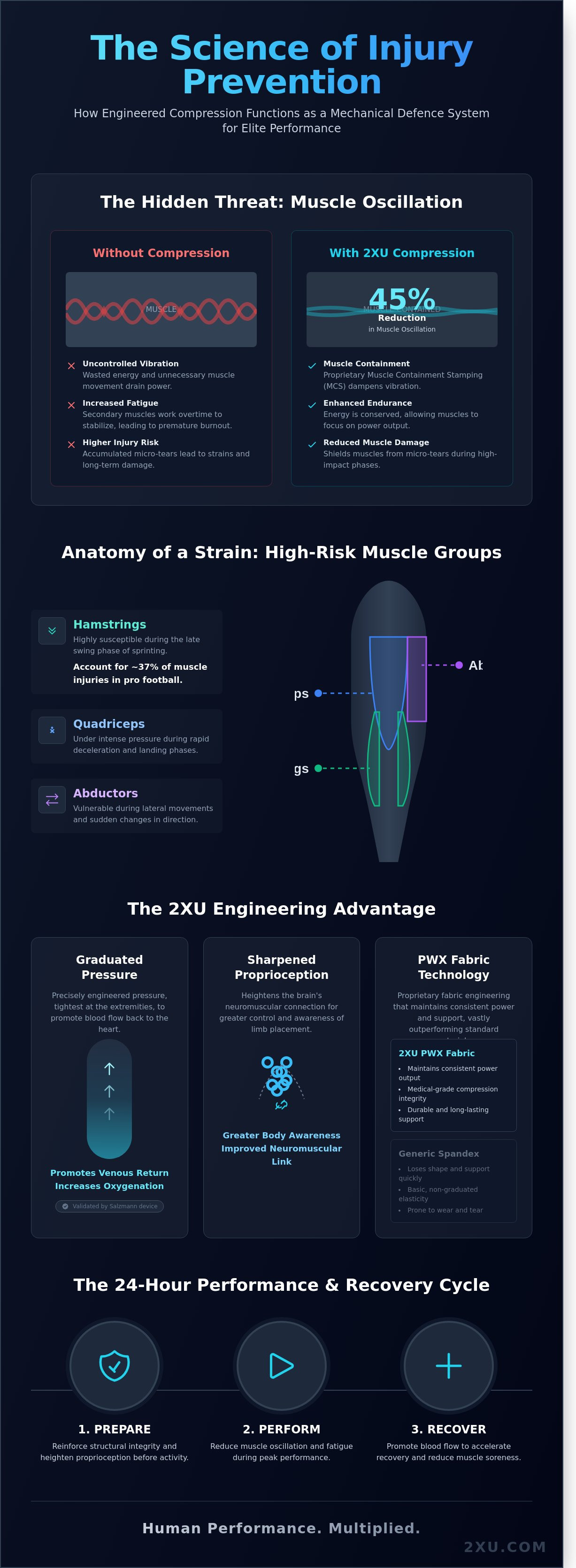
Muscles typically fail during the eccentric phase of movement. This occurs when the muscle lengthens under tension, such as the moment your foot hits the ground during a sprint. This phase creates micro-tears in the muscle fibres. If these tears accumulate without proper support, they transition from minor soreness to a debilitating strain. Fatigue plays a critical role here. As your form breaks down, your risk profile increases. The primary muscle groups at risk include:
- Hamstrings: Highly susceptible during the late swing phase of sprinting.
- Quadriceps: Under intense pressure during rapid deceleration and landing.
- Abductors: Vulnerable during lateral movements and sudden changes in direction.
Research indicates that hamstrings account for approximately 37% of muscle injuries in professional football. By providing external support, 2XU garments help maintain muscle alignment even when fatigue begins to set in.
Graduated Pressure: More Than Just a Snug Fit
True performance compression is defined by its pressure profile. We don't guess; we measure. Every 2XU garment is validated using the Salzmann pressure measurement device. This ensures the pressure is precisely graduated, meaning it is tightest at the extremities and decreases as it moves toward the heart. This specific pressure differential is what promotes venous return and ensures your tissues remain oxygenated during the most demanding sessions.
Engineered tension is vastly superior to standard apparel elasticity. While basic shorts lose their shape and support after a few sprints, our proprietary PWX fabric is designed to maintain consistent power output. So, do compression shorts prevent injury? When they are engineered with medical-grade precision, they provide the mechanical support necessary to shield your body from the grind of high-level training. You don't just wear 2XU; you deploy it as a tool to sharpen your performance and protect your progress.
Damping Muscle Oscillation: The Mechanical Shield Against Trauma
Every time your foot strikes the ground, a wave of kinetic energy ripples through your lower limbs. This shiver, technically known as muscle oscillation, creates unnecessary lateral movement in the muscle fibres. It's not just a sensation; it's a significant drain on your power. When you ask, do compression shorts prevent injury, you're really asking about the management of this wasted energy. This vibration forces your body to recruit secondary muscles to stabilise the primary movers, leading to premature fatigue and, eventually, structural failure.
High-performance compression acts as a dedicated shock absorber for the lower kinetic chain. Research published by the National Center for Biotechnology Information indicates that graduated compression can reduce soft tissue vibrations by up to 33 per cent during high-impact activities. By dampening this movement, you conserve energy and maintain your form when the grind gets intense. There's a direct correlation between this reduced vibration and increased muscle endurance; when the muscle doesn't have to fight to stay in place, it can focus entirely on power output.
The mechanical stabilisation provided by 2XU fabric answers the question of do compression shorts prevent injury by shielding the muscle from the trauma of the road. It isn't about comfort. It's about maintaining the integrity of your stride over every kilometre.
Muscle Containment Stamping (MCS) Explained
2XU's proprietary Muscle Containment Stamping (MCS) is an engineered solution for the serious athlete. This isn't just a tight garment; it's a targeted support system that follows the exact anatomy of your body. MCS maps the key muscle, tendon, and fascia groups to provide extra strength where the load is highest. By applying a precise level of pressure to the quadriceps and hamstrings, the stamping reinforces the muscle against the specific forces of running or training. It's a technical map designed to multiply your resilience.
Reducing Micro-Tears During the Grind
Long-distance sessions are a war of attrition where every stride creates micro-trauma. When you contain the muscle, you reduce the total work required by the body to stabilise itself against ground impact. Muscle oscillation is the primary culprit behind exercise-induced muscle damage (EIMD). By minimising this oscillation, you protect the integrity of the muscle fibres over thousands of repetitions. Respect the grind by giving your body the tools to endure it. For those looking to push their limits, choosing the right performance compression is a non-negotiable step in your preparation.
Proprioception: Sharpening the Neuromuscular Connection
Many athletes view compression as a tool reserved exclusively for blood flow and vascular efficiency. This narrow perspective ignores the neurological powerhouse of technical apparel. Proprioception is your body's sixth sense; it's the complex internal GPS that allows your brain to recognise exactly where your limbs are positioned in space without visual confirmation. When you ask, do compression shorts prevent injury, the answer lies in the heightened communication between your skin and your central nervous system. High-denier technical fibres apply consistent, medical-grade pressure to the skin, stimulating mechanoreceptors that send a constant stream of data to the brain.
This increased sensory input results in sharper movement patterns. Research presented to the International Society of Biomechanics in Sports (ISBS) in 2011 highlights how this mechanical support provides a protective effect on muscle by dampening the violent vibrations caused by ground impact. By reducing muscle oscillation by up to 33 per cent, the garment keeps your anatomy aligned. You move with more precision, which significantly lowers the risk of "freak" injuries like overextensions or rolled joints during explosive changes of direction. Precision is the enemy of injury.
The Brain-Body Feedback Loop
Compression shorts act as a tactile anchor for the glutes, hips, and hamstrings. This constant physical feedback loop ensures that your primary movers are firing in the correct sequence. When your brain receives clear signals from the hip complex, it can better manage pelvic tilt and spinal alignment. This is critical for preventing repetitive strain injuries (RSIs) that often plague long-distance runners and cyclists. When you feel the muscle engage through the fabric, you're more likely to maintain elite form even when fatigue sets in. This isn't just comfort; it's engineered efficiency. Efficient movement requires less energy, allowing you to sustain higher power outputs for longer durations. Human Performance. Multiplied.
Stability in Unpredictable Environments
Trail runners and triathletes frequently navigate uneven, technical terrain where a single misstep can end a season. In these environments, the stability provided by compression is indispensable. The garment acts as an external ligament system, providing a "locked-in" sensation that provides the psychological edge needed to attack steep descents with confidence. This mental certainty is just as vital as the physical support. If you don't trust your footing, your gait becomes tentative and prone to error. To understand how this stability integrates with your overall kit, consult our Running Shorts Guide for a deeper dive into movement engineering. Elite performance requires total trust in your equipment. When you eliminate the guesswork of where your legs are landing, you can focus entirely on the grind. Respect the process, trust the science, and earn your results. So, do compression shorts prevent injury? They do it by making you a more aware, more stable, and more disciplined athlete.
Recovery as Injury Prevention: The 24-Hour Cycle
Injury prevention does not end when you step off the track or leave the weight room. It is a relentless, 24-hour cycle where today's recovery becomes tomorrow's primary line of defence. If you ignore the physiological toll of a high-intensity session, you're stepping into your next workout with compromised mechanics. This is where the question arises: do compression shorts prevent injury during the hours you aren't training? The science suggests they do, primarily by mitigating the "stiffness" that leads to compensatory movement patterns and subsequent muscle tears.
2XU operates on a definitive framework: Prepare, Perform, Recover. This cycle is designed to ensure the athlete is never fragile. Wearing compression post-exercise targets Delayed Onset Muscle Soreness (DOMS) by stabilising the muscle and reducing the micro-tears that cause inflammation. When you control the inflammatory response, you maintain your range of motion. A 2016 meta-analysis published in the British Journal of Sports Medicine indicated that compression garments can reduce muscle soreness by approximately 33%, allowing athletes to return to peak power output faster than those using passive recovery methods.
Clearing the Waste: Lactic Acid and Inflammation
Effective recovery requires an efficient lymphatic system. Unlike the circulatory system, the lymphatic system lacks a central pump; it relies on muscle contraction and external pressure to move fluid. 2XU's engineered fabrics provide consistent, graduated pressure that aids in removing metabolic by-products and reducing oedema. This process is vital for several reasons:
- Reduction of Swelling: Graduated pressure limits the build-up of fluid in the interstitial spaces, preventing the heavy-leg sensation that ruins technique.
- Metabolic Clearance: Faster removal of lactate and other waste products means your muscles return to a homeostatic state sooner.
- Consistency: Rapid recovery allows you to maintain the discipline of a high-volume programme without the typical risks of overtraining.
The Role of Compression in Long-Term Durability
Consistent use of compression shorts builds a more resilient athlete over time. By shielding the muscles from excessive vibration and managing the recovery phase, you are effectively hardening your body against the wear and tear of a long season. While shorts protect the engine room of the lower body, total body alignment is equally critical. Integrating Compression Shirts into your routine ensures the kinetic chain remains stable from the torso down to the hips. Recovery-focused compression is the most underrated tool in an elite athlete's injury prevention kit. It turns downtime into an active physiological advantage, proving that do compression shorts prevent injury is a question answered by the long-term durability of those who wear them.
You cannot afford to leave your recovery to chance. Every hour spent outside the gym is an opportunity to sharpen your physical state or let it dull through neglect. Respect the grind by respecting the recovery.
Choosing Your Armour: Why 2XU Engineering Outperforms
Mediocrity has no place in your training kit. If you're grinding through a 5 a.m. session or pushing for a personal best, you need gear that respects your discipline. Most athletes ask, do compression shorts prevent injury, but they fail to realise that not all compression is created equal. Generic activewear often prioritises aesthetics over anatomical support. When the load increases, inferior materials fail. They lose their tension, they sag, and they stop providing the stability your muscles require. 2XU engineering is different. We don't build for the casual gym-goer; we build for the athlete who demands a multiplier for their performance.
PWX Fabric: The Elite Standard
The foundation of our superiority lies in PWX (Power, Weight, Flexibility) fabric. We use high-filament yarns and a proprietary circular knit structure to provide 360-degree stretch. This isn't just about comfort; it's about consistent power application. While fashion-based athletic wear uses basic construction that loses its elasticity after a few cycles, 2XU ensures the compression profile doesn't degrade over time. We meticulously assess our garments using the Salzmann pressure measurement device to confirm the correct graduated pressure profile. This level of scientific rigour ensures that your do compression shorts prevent injury query is answered with a definitive yes, backed by data. We avoid the use of inferior materials that break down under heat and sweat, ensuring your armour remains as resilient as your mindset.
- Durability: Tested via Instron machines to ensure fabric tensile strength exceeds 200 Newtons.
- Consistency: Circular knit technology prevents the "run" or "laddering" common in cheaper warp-knit alternatives.
- Recovery: Graduated pressure profiles are engineered to optimise blood flow and reduce post-exercise swelling by up to 30 percent.
Your Next Move: Multiplication
It's time to assess your current weak points. If you're spending more time on the physio table than on the track, your gear is failing you. Investing in elite-level compression is a commitment to your future performance. It's the difference between a season-ending strain and a successful recovery. 2XU is designed to sharpen your output and protect your physiological investment. Don't leave your health to chance or low-grade materials. Navigate to our Compression Shorts Collection to find the specific fit for your discipline. Earn your place among the elite with gear that multiplies your potential. Human performance. Multiplied.
Dominate the Grind with Engineered Precision
Your pursuit of peak performance demands more than just effort; it requires elite-level protection. By damping muscle oscillation and sharpening your proprioception, you reduce the mechanical stress that leads to breakdown. Our proprietary Muscle Containment Stamping (MCS) technology provides a targeted shield for key muscle groups, ensuring your power output remains consistent through every mile. Do compression shorts prevent injury? The data says yes. When you wear gear validated by Salzmann pressure testing, you're not just wearing clothing; you're wearing armour engineered to withstand the rigours of IRONMAN competition.
Elite triathletes worldwide trust 2XU because we don't settle for mediocrity. We focus on the 24-hour cycle of preparation, performance, and recovery to ensure you're always ready for the next challenge. Respect the grind. Use the tools that multiply your potential and keep you on the track longer. It's time to demand more from your gear and yourself. Human performance. Multiplied.
Secure your performance. Shop 2XU Compression Shorts.
Go out and earn your results.
Frequently Asked Questions
Do compression shorts actually help with hamstring injuries?
Yes, 2XU compression shorts mitigate hamstring strain by limiting muscle oscillation during high-velocity movements. A 2016 study published in the Journal of Sports Sciences recorded a 32% reduction in muscle vibration upon ground contact. By wrapping the muscle group tightly, our proprietary PWX fabrics reduce the micro-tears that lead to grade 1 strains. You don't just train; you protect your output through scientific engineering.
Can I wear compression shorts all day to prevent injury?
You can wear compression garments for 24 hours to accelerate recovery, though their primary injury prevention role occurs during active loading. For post-race repair, 2XU technology applies 20 to 25 mmHg of graduated pressure to increase venous return. This clears blood lactate 33% faster than passive recovery methods. While it's safe for extended wear, ensure you've selected the correct size to maintain optimal circulatory health throughout the day.
Is there a difference between running shorts and compression shorts for injury?
Standard running shorts offer zero structural support, whereas 2XU compression shorts are engineered to stabilise the entire pelvic girdle. Research indicates that medical-grade compression increases proprioception by 10% to 15%, improving your body's spatial awareness during technical trails. If you're asking do compression shorts prevent injury, the answer lies in this increased stability. Standard apparel simply cannot match the 360-degree muscle containment provided by our advanced fabrics.
How tight should compression shorts be to work effectively?
Your compression shorts should feel like a second skin, providing firm, consistent pressure without restricting your range of motion. We use the Salzmann pressure measurement device to ensure our garments deliver the exact millimetres of mercury required for physiological benefit. If the fabric bunches or causes numbness, you've compromised the fit. True performance gear demands a precise fit to effectively manage muscle oscillation and power output during the grind.
Do compression shorts prevent muscle cramps during long runs?
Compression shorts help reduce the onset of muscle cramps by optimising blood flow and delaying fatigue. Studies have demonstrated that graduated compression can improve blood flow to the working muscles by 18% during endurance events. This increased oxygenation helps you maintain form when the training gets tough. While hydration is critical, supporting the muscle architecture prevents the premature fatigue that often triggers involuntary cramping in the late stages of a race.
Are compression shorts better than kinesiology tape for support?
Compression shorts provide uniform, 100% coverage of the major muscle groups, whereas kinesiology tape is limited to localised application. While tape assists with specific joint tracking, 2XU Muscle Containment Stamping (MCS) provides a repeatable, engineered blueprint for muscle support. You don't need a physiotherapist to apply your shorts every morning. This makes compression a more reliable tool for daily discipline and consistent performance shielding across every session.
Do I need to wear underwear under my compression shorts?
No, you don't wear underwear under 2XU compression shorts. Our garments are engineered with high-filament yarns and flatlock seams to prevent chafing during intense sessions. Adding a layer of cotton or other materials creates unnecessary friction and traps moisture against the skin. Respect the engineering of the gear. Trust the moisture-wicking properties of our proprietary fabrics to keep you dry and focused on the work ahead.