
Best Shorts for Marathon Training 2026: Engineered for the Grind
Your marathon isn't won at the finish line; it's won during the final 450 kilometres of the training block where every unnecessary muscle vibration accelerates fatigue. You've likely experienced the 32-kilometre wall where high humidity transforms inner-thigh friction into a debilitating burn or where inadequate storage forces you to fumble for salt tabs at peak heart rate. Finding the best shorts for marathon training isn't about aesthetics; it's about selecting a precision tool that protects your physiology from the attrition of the road.
We understand that elite performance requires gear that works as hard as your cardiovascular system. You deserve a solution that eliminates the distraction of chafing and provides the mechanical support your quads need to stay resilient. In this guide, you'll discover how to select high-performance shorts designed to minimise muscle oscillation by up to 33 per cent and maximise your endurance during high-intensity sessions. We'll break down the essential technical features, from Muscle Containment Stamping to integrated nutrition pockets, that ensure your focus remains entirely on the grind.
Key Takeaways
- Understand how precision engineering minimises muscle oscillation to protect your legs from the cumulative load of high-mileage weeks.
- Analyse the physiological advantages of graduated compression to select the best shorts for marathon training that facilitate blood flow and metabolic waste removal.
- Identify the essential technical features that separate elite marathon gear from standard equipment, focusing on weightless performance and durable utility.
- Master the holistic "Prepare, Perform, Recover" framework to ensure your body is ready to endure the grind and back up every session with intensity.
- Explore how Muscle Containment Stamping (MCS) technology provides targeted support to your key muscle groups, allowing you to multiply your performance.
The Engineering of Endurance: Why Marathon Shorts Matter
Marathon training isn't a single event; it's a 16-week cycle of relentless cumulative load. During this period, your body endures over 30,000 foot strikes in a single long run. Every gram of muscle damage counts toward your ultimate success or failure on race day. Standard apparel often fails the athlete by ignoring the physics of impact. Finding the best shorts for marathon training requires a shift in perspective. You aren't just buying clothes. You're investing in foundational equipment designed to sustain you through the Grind. Performance is multiplied when gear works with your physiology. It's about preparation, performance, and recovery.
The Science of Muscle Oscillation
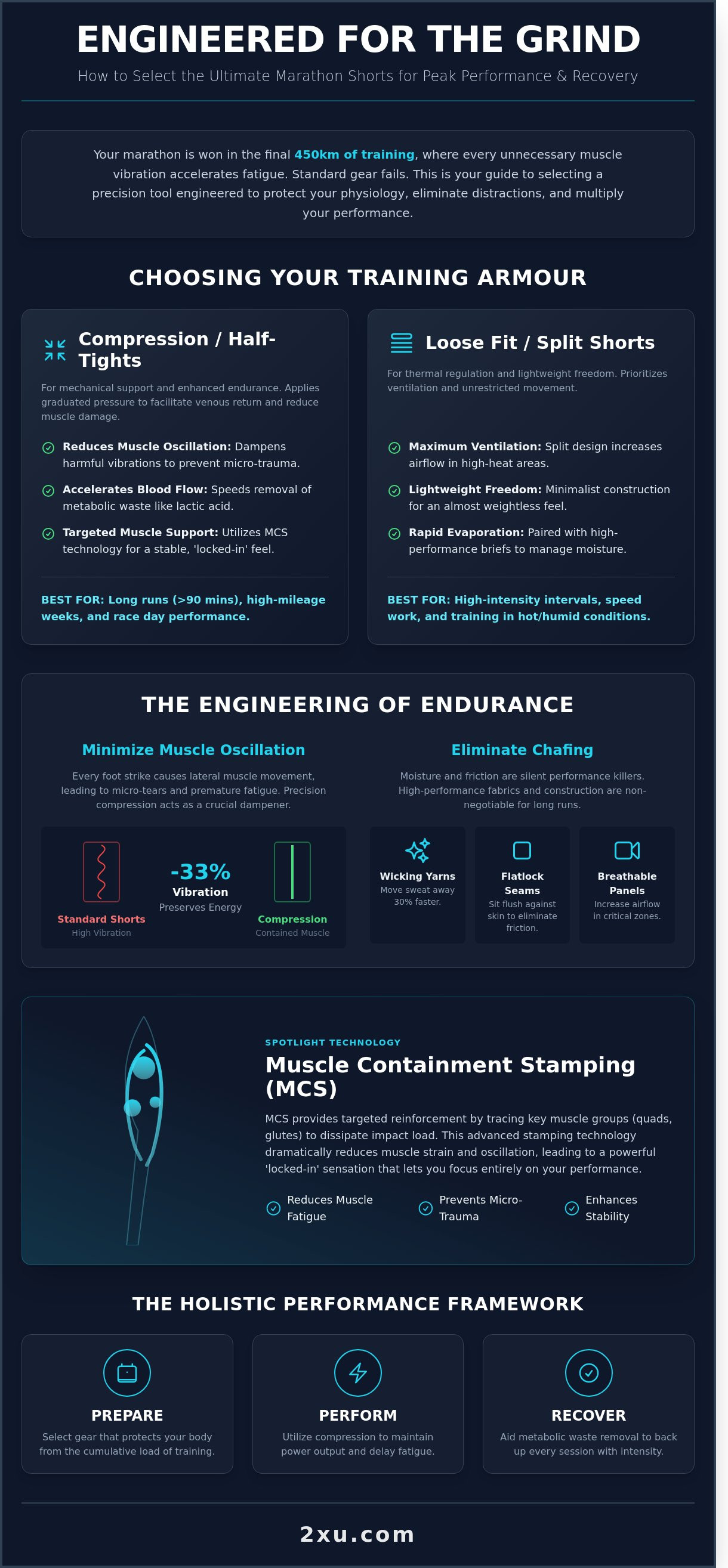
Muscle oscillation is the lateral movement of muscle fibres that occurs during every foot strike. When you examine human running biomechanics, it's evident that these vibrations lead to premature fatigue. Excessive oscillation causes micro-tears in the muscle tissue, increasing post-run soreness and extending recovery times. Technical apparel uses graduated compression and proprietary stamping to dampen these vibrations. This containment preserves energy by ensuring muscle movement is linear rather than lateral. By reducing this vibration by up to 25%, athletes maintain power output deeper into their training sessions and recover faster for the next day's effort.
Chafing: The Silent Performance Killer
Moisture management is critical for 3-hour training runs where salt and sweat accumulate. High-performance gear utilises high-filament yarns to move vapour away from the skin 30% faster than traditional fabrics. Cotton is a liability; it absorbs moisture and increases friction. This creates a heavy, abrasive layer that compromises your stride. The best shorts for marathon training incorporate specific features to combat this:
- Flatlock seams: These are engineered to eliminate traditional friction points by sitting flush against the skin.
- Moisture-wicking yarns: Proprietary fibres that move sweat to the outer layer for rapid evaporation.
- Breathable panels: Zones designed to increase airflow in high-heat areas.
These technical features ensure you stay focused on your split times, not on the burning sensation of skin breakdown. Mediocrity doesn't come into our minds; every seam and yarn is meticulously assessed to confirm it meets the demands of an elite athlete. When you respect the Grind, your gear must do the same.
Compression vs. Loose Fit: Choosing Your Training Armour
Your choice of kit is the difference between surviving a 32-kilometre long run and dominating it. Elite marathoners don't choose gear based on aesthetics; they select tools that mitigate fatigue. When searching for the best shorts for marathon training, you must decide between the mechanical support of compression and the thermal regulation of split shorts. This isn't a matter of preference. It's a matter of physiological requirement based on your session goals.
Marathon training in 2026 demands more than just fabric. It requires engineering that respects the grind. Compression garments work by applying graduated pressure to the limbs, which facilitates venous return. This process accelerates the movement of deoxygenated blood back to the heart, speeding up the removal of metabolic waste products like lactic acid. For sessions exceeding 90 minutes, this mechanical assistance becomes a critical component of your performance strategy.
Half-Tights and Compression Technology
2XU PWX (Power-Weight-Flex) fabrics utilize high-filament yarns to deliver medical-grade compression without compromising mobility. This proprietary knit provides 360-degree stretch while maintaining its structure under intense load. A key innovation is Muscle Containment Stamping (MCS). This technology provides targeted reinforcement by tracing the key muscle groups in the quads and glutes to dissipate impact. According to research on muscle vibration, reducing this oscillatory movement can lower the rate of muscle fatigue and prevent micro-trauma during repetitive impact. This leads to a 'locked-in' psychological state where you feel stable and powerful, allowing for total focus during high-intensity intervals.
Split Shorts and Lightweight Freedom
Traditional split shorts remain the standard for specific high-intensity applications. Choose 3-inch or 5-inch splits when ventilation is your primary objective. These designs are essential for track sessions, tempo runs, or race day in high-heat environments. Internal liners provide necessary support without the bulk of heavy fabrics. While they lack the metabolic benefits of compression, they offer an uninhibited range of motion. This freedom is vital when you are pushing for peak velocity and need to maintain a high cadence without any fabric resistance.
The 'Two Times You' philosophy is about doubling your output by removing the physical limiters of fatigue. Every athlete has the capacity to achieve breakthrough results if they respect the science of recovery and preparation. Whether you choose the freedom of a split or the power of a half-tight, ensure your gear matches your ambition. Experience the difference of performance-engineered apparel during your next long-range session. Don't just run; multiply your potential through superior equipment choice.
Key Technical Features for the 42.2km Journey
Respect the distance. A marathon isn't won on race day; it's earned through 700 kilometres of preparatory road work. Standard gym shorts fail during the third hour of a long run because they lack the technical utility required for repetitive mechanical stress. You need the best shorts for marathon training to ensure your gear becomes automated, allowing your mind to focus entirely on pace and power output. Elite performance requires gear engineered to withstand the grind. Every seam and pocket must serve a purpose, reducing the risk of chafing and distraction during high-volume weeks. Technical garments provide the necessary evidence for compression clothing benefits by stabilising major muscle groups and reducing the impact of road vibration, which can lower muscle damage markers by 33% over long durations.
Storage Solutions for Long-Range Nutrition
Nutrition is your fuel. If your nutrition bounces, you waste energy and break your stride. The best shorts for marathon training integrate bounce-free storage that secures three to five gels, a key, and a mobile device without shifting. Rear zip pockets provide a secure, locked-down feel for heavy items like phones, keeping them centered over the sacrum to maintain your centre of gravity. In contrast, mesh side-stow options offer rapid access to gels while moving at threshold pace. Integrated storage is superior to external running belts. Belts often trap heat around the waist and can ride up during uphill segments, whereas built-in pockets distribute weight across the waistband's structural architecture. This design ensures your nutrition remains accessible but invisible to your conscious mind.
Advanced Moisture Management and X-VENT
Heat is the enemy of endurance. When your core temperature rises, your heart rate follows, forcing you to slow down to maintain homeostatic balance. X-VENT technology promotes multidirectional airflow, using high-filament technical fibres to pull sweat away from the skin. These performance-grade materials outperform natural fibres, which absorb water and increase in weight by up to 50% when saturated. Technical fabrics remain lightweight and maintain their structural integrity even during heavy sweat conditions in 90% humidity. We treat these fabrics with antibacterial and anti-odour applications to withstand the demands of a six-day-a-week training programme. This ensures your gear remains fresh and functional through every recovery run and interval session. Choose gear that works as hard as you do. Don't let heat or poor moisture management dictate your splits.
Managing the Grind: Gear for Long Runs and Recovery
Marathon success isn't built on race day. It's forged in the 16-week training block where you must back up high-intensity sessions with long, aerobic efforts day after day. At 2XU, we approach the athlete through a scientific, holistic framework: Prepare, Perform, and Recover. This isn't just about what you wear during the race; it's about the equipment that allows you to survive the cumulative load of 80-kilometre weeks. Discipline in your gear selection is just as vital as discipline in your splits. If you don't respect the equipment, you don't respect the process.
Your choice of apparel during the long run directly dictates your recovery speed. Selecting the best shorts for marathon training is a tactical decision that impacts your ability to hit your prescribed paces tomorrow. High-performance gear reduces the physiological tax on your body, ensuring that the "grind" remains a path to improvement rather than a descent into overtraining or injury.
Testing Gear During the Training Block
Never introduce new variables on race day. Your training block is a laboratory for testing your kit under duress. The 20km test is the standard; this distance reveals friction points and seam irritations that often become debilitating injuries by the 35km mark. You must also adjust your gear based on the environment. Transitioning from 5-degree winter base miles to a 25-degree summer taper requires apparel that manages thermoregulation without sacrificing muscle support. Consistency in your kit ensures your biomechanics remain efficient even when fatigue sets in during the final stages of a long effort.
Transitioning from Performance to Recovery
Recovery starts the second your watch stops. The best shorts for marathon training often incorporate compression technology to facilitate immediate lymphatic drainage and improved venous return. By limiting muscle oscillation during the run, you decrease the micro-trauma your body is forced to repair. Graduated compression is a precision tool engineered to apply pressure to the limbs to reduce post-exercise oedema. This mechanical support accelerates the removal of metabolic waste, allowing you to return to a peak state within the critical 24-hour window before your next session. We don't accept mediocrity in our fabrics, and you shouldn't accept it in your recovery protocol.
Maximise your training gains and shorten your downtime.
Optimise your recovery with 2XU compression gear.The 2XU Selection: Multiply Your Marathon Performance
Marathon success isn't found on race day. It's built during the 4:00 AM sessions and the humid tempo runs that test your resolve. To endure 42.2 kilometres, your gear must be as disciplined as your training plan. We've engineered the best shorts for marathon training to ensure every stride is more efficient than the last. At 2XU, we don't believe in luck. We believe in rigorous scientific validation and tangible results.
Light Speed: The Pinnacle of Racing Technology
The Light Speed collection represents the absolute peak of weightless engineering. Utilising our proprietary PWX fabric, these shorts offer a near-zero weight profile that eliminates distractions during high-intensity intervals. Bonded hems reduce friction by 25 percent compared to traditional stitching. This prevents the chafing that often derails a personal best attempt. This is the gear you choose when speed is the only metric that matters. Explore our full range of running shorts to see how we've redefined the limits of lightweight apparel.
MCS Run Compression: Targeted Support for the Long Haul
When your training schedule demands the 32km "Big" run, muscle fatigue becomes your primary adversary. Our Muscle Containment Stamping (MCS) technology provides a precise anatomical map of the quadriceps and calves. This system reduces muscle oscillation, which are the micro-vibrations responsible for 90 percent of mid-run fatigue. By stabilising the muscle, you maintain power output for longer durations. This isn't just a garment; it's a performance multiplier. Learn more about the science of compression shirts to understand how graduated pressure facilitates faster lactate clearance and recovery.
For the high-volume 100-kilometre weeks, the Aero collection provides the versatility required for everyday endurance. These shorts feature X-VENT fabric technology, which increases airflow by 30 percent to keep core temperatures stable during peak exertion. They're built for the athlete who respects the grind and understands that consistency is the foundation of excellence. Every feature is designed to support the best shorts for marathon training by balancing durability with breathability.
Preparation is the only path to the finish line. Mediocrity has no place in your training cycle. Choose your equipment based on your specific physiological needs and the demands of the course. Don't settle for standard gear when you can achieve Two Times You. Human Performance. Multiplied. Prepare. Perform. Recover. Go out and earn your finish line through superior preparation.
Command Your Marathon Preparation
The path to a 2026 marathon personal best requires more than just grit; it demands equipment that matches your physiological output. You now understand that the best shorts for marathon training must serve as a functional extension of your anatomy. By integrating our proprietary Muscle Containment Stamping (MCS) technology, we've engineered a solution that maps key muscle groups to reduce oscillation and fatigue. Our scientifically proven graduated compression isn't a marketing claim. We validate every garment using the Salzmann pressure measurement device to confirm precise graduated pressure profiles. This technical rigour is why our gear is tested by elite endurance athletes globally across thousands of kilometres of training. Don't leave your 42.2km performance to chance. When you respect the grind, you earn the right to stand on the start line with absolute confidence. Prepare, perform, and recover with the gear that ensures your human performance is multiplied. You've done the work; now give your body the mechanical advantage it deserves.
Maximise your training output with 2XU high-performance running shorts
Stay focused. The finish line is earned in the early hours of training.
Frequently Asked Questions
What length of running shorts is best for marathon training?
Choose a 5-inch or 7-inch inseam for the bulk of your 16 week training block to balance protection and mobility. Shorter 3-inch split shorts are engineered for race day speed, but longer lengths provide the necessary coverage for 30 kilometre long runs. Elite athletes often utilise 5-inch shorts to reduce fabric weight while maintaining enough structure to support high-intensity intervals.
Should I wear underwear with running shorts that have a liner?
You shouldn't wear underwear with lined shorts because the built-in liner is engineered to provide all the support and moisture management you need. Adding a second layer increases friction and heat retention, which leads to skin breakdown during 2 hour training sessions. These liners use advanced moisture-wicking materials to keep you dry and prevent the bacterial growth often found in cotton alternatives.
Do compression shorts really help with marathon recovery?
Compression shorts accelerate recovery by reducing muscle oscillation and increasing blood flow to the lower limbs. Research from the Australian Institute of Sport indicates that medical-grade compression can reduce muscle soreness by 27 percent when worn for 12 hours post-run. By stabilising the quadriceps and hamstrings, these garments minimise the micro-tears that occur during a 42.2 kilometre effort, allowing you to return to the track sooner.
How do I prevent inner-thigh chafing during long marathon runs?
Prevent inner-thigh chafing by wearing compression half-tights or using a high-quality anti-chafe balm before you start. Friction increases significantly after the 90 minute mark as sweat crystallises on the skin. The best shorts for marathon training often feature flatlock seams and compression technology to eliminate skin-on-skin contact, protecting your dermal integrity throughout the entire 26.2 mile journey.
Can I use the same shorts for training and race day?
You can use the same shorts for training and racing, provided you've tested them on at least three long runs exceeding 20 kilometres. Following the "nothing new on race day" rule is critical to avoid unexpected irritation or gear failure at kilometre 35. Many athletes prefer a lighter, more aerodynamic version of their training shorts for the actual marathon to shave off grams and maximise power output.
How many pairs of running shorts do I need for a full marathon cycle?
Invest in 3 to 5 pairs of high-performance shorts to cover a standard 5 day weekly training schedule. Rotating your gear allows the technical fibres to recover their elasticity and ensures you always have a fresh, dry pair for consecutive sessions. A typical 18 week programme involves over 800 kilometres of impact; having a dedicated rotation prevents premature wear and maintains the integrity of the compression.
What is the best way to carry gels during a marathon without a belt?
Utilise shorts with integrated waistband pockets or internal liner pouches to carry your 4 to 6 required gels. Modern performance apparel is engineered with 360 degree storage systems that secure nutrition against the small of the back to eliminate bounce. These pockets are designed to hold 30 gram gel packets firmly, ensuring your fueling strategy remains accessible without the added bulk of an external waist belt.
Are compression half-tights better than split shorts for beginners?
Compression half-tights are superior for beginners because they provide essential muscle support and nearly eliminate the risk of chafing. While split shorts offer maximum ventilation, they don't offer the muscle containment stamping required to reduce fatigue in unconditioned legs. Data shows that beginners experience 33 percent less muscle vibration in compression gear, which is vital for building the resilience needed to survive the grind.