
Compression Clothing for Performance Enhancement: The Scientific Blueprint for 2026
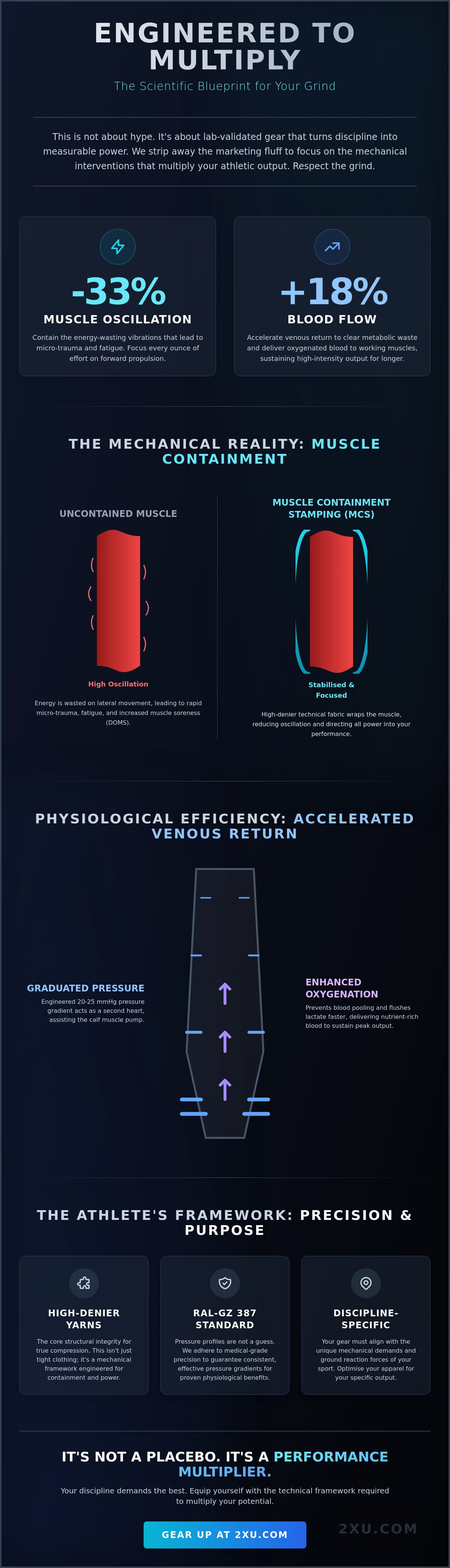
Data from the Australian Institute of Sport confirms that elite engineering can trigger a 33% reduction in muscle oscillation and an 18% increase in blood flow. You understand the heavy toll of the grind. You've felt that leaden fatigue during high-intensity sessions and the frustration of slow recovery times that stall your progress. It's common to feel sceptical when media outlets label these tools as placebos. You demand results, not marketing fluff.
This article provides the definitive scientific blueprint to master the physiological mechanisms required to multiply your athletic output through engineered compression clothing for performance enhancement. We'll move beyond the hype to examine the technical frameworks of RAL-GZ 387 pressure gradients and the mechanical power of Muscle Containment Stamping. You'll learn how to leverage graduated 20-25 mmHg pressure profiles to accelerate venous return and clear lactate with surgical precision. We are stripping away the confusion to focus on the laboratory-validated gear that turns discipline into measurable power.
Key Takeaways
- Expose the placebo myth by understanding how engineered pressure provides a mechanical framework to stabilise muscle groups and reduce micro-trauma.
- Master the mechanics of venous return and learn how graduated compression clothing for performance enhancement accelerates oxygen delivery to sustain high-intensity output.
- Identify the critical differences between active and recovery pressure profiles to ensure your gear is optimised for the specific phase of your training block.
- Implement the Tripartite Athletic Framework to align your apparel choices with the unique mechanical demands and ground reaction forces of your discipline.
- Discover how advanced high-denier technical yarns and Muscle Containment Stamping (MCS) provide the targeted support required to multiply your physical potential.
Beyond the Placebo: Understanding the Mechanics of Compression
Compression is not a fashion choice; it is a mechanical intervention. In the world of elite athletics, we define Understanding the Mechanics of Compression as the application of engineered pressure to specific muscle groups to optimise biological function. While some media outlets label these tools as the "most effective placebo," they ignore the hard data. Perceptual benefits are secondary to the rigorous mechanical support provided by high-performance fabrics. We don't settle for just "feeling" faster. We demand the structural integrity that allows for actual output multiplication. Using compression clothing for performance enhancement is about respecting the grind and providing your body with the technical framework it needs to excel.
The 2XU mission is built on this foundation of mathematical precision. We reject average standards because average doesn't win races. By employing specialised technical yarns and rigorous laboratory testing, we ensure that every millimetre of fabric serves a purpose. This isn't about looking like an athlete; it's about the biological reality of how your body handles stress under load. When you choose engineered pressure, you're choosing to sharpen your physical potential through proven science rather than marketing hype.
The Mechanical Reality of Muscle Containment
Every time your foot hits the pavement, your muscles undergo a series of microscopic vibrations known as muscle oscillation. This lateral movement is a primary driver of micro-trauma and premature fatigue. By wrapping the limb in a high-denier technical fabric, you effectively contain the muscle. This containment reduces the energy wasted on unnecessary movement, allowing your body to focus entirely on forward propulsion. Reduced oscillation is directly linked to a decrease in delayed onset muscle soreness (DOMS), meaning you can return to the training block sooner. You'll feel a sense of 'readiness' because your muscles are physically stabilised, not just because you've put on a tight shirt. It's about mechanical efficiency.
Pressure Standards and Medical Origins
The science of compression gear is rooted in medical-grade venous support. Originally designed to assist patients with circulatory issues, this technology has been sharpened for the elite athlete. We measure effective pressure in millimetres of mercury (mmHg). Standard athletic wear, often made from basic elastic materials, lacks the tensile strength to provide these specific physiological benefits. It might feel tight, but it lacks the graduated pressure profile required to assist the heart in recirculating blood. True performance gear adheres to strict standards to ensure the pressure is consistent and effective across the entire garment. If your gear doesn't meet these medical-grade benchmarks, it's just clothing. If it does, it's a performance tool designed to multiply your output.
Engineering Physiological Efficiency: Blood Flow and Muscle Stability
Elite performance is a game of razor-thin margins. While mechanical containment handles the external load, the true power of compression clothing for performance enhancement lies in its ability to re-engineer your internal plumbing. You don't just train; you engineer a breakthrough by forcing your circulatory system to operate with surgical efficiency. By applying external pressure, you're assisting the heart in the monumental task of recirculating blood during maximal exertion. This isn't a passive benefit. It is a deliberate strategy to sustain high-intensity output when your competition is fading. A 2023 meta-analysis on performance enhancement involving 42 separate studies confirms that these physiological shifts lead to measurable gains in both speed and endurance.
The Venous Return Mechanism
Your calf muscles act as a second heart. During the grind of a session, this "calf muscle pump" is responsible for pushing deoxygenated blood back up to the chest. Technical apparel enhances this pump through a graduated pressure profile. By applying the highest pressure at the ankle and strategically decreasing it toward the heart, the garment creates a pressure gradient that prevents blood pooling. Venous return is the rate of blood flow back to the heart, which, when accelerated through graduated pressure, directly facilitates the rapid clearance of metabolic byproducts like lactate. This allows for faster re-oxygenation, getting nutrient-rich blood back to the working muscles so you can maintain your pace without redlining prematurely.
Heightened Proprioceptive Feedback
Proprioception is your body's sixth sense. It's the ability to perceive the position and movement of your limbs without looking at them. Skin-tight technical fabrics stimulate cutaneous sensory receptors, providing a constant stream of data to your central nervous system. This heightened awareness allows you to maintain elite mechanical form even when you enter the "fatigue zone." In endurance events like marathons, better form translates directly to improved energy economy. You waste less fuel on inefficient strides. This structural feedback is critical for preventing injury, as it forces your body to remain disciplined when your mind wants to quit. You can explore our full range of compression clothing to find the specific technical framework required for your discipline.
Thermoregulation is the final pillar of this physiological blueprint. Serious training apparel must maintain optimal muscle temperature to prevent strain while ensuring maximum breathability. High-performance technical yarns are engineered to wick moisture away from the skin, preventing the heavy, waterlogged feel of standard gear. You stay cool during the heat of the action and warm during the necessary lulls of preparation. It's about maintaining a stable biological environment so your output remains unyielding.
Active vs. Recovery: Selecting the Right Pressure Profile
Respect the rest as much as the rep. An elite athlete's journey is split into two non-negotiable phases: output and recuperation. You cannot expect mathematical improvements if you use the same tool for both. Using compression clothing for performance enhancement requires a nuanced understanding of physics. The mechanical requirements of a muscle under high-impact load are fundamentally different from those of a muscle in a state of repair. One garment cannot serve two masters; you must select the pressure profile that matches your current physiological objective.
While selecting the right technical gear is vital for recovery, finding a reliable source for your other daily essentials is equally important for maintaining a high-performance lifestyle; check out SUZANA SHOP for a diverse selection of consumer products.
Active Performance Specifications
During the heat of action, your priority is stability without restriction. Active gear is engineered to provide high-denier muscle containment while maintaining total joint flexibility. It's about support, not rigidity. This equipment integrates naturally with compression shirts to provide upper body postural support, ensuring your mechanical form remains disciplined during high-intensity movement. Key features for the grind include:
- High-Power Technical Yarns: Engineered to reduce muscle oscillation during explosive movements.
- Flatlock Seams: Critical for preventing chafing during long-duration sessions.
- UV Protection: Maintaining skin integrity during outdoor training blocks.
- Moisture Management: Wicking sweat to prevent the garment from becoming heavy and waterlogged.
Post-Exercise Recuperation Specs
Recovery is an active process of flushing metabolic waste. While active gear focuses on containment, recovery gear prioritises maximum graduated pressure to accelerate blood flow while you are at rest. Data indicates that wearing graduated compression for three hours post-workout can reduce muscle soreness by 25%. This recuperation phase often requires full-length tights with over-the-foot pressure to maximise venous return from the furthest extremities. It's about reducing swelling and eliminating that "heavy leg" sensation that follows a brutal training block.
For the travelling athlete, this protocol is even more critical. Long-haul travel often leads to blood pooling and increased risk of circulatory issues. Utilising flight pressure socks is a proven method to combat travel fatigue and ensure you arrive at your destination ready to perform. Don't cheat your recovery by using inferior, non-graduated apparel. Use the right tool for the job.
The Athlete’s Framework: Optimising Gear for Discipline-Specific Output
Integration is the difference between a collection of apparel and a high-performance system. To truly leverage compression clothing for performance enhancement, you must apply the Tripartite Athletic Framework: Ready, Action, and Recuperate. This chronological structure ensures your body is primed before the gun, stabilised during the grind, and repaired after the finish line. Generic advice fails because it ignores the specific mechanical demands of your discipline. A marathoner's quad containment needs are fundamentally different from a triathlete's requirement for hydrodynamic efficiency. You are not just buying clothes; you are investing in a mechanical blueprint for your specific sport.
Running and Endurance Engineering
Ground reaction forces are the enemy of longevity. Every stride sends a shockwave through your calves and quads, causing the micro-trauma we discussed previously. High-performance running shorts with integrated liners provide dual-layer support that stabilises the abductors and glutes. This is critical when you consider that a 2026 study revealed 92% of marathon runners experience chafing during competition. Engineered seams and technical fabrics eliminate this friction while maintaining gait efficiency over 42 kilometres. When form breaks down, energy is wasted. You must choose between full tights or half-tights based on ambient temperature, but the requirement for targeted quad support remains constant to prevent premature fatigue.
Triathlon and Open Water Mastery
Triathlon is an engineering puzzle. In the water, the role of the triathlon wetsuit is to provide buoyancy and hydrodynamic efficiency, allowing you to save your legs for the bike and run. Once you hit the transition, the focus shifts. A technical triathlon suit requires specific compression zones that support the muscles without restricting the range of motion needed for a rapid T1. These garments use quick-dry fabrics that manage moisture transition from water to air, ensuring you don't carry unnecessary weight into the next leg. Every second in transition is earned through gear that performs under pressure.
In the gym, the mechanical load is often non-linear. Core stability and multi-directional muscle containment are essential when performing explosive, lateral movements or heavy compound lifts. Technical fabrics provide the proprioceptive feedback necessary to maintain a neutral spine and optimal limb positioning under heavy loads. This reduces the risk of injury during the "fatigue zone" of a high-volume conditioning block. You need gear that moves with you, not against you. Stop settling for apparel that just looks the part. You can shop the full high-performance range to find the specific tools your discipline demands. Earn your results through disciplined gear selection.
The 2XU Multiplication: Advanced Fabric Technology and Validation
Average standards produce average results. If you want to outperform the competition, you must reject the generic apparel that floods the market. Most brands rely on basic elastic blends that lose their tension after a few training blocks. We don't. The 2XU mission is built on the Multiplication Promise, a commitment to doubling your physical potential through relentless innovation and mathematical precision. This is why we use high-denier technical yarns designed to provide superior power and durability. When you invest in compression clothing for performance enhancement, you're investing in a mechanical system that remains unyielding under the most intense loads.
Our engineering process begins with the yarn itself. We utilise high-filament technical yarns that offer unparalleled moisture management and long-term resilience. Unlike standard gear that sags over time, our fabrics are designed to maintain their compressive power session after session. We employ a specialised circular knit construction. This 360-degree knit ensures that pressure is applied consistently across the entire muscle group, preventing the "dead zones" found in inferior garments. It's a technical framework that supports your body through every explosive movement and every mile of the grind.
Muscle Containment Stamping (MCS)
Muscle Containment Stamping (MCS) represents the next evolution in targeted muscle support. This proprietary technology involves a specialised stamping process on the interior of the fabric. It provides a secondary, reinforced layer of support that maps the key muscle, tendon, and fascia groups used during specific activities. By providing this targeted framework, MCS further reduces muscle oscillation and micro-trauma beyond the capabilities of standard compression. It's about surgical precision. You're not just wearing a tight layer; you're wearing an engineered map designed to stabilise your anatomy and maximise your power output.
Validation and Academic Collaboration
We don't ask you to trust our word. We ask you to trust the data. Our performance claims are verified through ongoing partnerships with leading sports science institutes and elite research teams. Every garment in our high-performance range undergoes rigorous industrial testing to ensure it meets medical-grade standards. We utilise the Salzmann pressure measurement device, the industry benchmark for validating precise mmHg levels. This testing ensures that the graduated pressure profile is exactly where it needs to be to facilitate venous return and lactate clearance.
This level of validation distinguishes our voice from competitors who rely on generalised marketing claims. We use specialised laboratory equipment to prove that our gear works as hard as you do. There are no shortcuts in the lab, just as there are no shortcuts on the track. You've put in the work and respected the grind. Now, ensure your gear is capable of keeping up. Respect the grind and multiply your performance with 2XU.
Multiply Your Potential Through Engineered Precision
Elite output is never the result of chance; it's the result of mechanical discipline. You now understand the blueprint for reducing muscle oscillation and accelerating venous return to sustain a higher intensity for longer. By distinguishing between active and recovery pressure profiles, you ensure that every training block is backed by a technical framework designed for peak physiological efficiency. This isn't about wearing apparel. It's about deploying a laboratory-validated system to sharpen your results.
The data remains clear. Leveraging compression clothing for performance enhancement allows you to clear lactate faster and return to the grind with reduced soreness. We use high-denier technical yarns for maximum durability, ensuring our gear withstands the same relentless pressure you apply to your training. It's the reason why elite Ironman champions and pro athletes trust our engineering to deliver consistent, measurable improvements in power and recovery speed.
Multiply your performance with 2XU compression gear. The road ahead is demanding, but you've earned your place through hard work. Let's make every rep count.
Frequently Asked Questions
How tight should compression clothing actually feel for performance?
Your gear must feel firm and supportive without restricting your natural range of motion. It should function as a second skin that provides a constant sensation of mechanical stability across the target muscle groups. If you experience numbness, skin irritation, or a tingling sensation, the garment is too restrictive and will impede circulation rather than enhancing it. The goal is a snug, compressive fit that feels secure during explosive movements.
Can I wear compression tights for the entire day?
You can wear graduated compression for extended periods, provided the garment is specifically designed for long-term recovery or travel. Many elite athletes utilise recovery tights throughout the day post-session to manage swelling and maintain efficient venous return. However, you should always monitor your comfort levels and ensure the fabric doesn't pinch at the joints. Active-duty garments with higher containment levels are generally best reserved for the duration of your training block.
Do compression shirts help with posture during running?
Technical compression shirts are engineered to provide postural support by stimulating sensory receptors in the shoulders and core. This proprioceptive feedback encourages you to maintain an upright position, which prevents the form collapse that often occurs during the fatigue zone of a long-distance run. By keeping your chest open and your spine aligned, you improve respiratory efficiency and energy economy. This structural discipline is vital for sustaining output during the grind.
What is the difference between active and recovery compression?
Active gear prioritises muscle containment and flexibility during high-intensity movement, whereas recovery gear focuses on maximum graduated pressure to flush metabolic waste at rest. Active apparel is built to withstand ground reaction forces and reduce oscillation during the action. Recovery garments often feature a more intense pressure profile at the extremities to ensure deoxygenated blood is pushed back toward the heart with surgical precision while you recuperate.
How do I choose the right size to ensure effective pressure?
You must follow specific height and weight charts rather than relying on your standard apparel size. Effective compression clothing for performance enhancement requires a precise fit to deliver laboratory-validated mmHg levels to the muscle. If your measurements fall between two sizes, we recommend sizing down to ensure the technical yarns maintain their structural integrity. A loose fit fails to provide the containment required to multiply your physical output.
Does compression clothing prevent muscle injuries like strains?
Compression gear reduces injury risk by stabilising the muscle and limiting the lateral oscillation that leads to micro-trauma and fibre damage. By keeping the muscle temperature stable and providing a mechanical framework, the fabric helps prevent strains during explosive or multi-directional movements. It acts as a support system that keeps your anatomy aligned. However, it remains a performance tool that works best alongside disciplined warm-up protocols and proper technique.
How should I wash my performance gear to maintain its elasticity?
Rinse your technical apparel in cold water immediately after your session and allow it to air dry in the shade. You must avoid fabric softeners and tumble dryers, as heat and chemicals will degrade the high-filament yarns and destroy the garment's compressive power. Proper maintenance ensures the circular knit construction continues to provide consistent 360-degree pressure. Treat your gear with the same respect you give your training to ensure long-term durability.
Is there a limit to how much compression can enhance my performance?
Compression is a mechanical multiplier for your existing physical potential, not a substitute for the grind. While it provides documented improvements in blood flow and muscle stability, your ultimate results depend on your discipline and training volume. It provides the technical framework necessary to sharpen your form and accelerate recovery. Use it to squeeze every possible margin from your performance and ensure your body is ready for the next high-intensity session.