
How to Prevent Chafing When Running: The Science of Frictionless Performance
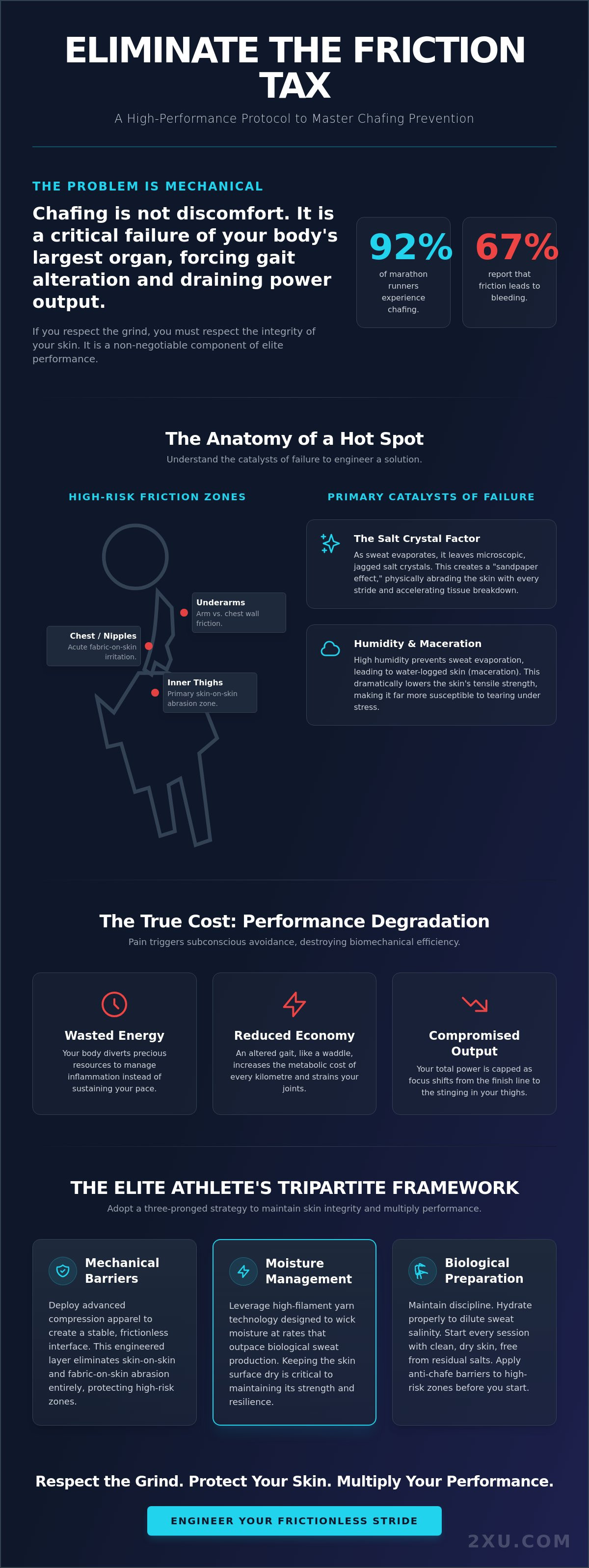
A 2026 study by Vaseline revealed that 92% of marathon runners experience chafing during competition, with 67% reporting that the friction leads to bleeding. This is not merely a discomfort; it is a critical mechanical failure that forces you to alter your gait and compromises your total physical output. If you want to maintain elite standards, you must master how to prevent chafing when running through rigorous biological and mechanical protocols. We understand the frustration of a training cycle interrupted by skin rawness or the excruciating sting of a post-run shower. This guide promises to deliver a permanent solution to friction by aligning your preparation with high-performance engineering. We will examine the science of moisture management, the importance of applying barriers to dry skin, and the role of advanced compression clothing in stabilising muscle tissue. You will learn to eliminate the variables that cause performance degradation and ensure your gear survives even the highest sweat rates to multiply your endurance.
Key Takeaways
- Quantify the "friction tax" as a mechanical failure of the epidermis that compromises gait efficiency and drains your power output.
- Master the technical protocols for how to prevent chafing when running by neutralising the abrasive effects of salt crystallisation on the skin.
- Deploy mechanical barriers using compression clothing to eliminate skin-on-skin contact and provide a stable, frictionless interface.
- Adopt a tripartite framework to maintain skin integrity across the entire athletic journey, from pre-run readiness to post-run recovery.
- Leverage high-filament yarn technology to wick moisture at rates that outpace biological sweat production, ensuring your gear remains a performance asset.
The Mechanics of Friction: Why Chafing Halts Your Progress
Chafing is not a minor inconvenience; it is a calculated mechanical failure of the human epidermis. At its core, The Mechanics of Friction involve the repetitive abrasion of the skin surface, where thousands of low-impact movements aggregate into significant tissue damage. This process creates a "friction tax" that saps your energy and forces your body to divert resources toward managing an inflammatory response rather than sustaining your pace. To truly understand how to prevent chafing when running, you must distinguish between skin-on-skin friction, typically occurring in the inner thighs, and fabric-on-skin irritation caused by coarse materials or poorly placed seams. Elite performance requires a zero-tolerance policy for skin breakdown. If you respect the grind, you must respect the integrity of your largest organ.
The Anatomy of a Hot Spot
A "hot spot" is the early warning sign of an impending system failure. As you run, your skin experiences micro-tears caused by the shear stress of repetitive strides. These microscopic lacerations trigger an immediate inflammatory response, manifesting as redness and a sharp, stinging sensation. Without intervention, these micro-tears escalate into full-thickness skin loss. High-risk zones are non-negotiable areas for protection:
- The Inner Thighs: The primary site for skin-on-skin mechanical abrasion.
- Underarms: Frequent contact between the upper arm and the lateral chest wall.
- The Chest: Specifically nipple friction, where fabric-on-skin irritation is most acute.
Performance Degradation and Gait Alteration
The true cost of chafing is found in your biomechanical efficiency. When the brain detects the pain of raw skin, it initiates subconscious pain avoidance protocols. This often results in a "waddle" or an unnaturally wide gait to prevent further inner-thigh contact. Such alterations destroy your running economy, increasing the metabolic cost of every kilometre and placing unnecessary strain on your joints. Elite athletes don't just endure the pain; they eliminate it. They prioritise prevention to maintain technical precision and ensure that their focus remains on the finish line, not the stinging in their thighs. Learning how to prevent chafing when running is a fundamental requirement for anyone serious about multiplying their physical output. It ensures that every ounce of effort is converted into forward momentum rather than being lost to the friction of your own movement.
Biological and Environmental Catalysts: Sweat, Salt, and Humidity
Sweat is a biological paradox. While your body relies on perspiration for thermoregulation, this fluid is the primary catalyst for skin failure. Initially, sweat acts as a lubricant, reducing the coefficient of friction between skin surfaces. However, as the water component evaporates, the chemical composition shifts. This transition is central to the medical definition of chafing, where the remaining solutes create a destructive environment for the epidermis. Mastering how to prevent chafing when running requires you to manage these biological variables with the same precision you apply to your split times.
Your hydration status directly dictates the abrasiveness of your sweat. Dehydration leads to a higher concentration of solutes in your perspiration, making it more viscous and irritating. When you maintain optimal hydration, you dilute the salinity of your sweat, reducing the potential for chemical irritation. High humidity levels compound this issue by preventing evaporation, leading to skin maceration. Softened, water-logged skin has a significantly lower tensile strength, making it far more susceptible to tearing under mechanical stress. To maintain performance, you must utilise engineered training apparel designed to manage moisture flow away from the skin surface.
The Salt Crystal Factor
The "sandpaper effect" is a literal description of salt crystallisation on the skin. As sweat dries during long-duration efforts, it leaves behind microscopic sodium chloride crystals. These jagged structures act as a physical abrasive, accelerating the breakdown of the skin's protective barrier with every stride. Long runs increase this accumulation, turning a minor irritation into a performance-ending wound. Proper pre-run hygiene is essential; ensure your skin is free of residual salts from previous sessions. Discipline in your preparation ensures that your skin remains a resilient shield rather than a liability.
Environmental Impact on Fabric Integrity
Environmental moisture, whether from high humidity or rain, fundamentally alters the mechanics of your gear. Standard fabrics often absorb water, increasing their total weight and causing the fibres to sag. This loss of structural integrity leads to increased fabric movement and bunching, which creates new friction points against the skin. You must optimise your gear choice based on the specific dew point and temperature of your environment. Technical materials that resist water absorption and maintain their compressive fit even when saturated are non-negotiable for the elite athlete. Respect the grind by choosing equipment that survives the elements without compromising your biomechanical efficiency.
Mechanical Barriers vs. Lubrication: Engineering a Frictionless Stride
Stop relying on temporary chemical films to fix a mechanical problem. It's a common mistake. While balms are popular, they are prone to failure in high-intensity scenarios where sweat volume and duration exceed the product's functional lifespan. Mastering how to prevent chafing when running requires an engineering mindset that prioritises permanent mechanical solutions over temporary chemical ones. This is the foundation of the "Second Skin" philosophy. By deploying high-performance compression, you eliminate skin-on-skin contact entirely, replacing an erratic biological interface with a stable, lab-tested one. These engineered fibres outperform loose-fit cotton or basic polymers, which absorb moisture and lose their structural integrity, eventually becoming the very source of the irritation you're trying to avoid.
The Case for Compression
Compression clothing is the primary tool for maintaining skin integrity. By locking muscle groups in place, compression shorts significantly reduce skin oscillation, which is a leading driver of mechanical abrasion. When your tissues are stabilised, the shear stress on your epidermis is minimised. Furthermore, elite-grade apparel must utilise flatlock seams. These low-profile joins sit flush against the skin, eliminating the raised ridges that cause linear irritation during thousands of repetitive strides. This isn't a matter of comfort; it's about maintaining a precise, uninterrupted biomechanical output. You earn your results through discipline, and your gear should be a reflection of that commitment to excellence.
Topical Solutions: When to Use Them
When assessing how to prevent chafing when running, you must recognise that topical solutions are a secondary layer of defence. In ultra-endurance or high-sweat environments, even the most resilient balms eventually wash away or become contaminated with salt crystals. Petroleum-based products are particularly problematic, as they can clog pores and degrade the elasticity of technical fabrics over time. If you must use a lubricant, prioritise silicone-based formulas for their superior water resistance and longevity. Reserve these solutions for anatomical areas that mechanical barriers cannot reach, such as between the toes or around the neckline. Use them strategically to support your gear, but never expect a gel to do the job of high-performance engineering.
- Silicone-based: High water resistance, stays on the skin longer during intense perspiration.
- Petroleum-free: Protects the integrity of your technical yarns and prevents pore blockage.
- Targeted application: Focus on small, high-friction areas like the heels, toes, and skin-fold junctions.
The Elite Athlete’s Protocol: A Tripartite Framework for Prevention
Elite performance isn't an accident. It's the result of a disciplined, chronological approach to skin management. To maintain a high output, you need a protocol that covers the entire athletic journey. This tripartite framework moves beyond simple lubrication, focusing on readiness, action, and recovery to ensure you never lose a session to avoidable tissue damage. Understanding how to prevent chafing when running starts with your equipment choices and ends with your post-run ritual. By treating your skin as a critical component of your mechanical system, you ensure that every training cycle remains uninterrupted.
Phase 1: Readiness and Gear Selection
Preparation starts in the lab and ends in your gear bag. You must select apparel engineered with high-filament yarns. These fibres provide superior moisture management by increasing the surface area for evaporation, ensuring your skin remains dry and resilient. For protecting the torso and underarms, the use of compression shirts is non-negotiable. They provide a stabilising layer that eliminates the friction caused by upper-body oscillation. Before every session, execute a zero-irritation checklist: inspect all seams for wear and ensure every tag is removed. If the gear isn't perfect, it doesn't belong on your body.
Phase 2: Action and Mid-Effort Management
During the peak of your effort, you must remain hyper-aware of your body's sensory feedback. A "hot spot" is a signal of mechanical failure. If you detect a sharp sting or localised heat, you must stop and re-apply protection immediately. Staying dry is the most effective way to manage how to prevent chafing when running during multi-hour efforts. Breathable gear prevents skin maceration, which is the softening of the epidermis that leads to rapid tearing. Respect the grind by managing these variables in real-time, especially when environmental conditions shift mid-race.
Phase 3: Recovery and Skin Repair
The protocol doesn't end at the finish line. Post-run hygiene is critical for removing residual salt and bacteria that can cause secondary irritation. Use lukewarm water and mild cleansers to avoid stripping the skin's natural oils. Once clean, apply topical repair creams to restore the lipid barrier of your epidermis. This accelerates the healing of any micro-tears and prepares your skin for the next session. Utilising immediate recovery gear helps stabilise both skin and muscle, reducing the inflammatory response. This ensures your body is ready for the next challenge without delay.
Multiply your capacity for endurance by equipping yourself with lab-tested compression clothing designed for the elite athlete.
Multiplied Performance: How 2XU Technology Eliminates Friction
Eliminating the friction tax requires more than just willpower; it requires superior engineering. At 2XU, our mission is to multiply human capability by removing the mechanical obstacles that hinder your progress. Our proprietary PWX (Power-Weight-Flex) fabric is the result of rigorous laboratory validation, designed to function as the ultimate mechanical barrier. By understanding how to prevent chafing when running at a molecular level, we've developed textiles that maintain their structural integrity under the most demanding conditions. This isn't just clothing. It's a performance-enhancing system that ensures your focus remains on the grind, not on the degradation of your skin.
PWX Fabric: The Ultimate Mechanical Barrier
The PWX circular knit structure is engineered to provide 360-degree stretch, ensuring the garment moves in perfect synchronisation with your musculature. Unlike standard knits that sag when saturated, our high-denier yarns maintain a consistent compressive fit that locks muscle groups in place. This reduction in muscle oscillation is a critical factor in how to prevent chafing when running, as it stops the repetitive skin rubbing that leads to epidermal breakdown. In high-friction zones, we deploy reinforced high-denier yarns to increase abrasion resistance without compromising breathability. The result is a stable interface that survives high-intensity sweat and maintains its technical precision over long-duration efforts.
Flatlock Seams and Tagless Construction
Traditional stitching creates raised ridges that act as saw-like edges against the skin. Our engineering protocol mandates the use of flatlock seams, which sit flush against the body to eliminate this "cutting" effect. Every seam placement is lab-tested to ensure it avoids high-movement junctions, providing a frictionless experience even during high-velocity strides. We've removed tags and unnecessary internal components to ensure a zero-irritation environment. This meticulous attention to detail is what distinguishes elite gear from average standards. We reject compromises. Your gear must be as unyielding as your discipline.
Multiply Your Output
Chafe-free running is a prerequisite for breakthrough performance. When you eliminate the pain and gait alterations caused by skin rawness, you unlock the ability to push your physical limits further. Respect the grind by equipping yourself with tools that match your ambition. Don't settle for gear that fails when the intensity peaks. High-filament yarns wick vapour faster than you can sweat, keeping your skin dry and your performance consistent. It's time to stop managing irritation and start multiplying your potential. Explore the full range of performance-engineered compression clothing and take command of your training cycles.
Master Your Mechanics for Uninterrupted Performance
Chafing is an avoidable friction tax that no serious athlete should pay. You've learned that this mechanical failure is driven by biological catalysts like salt crystallisation and environmental moisture. By prioritising mechanical barriers over temporary lubricants, you ensure your gait remains precise and your energy is directed solely toward forward momentum. Mastering how to prevent chafing when running is a fundamental discipline that separates the elite from the average. It requires a commitment to lab-validated equipment and a rigorous tripartite protocol of readiness, action, and recovery. Our PWX compression fabric and low-profile flatlock seams are engineered to withstand the most intense training cycles, a fact endorsed by elite triathlon and running coaches worldwide. Don't let skin breakdown dictate your finishing time. Equip yourself with 2XU performance gear and multiply your potential. You've put in the work; now, ensure your gear is as unyielding as your ambition. Stay focused and respect the grind.
Frequently Asked Questions
What is the best way to prevent inner thigh chafing while running?
The most effective method is the deployment of high-performance compression shorts to establish a permanent mechanical barrier. This eliminates skin-on-skin contact, which is the primary driver of inner thigh abrasion. By locking the muscles in place, you reduce the oscillation that causes the epidermis to rub against itself. This is a critical component of how to prevent chafing when running over long distances where gait consistency is paramount for elite output.
Can compression shorts actually stop chafing better than balms?
Compression shorts provide a superior solution because they offer a consistent physical interface that does not degrade with sweat. Balms are temporary chemical films that eventually wash away or become contaminated with abrasive salt crystals. While a lubricant might work for short sessions, high-intensity efforts require the unyielding protection of lab-tested fabrics. Relying on engineering rather than chemistry ensures your performance remains uninterrupted by the friction tax.
Why does my skin sting in the shower after a run even if I don't see a rash?
Stinging in the shower is the result of microscopic lacerations in the epidermis caused by repetitive shear stress. Even if no rash is visible, the integrity of your skin's barrier has been compromised by thousands of strides. These micro-tears allow water and soap to penetrate the deeper layers of the skin, triggering a sharp neural response. It's a clear sign that your current protocols for skin protection have failed under the pressure of the grind.
Is it better to wear underwear under compression shorts to prevent chafing?
You should never wear underwear under compression shorts if your goal is maximum friction reduction. Adding an extra layer creates additional seams and increases moisture retention, which leads to skin maceration and increased irritation. Compression gear is engineered for direct skin contact to facilitate efficient moisture wicking. Every additional layer is a variable that increases the risk of mechanical failure. Stick to the primary barrier and respect the design of your gear.
How do I treat skin that is already chafed so I can run tomorrow?
Immediate intervention requires gentle cleansing with lukewarm water followed by the application of a lipid-restoring repair cream. You must remove residual salt and bacteria without further irritating the damaged tissue. To run the following day, you must utilise a mechanical barrier like compression clothing to shield the area from further contact. Discipline in your recovery ritual is just as important as the effort you put into the training session itself.
Does humidity make chafing worse for long-distance runners?
Humidity significantly escalates the risk of chafing by hindering the evaporation of perspiration. This leads to skin maceration, where the epidermis absorbs excess moisture and becomes soft and vulnerable to tearing. In these conditions, your choice of gear is critical. You need high-filament yarns that can manage moisture flow even when the dew point is high. Mastering how to prevent chafing when running in humid environments is essential for maintaining your biomechanical efficiency.
What fabric is best for preventing running-related skin irritation?
High-filament yarns are the gold standard for preventing skin irritation because they maximise surface area for moisture transport. These fibres pull vapour away from the skin faster than biological sweat production can accumulate. Avoid materials that absorb water and sag, as they lose their shape and create new friction points. Elite athletes prioritise fabrics that maintain their structural integrity and compressive fit, ensuring a stable and dry interface regardless of the intensity.
How do I prevent nipple chafing during a marathon?
Preventing nipple abrasion requires the elimination of fabric oscillation through the use of a tight-fitting compression shirt. This provides a stable second skin that doesn't move independently of your body, stopping the repetitive rubbing that causes bleeding. For marathon-length efforts, this mechanical solution is far more reliable than temporary patches or balms. It's about engineering a zero-irritation environment so you can focus entirely on your pace and tactical execution.