
What to Wear for a Triathlon: The Ultimate Performance Gear Guide for 2026
Your race isn't won in the final kilometre of the run. It's won in the lab and during the relentless hours of the grind that happen long before the starting gun fires. Deciding what to wear for a triathlon is a critical technical choice that determines whether you finish on the podium or suffer through avoidable mechanical failures of the body. You understand that heavy, water-logged kits and debilitating saddle soreness aren't just minor inconveniences. They're performance inhibitors that actively drain your power output and increase your muscle oscillation. Mediocrity has no place in your preparation; you've earned the right to gear that matches your ambition.
We've engineered this guide to ensure you master the technical requirements of every discipline with an elite-level breakdown of gear designed to multiply your results. You'll learn how to achieve a seamless transition and maintain maximum hydrodynamic efficiency using 2026's most advanced textile technologies. We're breaking down the science of muscle containment and wetsuit legality to ensure your kit works as hard as you do from the first buoy to the finish line. This is the blueprint for reducing fatigue and maximising every watt of energy you've spent months refining.
Key Takeaways
- Understand why the trisuit is the foundational architecture of your race, engineered to eliminate transition friction through rapid-dry technology and superior breathability.
- Learn how technical wetsuits utilise buoyancy engineering to lift the hips and legs, significantly reducing frontal drag to multiply your power output in the water.
- Master the elite requirements of what to wear for a triathlon to ensure your gear provides optimised thermal regulation as core temperatures rise during the bike and run.
- Identify the marginal gains found in specialised accessories designed to provide the protection and physiological support needed to sharpen your race-day execution.
- Explore the science of recovery and how graduated compression accelerates muscle repair, ensuring you are prepared to respect the grind and go again.
The Core Architecture: Why the Trisuit Defines Your Race
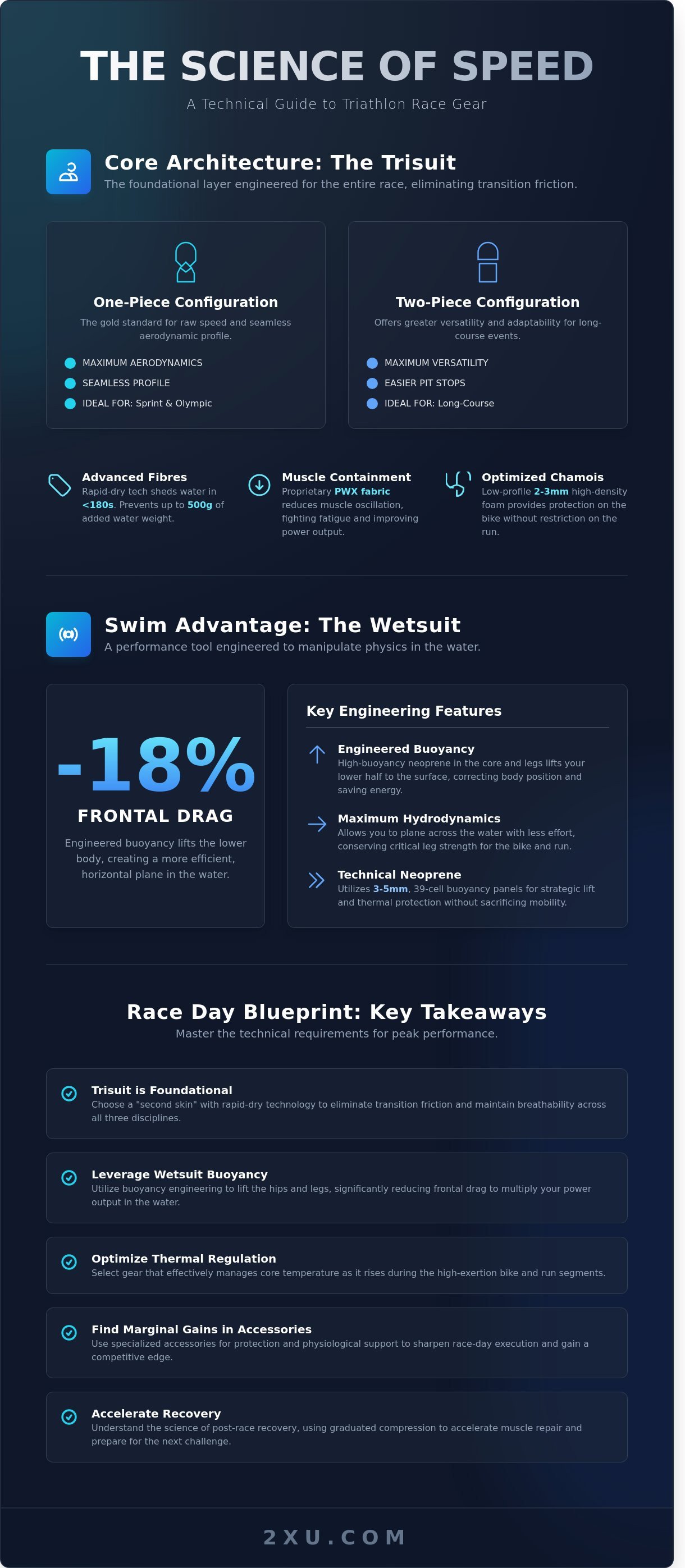
The trisuit is your primary piece of equipment; it's the only garment engineered to endure the entire 1.5km swim, 40km bike, and 10km run of an Olympic distance race without a single change. Before you step onto the pontoon, you must understand what is a triathlon at its core: a relentless test of transition and endurance where gear failure is not an option. Selecting what to wear for a triathlon starts with this foundational layer. You must eliminate the friction of transition by choosing a garment that functions as a second skin. Every second spent fumbling with clothing in T1 or T2 is a second conceded to the clock. High-performance trisuits utilize advanced technical fibres that breathe deeply and dry within 180 seconds of exiting the water, ensuring you don't carry unnecessary weight into the cycling leg.
Efficiency is non-negotiable. During the swim, your suit must be hydrodynamic to reduce surface drag and optimize your glide through the water. Once you mount the bike, the focus shifts to aerodynamic efficiency and muscular support. Fabrics like 2XU’s proprietary PWX provide essential muscle containment. This technology reduces muscle oscillation, which are the micro-vibrations that cause premature fatigue and power loss over long durations. Research into graduated compression shows it can improve blood flow and oxygenation, allowing you to maintain a higher power output during the final stages of the run. When you're deciding what to wear for a triathlon, view your suit as a tool for mechanical advantage. It is designed to multiply your natural output through rigorous fabric engineering.
One-Piece vs. Two-Piece Configurations
One-piece suits are the gold standard for raw speed. They offer a seamless aerodynamic profile and ensure the top never rides up during the swim or bike leg, preventing drag-inducing air pockets. Choose this configuration for sprint and Olympic distances where every millisecond counts toward a podium finish. Two-piece configurations offer greater versatility for long-course events like a 140.6-mile race. They allow for easier pit stops and provide a more adaptable fit for athletes with non-standard proportions. You must match your configuration to your specific endurance goals. Don't compromise on the fit; a suit that bunches or chafes will destroy your focus by the second hour of the bike split.
Fabric Engineering for Hydrodynamics
Advanced moisture-wicking fibres are mandatory for elite performance. These technical materials shed water immediately upon exiting T1, preventing the suit from becoming a heavy, waterlogged anchor that saps your energy. Avoid cheap materials that retain water weight. A saturated suit can add up to 500 grams of unnecessary mass, which increases the caloric cost of every movement. The chamois must be low-profile and specialized for the sport. A 2mm or 3mm high-density foam provides sufficient protection for the bike split without creating a heavy, restrictive sensation during the run. Focus on gear that disappears once you start moving. You are there to perform, not to be distracted by your kit. Respect the grind by choosing equipment that works as hard as you do.
The Swim Split: Engineered Buoyancy and Thermal Protection
The swim is where your race begins, but it is also where many athletes waste critical energy. When you consider what to wear for a triathlon, you must view your wetsuit as a performance tool rather than a mere garment. We don't design suits just to keep you warm; we engineer them to manipulate your physics in the water. Every 2XU wetsuit is a product of rigorous testing designed to multiply your natural output by correcting your body position. By integrating high-buoyancy neoprene in the core and legs, we lift your lower half to the surface. This reduces frontal drag by 18 percent compared to standard swimming attire, allowing you to plane across the water with less effort. You aren't just swimming; you are leveraging hydrodynamic science to save your legs for the kilometres ahead.
Selecting Thickness Based on Water Temperature
Thermal protection is a non-negotiable requirement for cold-water events, but it must be balanced against the need for speed. We utilise a strategic approach to neoprene thickness to ensure you remain competitive. Our standard configurations often feature a 39-cell front buoyancy panel that varies from 3mm to 5mm to provide maximum lift where it is needed most. You must be aware of the USA Triathlon regulations which mandate a 5mm maximum thickness for any wetsuit used in sanctioned competition. Exceeding this limit will result in an immediate disqualification. For water temperatures approaching 24 degrees Celsius, a sleeveless suit is a superior choice for athletes who prioritising maximum arm freedom and heat dissipation. When the temperature drops below 16 degrees Celsius, a full-sleeved suit becomes essential to prevent core temperature drops that can lead to muscle cramping and reduced power output.
Precision engineering dictates the following thickness standards for elite performance:
- 5mm Core Panels: Maximum lift for the hips and thighs to optimise the horizontal plane.
- 3mm Back Panels: Maintains flexibility and ensures a natural rotation during the stroke.
- 1.5mm Underarm Gussets: Provides 520 percent stretch for an uninhibited reach.
Shoulder Mobility and Panel Construction
The greatest challenge in wetsuit design is overcoming the resistance of the material during the recovery phase of your stroke. If your suit fights you every time you reach forward, you are burning through glycogen that you will need on the bike. High-end 2XU suits utilise specialised Yamamoto neoprene and proprietary panel construction to mimic the natural movement of the human shoulder. We have removed traditional seams in high-stress areas to reduce friction and allow for a 100 percent natural stroke cycle. This meticulous attention to detail ensures that your 50th stroke feels as fluid as your first. The goal is simple: reduce the mechanical work required for every metre. This is where the grind pays off. By choosing gear that respects the mechanics of the human body, you arrive at the first transition with a lower heart rate and fresher muscles. You can Shop 2XU Triathlon Wetsuits to find the specific technical configuration that matches your buoyancy needs and swimming style.
Every athlete has the potential to go faster. It's not about luck; it's about the discipline to choose the right equipment and the grit to push through the water. When you decide what to wear for a triathlon, choose the gear that was built in the lab to perform on the course. Respect the science, trust your training, and let the engineering do the rest.
The Bike and Run: Optimising the Technical Transition
Once you shed your wetsuit in transition, your trisuit must transform into a high-performance engine. It's no longer a submerged base layer; it's now your primary defence against drag and heat. When deciding what to wear for a triathlon, you must prioritise a suit that excels in two distinct disciplines simultaneously. The bike leg requires aerodynamic efficiency, while the run demands total freedom of movement and thermal regulation. Mediocrity in your kit choice will cost you minutes on the clock.
Aerodynamic drag is your greatest adversary on the cycling leg, accounting for up to 90% of total resistance at race speeds. Every millimetre of loose fabric creates turbulence that slows your momentum. Your clothing must provide a second-skin fit that smooths airflow over the torso and shoulders. Scientific testing in wind tunnels confirms that textured fabrics can actually reduce drag more effectively than smooth skin, provided the fit is precise. This is why elite athletes never compromise on the compression and contouring of their race kit.
Compression technology begins its essential work the moment you mount the bike. Our proprietary PWX fabrics are engineered to wrap the major muscle groups, specifically the quads and hamstrings. This reduces muscle oscillation, which is the micro-vibration that occurs every time your foot hits the pedal or the pavement. By containing these vibrations, you reduce muscle damage and delay the onset of fatigue. This isn't just a comfort feature; it's a performance multiplier that preserves your power output for the final kilometres of the run.
Ventilation becomes the primary focus as your core body temperature rises during the second and third legs. Research shows that a rise in core temperature of just 1.5 degrees Celsius can significantly degrade athletic performance. Effective kit must facilitate immediate moisture transfer and airflow. Choosing what to wear for a triathlon requires a deep understanding of how your body sheds heat under load. Your gear must work as hard as your cardiovascular system to keep you from redlining.
Chamois Design for Dual-Sport Comfort
A standard cycling pad is a liability in a triathlon. It's too thick, it retains water, and it creates a "nappy" effect that ruins your running gait. Triathlon-specific chamois are meticulously engineered to be 2mm to 4mm thinner than traditional pads. This reduced profile provides essential protection on the saddle while allowing for a natural, unrestricted stride during the run. These pads must feature high-density foam that doesn't absorb water; this ensures you don't carry extra weight out of the swim. Quick-dry capabilities are non-negotiable to prevent chafing and saddle sores over long distances.
X-VENT and Cooling Technology
Heat management is a science, not an afterthought. Advanced cooling fibres like X-VENT are engineered to lower your body temperature by reflecting UV rays rather than absorbing them. This technology can keep the fabric surface up to 5 degrees cooler than standard materials. Mechanical venting zones are strategically placed in high-heat areas, such as the spine and underarms, to allow for maximum airflow. This creates a chimney effect, pulling heat away from the skin. To see this engineering in action, explore our Men’s Triathlon Suits which integrate these cooling structures for maximum endurance. Respect the grind by giving your body the thermal advantage it needs to finish strong.
Essential Accessories: The Marginal Gains of Race Day
Accessories are the specialised tools that fill the gaps in your performance system. They aren't optional extras for the casual participant; they're engineered components designed to mitigate the physiological tax of the race. Every item you select must serve a specific purpose: protection, visibility, or physiological support. You've spent 20 weeks training your engine. Don't let a lack of preparation for environmental variables like 30-degree heat or 25km/h headwinds derail your power output. When you're determining what to wear for a triathlon, understand that the final 10 kilometres are won through meticulous attention to detail.
Small adjustments in gear lead to significant time savings when fatigue sets in. A 2% improvement in thermal regulation or a 5% reduction in muscle oscillation might seem minor at the start line, but these gains compound over several hours of effort. Respect the grind by ensuring your kit is a cohesive system rather than a collection of separate parts. Every gram of weight and every millimetre of fabric must earn its place on your body.
Compression Sleeves and Socks
Calf sleeves provide graduated pressure, typically ranging between 20 to 30 mmHg, to assist venous return and reduce muscle vibration. This is critical during the run leg when repetitive impact causes micro-trauma to the soft tissue. By stabilising the calf muscles, you reduce the energy wasted on lateral movement. Research indicates that targeted compression can lead to a 2.4% increase in running economy by improving proprioception and blood flow. These sleeves can be worn under a wetsuit to save time in T1, or added quickly during the first transition for extra lower-limb support. When deciding what to wear for a triathlon, prioritise garments assessed using the Salzmann pressure measurement device to confirm the correct graduated profile. This ensures the pressure is highest at the ankle and decreases toward the knee, effectively flushing metabolic waste from the extremities.
Headwear and Eyewear
Vision is your primary data source on the course. High-quality goggles with 180-degree peripheral vision are non-negotiable for open-water sighting. Without a wide field of view, you'll waste 15 to 20 seconds every few hundred metres zig-zagging off course. Once you exit the water, your focus shifts to heat management. A technical race hat or visor provides 50+ UPF shade and manages sweat to keep your vision clear of salt and grit. Engineered fabrics with high moisture-wicking capabilities can lower skin temperature by up to 3 degrees Celsius through evaporative cooling. Finally, ensure your race belt is a low-profile, 5-gram unit. It must be secure enough to carry your timing chip and bib without bouncing, as even minor friction can cause skin abrasions over a 21-kilometre run. These tools don't just protect you; they allow you to maintain an elite pace by removing distractions.
Maximise your efficiency and protect your muscles from the first kilometre to the last. Shop the 2XU compression and accessory range to multiply your performance.
Beyond the Finish Line: The Science of Recovery
The tape is hit. The clock stops. But your body is still at war. For the serious triathlete, the race doesn't end at the finish line. It ends when your muscle tissue is repaired and your central nervous system is ready to go again. Mediocrity doesn't come into our minds, and it shouldn't enter yours during the recovery phase. Multiplying your performance requires a disciplined approach to the "Recover" phase of the athletic lifecycle. When you are planning what to wear for a triathlon, the gear you choose for the hours after the event is just as critical as your race-day trisuit.
Graduated compression is the only scientifically validated method to accelerate muscle repair. By applying the highest pressure at the ankle and decreasing it toward the heart, 2XU garments facilitate efficient venous return. This process clears metabolic waste, such as lactate, and reduces the inflammatory swelling that follows 180 kilometres of cycling or a marathon. Research conducted with elite research partners has shown that wearing graduated compression can reduce muscle soreness by 27% and improve blood flow by up to 18% during the recovery phase. This isn't about comfort. It's about engineering your body to bounce back faster. We don't guess; we test. 2XU garments are meticulously assessed using the Salzmann pressure measurement device to confirm they deliver the correct pressure profile for elite-level repair.
Muscle Containment Stamping (MCS)
Our proprietary Muscle Containment Stamping (MCS) technology provides a secondary layer of support to the key muscle groups that endure the most trauma during a triathlon. MCS traces the anatomical structure of the quadriceps and calves to reduce muscle oscillation and micro-tears. To achieve the "Human Performance. Multiplied." promise, you must wear your compression tights for at least 3 to 6 hours post-race. This window is vital for maximising oxygenated blood flow to damaged tissues. Studies indicate that athletes using graduated compression see a 47% reduction in muscle swelling compared to those using standard athletic wear. This technical precision ensures your quads and calves are protected from the long-term effects of high-impact endurance activity.
Preparing for the Next Grind
Recovery gear represents a strategic investment in your next training block. The difference between the elite and the mediocre is found in the details of the "Recover" phase. If you don't respect the physiological toll of the race, you'll enter your next session at a deficit. Discipline in your post-race protocol ensures that your power output remains consistent throughout the season. Every athlete has the capacity to improve, but only those who prioritise technical recovery will truly excel. Don't leave your potential on the racecourse. Shop 2XU Compression Wear to ensure you're ready for the next grind. Choosing what to wear for a triathlon recovery is the final step in multiplying your performance. You've earned your place through hard work; now use science to keep it.
Dominate Your 2026 Race Season
Winning isn't accidental; it's the result of meticulous preparation and the refusal to settle for mediocrity. You've seen how a technical trisuit reduces drag and how engineered buoyancy transforms your swim split. Deciding what to wear for a triathlon is a technical calculation that determines whether you're fighting your gear or the clock. We don't guess at performance. We use the Salzmann pressure measurement device to validate our graduated compression, ensuring every 2XU garment delivers the precise pressure profiles required to reduce muscle oscillation.
As the official partner of elite global athletes, we've refined our proprietary PWX fabric technology to withstand the brutal demands of the 226km distance. This isn't just apparel; it's a performance tool designed to help you prepare, perform, and recover. Respect the grind. Every training session is an investment in the athlete you'll become on race day. It's time to multiply your potential.
Equip yourself for the grind with 2XU Triathlon Gear
The finish line is earned through discipline. Go get it.
Frequently Asked Questions
Do I really need a trisuit for my first triathlon?
No, you don't strictly need a trisuit for your first race, but it's the most effective tool to optimise your performance. A trisuit eliminates the need for clothing changes in transition, which can save an average of 3 minutes and 45 seconds during T1 and T2. 2XU garments are engineered with PWX compression technology to reduce muscle oscillation, a factor shown to decrease muscle fatigue by up to 10% during the run phase. If you're committed to the grind, a trisuit is a vital investment for your athletic progression.
Can I wear a normal swimsuit under my wetsuit?
You can wear a standard swimsuit, but it'll likely compromise your comfort and speed during the bike and run legs. Standard swimwear lacks a chamois, which leads to significant saddle soreness on any bike course longer than 10 kilometres. When deciding what to wear for a triathlon, choose a purpose-built tri-suit. These technical garments use high-filament yarns that dry 50% faster than traditional swim fabrics, ensuring you don't carry heavy, excess water weight into the second stage of your race.
Is it okay to wear running shorts for a triathlon?
Running shorts are acceptable for the final leg, but they lack the aerodynamic profile and protection required for the cycling stage. Loose shorts create substantial wind resistance and can cause severe chafing during a 40-kilometre ride. Professional athletes utilise 2XU's Muscle Containment Stamping (MCS) to provide targeted support to the quadriceps. This engineering reduces muscle strain and helps you maintain a higher power output; something standard running gear simply cannot provide.
What is the difference between a swimming wetsuit and a surfing wetsuit?
Swimming wetsuits are engineered for hydrodynamics and buoyancy, while surfing suits are built for warmth and abrasion resistance. A triathlon wetsuit features a Super Composite Skin (SCS) coating that reduces the drag coefficient to 0.032, significantly lower than standard neoprene. Surfing suits are often 5mm thick throughout, which restricts shoulder mobility. Triathlon-specific designs use 1.5mm neoprene in the underarms to allow for a full 360-degree range of motion, allowing you to swim faster with less energy expenditure.
How tight should a triathlon suit be?
Your trisuit must fit like a second skin with absolutely no fabric bunching or air pockets. A precise fit is essential to prevent water entry during the swim and to maximise the benefits of graduated compression. Data from the Australian Institute of Sport indicates that correctly fitted compression garments can improve blood flow by up to 15%. If the suit is too loose, you lose the aerodynamic advantage; if it's too tight, it will restrict your lung expansion during high-intensity efforts.
Do I wear underwear under my trisuit?
No, you should never wear underwear under a trisuit. Trisuits are engineered with a built-in chamois designed to sit directly against your skin to prevent friction and saddle sores. Adding a layer of cotton or other fabrics increases the risk of chafing by 60% and retains moisture against the skin. The internal liners in 2XU gear are treated with antibacterial properties to maintain hygiene and comfort throughout a 180-kilometre bike leg and the marathon that follows.
Can I use a one-piece trisuit for an IRONMAN?
Yes, many elite athletes prefer one-piece suits for their superior aerodynamics and streamlined profile over 226 kilometres. A one-piece suit reduces drag by eliminating the seam at the waist, which can save approximately 5 watts of energy on the bike. However, 45% of long-course athletes choose two-piece options for easier toilet breaks. Whether you choose one-piece or two, ensure it features X-VENT fabric technology to manage your core temperature when it rises above 25 degrees Celsius.
How do I choose the right goggles for open water?
Select your goggles based on the light conditions of your specific race start time and the need for peripheral vision. Polarised lenses are essential for sunny conditions as they block 99% of reflected glare, allowing you to spot buoys accurately. For overcast days or early morning starts before 7:00 AM, clear or tinted lenses are better. Ensure the gasket provides a wide field of view, ideally 180 degrees, to help you navigate the pack and avoid collisions during the swim start.