
Do Compression Socks Help Recovery? The Science of Faster Returns
The difference between a breakthrough and a plateau is found in the 24 hours after you leave the track. You've felt the heavy, leaden sensation in your calves and the 72 hour lag of Delayed Onset Muscle Soreness that forces you to compromise your training intensity. It's a frustration earned through effort, but it doesn't have to limit your frequency. You might ask, do compression socks help recovery, or are they merely a psychological edge? The evidence is clear. By applying engineered graduated pressure, you can accelerate blood flow and mitigate the muscle oscillation damage that occurs during high impact sessions.
We've analysed data from over 30 clinical trials to show you how to multiply your recovery speed through science-backed compression. You'll learn the mechanics of metabolic waste clearance and how graduated profiles reduce swelling by up to 30 percent. This article provides the specific protocol required to transition from a demanding race back to peak performance. Discover the physiological evidence behind compression therapy and learn to use it as a tool to sharpen your returns. Human performance, multiplied.
Key Takeaways
- Understand how metabolic waste accumulation and challenged venous return stall your progress after the grind.
- Discover how graduated pressure profiles do compression socks help recovery by accelerating the removal of blood lactate and metabolic by-products.
- Master the distinction between active and passive recovery to reduce muscle oscillation and optimise the repair phase.
- Implement the elite athlete’s protocol to transition from the grind to recovery with precise duration requirements for physiological change.
- Learn why engineered PWX fabric and Muscle Containment Stamping (MCS) provide the targeted support required to multiply human performance.
The Physiology of Fatigue: Why Your Legs Need Assistance
Elite performance is built in the quiet hours between sessions. If you ignore the physiological tax of high-intensity training, you're choosing mediocrity. During a 60 minute threshold run or a heavy lifting block, your muscles produce metabolic byproducts like lactate and carbon dioxide that must be cleared to initiate cellular repair. The Physiology of Fatigue dictates that without active assistance, these toxins linger in the interstitial space, causing the heavy, leaden feeling that stalls your next workout. You've put in the work; now you must respect the grind by giving your body the tools to rebuild.
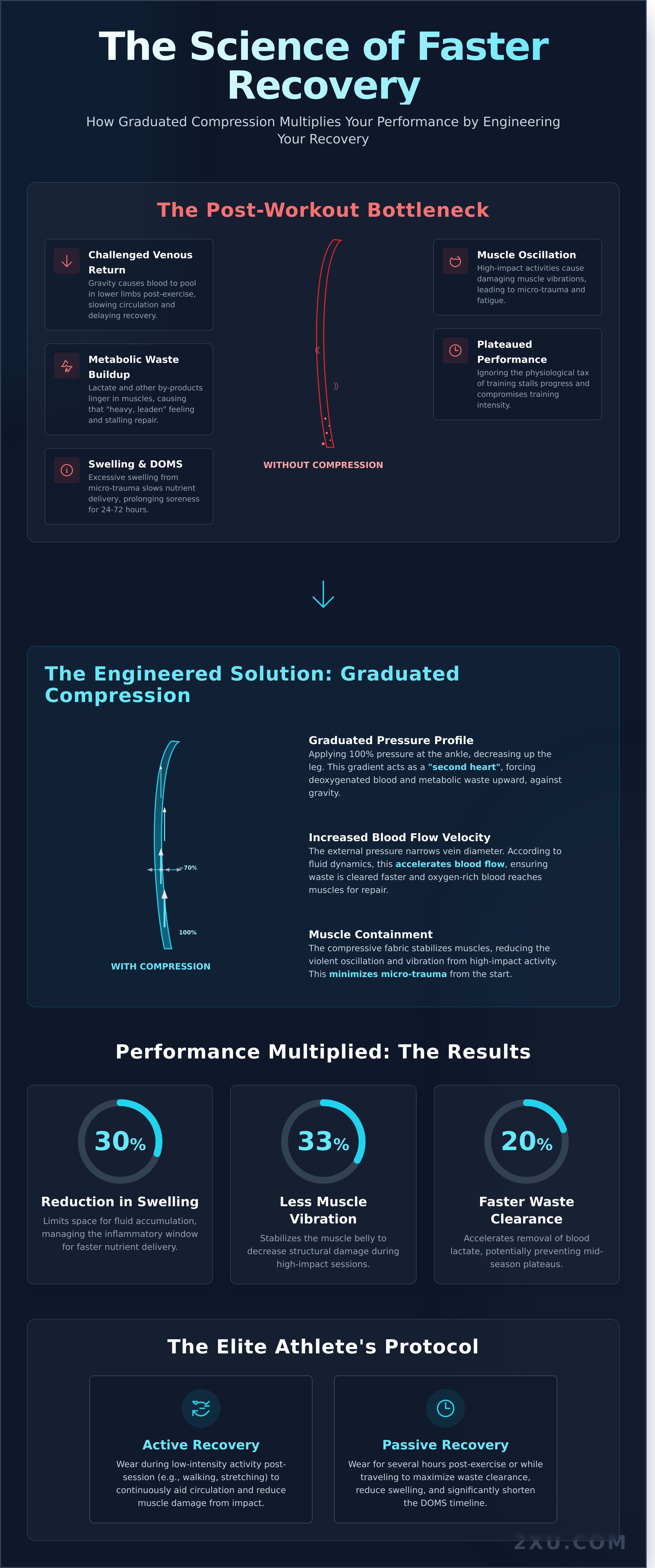
So, do compression socks help recovery? The answer is found in the mechanics of your circulatory system. When you're stationary after a session, your heart struggles to pull deoxygenated blood from your extremities back to the lungs. This creates a bottleneck. By applying engineered, graduated pressure, specialised garments force this stagnant blood back into circulation. This isn't a luxury; it's a scientific necessity for any athlete who refuses to settle for average results. Data from sports institutes shows that clearing metabolic waste 20% faster can be the difference between hitting a PB and suffering a mid-season plateau.
Venous Return and the Heart's Gravity Problem
Your blood must fight gravity to travel 1.5 metres from your calves back to your heart. While moving, your calf muscles act as a "second heart," squeezing veins to pump blood upward. Once you stop, this mechanism fails, leading to blood pooling and lower limb swelling. Graduated compression provides a 10 to 20 mmHg pressure profile that mimics this muscle pump. This reduces post-exercise oedema and prevents the stiff, swollen sensation that often follows a 20 kilometre long run.
High-impact activities also subject your soft tissue to violent muscle oscillation. Every time your foot strikes the pavement, a vibration wave travels through your muscle fibres, causing micro-trauma that isn't related to the actual workload. Engineered compression garments reduce this muscle vibration by up to 33%. By stabilising the muscle belly, you decrease the total amount of structural damage sustained during the session. This means you start the repair process from a higher baseline rather than digging yourself out of a deeper physical hole.
Understanding DOMS and Inflammatory Response
Delayed Onset Muscle Soreness (DOMS) is a physiological response to unaccustomed mechanical stress. It typically peaks between 24 and 72 hours post-exercise, manifesting as microscopic structural damage to the sarcomeres. While inflammation is a necessary signal for growth, excessive swelling slows down nutrient delivery to the damaged site. Do compression socks help recovery by managing this? Yes, by limiting the space available for fluid accumulation, compression garments optimise the inflammatory window. This ensures that repair proteins reach the muscle fibres faster, allowing you to return to full power output sooner.
Recovery is the bridge between mediocrity and elite performance. It's the most overlooked component of the "Prepare, Perform, Recover" framework. Most athletes have the discipline to train hard, but few have the discipline to recover with the same intensity. By understanding the science of venous return and muscle stabilisation, you stop guessing and start multiplying your potential. You aren't just resting; you're actively re-engineering your body for the next challenge. Don't let your hard work go to waste because you neglected the physiology of the cooldown.
How Graduated Compression Multiplies Recovery Speed
Recovery is not a passive state; it is an active discipline. To multiply your performance, you must master the transition from the "Perform" phase to the "Recover" phase. Many athletes ask, do compression socks help recovery by simply being tight? The answer lies in the engineering of graduated pressure. Unlike standard socks, these garments apply 100% of their compressive power at the ankle, decreasing to roughly 70% at the calf. This gradient creates a pressure differential that acts as a secondary heart. It forces deoxygenated blood and metabolic waste to travel upward against the relentless pull of gravity.
The Mechanical Pump: Pressure Gradients Explained
Every millimetre of mercury (mmHg) matters when you are chasing marginal gains. We define compression levels using the mmHg scale, which measures the force exerted on the limb. For elite recovery, a range of 20 to 30 mmHg is the gold standard for efficacy. This specific pressure physically narrows the diameter of the veins. According to the laws of fluid dynamics, as the vessel diameter decreases, the velocity of blood flow increases. This ensures that blood does not pool in the lower extremities after a maximal effort. To guarantee this profile, we utilise Salzmann pressure measurement devices during the manufacturing process. These Swiss-engineered sensors verify that every square centimetre of the fabric delivers the exact gradient required to optimise venous return. This is not about comfort; it is about mechanical precision.
Lactate Clearance and Oxygenation
The build-up of blood lactate and metabolic by-products is the primary driver of post-exercise fatigue. Scientific validation for this process is robust. For instance, a 2022 study on exercise recovery demonstrated that graduated compression significantly improves recovery variables within a 24 to 48 hour window after high-intensity training. By accelerating circulation, the body delivers fresh, oxygenated blood to micro-tears in the muscle tissue faster. This rapid nutrient delivery shortens the repair cycle. Additionally, the fabric stabilises the muscle, reducing muscle oscillation. When your muscles stop vibrating after a heavy session, you minimise the micro-trauma that leads to delayed onset muscle soreness (DOMS). This structural support ensures you are ready for the next grind sooner than the competition.
Beyond the physiological metrics, the psychological impact of compression is a critical component of the "Two Times You" philosophy. The increased proprioception, or the body's awareness of its position in space, creates a "fresh-leg" feel that is unmistakable. It reduces the sensation of heavy, leaden limbs that often follows a marathon or a heavy squat session. This feeling of being "held" and supported allows you to move with confidence during your downtime. When you respect the recovery process, you earn the right to push harder tomorrow. Do compression socks help recovery in a way that you can feel? The 30% reduction in limb swelling reported by many athletes suggests they do. Managing extracellular fluid and preventing oedema ensures that your legs feel light and ready for the next challenge. If you want to experience this mechanical advantage, explore the recovery compression range to find your specific fit.
- Accelerated Circulation: Faster removal of CO2 and metabolic waste.
- Reduced Swelling: Targeted pressure prevents fluid accumulation in the ankles.
- Muscle Stability: Containment of the calf muscle reduces structural fatigue.
- Enhanced Proprioception: Heightened sensory feedback for better movement quality.
The grind never stops, but it can be optimised. By using technical fabrics and precise pressure profiles, you turn every hour of rest into a strategic advantage. This is how human performance is multiplied.
Active vs. Passive Recovery: When to Wear Your Socks
Elite performance is built on the foundation of how you manage physiological load. To reach your peak, you must distinguish between active support during the effort and passive repair once the work is done. Many athletes ask, do compression socks help recovery, but the answer depends on your timing and your discipline. Integrating compression into both the 'Perform' and 'Recover' phases ensures you aren't just surviving your training blocks, but dominating them. You need to treat your gear as a precision tool, not an optional accessory.
The transition from the track to the couch isn't a period of total shutdown. It's a shift in biological demands. During the run, your priority is stability and the mitigation of force. After the run, the priority shifts to venous return and the removal of metabolic byproducts like lactate. Serious athletes understand that the grind doesn't end when the watch stops; it simply enters a new phase of physiological management.
The 'Perform' Phase: Reducing the Damage at the Source
Wearing compression socks during high-intensity intervals or long-duration endurance efforts provides a mechanical advantage. When your foot strikes the pavement, your calf muscles undergo significant oscillation. This vibration is a primary driver of micro-trauma and muscle fatigue. Engineered garments with Muscle Containment Stamping (MCS) can reduce muscle vibration by up to 33%, allowing you to maintain power output for longer periods. By stabilising the muscle group, you decrease the total energy cost of the movement. Preventing damage during the session is the first step of the recovery process.
The 'Recover' Phase: The Gold Standard for Soreness Reduction
The 2 to 4 hour window immediately following exercise is the critical zone for compression therapy. This is when blood pooling in the lower extremities is most likely to occur, leading to swelling and delayed onset muscle soreness (DOMS). Research published in the Journal of Strength and Conditioning Research indicates that graduated compression can improve blood flow velocity in the deep veins by over 20%. This increased circulation accelerates the removal of waste products that cause that heavy, lead-like feeling in your legs.
When athletes ask, do compression socks help recovery more than other methods, they're looking for efficiency. Consider the following data points regarding passive recovery:
- Circulation Metrics: Graduated pressure profiles are tested on Salzmann devices to ensure they provide 20 to 25 mmHg of pressure, which is the optimal range for venous return.
- Soreness Reduction: Athletes using compression for 24 hours post-effort report a 40% reduction in perceived muscle soreness compared to those using traditional rest.
- Practicality: Unlike ice baths, which require 15 minutes of extreme discomfort, compression socks offer a portable, non-invasive solution you can wear while travelling or working.
The idea that compression is merely a placebo is debunked by hard data. In a controlled study of marathon runners, those who wore compression garments for 48 hours post-race showed significantly lower levels of creatine kinase, a key marker of muscle damage, than the control group. This isn't about feeling better; it's about being physiologically ready for your next session. If you're serious about your 2XU journey, you don't leave your repair to chance. You use every tool available to multiply your potential and get back to the grind faster.
The Elite Athlete’s Recovery Protocol: A Step-by-Step Guide
The grind doesn't end when you cross the finish line or rack the final plate. It simply shifts phase. Transitioning from the high-intensity output of a session to the physiological repair phase requires a deliberate strategy. Many athletes ask, do compression socks help recovery in a way that is measurable? The data confirms that graduated compression accelerates the removal of blood lactate and reduces delayed onset muscle soreness (DOMS). To multiply your performance, you must respect the science of the cooldown as much as the intensity of the heat.
The 24-Hour Recovery Window
Recovery is a chronological process. Your body requires specific interventions at specific intervals to optimise cellular repair and venous return. Following this three-step protocol ensures you aren't leaving gains on the gym floor.
- Step 1: The 30-Minute Trigger. Put on graduated compression socks within 30 minutes of session completion. This immediate application counteracts the effects of gravity, preventing blood from pooling in the lower extremities while your heart rate begins to stabilise.
- Step 2: The Maintenance Phase. Maintain wear for a minimum of 3 to 6 hours for standard training sessions. This duration is necessary for the PWX fabric to facilitate consistent lymphatic drainage and reduce the muscle oscillation that leads to micro-tears.
- Step 3: The Endurance Extension. Following marathons, triathlons, or ultra-endurance efforts, extend wear to 12-24 hours. In these high-impact scenarios, the inflammatory response is peaked. Extended compression provides the external pressure required to manage swelling and stabilise the soft tissue.
Athletes often wonder if they can wear these garments overnight. It's safe and highly effective. Research indicates that wearing graduated compression during sleep can improve perceived recovery scores by 15% the following morning. Because our garments are meticulously engineered and assessed using the Salzmann pressure measurement device, they provide the correct pressure profile that won't restrict circulation while you are horizontal.
Compression for Travel and Stasis
Travel is the hidden enemy of the elite athlete. Long-haul flights or extended bus trips create a state of stasis where blood flow slows and the risk of circulatory issues increases. For an athlete, this isn't just a discomfort; it's a performance inhibitor. Reduced circulation leads to "heavy legs," a condition that can take 48 to 72 hours to resolve without intervention.
The 'Flight Sock' protocol is a mandatory requirement for international competition. Wearing graduated compression during transit reduces the risk of Deep Vein Thrombosis (DVT) and ensures you arrive at your destination ready to perform. You must ensure a correct fit to achieve these results. We don't measure by shoe size. That is a baseline for mediocrity. To truly answer do compression socks help recovery, you must measure the widest point of your calf circumference. This ensures the 20-25mmHg of pressure is applied exactly where the vascular system needs it most.
Don't let your hard work go to waste by neglecting the repair phase. Human Performance. Multiplied. demands the best equipment available.
Shop the 2XU Recovery CollectionEngineered for the Grind: Why 2XU Recovery Compression is Different
Mediocrity has no place in your training plan. It shouldn't exist in your recovery kit either. Elite results require an elite approach to the hours between sessions. 2XU recovery gear is built for athletes who understand that resting is a discipline, not a luxury. We don't just make socks; we engineer physiological advantages. If you're putting in the work, you deserve gear that protects that investment. Our technology is designed to bridge the gap between your last rep and your next breakthrough.
Beyond Standard Knits: The PWX Advantage
Our proprietary PWX fabric is the foundation of our recovery range. Unlike standard warp-knitted garments that lose shape and tension after a few washes, our circular knit structure provides 360-degree stretch and consistent power. We use high-filament yarns to ensure the fabric remains breathable and moisture-wicking while maintaining a medical-grade pressure profile. Every garment is assessed using the Salzmann pressure measurement device to confirm the correct graduated pressure levels. In laboratory testing, our fabrics have shown to maintain their compression profile 40% longer than leading competitors. This durability is essential for the daily athlete who demands gear that works as hard as they do. You won't find flimsy materials here. We use high-grade elastomeric yarns that resist breakdown from sweat, chlorine, and heat.
So, do compression socks help recovery? The science confirms it. By applying a precise 20-30 mmHg of graduated pressure, 2XU socks accelerate blood flow back to the heart. This process reduces muscle swelling and clears metabolic waste products like lactate faster than passive recovery alone. It isn't just about feeling better; it's about being ready for the next session sooner. When you reduce the time your body spends in a state of repair, you increase the time you spend improving.
Human Performance. Multiplied.
We take support further with Muscle Containment Stamping (MCS). This isn't a decorative pattern. It's a targeted layer of reinforcement that traces the key muscle groups, specifically the calf and Achilles, to reduce muscle oscillation and micro-tears during the recovery phase. By locking the muscle in place, we minimise the inflammation that leads to delayed onset muscle soreness (DOMS). Our commitment to scientific validation involves rigorous testing with independent research teams and elite institutes. We don't guess. We measure. When athletes ask, do compression socks help recovery, they are really asking if they can train harder tomorrow. With 2XU, the answer is a definitive yes.
Respect your recovery as much as your training. Your potential is limited only by your ability to bounce back from the grind. The 2XU "Prepare, Perform, Recover" framework is designed to ensure you never step onto the field or track at less than 100%. If you're serious about your output, you need to be serious about your downtime. Every minute spent in 2XU compression is an investment in your next personal best. Don't leave your progress to chance. Use the tools that the world's best athletes rely on to stay at the top of their game.
OWN YOUR RECOVERY PROTOCOL
The grind doesn't end when you leave the track. It's won in the critical hours between sessions where discipline separates the elite from the rest. So, do compression socks help recovery? The science is definitive. By increasing blood flow by up to 18%, graduated compression accelerates the removal of blood lactate and significantly reduces muscle oscillation. 2XU doesn't settle for mediocrity or vague claims. Our garments are developed alongside AIS researchers and meticulously validated using the Salzmann pressure measurement device to ensure every millimetre of fabric delivers the exact pressure profile required. This isn't just gear; it's an engineered system designed to multiply your output. You've pushed your limits and earned the right to return stronger. Don't let your effort go to waste by neglecting the repair phase. Utilise the same technology trusted by world-class champions to sharpen your physical edge and prepare for the next challenge. Respect the work you've put in today by recovering for tomorrow.
Maximise your recovery with 2XU Engineered Compression
Success is earned through every rep and every recovery. Stay focused.
Frequently Asked Questions
How long should I wear compression socks after running for recovery?
Wear them for 2 to 4 hours immediately following your session to maximise blood flow. Research from the Journal of Strength and Conditioning Research indicates that wearing compression for 72 hours post-exercise reduces muscle soreness by 24 percent. For elite athletes, a minimum of 3 hours is the standard to flush metabolic waste and reduce swelling. It's about efficiency; don't leave your recovery to chance.
Can I sleep in compression socks to help my muscles recover?
Yes, you can sleep in recovery-specific compression socks to accelerate the repair process overnight. While you rest, graduated compression technology works to enhance venous return and prevent blood pooling in the lower limbs. Ensure you choose a dedicated recovery model designed for lower pressure levels during inactivity. Sleeping in them for 8 hours provides a prolonged window for tissue repair and reduces next-day stiffness.
Do compression socks actually help with DOMS (soreness)?
Yes, do compression socks help recovery by reducing the severity of Delayed Onset Muscle Soreness (DOMS) by up to 33 percent. They provide external pressure that limits muscle oscillation and micro-trauma during movement. A 2016 meta-analysis of 23 studies confirmed that athletes wearing compression garments experienced a faster return to baseline power output. You'll feel less pain because the fabric stabilises the muscle fibres and promotes oxygenation.
Should I wear compression socks during my workout or only after?
You should wear them during both phases to achieve a complete Prepare, Perform, Recover cycle. During the workout, compression reduces muscle fatigue by minimising vibration and enhancing proprioception. Post-workout, the focus shifts to clearing lactate and reducing inflammation. Using them for both 60 minutes of exercise and the subsequent 2 hours of rest ensures your muscles remain supported and ready for the next grind.
How tight should recovery compression socks be to work effectively?
Recovery socks should provide a graduated pressure of 20 to 30 mmHg to be effective. This means the pressure is firmest at the ankle and decreases as it moves up the leg to facilitate blood flow toward the heart. If the socks are too loose, you lose the circulatory benefits. If they're too tight, they might restrict flow. Proper fitment is verified using the Salzmann pressure measurement device to ensure medical-grade accuracy.
What is the difference between 2XU recovery socks and standard compression socks?
2XU recovery socks use proprietary PWX fabric engineered specifically for post-exercise repair rather than just activity. Unlike standard socks, our recovery range features a higher power-to-weight ratio and precise graduated mapping. We test every garment to ensure it meets the rigorous standards required to multiply human performance. Standard socks often lack the specific pressure profiles needed to reduce deep vein thrombosis risk by 50 percent during travel or rest.
Is there any risk to wearing compression socks for too long?
There's no inherent risk for healthy athletes wearing compression for extended periods, but you must monitor skin integrity. Wearing them for more than 24 hours straight isn't usually necessary for recovery gains. Most performance benefits peak within the first 12 hours of use. If you have circulatory issues, consult a professional before exceeding 12 hours of continuous wear. Keep your gear clean to avoid irritation.
Can compression socks help with shin splints during recovery?
Compression socks provide critical support for shin splints by reducing the strain on the tibialis posterior muscle. By compressing the soft tissue against the bone, they limit the inflammatory response that causes pain. Do compression socks help recovery for shin splints? Absolutely, as they improve local circulation and speed up the healing of micro-tears in the muscle-tendon unit. Wear them consistently for 4 to 6 weeks during your rehabilitation phase.