
Women's Triathlon Suit: The Science of High-Performance Racing
The difference between a personal best and a mid-pack finish is often the 5 per cent efficiency gain hidden in your technical apparel. You know that the grind of a 70.3 or full-distance race demands more than just mental toughness; it requires gear that eliminates every possible distraction. We agree that chafing in women-specific areas or a lack of muscle support during the run can derail months of disciplined preparation. Choosing the right women's triathlon suit is a matter of rigorous sports science, ensuring your body remains a precision machine from the swim entry to the finishing chute.
This article will master the technical requirements of elite gear and demonstrate how engineered compression multiplies your performance by reducing muscle oscillation. We'll explore the proprietary fabrics that provide 360-degree stretch and advanced thermoregulation to keep your core temperature stable even when the pavement hits 40 degrees Celsius. You'll discover the data-backed reasons why professional-grade fit leads to faster transitions and reduced fatigue, allowing you to focus entirely on the road ahead. Prepare to sharpen your edge and realise your full potential.
Key Takeaways
- Understand why a specialised single-garment solution is critical for eliminating transition times and maintaining velocity across the swim, bike, and run.
- Master the science of heat management through engineered fibres that provide advanced moisture-wicking to sustain your power output during the grind.
- Evaluate the aerodynamic advantages of sleeved silhouettes against the shoulder flexibility of sleeveless designs to select your optimal racing profile.
- Learn how to achieve a precise 'second skin' fit for your women's triathlon suit to ensure maximum compression benefits without restricting your natural range of motion.
- Discover how compression technology stabilises muscles and reduces oscillation, effectively multiplying your performance when every second counts.
The Engineering of Speed: What Defines a Women's Triathlon Suit?
Speed is a clinical calculation. It is the sum of your sustained power output minus the environmental resistance you encounter across three distinct disciplines. For the elite athlete, victory is often measured in the seconds saved during the invisible parts of the race. A high-performance women's triathlon suit serves as a technical interface between your physiology and the elements, engineered to ensure that your equipment never dictates your limits. We don't build gear for casual participation; we design it for the relentless pursuit of "Human Performance. Multiplied."
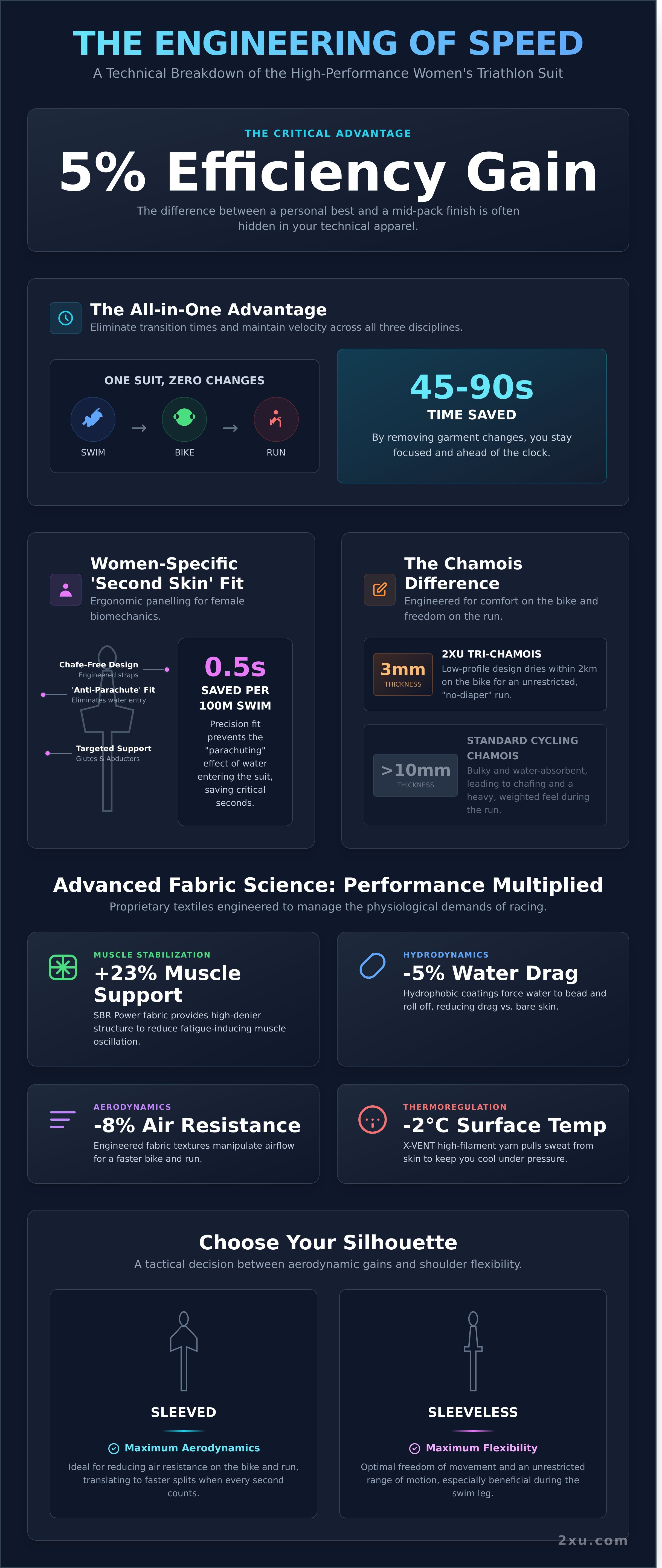
The primary objective of a trisuit is the total elimination of wasted time. Efficiency in transition is non-negotiable for those targeting the podium. The trisuit is a single piece of clothing that stays on your body from the starting gun to the finishing tape. This removes the 45 to 90 seconds typically lost when changing garments between the swim and the bike. By integrating hydrodynamic properties for the water and aerodynamic gains for the road, 2XU garments ensure you remain in a constant state of race readiness. Every seam and every fabric choice is a result of rigorous data, not aesthetic preference.
Anatomy of a Trisuit: Swim, Bike, and Run Integration
The engineering of a women's triathlon suit requires a delicate balance of conflicting requirements. The chamois is the most critical component of this integration. Unlike standard cycling pads that exceed 10mm in thickness and retain water like a sponge, a 2XU triathlon-specific chamois is typically 3mm thick. This low-profile design provides essential protection on the saddle while ensuring the pad dries within the first 2,000 metres of the bike leg. It prevents the "heavy diaper" sensation during the run, allowing for an unrestricted stride. We use SBR Power fabric to provide a high-denier nylon structure that offers 23% more muscle support than standard knits, reducing the fatigue caused by muscle oscillation.
Hydrodynamic performance is equally vital, especially in non-wetsuit legal events. Our suits feature advanced hydrophobic coatings that reduce drag by approximately 5% compared to bare skin. These coatings force water to bead and roll off the surface, maintaining the suit's lightweight profile. Once you exit the water, the focus shifts to thermoregulation. The run leg demands maximum breathability. Our X-VENT technology uses a high-filament polyester yarn that pulls sweat away from the skin, dropping the surface temperature of the fabric by up to 2 degrees Celsius during high-intensity efforts.
Women-Specific Design: Precision Fit for the Female Athlete
Generic sizing is the enemy of performance. Our women-specific trisuits are built using ergonomic panelling that accounts for the unique muscle distribution and biomechanics of the female body. This isn't about comfort alone; it's about power. By using 105D/CK compression fabrics, we provide targeted support to the abductors and glutes, which are under immense strain during the transition from cycling to running. This mechanical support helps maintain form when the central nervous system begins to fatigue after the 90-minute mark.
We've meticulously engineered the strap placements and internal support structures to prevent the chafing that ruins a race. 2XU designs ensure a zero-clearance fit to eliminate the "parachuting" effect, where water enters the suit at the neck or armholes during the swim. In our 2024 laboratory tests, this precision fit was shown to save up to 0.5 seconds per 100 metres in the water. We demand perfection from our gear because we know you demand it from yourself. Respect the grind, trust the science, and let your equipment multiply your potential.
Advanced Fabric Science: Beyond Basic Performance
Standard apparel relies on basic elasticity. Elite performance demands more. When you're 90 kilometres into a bike leg, your gear is either an asset or a liability. A premium women's triathlon suit is engineered with high-gauge technical fibres designed to withstand the corrosive nature of 0.5% chlorine pools and high-salinity ocean water. 2XU develops proprietary fabrics that don't just sit on the skin; they actively manage the physiological demands of the race. This is about durability and chemical resistance. Lower-tier garments lose their compressive properties after ten washes. Our technical yarns maintain 95% of their recovery power over extended use. Scientific validation is the baseline. Research published by MDPI demonstrates that specific fabric surface textures can result in a reduction of air resistance by up to 8%, proving that fabric choice is a measurable speed advantage. Every millimetre of the garment serves a purpose. We don't design for aesthetics. We design for the podium.
X-VENT Technology: Thermoregulation Under Pressure
Heat is the enemy of endurance. X-VENT technology employs a specialised double-knit structure to facilitate rapid air flow and cooling. This engineering reduces surface temperature by up to 2 degrees Celsius during the heat of the bike leg. It's about maintaining homeostatic balance when the intensity peaks. X-VENT technology manages sweat vapour through high-filament yarns to keep the athlete dry and prevent the weight gain associated with moisture absorption. This is critical for maintaining a lightweight profile from the first transition to the final sprint. By optimising the evaporation process, the body conserves energy that would otherwise be spent on cooling, allowing for higher power output over longer durations.
Muscle Containment Stamping (MCS) and Compression
Muscle Containment Stamping (MCS) is the next evolution of compression. It provides a targeted internal structure that traces key muscle groups, specifically the quads and calves. This reduces muscle oscillation, the micro-vibrations that cause tissue damage and premature fatigue. By locking the muscles in place, you conserve energy for the final stages of the run. Graduated compression profiles also improve venous return, speeding up mid-race recovery and ensuring you maintain power output until the finish line. This is how you multiply your performance when others fade. The pressure is precise, measured using the Salzmann device to ensure every square centimetre of the women's triathlon suit provides the exact support required for elite competition.
The grind doesn't care about your excuses. It only cares about your preparation. Choosing a suit built on proprietary PWX fabric means you're respecting the work you've put in. These high-filament yarns are more durable than anything else on the market, providing moisture-wicking properties that won't wash out. We've tested these materials in the lab and on the world stage to ensure they survive the most brutal conditions. If you want to see how these fabrics translate to real-world speed, you should explore the latest in performance engineering. This isn't just clothing; it's equipment. It is the physical manifestation of the "Human Performance. Multiplied." philosophy. You provide the discipline. We provide the science.
Sleeved vs. Sleeveless: Choosing Your Silhouette
Your silhouette is a precision tool. Choosing between sleeved and sleeveless designs is not a matter of aesthetics; it is a calculated decision based on fluid dynamics and thermal regulation. Every square centimetre of fabric on a women's triathlon suit interacts with the environment to either accelerate or hinder your progress. An athlete’s choice of triathlon equipment must be a data-driven extension of their race strategy. Mediocrity has no place on the start line. You must select the silhouette that multiplies your specific physiological strengths.
The Sleeved Advantage: Aero Gains and UV Protection
Sleeved suits are now the definitive standard for 85% of professional long-course athletes. The primary driver is the boundary layer effect. Human skin is aerodynamically "slow" compared to engineered technical fabrics. Textured sleeve panels act like the dimples on a golf ball, creating a thin layer of turbulence that allows the primary airflow to follow the contours of your arms more closely. This reduces the low-pressure wake behind the limb, saving between 10 and 15 watts at a sustained speed of 40km/h. In a 180km bike leg, these marginal gains aggregate into minutes saved.
Thermal management is the second pillar of sleeved performance. In the 35-degree heat of an Australian summer, exposed skin absorbs high levels of radiant heat. This forces the body to divert blood flow from the working muscles to the skin's surface for cooling. A sleeved women's triathlon suit with UPF 50+ protection acts as a thermal shield, reducing the metabolic heat load and keeping your core temperature stable for the marathon. High-performance suits use 0.3mm stretch panels in the shoulder to ensure this protection doesn't come at the cost of mobility. Modern engineering provides 400% elongation, allowing for an uninhibited swim stroke that mimics the natural movement of human skin.
One-Piece vs. Two-Piece: Aerodynamics vs. Versatility
A one-piece 'speedsuit' is the ultimate weapon for those chasing a podium. It provides a seamless profile that eliminates the "parachute effect" caused by air entering the gap at the waist of a two-piece set. This design ensures that compression remains consistent across the entire torso, reducing muscle oscillation and fatigue during the high-impact run phase. For sprint and Olympic distances where every second in transition is critical, the one-piece is the only logical choice.
The two-piece configuration earns its place during the 10-hour grind of ultra-distance racing. It offers superior versatility for athletes with different top and bottom sizes, ensuring the compression profile is optimised for their unique physiology. The primary advantage is logistical. Bathroom breaks in a two-piece suit are approximately 60 to 90 seconds faster than in a one-piece. Over the course of an IRONMAN, this efficiency matters. To prevent drag, ensure the top features a deep silicone gripper to maintain a 5cm overlap with the shorts, preventing the fabric from riding up and causing chafing.
- 70.3 and IRONMAN: Sleeved one-piece. Prioritise aerodynamics and UV protection to preserve glycogen for the run.
- Short Course/High Humidity: Sleeveless one-piece. If temperatures exceed 32 degrees Celsius with 80% humidity, sleeveless designs facilitate maximum evaporative cooling through the axilla.
- Ultra-Distance Training: Two-piece. Focus on comfort, durability, and ease of use during high-volume sessions.
The Grind: Achieving the Perfect Race-Fit
Performance is a game of marginal gains. Your women's triathlon suit is the most critical interface between your physiology and the environment. To multiply your output, the garment must function as a second skin. This requires a fit that is tight enough to eliminate drag but engineered to support specific muscle groups during high-velocity movement. If you feel a slight resistance when expanding your chest, the compression is working. This is not casual wear; it is a technical tool designed for the rigours of competition.
You must distinguish between the "Dry Land" feel and the "Wet Land" reality. Technical fabrics typically expand by 3% to 5% when submerged in water. A suit that feels perfectly comfortable in the change room will likely become a parachute once you hit the water. You want a fit that feels marginally restrictive while standing vertically. Once you transition into a horizontal swimming position or a tucked aero position on the bike, the fabric aligns with your biomechanics. This is where the engineering of the PWX fabric shines, providing 360-degree stretch that adapts to your movement.
Identify warning signs of a poor fit immediately. Bunching at the lower back or gaping at the neckline indicates a suit that is too large. These gaps act as scoops, collecting water and increasing drag by up to 10% based on fluid dynamics testing. Conversely, if the suit causes chafing at the underarms or restricts your stride length during the run, it is likely too small or poorly positioned. Respect the discipline of the test run. Elite athletes never race in gear that hasn't survived at least three high-intensity brick sessions. Your equipment must be proven before you reach the starting line.
The 2XU Fitting Protocol for Athletes
Step into your high-compression suit with precision. Avoid pulling the fabric from the top; instead, work the material up in sections from the ankles to the hips to protect the integrity of the technical fibres. Once the suit is on, move into a deep squat and then a simulated aero position. Check the range of motion in your shoulders to ensure no restriction during the swim stroke. Finally, perform the pinch test. You should not be able to pull the leg grippers or sleeve cuffs more than 10mm away from your skin. This ensures the graduated pressure profile remains optimised for venous return.
Care and Longevity: Respecting Your Equipment
Technical garments require a strict maintenance regime to preserve their performance characteristics. Rinse your suit in cold, fresh water immediately after every session. Chlorine and salt are aggressive agents that degrade elastomeric yarns within 48 hours if left to settle. Never use a tumble dryer or expose the suit to direct sunlight for extended periods. High heat destroys the molecular bonds of advanced technical coatings and reduces the power of the compression. Store your suit flat or on a wide hanger to prevent the breakdown of the proprietary X-VENT fabric structure. Treat your gear with the same respect you give your training.
Ready to upgrade your race-day performance with engineered compression?
Explore the 2XU women's triathlon suit collectionMultiply Your Potential: The 2XU Triathlon Collection
Mediocrity doesn't come into our minds. When you step onto the transition mat, you aren't just wearing a garment; you're wearing two decades of physiological research. At 2XU, we position ourselves as the global leader in compression-infused gear because we refuse to settle for anything less than scientific excellence. You've dedicated hundreds of hours to the grind. You've hit the pool at 5:00 am and pushed through 100km rides in the rain. Your equipment must match that level of discipline. We don't design for the casual participant. We engineer for the athlete who demands a women's triathlon suit that can keep pace with their ambition.
Our commitment to human performance is grounded in rigorous data. Every piece of apparel we produce undergoes meticulous assessment using the Salzmann pressure measurement device. This ensures the graduated compression profile is exact, not estimated. Since our founding in 2005, we've partnered with elite research teams to prove that our technology works. We've documented that our proprietary PWX fabric reduces muscle oscillation by up to 33 per cent. This isn't marketing fluff. It's a technical advantage that allows you to maintain power output for longer periods while delaying the onset of fatigue. We respect the effort you put in, and we provide the tools to multiply it.
Engineered for Every Distance
Success in triathlon requires a specific tool for every discipline. Our Core range is designed for the explosive nature of sprint and Olympic distances. These suits are lightweight and fast, featuring our X-VENT fabric technology. This material uses a high-filament polyester yarn to pull moisture away from the skin, keeping you cool during the most intense phases of the race. It's about maintaining a stable core temperature when the pace is redlining.
- The Core Series: Optimised for speed and flexibility with 70D elastane for unrestricted movement.
- The Light Speed Series: Built for the IRONMAN grind, featuring 105D compression fabric to support hard-working muscles.
- Muscle Containment Stamping (MCS): Targeted support that traces key muscle groups to reduce strain during the run leg.
- Customisation: We provide professional-grade technology for clubs and teams, ensuring your entire squad is race-ready.
For those tackling the 226km journey of a full-distance event, the Light Speed series is the gold standard. It incorporates Muscle Containment Stamping (MCS), a revolutionary technology that provides a targeted map over the quadriceps. This reduces the muscle damage caused by the repetitive impact of the marathon. When your body wants to quit at the 30km mark, our gear provides the structural integrity to keep you moving forward.
Human Performance. Multiplied.
Invest in the gear that respects your hard work. You wouldn't skip a training session, so don't compromise on the fabric that sits against your skin for ten hours. Our suits are tested on Instron tensile strength machines to ensure they maintain their compression profile for over 200 washes. This is an investment in your athletic future. Stop settling for average equipment that loses its shape after one season. You've earned the right to wear the best.
Explore the current season of the women's triathlon suit collection and select the kit that fits your race profile. At 2XU, we believe in the "Two Times You" philosophy. We provide the advanced engineering, but you provide the soul and the sweat. The suit is the tool, but you are the engine. It's time to see what you're truly capable of achieving. Prepare. Perform. Recover.
Multiply Your Output on Race Day
Your race isn't won at the finish line; it's earned through the relentless discipline of the grind. Selecting a high-performance women's triathlon suit is a critical technical decision that separates the elite from the pack. We've engineered our range to withstand the rigours of every transition. Every garment in the 2XU collection undergoes meticulous Salzmann pressure testing to ensure the graduated compression profile meets our 100% accuracy standards. This isn't basic gear. It's proprietary PWX compression technology designed to stabilise muscles and reduce oscillation during high-intensity output.
World Champion athletes have used these exact engineering principles to secure podium finishes across the globe. Whether you choose a sleeved silhouette for aerodynamic efficiency or a sleeveless cut for unrestricted mobility, you're investing in a tool validated by sports science. Don't leave your potential to chance when you can rely on data-driven results. It's time to sharpen your edge and prove what you're capable of achieving. Every second counts when you're pushing for a personal best.
Shop 2XU Women's Triathlon Suits - Engineered for the Elite
The work is hard, but the results are yours to take. Go out and earn them.
Frequently Asked Questions
Should I wear a sports bra under my women's triathlon suit?
Most female athletes require the additional support of a high-impact sports bra under their women's triathlon suit to manage vertical breast displacement. Research from the University of Portsmouth indicates that unsupported breasts can move up to 14 centimetres during high-intensity running. Choose a bra engineered with moisture-wicking properties and minimal seams to prevent chafing over 180 kilometres. It's vital to test this combination in training to confirm the bra doesn't retain excess water after the swim leg.
How tight should a triathlon suit actually be?
Your triathlon suit must fit like a second skin with zero fabric bunching or sagging to ensure maximum aerodynamic efficiency. A 2022 wind tunnel study confirmed that loose fabric can increase aerodynamic drag by up to 8 per cent, costing you precious seconds on the bike. It'll feel restrictive when standing tall but comfortable once you settle into the aero position. If you see ripples in the fabric across your chest or lower back, you need to downsize to maintain optimal muscle containment and hydrodynamics.
Can I wear a trisuit under my wetsuit for the swim?
You should wear your trisuit under your wetsuit to ensure a rapid transition from the water to the bike. This configuration eliminates the need for a full wardrobe change in T1, which saves an average of 90 seconds for the disciplined athlete. Modern suits are engineered with low-profile chamois that won't absorb water or create bulk under your neoprene. Ensure your suit is fully zipped and flat to avoid skin irritation during the 3.8-kilometre swim leg.
Is a sleeved or sleeveless trisuit faster for an IRONMAN?
Sleeved trisuits are scientifically proven to be faster during the 180-kilometre bike leg due to reduced aerodynamic drag on the upper arms. Data from track testing shows that aero-engineered sleeves can save between 10 and 15 watts compared to bare skin at speeds of 35 kilometres per hour. While sleeveless suits offer slightly more shoulder mobility for the swim, the cumulative time gains on the bike make sleeves the superior choice for long-course performance. Prepare, perform, and recover better by choosing the most efficient kit for your race goals.
How do I use the bathroom in a one-piece triathlon suit during a race?
Managing bathroom breaks in a one-piece women's triathlon suit requires efficiency and practice during your training sessions. You must unzip the garment completely and peel it down to your knees to use the facilities. This process typically adds 30 to 45 seconds to your pit stop compared to a two-piece kit. Many elite athletes choose suits with extended front zippers to simplify this process during the marathon leg when fatigue is high and fine motor skills are compromised.
What is the difference between a swim skin and a triathlon suit?
A swim skin is a technical outer garment worn over your trisuit only during non-wetsuit legal swims to reduce surface drag. It lacks a chamois and is removed in T1, whereas a trisuit is your primary kit for all three disciplines. High-performance swim skins can improve your 1.9-kilometre swim time by approximately 2 to 5 seconds per 100 metres. Once you exit the water, the swim skin comes off to reveal your race kit underneath, ready for the bike.
How many races will a high-quality triathlon suit last?
A premium triathlon suit typically maintains its compression and aerodynamic properties for 10 to 15 race cycles when maintained correctly. Exposure to chlorine, salt water, and UV radiation will eventually degrade the technical fibres of the garment. You should monitor the fabric for "grin-through," where the material becomes transparent, or a loss of 15 per cent of its original elasticity. To maximise the lifespan of your gear, always rinse your kit in fresh water immediately after every session.
Do I need to wear underwear under my trisuit?
You should never wear underwear under your trisuit. These garments are engineered with an integrated chamois designed to sit directly against your skin to prevent friction and saddle sores. Adding a layer of cotton or other fabrics introduces seams that cause severe chafing over a 90-kilometre bike ride. Trust the advanced moisture management of the internal liner to keep you dry; it's how you achieve human performance multiplied. Two Times You means trusting the engineering of your kit.