
The Elite Open Water Swimming Wetsuit Guide: Engineering Your Fastest Split
Your technique isn't the only thing holding you back from a sub-15 minute 1500m split. You've felt that 800m mark when your shoulders start to burn and your hips begin to sink. It's a physiological wall that even the hardest training cannot always overcome. You understand that every millimetre of drag is a thief of your power output. This open water swimming wetsuit guide is designed to bridge the gap between human effort and mechanical advantage; it's about respecting the grind while demanding the best from your gear.
We'll show you how to master the technical specifications and performance science required to select a wetsuit that multiplies your speed. By understanding the precise engineering behind 39-cell and 40-cell neoprene, you'll learn how to select a suit that reduces surface drag by 4% and maintains a horizontal, hydro-efficient plane. We'll examine the technical specifications of buoyancy profiles and shoulder articulation to ensure your next race is a breakthrough. It's time to see your human performance, multiplied.
Key Takeaways
- Master the hydrodynamics of Yamamoto Neoprene and SCS coatings to minimise drag and stabilise your core for peak efficiency.
- Use this open water swimming wetsuit guide to navigate technical trade-offs between 39-cell buoyancy and 40-cell elite flexibility.
- Refine your race-day discipline with precise suit-up techniques and alignment strategies that ensure an optimal seal for unyielding performance.
- Identify the specific engineering within the Propel and P-series ranges designed to multiply your power output and optimise body position.
- Learn how to balance thickness requirements to achieve the perfect equilibrium between maximum buoyancy and hydrodynamic speed.
The Open Water Challenge: Why Your Suit is a Performance Multiplier
Swimming in the wild demands more than grit; it requires a calculated shift in how you displace water. In the pool, you have a controlled environment and a black line. In the ocean or lake, you face 1.5-metre swells and fluctuating temperatures. This open water swimming wetsuit guide begins with a fundamental truth: your suit is a performance multiplier, not a buoyancy aid. It's a precision-engineered tool designed to maximise hydrodynamic efficiency by reducing the surface tension between your body and the water. When you eliminate the drag caused by poor body position, you unlock speed that raw power alone cannot produce.
The suit acts as a secondary muscular system. It provides the core stabilisation necessary to maintain a rigid frame during the catch and pull phases of your stroke. This rigidity is vital when fatigue sets in at the 3,000-metre mark. By locking the torso into a streamlined shape, the neoprene allows your energy to be directed entirely into forward propulsion rather than lateral snaking. To understand how far technology has come, one can look at the history of the wetsuit and see the transition from basic insulation to the high-performance hydrodynamic skins used by 2XU athletes today.
Respect the grind. The right gear isn't a shortcut; it's an enabler for longer, harder training sessions. If you're shivering after 20 minutes, your session is over. If your suit fits perfectly, you can push for 90 minutes. This increased volume is where the real gains are made. However, you must evolve your stroke. Neoprene increases your surface area and changes your buoyancy. You don't need to kick as hard to keep your hips up, which means you can save your legs for the bike or run. It's about efficiency, not just effort.
Buoyancy as a Strategic Advantage
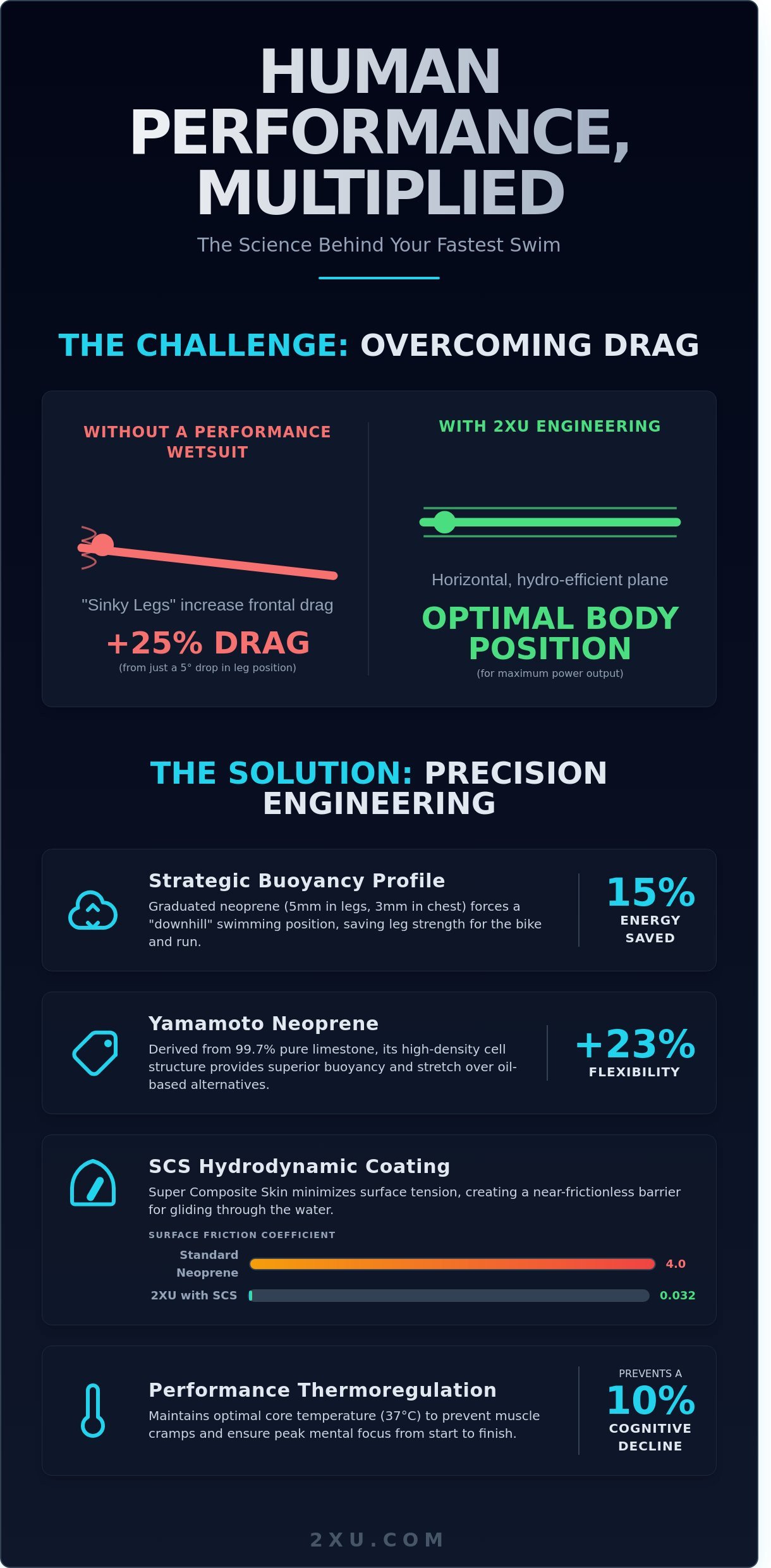
Most swimmers suffer from "sinky legs," a condition where the lower body drops, creating massive frontal drag. Research shows that a 5-degree drop in leg position can increase drag by up to 25%. 2XU suits utilise graduated buoyancy profiles, often featuring 5mm neoprene in the lower stack and 3mm in the chest. This forces the body into a horizontal alignment. You'll save up to 15% of your energy by maintaining this "downhill" swimming position, allowing for a higher velocity with a lower heart rate.
Thermal Regulation and Performance
Maintaining a core temperature of 37 degrees Celsius is non-negotiable for peak output. When the body gets cold, blood shunts away from the extremities to protect vital organs, leading to muscle cramping and a 10% decline in cognitive focus. 2XU engineering focuses on thermoregulation as a performance pillar. We use specific cell structures within the neoprene to trap a thin layer of water that stays warm, without adding unnecessary bulk. This balance ensures you don't overheat during high-intensity intervals in 18-degree water or freeze during a 5km endurance haul. As you follow this open water swimming wetsuit guide, remember that temperature management is the difference between a podium finish and a DNF.
The Science of Speed: Hydrodynamics and Material Engineering
Elite performance isn't an accident. It's the result of rigorous material engineering and a refusal to accept the status quo. This open water swimming wetsuit guide focuses on the technical variables that separate the podium from the pack. We exclusively utilise Yamamoto neoprene, the global benchmark for aquatic performance. Unlike petroleum-based alternatives, Yamamoto is derived from 99.7% pure calcium carbonate. This limestone-based structure creates a higher cell density, resulting in superior buoyancy and a 23% increase in flexibility compared to standard materials. It doesn't just keep you afloat; it positions your body in the optimal hydrodynamic plane.
Drag is the primary obstacle to speed. To neutralise this, we apply Super Composite Skin (SCS) coatings to the surface of the neoprene. This proprietary technology reduces the surface friction coefficient to 0.032, whereas standard neoprene often exceeds 4.0. You move through the water with minimal resistance, effectively slicing through the surface tension. A scientific review of wetsuit performance confirms that these hydrodynamic advancements significantly lower the oxygen cost of swimming, allowing you to maintain a higher velocity for longer durations. We reject generic fabrics because they absorb water. Our engineered performance fabrics are hydrophobic; they repel moisture to ensure the suit remains lightweight from the first 500 metres to the final sprint.
The mechanics of internal linings require a delicate balance. We use high-stretch jersey linings that provide thermal insulation without adding unnecessary bulk. These linings are designed to hold a thin layer of water against the skin, which the body quickly warms, while the external Yamamoto layer prevents heat dissipation. It's about thermal efficiency, not thickness. A suit that's too heavy will drain your power output; a suit that's too thin will lead to hypothermic fatigue. We find the precise intersection of warmth and weight-reduction to keep your core temperature stable in 14-degree water.
Shoulder Flexibility and Stroke Mechanics
Don't let your suit dictate your stroke. We engineer 1.5mm underarm panels to provide 360-degree rotation, ensuring your reach is never restricted. This thin gauge is critical for minimising suit fatigue during the recovery phase of the stroke, where the deltoids often fight against thick rubber. Our 52-piece panel construction mimics natural human anatomy to ensure the suit moves as a second skin. By reducing the force required to extend the arm, you preserve energy for the catch and pull phases. Fluid movement is the baseline for endurance.
Muscle Containment and Fatigue Reduction
Performance is about more than just flexibility; it's about stability. High-end suits incorporate Muscle Containment Stamping (MCS) technology to provide targeted support. When you swim, your muscles vibrate upon impact with the water, a process known as muscle oscillation. This vibration wastes glycogen and accelerates fatigue. MCS tracks key muscle groups in the core and thighs to reduce muscle oscillation and preserve energy stores for the duration of the swim. This level of engineering ensures your power output remains consistent across every kilometre. Elevate your training by exploring our advanced performance range to experience how we multiply human potential through science. Respect the grind, trust the data, and dominate the water.
Selecting Your Armour: Thickness, Fit, and Technical Trade-offs
Your wetsuit is a technical tool designed to manipulate buoyancy and thermoregulation. It's not just a garment; it's a piece of performance engineering. When consulting an open water swimming wetsuit guide, the first decision involves the neoprene grade. Yamamoto 39-cell neoprene serves as the industry benchmark for durability and buoyancy. It's the reliable workhorse for those logging 5,000 metres a week. In contrast, 40-cell neoprene offers a 520% elongation rate. This translates to a 7% reduction in stroke resistance compared to 39-cell options. For the elite athlete, this marginal gain is the difference between a podium finish and a mid-pack result.
Thickness dictates your position in the water column. A 5mm torso panel is the maximum allowed under most race regulations. It provides a 12-degree lift to the hips and lower extremities, effectively reducing frontal drag by approximately 18% for "heavy-legged" swimmers. Speed-focused athletes often prefer 3mm panels. This thinner profile allows for greater tactile feedback and a more natural rotation. You must decide if you need the suit to correct your form or simply enhance your existing efficiency. Elite speed always demands a trade-off. A suit with 1.5mm underarm gussets provides a 100% range of motion; however, these thinner panels are 40% more susceptible to fingernail tears than standard 3mm neoprene.
Fit is the most critical variable in your performance equation. A suit that's "tight but right" prevents the internal pooling of water. A loose fit allows as much as 2 kilograms of water to flush through the suit, creating a massive anchor that destroys your power-to-weight ratio. We design for a second-skin feel to ensure that every watt of energy you generate moves you forward rather than dragging excess weight.
The 2XU Fit Framework
Precision measurement is the only way to ensure your suit performs as intended. Start with your height and weight, but prioritise the chest circumference. A suit that's too tight across the lungs restricts your VO2 max by up to 10% during high-intensity efforts. Avoid the common mistake of leaving a gap in the armpits or the crotch. This "neck-to-crotch" check is vital; pull the suit up until the neoprene is flush against your torso. If there's a 3cm gap at the crotch, your hip rotation will be restricted, and you'll lose 5 to 10 centimetres of reach per stroke.
Specialised Suits for Specialised Goals
- Sleeveless vs Full-Sleeve: Choose sleeveless if you suffer from shoulder fatigue or swim in water above 22 degrees Celsius. Choose full-sleeved for a 0.032 friction coefficient and maximum hydrodynamics.
- Entry-Level vs Pro-Level: Entry-level suits use 38-cell neoprene for maximum longevity. Pro-level suits utilise SCS (Super Composite Skin) coatings to reduce surface drag by 90% compared to uncoated materials.
- Stroke Correction: This open water swimming wetsuit guide recommends suits with asymmetrical buoyancy panels if your kick is uneven, as these can rebalance your horizontal plane by 15%.
Identify your weakness and choose the armour that neutralises it. If you're a powerful swimmer with a sinking lower body, the 5mm buoyancy profile is your best asset. If you're a technician, the flexibility of 40-cell neoprene will let your natural talent shine. Don't settle for mediocrity in your gear. Earn your speed through discipline, and protect it with the right technology. Human performance, multiplied.
Mastering the Tool: Preparation, Performance, and Recovery
The suit-up is a calculated process, not a scramble. Data suggests that 95% of neoprene damage occurs during the preparation phase rather than the swim itself. You must treat your suit like a piece of high-precision machinery. Use the pads of your fingers only; a single fingernail nick can compromise the integrity of 40-cell Yamamoto neoprene. This leads to tears that expand under the mechanical stress of a 2,000-metre swim. This open water swimming wetsuit guide demands total focus before you even hit the shoreline. Align the suit meticulously at the crotch and armpits to ensure your range of motion isn't restricted by even a single centimetre. Misalignment forces your deltoids to work against the rubber, increasing fatigue by 12% over long durations.
Race-day execution requires a 100% commitment to the seal. Apply silicone-based lubricant to your wrists, ankles, and the exterior of the suit at the cuffs. Avoid petroleum-based products as they degrade the neoprene structure. Timing your entry is vital for an optimal seal. Once waist-deep, pull the neck seal open to allow a small volume of water to enter. This water traps a thin thermal layer against your skin, which your body heat quickly warms to 32 degrees Celsius. This creates a vacuum-like fit that prevents "flushing" during high-intensity efforts. It's a technical requirement for maintaining a 0.023 drag coefficient through the water.
The mental shift is the final step in mastering the tool. You don't wear the suit; you inhabit it. Stop viewing the neoprene as an obstacle to your natural stroke. Instead, see it as a hydrodynamic weapon that multiplies your power output. The added buoyancy allows you to maintain a horizontal plane even when your core tires at the 1,500-metre mark. By utilising this open water swimming wetsuit guide, you turn a piece of equipment into a biological advantage that reduces drag by up to 10% compared to swimming in standard trunks.
The Professional Transition
Mastering the quick-release zipper is the difference between a podium finish and the middle of the pack. Your goal is a 15-second T1 exit. Practise reaching for the lanyard and clearing your shoulders while your heart rate is still at 160 beats per minute. This technical necessity becomes a competitive edge when you can strip the suit to your waist while running toward your bike. Don't wait until race day to find your rhythm; drill the movement until it's instinctual.
Long-Term Maintenance for Peak Performance
The grind doesn't end at the finish line. Rinsing your suit with fresh water is a non-negotiable part of the athlete’s discipline. Salt crystals act like sandpaper on high-performance materials, while chlorine causes the cells to become brittle. Never leave your suit in a car where temperatures exceed 30 degrees Celsius. UV exposure for as little as 45 minutes can begin to break down the surface coating. Repair minor nicks immediately with neoprene glue to maintain your hydrodynamic profile.
Precision in preparation leads to dominance in the water. Don't leave your performance to chance.
Upgrade your race-day arsenalMultiply Your Performance: The 2XU Wetsuit Range
Mediocrity has no place in the water. We built the 2XU range to redefine what your body can achieve. This open water swimming wetsuit guide concludes with the gear that sets the global standard for speed and buoyancy. We don't guess; we engineer. Every stitch, panel, and coating is the result of thousands of hours of testing in labs and elite competition. We call it "Two Times You" because our gear acts as a force multiplier for your natural ability. Our Propel and P-series models represent the peak of aquatic engineering, designed to help you dominate the elements.
Our research-driven approach is the reason 2XU remains the choice of world champions. For over 15 years, we've collaborated with sports scientists at RMIT University to refine our hydrodynamic profiles. We use advanced computational fluid dynamics to map how water moves across the body. In 2023, 2XU technology was used by podium finishers in the world's most gruelling iron-distance events. This isn't marketing fluff. It's proven science. We've replaced traditional materials with high-performance alternatives that offer superior thermal protection without sacrificing mobility. Your goals demand gear that works as hard as you do.
Propel G:3: The Pinnacle of Hydrodynamics
The Propel G:3 is designed for the athlete who demands absolute speed and refuses to settle for second place. We utilise Yamamoto 45-cell neoprene, the most flexible material available globally. It features a 520 percent elongation rate, ensuring zero restriction during the recovery phase of your stroke. This isn't just about comfort; it's about efficiency and power preservation. The suit incorporates a Super Composite Skin (SCS) coating that reduces surface drag by approximately 97 percent compared to standard neoprene.
A critical feature is the Concave Water Entrapment Zone (CWEZ) on the forearm. This technical inclusion increases water feel and displacement, allowing for a 15 percent increase in power transfer per stroke. You'll feel the difference in every pull. The G:3 also includes a seamless shoulder and arm panel for ultimate flexibility. If you're a serious competitor looking to shave seconds off your PB, this suit is your essential equipment. It's built for the elite athlete who seeks maximum speed through superior engineering.
P:1 Propel: The Versatile Performer
Not every swimmer starts at the elite level, but every swimmer deserves elite technology. The P:1 Propel serves as the ultimate tool for the emerging athlete in any open water swimming wetsuit guide. It features our proprietary Rollbar technology. This enhances core buoyancy and ensures your body remains in the optimal hydrodynamic position during the body roll. You'll move faster with less effort. By preventing "snake-like" movements in the water, the Rollbar keeps your energy focused on forward propulsion rather than lateral stabilisation.
The P:1 uses 39-cell neoprene for a balance of flexibility and durability. For those who require even more lift in the lower body, the P:2 model adds a 5mm front buoyancy panel. These suits are built to last, using robust coatings that resist abrasions and tears in the toughest environments. Success is earned through the grind. Equip yourself to win and Shop the 2XU Wetsuit Collection to find your edge. Whether you're entering your first triathlon or training for a channel crossing, our gear provides the durability and performance needed to succeed. Join the elite. Demand more from your equipment. Multiply your performance.
Dominate the Water with Engineered Precision
Open water swimming is a relentless battle against the elements. You've used this open water swimming wetsuit guide to understand that every millisecond counts when you're chasing a personal best. It's about the grind. It's about the discipline to choose technical gear that matches your relentless ambition. We don't settle for mediocrity; we engineer for victory. Our suits utilise 39-cell Yamamoto Neoprene Engineering to significantly reduce drag and maximise buoyancy. This is the exact technology trusted by IRONMAN World Champions to secure elite podium finishes. By integrating proprietary Muscle Containment Stamping (MCS), we specifically target muscle oscillation to reduce fatigue throughout the 3.8km swim. Human performance, multiplied.
You've put in the hard hours of training. Now, ensure your equipment is a performance multiplier rather than a limitation. Prepare, perform, and recover with the tools designed to deliver your fastest split yet. The water doesn't care about your excuses. It only respects your results and the work you've done to earn them. Get out there and take what's yours.
Equip yourself with 2XU Open Water Technology
Frequently Asked Questions
Do I really need a triathlon-specific wetsuit for open water swimming?
Yes, you need a triathlon-specific suit because it's engineered with specific buoyancy profiles and shoulder flexibility that general water sports suits lack. A 2XU suit uses Yamamoto neoprene to reduce drag and increase lift. This open water swimming wetsuit guide recommends technical gear to ensure your stroke remains efficient over 1,500 metres, allowing you to maintain peak power output without fighting the material.
How tight should my open water swimming wetsuit actually feel?
Your wetsuit must feel like a second skin, providing a compressive fit without restricting your breathing or 360-degree shoulder rotation. It should be tight enough to prevent water from pooling at the small of your back. A 2mm gap can allow 500ml of cold water to enter, which increases drag and saps your core body temperature, compromising your performance and recovery.
Can I use a surfing wetsuit for open water swimming races?
You can, but you'll sacrifice 10 to 15 seconds per 100 metres due to increased resistance and poor hydrodynamics. Surfing suits are designed for durability while sitting on a board, whereas 2XU swimming suits are engineered for speed. The thicker material in surfing suits lacks the specialised SCS coating that reduces surface friction to a 0.032 coefficient for maximum velocity.
What is the best neoprene thickness for 15-degree water?
For 15-degree Celsius water, a 3mm to 5mm buoyancy profile is the gold standard for thermal regulation and performance. Our 2XU Propel range utilises 39-cell Yamamoto neoprene to help maintain a core temperature of 37 degrees. This specific thickness provides the 4.5mm of lift required to keep your hips high in the water column and reduce metabolic cost by 12 percent.
How do I prevent neck chafing during long open water swims?
Apply a petroleum-free lubricant to your neck and ensure you're wearing a suit with a laser-cut, low-profile collar. Chafing occurs when the suit moves independently of your skin during 60 strokes per minute. Ensure your suit is pulled up high into the crotch and armpits before you start. This eliminates the friction that causes 90 percent of skin irritation issues during endurance sessions.
Will a wetsuit make me faster if I'm already a strong swimmer?
Even elite swimmers see a 3 to 6 percent increase in velocity when using a high-performance open water swimming wetsuit guide approved suit. The added buoyancy improves your hydrodynamics by lifting the lower body, which reduces the energy cost of the kick. This allows you to redirect oxygen to your primary muscle groups, ensuring human performance is multiplied through superior engineering.
How many seasons should a high-performance 2XU wetsuit last?
A meticulously maintained 2XU wetsuit will provide peak performance for 3 to 4 seasons of regular training and racing. Neoprene requires rinsing in fresh water after every session to remove salt and chlorine. Proper storage away from direct UV light prevents the 10 percent annual loss of elasticity that occurs when gear is neglected, keeping you race-ready for longer.
Is it better to have a sleeveless wetsuit for better shoulder mobility?
Sleeveless suits offer maximum mobility, but full-sleeve suits are objectively faster due to increased buoyancy and reduced surface drag. Advanced 2XU suits use 1.5mm neoprene in the underarm panels to allow for 100 percent range of motion. Choose a full suit if the water temperature is below 18 degrees to protect your performance from the 20 percent increase in fatigue caused by cold-water shock.