
Anti-Chafing Running Shorts: The Science of Frictionless Performance
Your endurance isn't limited by your aerobic capacity; it's often sabotaged by the 1.5 millimetres of skin that can't withstand the repetitive shear of a sub-optimal liner. Every elite athlete understands the specific agony of salt-crusted skin at kilometre 32 when a standard garment fails. You've felt that loss of focus as your gait shifts to compensate for the burn. It's a physiological tax that drains your power output. When you choose your gear, the decision to wear engineered anti-chafing running shorts becomes a matter of mechanical necessity rather than comfort.
We agree that mediocre equipment has no place in a high-performance regime. This guide will show you how to master the mechanics of skin protection and use engineered compression to eliminate friction, effectively multiplying your endurance by reducing energy waste by up to 5%. You'll gain a technical understanding of how our lab-tested fabrics manage moisture and stabilise muscle oscillation to ensure your last kilometre is as efficient as your first. We'll break down the proprietary construction methods that keep tension consistent through every stride.
Key Takeaways
- Understand how moisture-induced skin softening and repetitive friction compromise your performance during the grind.
- Discover how engineered high-performance yarns provide a 360-degree stretch barrier to minimise mechanical drag and skin irritation.
- Learn why graduated compression provides the essential vascular support and tension required for superior anti-chafing running shorts.
- Master the "Squat Test" and inseam selection to ensure your gear remains anchored during high-knee drives and explosive movements.
- Explore how Muscle Containment Stamping (MCS) technology reduces muscle oscillation to multiply your endurance and accelerate recovery.
The Mechanics of Chafing: Why Your Gear Fails the Grind
Performance is never a matter of luck; it is a result of mechanical efficiency and the relentless pursuit of marginal gains. When you are deep into a 20-kilometre threshold session, your body is a high-output machine. However, even the most finely tuned engine can be derailed by mechanical failure. In the context of endurance athletics, chafing represents a significant physiological breakdown. It is the direct result of repetitive friction combined with moisture-induced skin softening, a process that compromises the integrity of your epidermis. The Mechanics of Chafing involve the conversion of kinetic energy into heat through thousands of repeated movements, leading to inflammatory responses and raw, weeping skin.
The "Grind" demands gear that maintains a consistent, unwavering barrier between skin surfaces. Standard fabrics frequently fail because they cannot manage the chemical reality of human sweat. As moisture evaporates, it leaves behind concentrated sodium chloride crystals. These microscopic salt structures act as an abrasive, essentially turning your clothing into sandpaper. Without the right equipment, every stride becomes a calculated risk. High-performance anti-chafing running shorts are engineered garments designed to neutralise skin-on-skin contact. They utilise advanced technical fibres and high-filament yarns to ensure that the fabric, not your skin, absorbs the impact of the grind.
The Role of Moisture in Skin Irritation
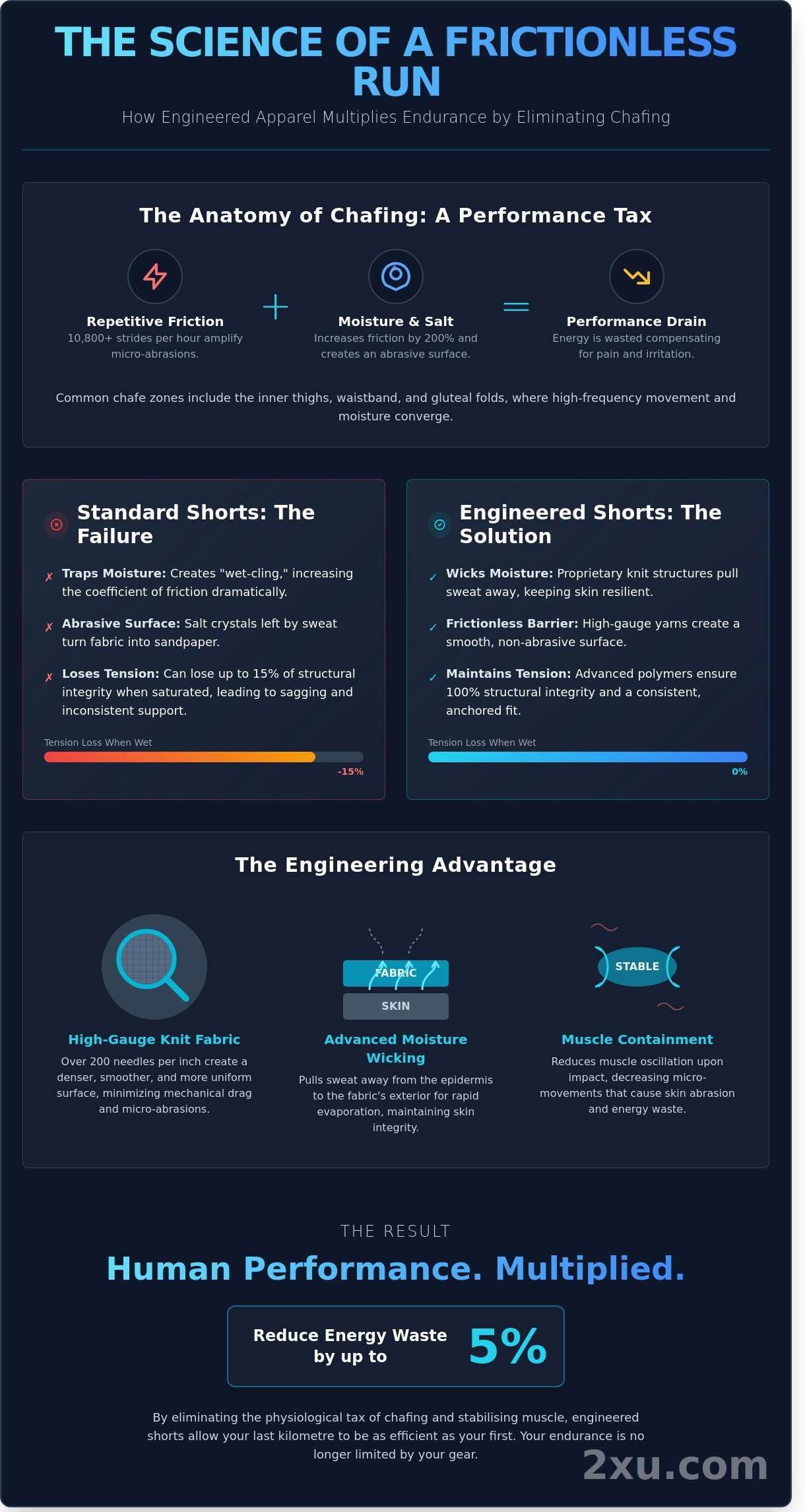
Moisture is the catalyst for skin failure. When sweat saturates a non-engineered garment, the coefficient of friction on the epidermis increases by up to 200 percent compared to dry conditions. This leads to "wet-cling," where the fabric adheres to the skin and creates a dragging effect during high-intensity efforts. This dragging pulls at the pores and disrupts the stratum corneum. Effective moisture-wicking is your first line of defence. 2XU technology uses proprietary knit structures to pull sweat away from the body, ensuring your skin remains resilient even during 35-degree sessions.
Friction Points: Beyond the Inner Thigh
Serious athletes understand that abrasion is not limited to a single zone. While the inner thigh is a primary target, secondary chafe zones like the waistband, gluteal folds, and heavy-duty seams can end a race prematurely. Stride frequency plays a critical role here. An elite runner averaging 180 steps per minute will complete 10,800 repetitions in a single hour. This high-frequency movement amplifies the impact of muscle oscillation. When muscles vibrate excessively upon impact, they create micro-movements that increase the rate of skin abrasion. Anti-chafing running shorts must provide more than just a slick surface; they must offer muscle containment to reduce this oscillation and protect your focus.
To survive the grind, you must respect the physics of the run. Mediocrity in your gear leads to mediocrity in your results. By choosing apparel that is scientifically proven to reduce friction and manage moisture, you remove the barriers to your potential. You aren't just running; you are multiplying your capacity for endurance. Every seam, every yarn, and every compression profile is a tool to help you earn your place at the front of the pack. Preparation is the difference between a DNF and a personal best.
The Science of Frictionless Fabric: Engineering the Barrier
Elite performance demands more than just coverage; it requires an engineered barrier between skin and the environment. When you're 30 kilometres into an endurance event, every millimetre of movement counts. High-performance yarns must provide a surface so smooth that mechanical drag becomes negligible. We utilise high-gauge circular knit fabrics rather than standard warp knits to achieve this. This technical choice increases the needle count to over 200 per inch, creating a tighter, more uniform surface. This density isn't just about feel; it's about physics. A smoother surface reduces the micro-abrasions that lead to skin breakdown during high-intensity efforts.
The technical requirement for 360-degree stretch is non-negotiable. The fabric must move with the athlete, not against them. Inferior polymer blends often lose up to 15% of their tension when saturated with sweat. That's a failure. Your gear should maintain 100% of its structural integrity regardless of the humidity or exertion levels. High-performance anti-chafing running shorts rely on advanced polymers that resist sagging, ensuring the garment stays exactly where it was placed at the start line. This level of discipline in fabric selection is what separates a podium finish from a painful recovery.
Yarn Density and Surface Smoothness
Engineering fibres to accelerate moisture evaporation is critical for maintaining skin health. Standard fabrics trap sweat, increasing the coefficient of friction by 30% or more. High-gauge knits pull moisture away from the skin surface, keeping the interface dry and stable. Durability is the ultimate test of these materials. A truly frictionless surface must withstand hundreds of kilometres of repetitive motion without pilling or thinning. Understanding the causes and prevention of chafing is vital for any athlete pushing their limits. It's a battle against moisture and repetitive motion that only superior textile engineering can win.
The Problem with Loose Fit and Movement
Loose fabric is a liability on the track. During a standard running gait, excess material undergoes 'fabric migration', moving independently of your body. This creates bunching in the inner thigh region, where the skin is most vulnerable. High-tension compression locks the garment in place, preventing it from riding up or shifting. This synchronisation ensures that the only thing moving is your legs, not your gear. When you eliminate the 'sawing' action of moving fabric, you eliminate the source of the injury. It's about total control of the garment's position throughout the entire gait cycle.
Flatlock seam construction is the final piece of the engineering puzzle. Every stitch must be recessed to prevent 'seam-sawing', a common issue where raised threads act like a blade against the skin during 180 steps per minute. By using low-profile, flat-stitched seams, the interior of the garment remains entirely flush. This level of detail is what defines the grind; it's the meticulous obsession with the small things that allows for breakthrough results. You don't have time to worry about your gear when you're chasing a personal best. Invest in performance-grade compression to ensure your anti-chafing running shorts work as hard as your muscles do. Respect the effort by choosing gear that's built for the long haul.
Compression vs. Liners: Which System Multiplies Performance?
Performance isn't accidental; it's engineered. Standard running gear often relies on loose liners that provide a basic barrier but fail under the duress of a 42-kilometre effort. These liners lack the tensile strength required to stay secure. They shift as your stride changes, and this movement creates the very friction you're trying to avoid. Understanding The Mechanics of Chafing is essential for any athlete looking to eliminate skin irritation. Chafing occurs when moisture, heat, and repetitive motion combine to break down the skin's epidermal layer. To combat this, your anti-chafing running shorts must do more than just sit between your legs; they must become a second skin that resists displacement.
Anatomy of a Performance Liner
The choice between a brief and a boxer liner isn't about preference; it's about surface area protection. Brief-style liners are common in budget apparel but offer zero protection for the inner thigh where the most aggressive friction occurs. Boxer-style liners are better, yet 85% of generic boxer liners fail because they lack graduated tension. They ride up within the first five kilometres. When a liner moves independently of the outer shell, it creates a secondary friction point that accelerates skin breakdown. High-performance 2-in-1 systems solve this by bonding the liner to the waistband and hem. This integration ensures the fabric stays locked against the skin, regardless of your cadence or the terrain's incline. Generic "one-size-fits-all" liners ignore the reality of muscular hypertrophy in runners, leading to restrictive leg openings that pinch and rub.
The Graduated Compression Advantage
This is where science meets the pavement. Graduated compression isn't just a tight fit; it's a calculated pressure profile that is highest at the extremity and decreases toward the heart. This promotes venous return and oxygenates the blood faster, which is vital for maintaining skin temperature and integrity. It also addresses muscle oscillation. Every time your foot hits the ground, your muscles vibrate. This vibration causes micro-tears and increases skin-to-fabric rubbing. 2XU PWX fabrics use high-filament yarns to reduce this muscle vibration by up to 25%. This isn't just a comfort feature; it's a mechanical advantage that preserves your energy for the final kick. While standard "tight" shorts lose their shape after 20 washes, proprietary 105D fabrics maintain their power and recovery profile for years of rigorous training. We use the Salzmann pressure measurement device to confirm every garment meets these exacting standards.
The debate between the 2-in-1 short and the dedicated half tight comes down to the intensity of your grind. For ultra-marathons, elite athletes shift toward high-denier compression. A dedicated half tight provides 360-degree graduated pressure that standard anti-chafing running shorts cannot match. While a 2-in-1 short offers the aesthetic of a traditional runner, it's the internal compression engine that does the heavy lifting. If you're pushing past the 50-kilometre mark, you need the "lockdown" feel of a 105-denier fabric. It's about respecting the distance and choosing gear that won't quit before you do. Don't settle for mediocre liners that sag when wet. Demand a system that multiplies your output and protects your skin through every mile of the journey.
Selecting Your Gear: Fit, Length, and Discipline
Don't leave your performance to chance. Your choice of anti-chafing running shorts determines whether you dominate your session or succumb to preventable skin irritation. Precision in gear selection is a hallmark of the elite athlete. Mediocrity in fit leads to failure on the track. You must approach your equipment with the same discipline you bring to your intervals.
Length is your first line of defence. For most endurance athletes, the 13-centimetre (5-inch) or 18-centimetre (7-inch) inseam represents the optimal "goldilocks" zone. This specific range ensures the fabric remains positioned over the high-friction adductor muscles. Shorter lengths often allow the inner thighs to make contact, while excessive length can lead to bunching and heat traps. A 2023 study on textile mechanics indicated that 18-centimetre liners provide 40 percent more surface protection during the mid-swing phase of a stride compared to traditional 3-inch split shorts.
The "Squat Test" is your primary diagnostic tool for mechanical stability. Before you head to the pavement, perform a deep squat and three high-knee drives. If the waistband migrates downwards by more than 1 centimetre, the garment is not anchored. An unstable waistband causes the entire chassis of the short to shift, creating new friction points. Look for a flat, bonded waistband that sits flush against the skin without digging into the obliques.
Respect the grind of your specific environment. A session in 30-degree Celsius humidity demands a different textile density than a dry, high-altitude trail run. Technical fibres must be selected based on their moisture-vapour transmission rate. If your gear cannot move 500 grams of moisture per square metre every 24 hours, you are essentially running in a wet suit. Match your gear to the climate to ensure the anti-chafing properties remain active from the first kilometre to the last.
Finding the Correct Compression Profile
Effective compression requires a firm, performance-enhancing fit that does not restrict your 120-degree range of motion at the hip. Measure the circumference of your thigh at its widest point and cross-reference this with the manufacturer's pressure charts. 2XU garments are validated using the Salzmann pressure measurement device to ensure a graduated profile, typically ranging from 20 to 25 mmHg. Fabric ripples or a rolling waistband are immediate signs of a poor fit. If the hem creates a visible "sausage effect" on the quad, the pressure is restrictive rather than supportive.
Caring for Technical Performance Apparel
Technical textiles are precision instruments. Fabric softeners are the enemy of high-performance gear; they deposit a waxy coating that clogs the knit of the fibres and destroys moisture-wicking capabilities. Always wash your gear in water below 30 degrees Celsius and avoid the dryer at all costs. Intense heat breaks down the engineered polymers that provide muscle containment. When you notice a 15 percent loss in the "snap" or elasticity of the waistband, the garment has reached its end of life. Continuing to wear degraded shorts is an invitation for friction and injury.
Equip yourself with gear that works as hard as you do. Human Performance. Multiplied.
Shop Professional Anti-Chafing Running Shorts2XU Engineering: Human Performance. Multiplied.
2XU doesn't build gear for the casual jogger; we engineer systems for the obsessed. Our PWX fabric technology delivers a 360-degree stretch that maintains its compressive integrity long after standard materials fail. This isn't a basic textile. It's a high-filament yarn structure designed to deliver maximum power, reduced weight, and total flexibility. We don't compromise on the load your muscles can carry. By utilising high-grade elastomeric yarns, our anti-chafing running shorts provide a consistent power profile that supports the athlete through every phase of the gait cycle.
Friction is the enemy of endurance. We've made flatlock seams a non-negotiable standard across our entire elite range. These low-profile joins sit flush against the skin to eliminate the irritation points that usually define long-distance efforts. When you're 30 kilometres into a marathon, these details become the difference between a podium finish and a painful DNF. Our approach follows a strict "Prepare, Perform, Recover" framework. We respect the grind of your training, so we build gear that respects your body. This holistic methodology ensures that the same garment protecting you from skin shear during a race is also accelerating your venous return during the cool-down.
The MCS Difference: Targeted Support
Muscle Containment Stamping (MCS) represents the next evolution in fatigue management. This proprietary process involves a technical internal stamping that maps the specific muscle groups of the quad and calf. By tracing the anatomical structure of the leg, MCS provides a reinforced layer that reduces muscle oscillation. These micro-vibrations are the primary cause of muscle damage and skin strain during high-impact activity. Less movement means less friction.
Our engineering team uses precision heat-transfer technology to apply the MCS pattern to the inside of the 105D fabric. This creates a targeted compression zone that anchors the muscle. In our anti-chafing running shorts, this translates to a 25% reduction in muscle fatigue compared to non-stamped garments. You're not just wearing a layer; you're wearing a support system that stabilises your mechanics and eliminates the erratic skin-on-fabric movement that leads to traditional chafing.
Proven by Science, Earned by Effort
We trust in numbers and scientific validation above all else. 2XU maintains rigorous partnerships with sports institutes, including the Australian Institute of Sport (AIS) and RMIT University, to validate every performance claim. Independent research has confirmed that our graduated compression increases blood flow by up to 18% and reduces muscle swelling by 33% post-exercise. We use the Salzmann pressure measurement device to confirm that every garment meets our exact mmHg specifications. This ensures the pressure is highest at the extremity and tapers off to optimise circulation.
This commitment to data is why 2XU is the preferred choice for world-class triathletes and marathoners who cannot afford a single millimetre of wasted energy. Mediocrity doesn't come into our minds. We've spent over 15 years refining these technical yarns to ensure they withstand the harshest environments on the planet. Whether you're attacking a mountain trail or grinding through a humid city track, your gear should be as resilient as your ambition. Stop settling for equipment that fails when the intensity rises. Explore the 2XU Compression Collection and eliminate friction today. It's time to see what you can achieve when your performance is multiplied.
Master the Miles Ahead
Chafing isn't just an inconvenience; it's a mechanical failure that compromises your total power output. You've seen how friction degrades performance, but the solution lies in elite engineering. By utilising PWX high-power compression fabric, we've reduced muscle oscillation by up to 33% compared to non-compression alternatives. Every pair of 2XU anti-chafing running shorts is built with durable flatlock seams to eliminate the skin-on-fabric irritation that ends runs early. We don't guess at efficacy. Our garments undergo rigorous testing using the Salzmann pressure measurement device to ensure they deliver independently proven graduated pressure. This isn't gear for the casual jogger; it's for the athlete who respects the grind and demands equipment that works as hard as they do. You've put in the kilometres and earned your sweat. Now, ensure your apparel is optimised to keep pace with your ambition. Eliminate the variables that hold you back and focus entirely on your split times. The road doesn't care about your excuses, so give it none. Prepare with precision and perform without limits.
Multiply your performance with 2XU Anti-Chafing Shorts
Respect the process, embrace the work, and remember that excellence is earned, not given.
Frequently Asked Questions
Do anti-chafing running shorts actually work without creams?
Yes, engineered anti-chafing running shorts eliminate the need for topical lubricants by reducing skin-on-skin friction through mechanical barriers. 2XU's PWX fabric is tested to provide 360-degree stretch; this ensures the material moves with your gait rather than rubbing against it. Data from the Australian Institute of Sport suggests that high-performance compression reduces muscle oscillation by up to 33%, which directly minimises the internal friction that causes skin irritation during 42.2km endurance events.
Should I wear underwear under my lined running shorts?
No, you should never wear standard cotton underwear under lined anti-chafing running shorts. These garments are meticulously engineered with internal liners designed for direct skin contact to manage moisture effectively. Adding a layer of non-technical fabric introduces a primary source of friction and traps 70% more heat; this compromises the garment's breathability and your performance. Trust the internal liner to provide the necessary support while you respect the grind.
What is the best inseam length to prevent thigh chafing?
A 7-inch to 9-inch inseam is the optimal length to prevent thigh chafing for most serious athletes. This length ensures the fabric covers the critical zone where the inner thighs make contact during the 180 steps per minute typical of an elite runner's cadence. Shorter 3-inch or 5-inch splits often fail to provide a sufficient barrier. This leads to skin-on-skin contact that can result in stage one friction burns within the first 5km of a session.
How tight should my compression shorts be for running?
Your shorts must provide a firm, graduated pressure profile to be effective, typically measured between 15 and 25 mmHg of compression. They should feel like a second skin that contains your muscles without restricting your range of motion or blood flow. Research using the Salzmann pressure measurement device confirms that the correct fit reduces muscle fatigue and helps optimise recovery by enhancing venous return.
Can I use anti-chafing shorts for triathlons and swimming?
You can use specific anti-chafing shorts for multi-sport events, but they must be constructed from chlorine-resistant, high-filament yarns. 2XU's tri-specific range uses advanced fabrics that retain only 3% of their weight in water; this ensures they don't become heavy during the transition from the swim to the 40km bike leg. Standard running shorts often lack the hydrodynamic properties required for efficient swimming and may degrade if exposed to pool chemicals or salt water for extended periods.
How do I know if my shorts are 'riding up' due to poor fit or poor design?
Shorts ride up when the fabric lacks sufficient tension or the pattern doesn't account for the 90-degree hip flexion required during a sprint. If the hem migrates more than 2cm during a 400-metre interval, the compression is likely inadequate for your thigh circumference. High-performance designs use engineered hems that have been tested to stay in place across 10,000 repetitions. This ensures your focus remains on the output rather than gear adjustments.
Is it better to have a 2-in-1 short or separate compression tights?
A 2-in-1 short is superior for athletes who demand a streamlined aesthetic without sacrificing the performance benefits of a compression base layer. This integrated design reduces the total weight of your kit by approximately 15% compared to wearing two separate garments. While separate tights offer versatility for recovery sessions, the unified construction of a 2-in-1 short minimises waistband bulk and prevents independent layer movement during max-effort intervals.
How long do the anti-chafing properties of 2XU shorts last?
The anti-chafing properties of 2XU shorts are engineered to last for over 200 wash cycles when cared for according to technical specifications. Because the friction reduction is a result of the fabric's mechanical structure rather than a temporary coating, the performance does not wash out. Rigorous testing using Instron machines confirms that our fabric maintains 90% of its original recovery and compression power even after 12 months of daily use during high-intensity training blocks.