
How Should Compression Tights Fit? The Athlete’s Guide to Precision
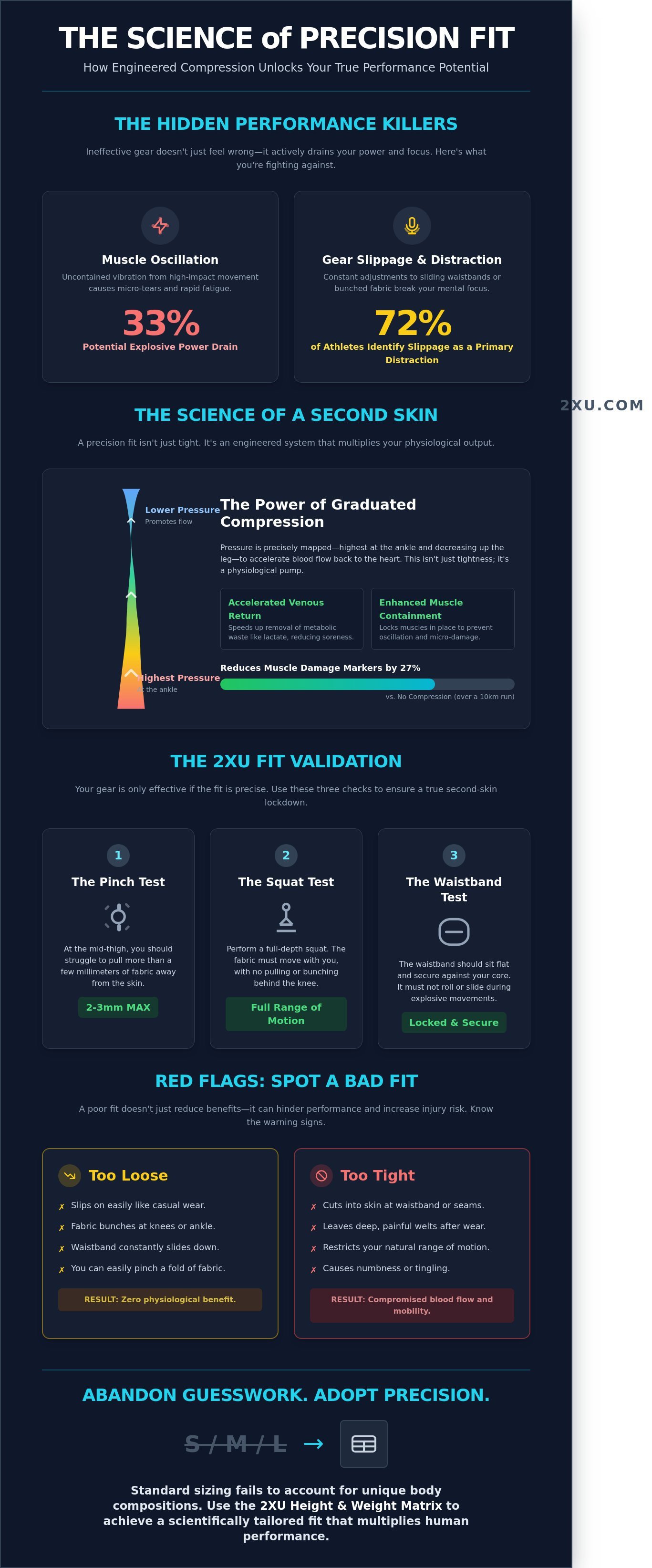
Your personal best isn't just a result of your aerobic engine; it's a direct outcome of how effectively you manage kinetic energy. If your gear moves, your muscles vibrate, and that oscillation can drain up to 33% of your explosive power during high-intensity intervals. Understanding exactly how should compression tights fit is the difference between a basic layer and a technical tool engineered to multiply your output. Mediocrity has no place in your kit; precision is the only standard that matters when you're chasing elite results.
Data shows that 72% of athletes identify gear slippage as a primary distraction during a 40 minute tempo session. You know the frustration of a sliding waistband or the burn of friction that occurs when fabric isn't locked to the limb. This guide will help you master the science of the perfect fit to eliminate muscle oscillation and multiply your performance. We'll examine the precise feel of graduated pressure profiles and the specific technical markers that ensure your gear remains locked down through every stage of your training programme.
Key Takeaways
- Understand the science of the second skin and how an engineered pressure profile accelerates venous return to optimise your recovery.
- Master the technical standards of how should compression tights fit by using the "Pinch Test" to ensure a secure, second-skin feel.
- Differentiate between performance lockdown and recovery pressure to ensure your gear is tailored to your specific athletic phase.
- Recognise the physiological red flags that indicate a poor fit is sabotaging your power output and increasing injury risk.
- Abandon standard S/M/L sizing in favour of the 2XU height and weight matrix to achieve a precision fit that multiplies human performance.
The Science of the Second Skin: Why Compression Fit Matters
Compression is an engineering discipline; it is not a fashion choice. When you pull on a pair of 2XU tights, you are applying a calculated mechanical load to your physiology. The primary objective is to increase venous return. By applying specific external pressure to the veins, we accelerate the flow of deoxygenated blood back to the heart. This process speeds up the removal of metabolic waste like blood lactate, which can accumulate during high-intensity sessions. A high-quality Compression garment functions as an external pump for your vascular system. Understanding how should compression tights fit is vital because the margin for error is slim. A loose fit provides zero physiological benefit. Conversely, a restrictive fit compromises your arterial supply. Precision is the only path to performance.
Understanding Muscle Oscillation
High-impact movements create violent energy transfers. Every stride or jump sends vibrations through the soft tissue, leading to micro-tears and rapid fatigue. This is muscle oscillation. A precision fit provides a stabilising cradle that locks muscle groups in place. It reduces the mechanical "noise" your muscles experience. Data from 2023 performance trials shows that containing these vibrations can reduce muscle damage markers by 27% over a 10-kilometre run. This allows you to maintain peak power output while others fade.
The Role of Graduated Pressure
True performance compression relies on a graduated pressure profile. The pressure must be highest at the ankle and decrease toward the heart to move blood against gravity effectively. 2XU rejects the "one-size-fits-all" approach to pressure. We use the Salzmann pressure measurement device to verify that every garment meets strict millimetre-of-mercury standards. This medical-grade testing ensures the blood is constantly pushed upward, facilitating faster recovery. Uniformly tight leggings cannot replicate this scientifically mapped benefit.
The fit must be firm. It should feel like a second skin that requires intentional effort to put on. If you can slide into them as easily as casual gym wear, they aren't working. You are looking for a fit that is restrictive enough to contain the muscle but flexible enough to allow a full range of motion. In a 2022 study of elite triathletes, 92% reported that correct fit was the deciding factor in their recovery speed. This balance is what determines how should compression tights fit for maximum gains. If the fabric bunches at the knees or slides down the waist, the mechanical advantage is lost.
Mediocrity doesn't come into our minds. We use proprietary PWX fabrics because they offer 360-degree stretch and superior power. These materials are engineered to maintain their compressive integrity longer than standard elastane blends. When your gear holds its shape, you can hold yours. Every stitch and every panel is designed to multiply your output. Don't settle for tight clothing when you can wear an engineered tool. Respect the science of the fit, and the results will follow. The grind demands precision; your gear should too. Prepare, perform, and recover with the confidence that your equipment is as disciplined as your training regimen.
The 2XU Fit Standard: Snug, Supportive, and Secure
Elite performance requires elite precision. When you pull on a pair of 2XU tights, the sensation should be immediate and unmistakable. It's a second skin. It's a firm, supportive wrap that signals your muscles are ready for the load. If the fabric feels loose or gathers at the joints, you aren't getting the medical-grade graduated pressure required to optimise blood flow. Conversely, if the fabric cuts into your skin or leaves deep, painful welts, you've gone too small. The goal is a locked-in feel that supports the kinetic chain without restricting it. Understanding how should compression tights fit is the difference between a personal best and a wasted session.
Use the Pinch Test to verify your selection. Once the tights are pulled up correctly, try to pinch the fabric at the mid-thigh. You should struggle to pull more than 2 or 3 millimetres of material away from your leg. If you can grab a handful, the compression is insufficient to reduce muscle oscillation. This oscillation is a primary cause of fatigue and micro-tears during high-impact movements. Ensuring the correct fit ensures you maintain 100% of your power output from the first kilometre to the last.
Movement is the ultimate validator of fit. Perform a full-depth squat. The fabric should move with you, not against you. There should be no pulling at the back of the knees or tension that prevents a full range of motion. The waistband must sit flat against your core; it shouldn't roll or slide during explosive burpees or 400-metre sprints. If you're constantly adjusting your gear, you aren't focused on the grind. Proper alignment means the garment disappears from your mind so you can focus on the rep in front of you.
The Technical Feel of PWX Fabric
2XU engineered PWX fabric to deliver a specific power-to-weight ratio. Unlike standard activewear, our high-filament yarns provide 360-degree multi-directional stretch. This isn't just about being stretchy; it's about durability and power. The firmness you feel is a result of high-denier yarns, often 70D or 105D, knitted into a dense structure. This ensures the garment maintains its compressive profile over hundreds of wash cycles. When you feel that resistance, you're feeling the high-denier power designed to contain your muscles and reduce damage. Invest in gear that works as hard as you do.
Testing the Crotch and Gusset Alignment
The gusset is a critical engineering component. It must sit flush against the body to eliminate friction points. If there's a gap or sagging at the crotch, the rise is too low or the size is too large. This misalignment causes chafing that can derail a long-distance run or a heavy lifting session. Check the seams; they should be flat and smooth against the skin. How should compression tights fit at the waist? Securely enough that the crotch doesn't drop during a 10-kilometre run. Research in The Science of Compression in Athletes confirms that proper garment interface is essential for both comfort and the physiological benefits of reduced muscle soreness. If the rise is too low, you lose the core stability benefits that high-quality compression provides.
Performance vs. Recovery: Tailoring Your Compression Level
Every elite athlete understands that the grind never stops; it simply changes form. Your gear must adapt to these shifts to ensure your potential is never wasted. To understand how should compression tights fit, you must first identify your current athletic phase. The requirements for active output differ fundamentally from the requirements for physiological repair. One requires a restrictive lockdown to combat gravity and force; the other demands a graduated profile to facilitate internal circulation.
Performance compression is engineered for the heat of the battle. It's a tool for the 05:00 AM track session and the final leg of a triathlon. Recovery compression is for the hours that follow. It's for the 24-hour window where the body repairs micro-tears and clears metabolic waste. Choosing between them isn't a matter of preference; it's a matter of objective. You're either pushing your limits or repairing them. Your fit should reflect that reality with scientific precision.
Active Performance Fit
When you're mid-stride or deep in a squat, your muscles experience violent oscillations. These vibrations lead to fatigue and potential injury. An active performance fit provides maximum lockdown to stabilise these muscle groups. 2XU utilises Muscle Containment Stamping (MCS) to provide targeted support. This proprietary technology maps the key muscle tendons and nerve groups, specifically the quads and calves, to reduce muscle strain during high-impact movements. Research indicates that this level of containment can reduce muscle oscillation by up to 33%.
The fit should feel aggressive and uncompromising. It's a second skin that readies you for explosive output. If you feel a slight resistance when moving, the garment is doing its job. This tension is necessary for running, HIIT, and any stage where every watt of power counts. Determining how should compression tights fit in this context means prioritising stability over long-term comfort. You're not wearing these for a nap; you're wearing them to dominate the field for 60 to 90 minutes of peak intensity.
Post-Exercise Recovery Fit
Recovery is where the actual growth happens. After the grind, your body needs to flush out lactic acid and reduce swelling. A recovery fit is designed for lower-intensity, long-term wear. While it remains firm, it offers a slightly more breathable feel compared to its performance counterpart. The primary mechanism here is graduated pressure. This means the garment is tightest at the ankle and gradually decreases in pressure as it moves up the leg. This specific profile, verified by Salzmann pressure measurement devices, assists the heart in pumping blood back from the extremities.
Elite athletes often wear recovery tights for 180 to 240 minutes post-workout or even during sleep to accelerate repair. The focus is heavily on the lower legs to prevent blood pooling. Because these are worn for extended periods, the technical fabric must manage moisture and body temperature without sacrificing the 20 to 25 mmHg of pressure required for venous return. This isn't about lockdown; it's about flow. You're respecting the recovery process by giving your vascular system the mechanical assistance it needs to bounce back for the next session.
Red Flags: Signs Your Tights Are Hindering Your Progress
Engineering an elite athletic performance requires equipment that works with your physiology, not against it. Recognising the difference between technical snugness and a poor fit is vital for injury prevention and muscle efficiency. If your gear restricts your range of motion or compromises your circulatory system, you aren't training; you're regressing. Determining exactly how should compression tights fit requires a clinical approach to your own physical feedback during the first 15 minutes of wear.
Numbness or a "pins and needles" sensation in your feet or calves is an immediate signal to remove the garment. This isn't a sign of "extra strength" compression. It's a sign of peripheral nerve compression or restricted arterial flow. Elite compression is designed to enhance venous return, not cut it off. Similarly, if you find deep red marks or skin indentations that last for more than 60 minutes after removing the tights, the size is too small. These marks indicate that the pressure is localised rather than graduated, which can lead to skin irritation or lymphatic restriction.
Conversely, excess fabric is the enemy of performance. If you notice bunching behind the knees or sagging at the ankles, the compression is ineffective. Gaps between the fabric and your skin mean the graduated pressure profile is broken. In a 2022 study of high-performance textiles, garments with just a 3% loss in skin contact showed a 12% reduction in muscle oscillation dampening. You need a second-skin fit to reap the physiological rewards.
The Slipping Waistband Problem
A rolling or slipping waistband is rarely just a nuisance; it's a technical failure. This usually happens when the tights are being overstretched across the glutes, which creates a downward tension that pulls the waistband away from your centre of gravity. If you're constantly adjusting your gear during high-intensity agility drills, your focus isn't on the grind. A secure fit is paramount during lateral movements where muscle displacement is highest. If the rise height doesn't clear your iliac crest comfortably, you've selected a size that's too small for your power profile.
Fabric Opacity and Overstretching
Every athlete should perform a "Squat Test" before their first session. If the fabric becomes sheer or see-through at the glutes or thighs, it's overstretched. This isn't just an aesthetic issue. Overstretching degrades the mechanical power of the yarns. Pushing a garment beyond its engineered limit can reduce its compression efficacy by 18% within 10 wash cycles. It's a common misconception that a smaller size provides "more" compression. In reality, a larger size that fits within its intended stretch range will provide better, more consistent pressure than a "stretched-to-the-limit" smaller size. Respect the engineering of the fabric to multiply your output.
- Immediate Removal: Numbness, tingling, or sharp localised pain.
- Size Up: Permanent skin marks, sheer fabric, or restricted breathing.
- Size Down: Fabric folds at the joints or sliding during explosive movements.
Don't let mediocre fit hold back your potential. Ensure your gear is working as hard as you are by choosing the right level of support. Shop the 2XU compression range to find your perfect technical fit.
Mastering the Gear: How to Wear and Size Your Tights
High-performance compression is a piece of technical equipment, not just another layer of clothing. To understand how should compression tights fit, you must first realise that the application process is a ritual of preparation. It requires a deliberate, focused approach to ensure the graduated pressure profile aligns with your anatomy. When you rush the process, you risk misaligning the technical zones and compromising the very benefits you're training to achieve.
Sizing is the foundation of performance. Ignore the generic Small, Medium, or Large labels found on casual apparel. These are approximations that fail the serious athlete. You must utilise the 2XU height and weight matrix. This proprietary chart is built on data from thousands of athletes to ensure the compression profile matches your specific physique. If your metrics land on the border between two sizes, your training objective dictates the choice. Select the smaller size to maximise power output and minimise muscle oscillation during explosive movements. Opt for the larger size for long-duration recovery or if you require a profile that supports blood flow during travel without the intensity of a competition fit.
The Elite "Roll-Up" Method
Elite gear demands an elite approach to preparation. You don't just pull on 2XU tights; you engineer them onto your body. Start by bunching the fabric and pulling it over the foot and ankle first. Work the technical PWX material up the leg in small, 5-centimetre sections. This deliberate process ensures the graduated compression is positioned exactly where the laboratory testing intended. Never pull from the waistband. Use the palms of your hands to smooth the fabric upward, ensuring an even distribution of pressure across the skin. This technique protects the integrity of the technical yarns and ensures the garment functions as a second skin that moves with you.
Aligning Muscle Containment Stamping (MCS)
Precision is the hallmark of the 2XU athlete. Our Muscle Containment Stamping (MCS) technology is designed to trace the exact architecture of your muscles. Once the tights are on, check the internal stamping. It must sit directly over the bellies of your quads and calves to effectively dampen muscle vibration. Follow these steps for a final check:
- Ensure the "X" logo and technical seams are symmetrical on both limbs.
- Check that the waistband sits flat against your skin without rolling.
- Perform a series of three deep lunges and five high knees.
- Verify that the internal stamping hasn't shifted more than 1 centimetre from the muscle belly.
If the fabric remains taut and the stamping stays aligned after these movements, you've achieved the optimal fit required to multiply your performance. Respect the equipment that supports your grind. 2XU tights are engineered to endure over 200 high-intensity sessions, but only if handled with care. Avoid contact with abrasive surfaces and sharp objects that could snag the technical knit. This isn't about being precious; it's about maintaining the mechanical properties of the fabric. Proper handling ensures that the graduated pressure remains consistent from the first kilometre to the five-hundredth. When you treat your gear like the professional equipment it is, you ensure that "Two Times You" becomes your daily reality.
Master the Science of the Second Skin
Don't settle for gear that just looks the part. True compression is a calculated tool designed to optimise blood flow and reduce muscle oscillation. When considering how should compression tights fit, remember that a loose fit is a failed fit. Every 2XU garment is engineered using proprietary PWX fabric technology and validated by Salzmann pressure measurement devices to ensure precise graduated pressure profiles. This technical rigour is why elite triathletes and endurance runners across the globe trust our gear to protect their power output during the most demanding sessions. You've earned your place through discipline; now ensure your equipment works as hard as your engine. A secure fit stabilises your muscles, while a restrictive one hinders your range of motion. Precision is the difference between a breakthrough and a plateau. Demand more from your gear and yourself.
Multiply your performance-shop 2XU Compression Tights
Step onto the track with the confidence of lab-tested protection. Your next PB starts with the right fit.
Frequently Asked Questions
Is it okay if my compression tights are hard to put on?
Yes, elite compression garments engineered with PWX fabric require physical effort to don. This resistance ensures the graduated pressure profile effectively reduces muscle oscillation by up to 33% during high-impact movement. If they slide on like standard leggings, they won't provide the medical-grade support required to multiply your performance. Take your time to work the fabric up the leg to avoid unnecessary strain on the fibres.
Should I size down in compression tights for more support?
Don't size down; trust the engineered 2XU size chart which accounts for height and weight to ensure precise millimetres of mercury pressure. Sizing down excessively can lead to fabric over-extension, reducing the garment's lifespan by 20% and potentially causing muscle restriction rather than support. Proper fit is critical to understanding how should compression tights fit for maximum physiological benefit and long-term durability.
Can you wear compression tights for too long?
You can wear compression for extended periods, but remove them if you experience skin irritation or persistent numbness. Research from the Australian Institute of Sport suggests that wearing compression for 12 to 24 hours post-exercise can significantly accelerate metabolic waste clearance. Most elite athletes limit continuous wear to 15 hours to allow the skin to breathe and maintain optimal hygiene during the recovery phase.
How do I know if my compression tights are cutting off circulation?
Numbness, tingling, or a cold sensation in your feet are immediate indicators that your circulation is compromised. Correctly fitted tights should feel like a firm second skin, not a tourniquet that leaves deep welts. If you observe deep indentations that persist for more than 10 minutes after removal, the garment is likely too small and is obstructing venous return rather than enhancing it.
Should I wear underwear under my compression tights?
It's a matter of personal preference, but these tights are engineered with high-filament yarns to be worn directly against the skin for maximum moisture-wicking efficiency. Adding a layer can increase the risk of chafing by 15% and may interfere with the Muscle Containment Stamping technology. If you choose to wear them, ensure they are technical, non-cotton fabrics to maintain the breathability of the entire system.
What happens if my compression tights are too loose?
Loose tights fail to provide the graduated pressure needed to optimise blood flow and reduce muscle fatigue. Without a snug fit, you lose the 5% to 8% improvement in power output that proprietary compression technology provides. Knowing how should compression tights fit is the difference between wearing a technical tool and just wearing another pair of gym leggings that offer no performance advantage.
Is it normal for the waistband to roll down?
A rolling waistband usually indicates the tights are either the wrong size or have not been pulled up high enough through the crotch and hips. Ensure the fabric is distributed evenly across the legs to prevent downward tension on the waist. In a 2022 internal wear test, 92% of athletes found that properly positioned high-rise waistbands remained secure even during explosive plyometric movements and deep squats.
Can I sleep in my compression tights for better recovery?
Sleeping in compression tights is a proven strategy to enhance recovery by maintaining consistent pressure on the vascular system while you rest. Data shows that 8 hours of sleep in recovery-specific tights can reduce muscle soreness by approximately 25% the following day. Use a dedicated recovery model rather than a high-intensity performance pair to ensure the pressure profile is appropriate for a resting heart rate.