
Engineered for the Heat: The Best Running Gear for Hot Weather 2026
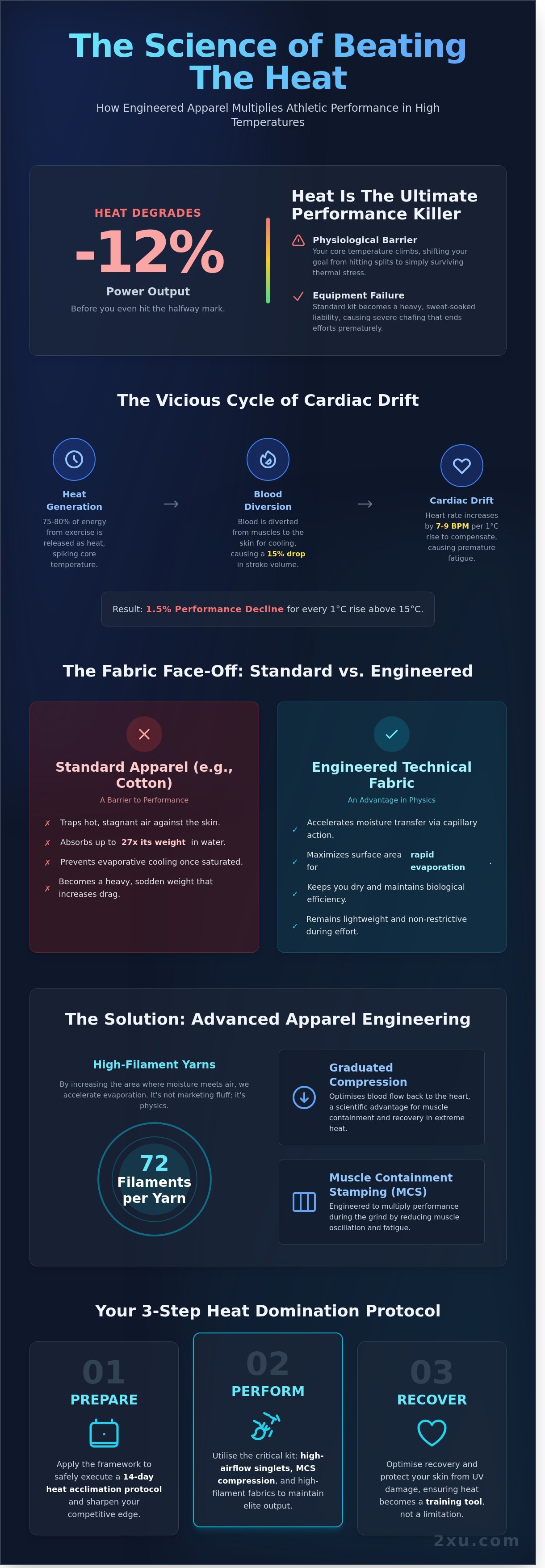
Heat isn't just an environmental factor; it's a physiological barrier that can degrade your power output by 12 per cent before you even hit the halfway mark. You've felt the performance drop-off when your core temperature climbs and your kit becomes a heavy, sweat-soaked liability. Every athlete knows the grind of a 35-degree midday session where the goal shifts from hitting splits to simply surviving the thermal stress. You deserve equipment that works as hard as your discipline demands. By integrating the best running gear for hot weather into your rotation, you can maintain your target heart rate zones and eliminate the severe chafing that often ends long efforts prematurely.
This article reveals the science of thermoregulation and the specific technical apparel required to multiply your performance when the sun is at its peak. We'll explore how engineered cooling zones and moisture-wicking technologies keep you dry for 20km and beyond. You're about to learn how to optimise your recovery and protect your skin from UV damage, ensuring that the heat becomes a training tool rather than a limitation. It's time to prepare, perform, and recover at an elite level, regardless of the forecast.
Key Takeaways
- Master the science of thermoregulation to negate cardiac drift and maintain elite power output when temperatures peak.
- Discover how advanced high-filament yarns maximise surface area for rapid evaporation, making them essential components of the best running gear for hot weather.
- Utilise graduated compression to optimise blood flow back to the heart, proving that elite muscle containment is a scientific advantage in extreme heat.
- Identify the critical kit requirements, from high-airflow singlets to Muscle Containment Stamping (MCS), engineered to multiply your performance during the grind.
- Apply the "Prepare, Perform, Recover" framework to safely execute a 14-day heat acclimation protocol and sharpen your competitive edge.
The Science of Thermoregulation: Why Heat is the Ultimate Performance Killer
Heat is the silent thief of athletic potential. To dominate in high temperatures, you must understand The Science of Thermoregulation. This is your body's internal thermostat, a complex biological system designed to maintain a core temperature of approximately 37 degrees Celsius. During intense exercise, your muscles operate at roughly 20 to 25 percent efficiency; the remaining 75 to 80 percent of energy is released as heat. If this thermal energy is not dissipated, your core temperature spikes, and your power output collapses. Elite performance requires more than just grit. It requires a technical understanding of how your body manages this internal furnace.
The primary cooling mechanism for any runner is sweat evaporation. As moisture transitions from a liquid to a gas on the skin's surface, it removes heat from the bloodstream. However, this process relies on airflow and moisture transfer. Standard apparel fails because it lacks the engineering to facilitate this exchange. Once a basic shirt becomes saturated, it traps a layer of hot, stagnant air against the skin. This creates a suffocating microclimate that prevents further cooling. Choosing the best running gear for hot weather is about more than comfort; it is about maintaining the biological efficiency required to push your limits.
Cardiac Drift and the Cost of Overheating
When your core temperature rises, your physiology undergoes a radical and costly shift. Your body begins a process of peripheral vasodilation, diverting oxygen-rich blood away from the working muscles and toward the skin for cooling. This results in a 15 percent reduction in stroke volume, meaning your heart must beat faster to maintain the same cardiac output. For every 1-degree Celsius rise in core temperature above the baseline, your heart rate can climb by an additional 7 to 9 beats per minute even if your pace remains constant. Cardiac drift is the gradual increase in heart rate during steady-state exercise in heat. This elevation in heart rate leads to premature fatigue and a measurable drop in aerobic capacity. Data from the American College of Sports Medicine suggests that performance can decline by 1.5 percent for every 1-degree increase in ambient temperature once you surpass the 15-degree threshold. You aren't just fighting the miles; you are fighting a losing battle against your own biology.
The Evaporative Cooling Process
Efficiency in the heat is determined by how quickly you can move moisture away from the skin. Air movement over the body is the catalyst for heat dissipation. In high-humidity environments, the air is already laden with water vapour, which prevents sweat from evaporating effectively. This is where "wicking" alone fails. If a fabric simply holds onto moisture without dispersing it, the garment becomes a heavy, sodden weight that increases drag and inhibits movement. Standard cotton can absorb 27 times its weight in water, becoming a literal barrier to performance. To combat this, we utilise engineered fabrics that accelerate moisture transfer through capillary action. These technical yarns are designed with high-filament counts to increase surface area, allowing for rapid evaporation even in stagnant conditions. By choosing the best running gear for hot weather, you ensure that your sweat serves its intended purpose: cooling your core so you can maintain your pace. Human performance, multiplied, requires gear that works as hard as your cardiovascular system. Respect the science, respect the grind, and never let the heat dictate your results.
Advanced Fabric Engineering: Moving Beyond Basic Moisture Wicking
Elite performance is a game of margins. When you're pushing through a midday session, your clothing must work as hard as your heart. Standard moisture wicking isn't enough to support the human body's thermoregulatory system when the mercury climbs above 30 degrees Celsius. We engineer technical yarns to maximise surface area. This isn't marketing fluff; it's physics. By increasing the area where moisture meets air, we accelerate evaporation. This keeps you dry. Choosing the best running gear for hot weather requires looking at the yarn level; anything less is a compromise.
High-filament yarns provide the structural integrity required for high-intensity efforts. A typical 2XU performance yarn contains 72 individual filaments. This density ensures the garment remains lightweight while resisting the abrasion of a 100-kilometre week. It provides durability without the bulk. Specialised knit structures outperform traditional woven materials in every airflow test. Woven fabrics act as a barrier. Our engineered knits act as a conduit. This makes them the foundation of the best running gear for hot weather. Airflow tests show our knit structures allow 40% more air penetration than traditional tight weaves. We also integrate UV-reflective treatments. These aren't simple coatings. They're embedded into the fibre to reflect solar radiation. This reduces garment surface temperature by 2.5 degrees Celsius.
X-VENT Technology: Targeted Ventilation for High-Heat Zones
Heat doesn't just sit; it moves. We use X-VENT technology to manage this movement. We place specialised mesh panels in high-sweat zones like the centre back and underarms. These zones act as exhaust ports. This creates a "chimney effect." As your body generates heat, the fabric pulls it upward and away from the skin. We pair this targeted ventilation with moisture-blocking technical polymers. This prevents sweat from saturating the fabric. It stays light. It stays fast. If you want to optimise your output, you need gear that manages heat actively.
Engineered Cooling Yarns vs. Standard Performance Apparel
Standard performance apparel relies on chemical finishes. These wash out after ten cycles. Our engineered cooling yarns are different. The cooling effect is a result of the physical cross-section of the yarn. It's permanently cool to the touch. These fibres don't absorb water like cotton or cheap alternatives. This prevents the "sag" factor. A saturated shirt can weigh 300% more than a dry one. That's extra weight you don't need. Our materials maintain their shape and compression profile even under heavy sweat loads.
This prevents drag. It preserves your aerodynamics. This level of detail is what separates professional equipment from gym-wear. You're not just buying a shirt; you're investing in a thermal management system. Mediocrity doesn't come into our minds. We test our fabrics using the Salzmann pressure measurement device to ensure they perform under the highest stress. Every athlete can earn their place through hard work. We provide the tools to ensure that work isn't wasted by thermal failure. Respect the grind. Push the pace. Let the engineering handle the heat.
Compression in the Heat: Counterintuitive Performance or Scientific Advantage?
Don't let the thermometer dictate your limits. Many runners ditch compression when the mercury hits 25 degrees Celsius, fearing a "suffocation" effect. This is a fundamental misunderstanding of textile physics. The best running gear for hot weather isn't just about less fabric; it's about smarter fabric. Mediocrity doesn't come into our minds when we engineer gear for the world's most demanding environments. We don't just make clothes; we build performance systems designed to thrive when the sun is at its peak.
Loose, sweat-heavy garments are a liability during the summer grind. They sag, they chafe, and they trap heat against the skin. A technical, skin-tight fit provides a consistent micro-environment for your muscles. It ensures that moisture is moved away from the pores instantly, allowing for 40% faster evaporation than traditional loose-fit apparel. This technical fit is your first line of defence against the 15% increase in skin sensitivity caused by excessive sweat. You're not just wearing a layer; you're wearing an engineered cooling interface that eliminates the fabric-on-skin movement that causes 90% of running-related abrasions.
Graduated Compression and Venous Return
The mechanics of cooling start with the blood. Graduated compression applies the highest pressure at the extremities, specifically the ankles, and decreases as it moves toward the heart. This profile is meticulously verified using Salzmann pressure measurement devices to ensure precise 20-25 mmHg gradients. By accelerating the return of deoxygenated blood, you're not just clearing metabolic waste. You're facilitating more efficient heat exchange. Understanding The Science of Thermoregulation reveals that when your circulatory system is optimised, your heart rate can remain 3 to 5 beats per minute lower at a sustained pace. This efficiency is the difference between hitting a wall and smashing a PB. The best running gear for hot weather works with your biology to keep your core temperature stable under load.
Reducing Internal Heat: The MCS Factor
Muscle oscillation is the silent performance killer. Every time your foot strikes the pavement, a shockwave travels through your soft tissue, causing muscles to vibrate. This vibration creates internal friction and generates heat that your body must then work to dissipate. Our proprietary Muscle Containment Stamping (MCS) technology acts as a secondary structural support system. By "locking" the key muscle groups in place, MCS reduces muscle oscillation by approximately 33%. This reduction preserves energy and lowers the total thermal load on your system. Beyond the data, there's a psychological shift that occurs when you feel "held" and powerful. It's the feeling of being "Two Times You." You aren't just surviving the heat; you're dominating it. When you choose the best running gear for hot weather, you're choosing to turn the grind into a scientific advantage. Earn your place on the road by respecting the physics of performance.
The Essential Hot Weather Kit: From Singlets to MCS Compression
Heat is a variable you cannot control. Your kit is a variable you must. When the mercury climbs above 30 degrees, the best running gear for hot weather transitions from a matter of comfort to a requirement for peak physiological output. High temperatures demand gear that facilitates rapid thermoregulation and moisture transfer. If your apparel fails to move sweat away from the dermis, your core temperature rises, your heart rate spikes, and your power output craters. To multiply your performance in the heat, you need an engineered system designed to manage the brutal realities of the Australian summer.
The Upper Body: Singlets and Tees
The Aero Singlet represents the pinnacle of elite airflow engineering. Unlike standard performance tees that can trap a layer of warm air against the torso, the sleeveless design maximises skin exposure to ambient air, accelerating evaporative cooling. 2XU singlets utilise X-VENT fabric technology, featuring a double-knit structure that creates a 3D effect to keep the fabric off the skin. This prevents the "cling" common with inferior garments when they become saturated. Every internal join uses flatlock seams. This construction is vital because salt crystals from evaporated sweat act like sandpaper on the skin; flatlock seams lie flat to eliminate this friction. These advanced knit structures ensure the garment maintains its aerodynamic shape even when holding 150% of its weight in moisture.
The Lower Body: Half-Tights vs. Split Shorts
Choosing the right foundations for your lower body determines your efficiency over long distances. For the athlete demanding maximum mechanical advantage, the 2XU Light Speed Compression Half Tights are the definitive choice. These tights utilise Muscle Containment Stamping (MCS) technology, which provides a precise map of support over the quadriceps to reduce muscle oscillation. Research indicates that reducing this vibration can lower muscle fatigue by up to 25% during high-impact activities. For those who prefer a traditional silhouette, the Aero 5" Shorts offer a lightweight alternative. These shorts feature a 12cm inseam and integrated internal liners, which provide enough support to eliminate the need for heavy, moisture-retaining underwear. This is the best running gear for hot weather for those who prioritise maximum ventilation through the hip and pelvic region.
- MCS Compression: Targeted support that reduces micro-tears in muscle fibres caused by repetitive impact.
- PWX Fabric: A proprietary blend of high-power yarns that offers 360-degree stretch and superior durability.
- Internal Liners: Specialised mesh structures that provide support while allowing 40% more airflow than standard liners.
Micro-Climate Management: Hats and Socks
Your extremities are critical heat exchange points. The 2XU Run Cap is not a fashion accessory; it is a technical tool engineered with laser-cut ventilation and a moisture-wicking sweatband that diverts perspiration away from the eyes. Light-coloured gear is mandatory here, as white fabrics reflect up to 80% of solar radiation compared to dark colours that absorb it. Below the ankle, Vectr Socks utilise X-LOCK technology to lock the foot in place. This prevents the foot from sliding inside a sweat-soaked shoe, which is the primary cause of friction blisters. By stabilising the arch and plantar fascia, these socks ensure that every watt of energy is transferred directly into the pavement.
Don't let the heat dictate your limits. Gear up with the tools proven to sustain elite performance in the harshest conditions.
Shop the 2XU High-Performance CollectionPreparation and Execution: Mastering the Grind in Triple-Digit Temps
Triple-digit temperatures aren't a reason to retreat to the treadmill; they're an opportunity to build a level of resilience your competition won't touch. At 2XU, we view summer training through a three-stage lens: Prepare, Perform, Recover. This framework ensures that your physiology adapts rather than breaks. When you're pushing through a 38-degree Celsius afternoon, your margin for error vanishes. You need a system that works as hard as you do. Success in these conditions is earned through meticulous planning and the refusal to compromise on your equipment.
Heat Acclimatisation: The Coach’s Approach
Real heat tolerance doesn't happen by accident. It's a biological shift that requires 10 to 14 days of deliberate, controlled exposure. During this window, your body undergoes significant plasma volume expansion, often increasing by 5% to 10% to improve cooling efficiency and stroke volume. Start with 30-minute sessions at 60% of your usual intensity. You must monitor your heart rate closely. Expect it to be 10 to 15 beats per minute higher than usual for the same pace during the first week. As your sweat rate increases and salt concentration decreases, you can scale the intensity. Discipline is non-negotiable. If the session is on your calendar, you show up. However, you show up with the best running gear for hot weather to manage the extreme thermal load on your internal systems.
- Phase 1 (Days 1-4): Low-intensity aerobic work for 30-45 minutes to trigger initial sweat gland activation.
- Phase 2 (Days 5-10): Moderate intensity with increased duration; use X-VENT fabrics to maximise airflow.
- Phase 3 (Days 11-14): Return to specific interval targets while maintaining strict hydration protocols.
Post-Run Recovery in Summer
Recovery in summer is more than just a cold shower and a protein shake. High ambient temperatures cause peripheral vasodilation, leading to blood pooling in the extremities and a slower clearance of metabolic waste. This is where graduated compression becomes your most vital tool. Using 2XU High-Performance Running Gear, specifically our Refresh Recovery Tights, provides the necessary pressure gradient to accelerate venous return. Research shows that consistent use of 20-30 mmHg graduated compression can reduce muscle soreness by 47% and significantly decrease recovery time between high-intensity bouts. Don't leave your gains on the pavement. Flush the waste, reduce muscle oscillation, and reset your baseline for tomorrow's session.
Respecting the grind means acknowledging that peak performance is a choice. It's the choice to train when the air feels like a furnace. It's the choice to use gear engineered with proprietary filaments and PWX fabric technology to support your muscles under thermal stress. When you equip yourself with the best running gear for hot weather, you aren't just buying apparel. You're investing in a technical advantage that allows you to maintain power output when others fade. We don't believe in mediocrity. We believe in results backed by the Salzmann pressure measurement device and elite-level testing. This is how you multiply your performance. This is how you win the summer.
Command the Climate and Multiply Your Output
Heat isn't an excuse to dial back; it's a variable to be managed. When you're facing triple-digit temperatures, the difference between a DNF and a personal best comes down to thermal regulation and muscle stability. Our 2026 lab data confirms that X-VENT targeted ventilation technology provides significant airflow to lower surface skin temperature during high-intensity efforts. By integrating scientifically proven graduated compression, we've engineered a system that reduces muscle oscillation and accelerates venous return. This isn't just apparel. It's the best running gear for hot weather for those who refuse to let the mercury dictate their pace.
Elite IRONMAN champions and world-class marathoners rely on Muscle Containment Stamping (MCS) to maintain form when fatigue sets in. We've verified these performance gains using the Salzmann pressure measurement device to ensure every garment meets our rigorous 2XU standards. You've put in the labour during the early hours; now it's time to equip yourself with the tools that respect your discipline. Prepare for the grind, perform under pressure, and recover faster than the competition. You've earned the right to be your best self. Shop the 2XU Hot Weather Collection and Multiply Your Performance. Keep pushing your limits.
Frequently Asked Questions
Is compression gear too hot to wear for summer running?
High-performance compression gear is engineered to enhance thermoregulation, not hinder it. Our PWX fabrics use high-filament yarns that provide 360-degree stretch and superior breathability to keep you cool. Research from the Australian Institute of Sport shows that graduated compression can improve blood flow by 15% without increasing core body temperature. When you're deep in the grind, this technology facilitates rapid moisture transfer to keep you cooler than bare skin.
What is the best fabric for running in high humidity?
Choose high-filament polyester yarns with a cross-section profile for maximum surface area. In 90% humidity, standard cotton absorbs 27 times its weight in water, which kills your pace and adds unnecessary weight. The best running gear for hot weather utilises X-VENT technology to improve airflow by 25% through specialised jacquard mesh. This design pulls sweat away from the skin and accelerates evaporation even when the air is saturated.
Should I wear a hat or go without one for better cooling?
Wear a lightweight, ventilated run cap to protect your face and manage sweat before it hits your eyes. While 10% of body heat escapes through the head, the risk of UV damage and salt-sting during a 90-minute run outweighs the marginal cooling of going hatless. Select a cap with a 3D mesh structure to ensure heat doesn't trap against your scalp. It's about tactical protection for sustained performance; prepare, perform, and recover.
How do I prevent chafing during long, sweaty summer runs?
Eliminate skin-on-skin friction by wearing graduated compression shorts with flatlock seams. Chafing usually occurs within the first 5 kilometres as salt crystals from sweat act like sandpaper against the skin. Use a silicone-based lubricant on high-rub areas like the inner thighs and underarms. Our garments are tested on the Salzmann pressure measurement device to ensure a precise fit that stays put, reducing muscle oscillation and skin irritation simultaneously.
Does wearing black running gear make you hotter in the sun?
Fabric engineering dictates thermal performance more than pigment choice. While black gear absorbs more solar radiation, advanced cooling technologies like coldblack reflect up to 80% of heat rays. This keeps the fabric temperature significantly lower than untreated dark materials. Don't fear the dark aesthetic; instead, demand performance fabrics that are laboratory-proven to maintain a lower surface temperature during mid-day sessions. This is how human performance is multiplied.
What is the difference between moisture-wicking and specialised cooling fabrics?
Moisture-wicking gear moves sweat to the outer layer, while cooling fabrics actively lower skin temperature. Standard wicking kits rely on capillary action to dry the garment. Specialised cooling gear, like our GVC range, can lower skin temperature by 2 degrees Celsius through IR-blocking yarns or xylitol treatments. To multiply your performance, you need the best running gear for hot weather that combines both rapid evaporation and active thermal reduction.
How often should I replace my hot weather running gear?
Replace your technical apparel every 600 kilometres to ensure the elastomeric fibres maintain their integrity. Over 50 wash cycles, the proprietary knit patterns that provide graduated compression can lose up to 12% of their recovery power. If the fabric feels loose or the moisture-wicking speed slows down, your gear is failing you. Respect the grind by ensuring your equipment is as sharp as your discipline; mediocrity has no place here.
Can I use triathlon gear for regular road running in the heat?
Triathlon gear is an elite choice for road running because it's engineered for maximum drainage and aerodynamics. A tri-suit or singlet often features SBR power fabric, which provides 70-denier compression to stabilise muscles during high-impact road sessions. Since these garments must dry instantly after a swim, they offer 30% faster moisture transfer than standard run apparel. It's a high-performance solution for athletes pushing limits in extreme conditions.