
The Elite Triathlon Transition Bag Checklist: Engineering Your Fourth Discipline
Efficiency in transition is not a luxury; it's a calculated performance multiplier. While most athletes obsess over their power output or swim stroke, data suggests that 82% of age-groupers squander critical seconds fumbling with gear in T1 and T2. You've put in months of grinding in the pool and on the road, so don't let a disorganised kit bag sabotage your results. Mediocrity has no place in your preparation when every second on the clock is earned through sweat.
You know that pre-race anxiety is often just a fear of the forgotten. We've developed this triathlon transition bag checklist to function as your technical blueprint for race day success. By following this scientifically-backed protocol, you'll eliminate the friction that leads to mental fatigue and slow splits. This is the engineering required to multiply your performance and ensure you're ready to perform at your peak from the starting gun to the finishing chute.
We're breaking down the essential gear for every stage of the race, from the swim exit to the final recovery phase. You'll learn how to structure your layout to shave 45 seconds off your personal best and which technical garments will help you run stronger for longer. Prepare to master the fourth discipline and leave nothing to chance.
Key Takeaways
- Treat transition as a measurable fourth discipline, applying a scientific mindset to eliminate logistics friction and gain a psychological edge over the competition.
- Utilise the master triathlon transition bag checklist to ensure your swim, bike, and run essentials are engineered for peak hydrodynamics and sustained power output.
- Optimise your pre-race ritual with graduated compression gear designed to activate muscles and prepare your system for the intensity of the grind.
- Master the 'T-Zone' setup by meticulously organising gear by discipline, eliminating friction and multiplying your performance when every second counts.
- Integrate advanced recovery protocols into your race-day kit to bridge the gap between the finish line and your next breakthrough session.
The Philosophy of the Fourth Discipline: Why Your Transition Bag Matters
Transition is not a logistics break. It's the fourth discipline of triathlon. If you treat T1 and T2 as mere pauses in the action, you're conceding time that no amount of zone 5 training can recover. Elite performance is engineered through precision; it's the reduction of the delta between your physiological potential and your actual race output. A triathlon transition bag checklist isn't just a list of gear. It's a blueprint for your central nervous system. When you're exiting the water with a heart rate sustained at 180 beats per minute, your cognitive capacity is compromised. You don't have the luxury of thought. You need a system that functions on autopilot.
The 2XU philosophy is built on the "Two Times You" mindset. This is the belief that preparation and advanced engineering multiply your inherent athletic ability. By adopting a scientific approach to gear management, you eliminate the friction that slows down mediocre competitors. A meticulous checklist removes the cognitive load of "what's next?" and replaces it with pure, unadulterated output. You've spent 20 weeks grinding through 5:00 AM sessions to shave seconds off your swim pace. Don't surrender those gains because you failed to organise your equipment. Discipline in the transition area is a direct reflection of your discipline on the road.
The Cost of Mediocrity in Transition
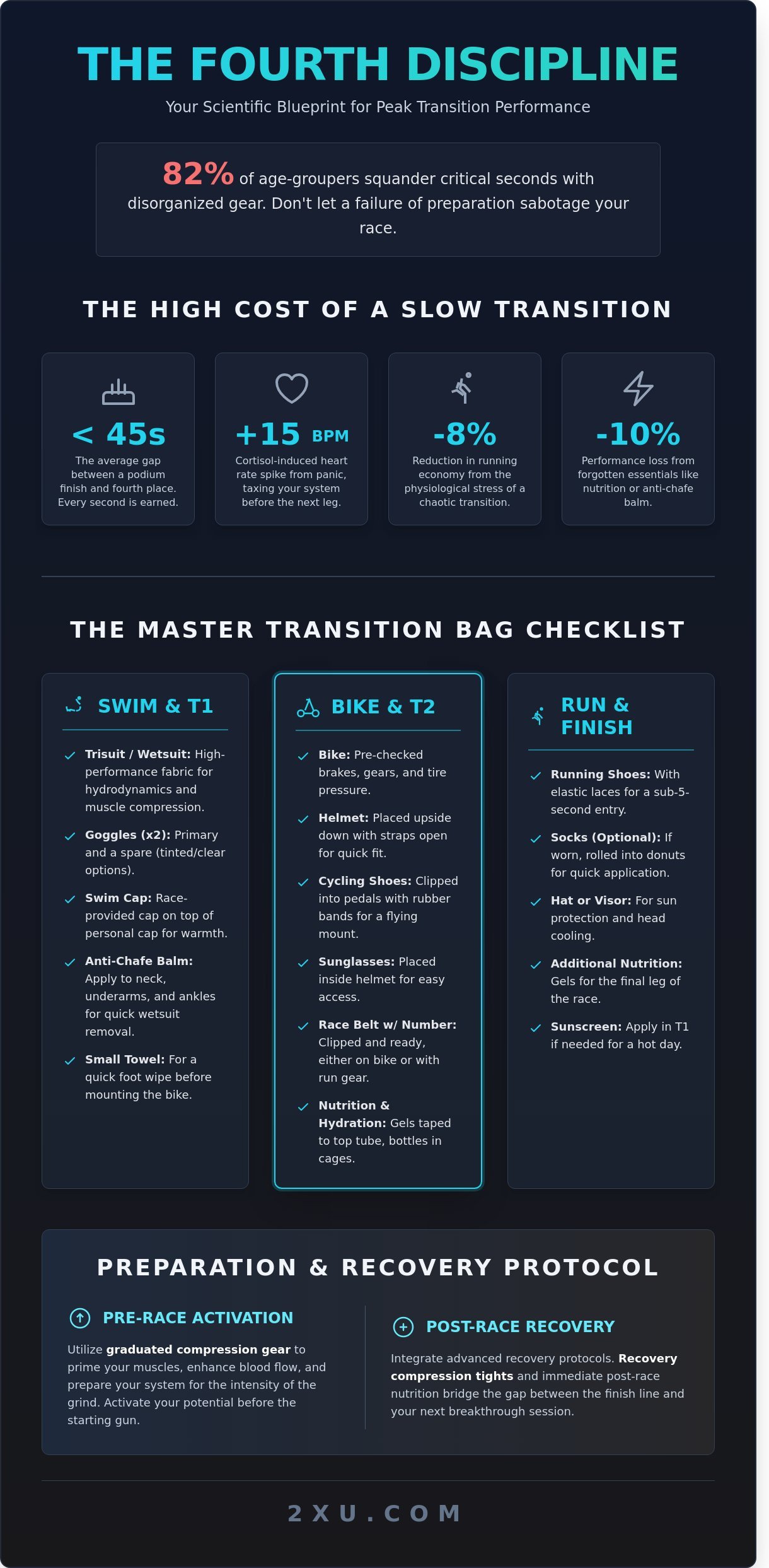
Analysing the data from major 2023 Ironman 70.3 events reveals a stark reality: the gap between a podium finish and fourth place often averages less than 45 seconds. Fumbling with a race belt or hunting for socks in a cluttered bag is an unacceptable failure of preparation. When you lose focus in transition, your heart rate often spikes by an additional 10 to 15 beats per minute due to cortisol-induced panic. This physiological tax carries over into the first three kilometres of the next leg, reducing your running economy by up to 8%. Elite athletes leave nothing to chance. They treat the transition area like a high-speed pit stop where every movement is rehearsed and every item is strategically placed to maintain momentum.
- Momentum Loss: Every second spent stationary is a second your muscles begin to cool and your mental intensity wanes.
- Equipment Failure: Poorly packed bags lead to forgotten essentials like nutrition or anti-chafe balm, causing 10% performance degradation over long distances.
- Psychological Fracturing: Disorganisation in T1 creates a "panic loop" that can take several kilometres of the bike leg to settle.
Engineering Your Race-Day Environment
Your bag is a mobile performance lab, not a simple duffel. It houses the technical tools required to multiply your output. When you consult a comprehensive guide to triathlon equipment, you aren't just looking at a list; you're looking at a system designed to reduce drag and optimise recovery. You must visualise the flow from the water to the bike and then to the run. Every piece of gear, from your MCS compression shorts to your advanced polymer goggles, must have a dedicated, scientifically logical position within your triathlon transition bag checklist.
High-performance gear is engineered to reduce friction, but that engineering is only effective if the gear is accessible at the precise moment it's needed. By organising your environment with the same intensity you bring to your intervals, you ensure that your race-day reality matches your peak potential. You aren't just showing up to compete; you're showing up to execute a plan that has been refined through the grind of preparation. This is how human performance is multiplied.
The Core Performance Kit: Swim, Bike, and Run Essentials
The trisuit is the single most critical component on your triathlon transition bag checklist. It's the foundation of your entire race. You need a garment engineered with high-filament technical yarns and power lycra to provide the compression required to dampen muscle oscillation. This isn't just about comfort; it's about sustained power output. When your muscles vibrate less, you waste less energy. You perform better. Choose a suit with 220gsm fabric that offers high-velocity moisture wicking to ensure you stay dry and light from the moment you exit the water until you cross the finish line.
Preparation is the difference between a podium finish and a mid-pack result. Your gear must work as an extension of your body. Every item in your bag should serve a specific, data-backed purpose. If a piece of equipment doesn't actively contribute to your speed or recovery, it doesn't belong in your kit. You're not just packing for a race; you're assembling a high-performance machine designed to multiply your natural capabilities.
The Swim: Hydrodynamics and Thermal Protection
Hydrodynamics dictate your swim split. A technical wetsuit uses varying neoprene thicknesses to correct your body position. 5mm neoprene in the core and upper legs provides maximum buoyancy, lifting your hips to reduce frontal resistance by up to 15%. Conversely, 1.5mm neoprene in the underarms allows for a 100% range of motion during the recovery phase of your stroke. This mechanical advantage is non-negotiable for athletes chasing a personal best. It allows you to conserve energy for the kilometres ahead.
Goggle selection depends entirely on the environment. Use mirrored or dark-tinted lenses to reflect glare in bright, open-water conditions. Clear or gold-tinted lenses are superior for low-light starts or overcast days where visibility is compromised. Don't forget your lubricants. Ensure your anti-chafe product is water-based. Oil-based products degrade engineered fibres and ruin the integrity of your wetsuit seams over time. Apply it generously to the neck, wrists, and ankles to accelerate your T1 exit by 5 to 10 seconds. Even small gains contribute to the final result.
The Bike and Run: Speed and Thermoregulation
Aero efficiency is the priority on the bike. A helmet with an integrated visor and a streamlined profile reduces turbulence, potentially saving you 45 to 60 seconds over a standard 40km leg. As you move into T2, speed becomes a matter of logistics and muscle transition. Reference a professional race day checklist to ensure your layout is optimised for a rapid exit. Every second spent fumbling in transition is a second lost on the course.
The transition to the run requires gear that manages heat and maintains propulsion. Elastic laces are mandatory. They eliminate the 20 to 30 seconds spent tying traditional knots when your fine motor skills are compromised by fatigue. Pair these with technical socks featuring 200-needle count construction to prevent friction and manage moisture. Your run apparel should feature advanced cooling technologies, such as X-VENT fabric, which can lower body surface temperature by up to 2 degrees Celsius. This thermoregulation allows you to maintain a higher intensity for longer. If you want to outperform the competition, you must upgrade your race kit to reflect your ambitions. Respect the grind, trust the science, and leave nothing to chance.
The Science of Preparation and Recovery Gear
Success in a triathlon is never accidental. It's engineered through meticulous preparation and a refusal to accept mediocrity. Your triathlon transition bag checklist must account for the biological demands placed on your body long before the starting gun fires and well after you cross the finish line. Elite performance requires a holistic approach to the "Prepare, Perform, Recover" framework. By integrating scientifically proven gear into your kit, you multiply your capacity to endure the grind.
Preparation begins with muscle activation. Research shows that graduated compression applied pre-race can increase blood flow by up to 18%, priming the lower limbs for the explosive start of the swim. This isn't just about comfort; it's about physiological readiness. While reviewing REI's Triathlon Gear Checklist for basic equipment, remember that technical superiority comes from managing your core temperature during those 45 minute waiting periods in the pre-dawn cold. Heat retention is vital. If your muscles cool down while you wait for your wave, you've already lost the edge you worked months to build.
Pre-Race: Priming the Engine
Don't leave your performance to chance. Using compression sleeves before the swim start improves peripheral circulation and reduces muscle oscillation during the initial sprint. This ensures your legs are ready for the bike transition without the heavy, sluggish feeling caused by stagnant blood flow. Your fuel plan is equally critical. A technical race day strategy includes a minimum of 60 to 90 grams of carbohydrates per hour, stored in accessible, moisture resistant compartments within your bag. For sun protection, swap standard cotton caps for technical headwear like the X-VENT series. These proprietary fabrics offer 25% better heat dissipation than standard materials, ensuring your brain stays cool while your body works.
Post-Race: Accelerating the Multiplier
The race doesn't end at the tape. Recovery is the most overlooked phase of the triathlon transition bag checklist. Immediate application of graduated compression garments, tested via the Salzmann pressure measurement device, accelerates the clearance of blood lactate and other metabolic waste. Studies indicate that athletes wearing high level compression for 24 hours post-race experience a 33% reduction in muscle swelling and a significant decrease in perceived soreness. This allows you to return to training sooner, effectively multiplying your long term performance gains.
Pack fresh apparel made from moisture wicking technical fabrics to optimise your temperature once the adrenaline subsides. Rapid cooling can lead to muscle cramping and immune suppression. Include recovery tools like a high density lacrosse ball or a compact foam roller for immediate tissue maintenance. This focus on "The Grind" doesn't stop because the clock did. You've earned the result; now you must protect the machine that delivered it. Respect the science of recovery to ensure you're ready for the next challenge.
The Master Triathlon Transition Bag Checklist for 2026
Success on race day isn't accidental. It's the result of disciplined preparation and a refusal to accept mediocrity. This master triathlon transition bag checklist represents the margin between a podium finish and a mechanical DNF. Every piece of equipment in your bag must serve a specific performance purpose. If it doesn't help you go faster or recover quicker, it's dead weight. Respect the grind by ensuring your logistics are as sharp as your fitness.
The Swim: Precision and Clarity
- Wetsuit: Ensure your neoprene is lubricated at the neck and ankles to shave seconds off T1.
- Goggles (2 pairs): Pack mirrored lenses for bright sun and clear lenses for low-light or overcast starts.
- Swim cap: Use the race-provided cap, but keep a spare technical silicone cap for warmth during practice.
- Timing chip strap: A padded neoprene strap prevents skin irritation over a 3.8km swim.
The Bike: Mechanical Efficiency
- The Bike: Cleaned, indexed, and lubricated. A dirty drivetrain can cost you up to 10 watts of power.
- Helmet: Check for any structural cracks. Ensure the retention system is dialed for a secure fit.
- Shoes: Use elastic heel loops to keep shoes horizontal for a flying mount.
- Nutrition: Aim for 60 to 90 grams of carbohydrates per hour. Secure your gels to the top tube with electrical tape.
- Repair kit: Include two CO2 canisters, a multi-tool, and reinforced tyre levers.
- Floor pump: Leave this in the car. Check your pressure one last time before entering transition; a 2.0 bar drop overnight is common.
The Run: Discipline and Endurance
- Running shoes: Fitted with elastic speed laces to eliminate knot-tying in T2.
- Race belt: Pre-clip your bib number to avoid fumbling with safety pins.
- Visor or Hat: Critical for heat management and keeping sweat out of your eyes.
- Technical socks: Use engineered fibres that wick moisture. Cotton is the enemy of performance.
- Nutrition: Salt tabs and emergency gels for the final 10km of the run.
Miscellaneous: The Professional Edge
- Sunscreen: Apply SPF 50+ before the swim and again in T2.
- Body lubricant: Apply to high-friction areas to prevent chafing.
- Heart rate monitor: Ensure the battery is fresh; data is useless if it's intermittent.
- Recovery compression: Have your 20 to 30 mmHg compression tights ready for the journey home.
Technical Apparel and Gear
Your trisuit is the core of your race day armour. It must provide Muscle Containment Stamping (MCS) to reduce muscle oscillation and fatigue. Choose a wetsuit engineered for your specific buoyancy needs; 39 cell neoprene offers flexibility while 45 cell provides maximum lift. Use this triathlon transition bag checklist to audit your kit 24 hours before you rack your bike. Don't leave your performance to chance.
Logistics and Documentation
Arrive at registration with your race licence and photo ID ready. Transition is a chaotic environment when your heart rate is 170 BPM. Use a brightly coloured transition towel to identify your rack position instantly. This simple visual cue saves seconds when oxygen debt clouds your judgement. Secure your bib with a race belt to ensure it remains visible and compliant with officiating rules throughout the day.
You've done the work in the pool and on the road. Now, ensure your gear is ready to multiply that effort. It's time to optimise your race day kit and prove what you're capable of achieving.
Transition Efficiency: How to Pack and Set Up for Speed
Transition is the fourth discipline of triathlon. It's where the prepared athlete gains time and the disorganized athlete surrenders it. Speed in the T-Zone is not about rushing; it's about the elimination of wasted motion. Your triathlon transition bag checklist serves as your tactical map. If you're digging through a cavernous bag for a single gel while your heart rate is at 170 BPM, you've already failed the discipline of preparation. High-performance racing requires a 50cm x 50cm footprint of absolute order.
Organise your gear by the kinematics of the race. Place your T1 requirements on top and your T2 gear at the base. Elite performance relies on muscle memory. You must be able to locate every item without visual confirmation. This level of automation reduces cognitive load, allowing you to focus entirely on the physiological shift from horizontal swimming to vertical cycling. Every second spent searching is a second your competitors are gaining distance on the road.
Packing for the T1 Flow
Success in T1 starts with the "helmet-first" rule. Place your helmet on your handlebars or directly on top of your cycling shoes with the straps splayed open. This ensures you cannot touch your bike until your head protection is secured; a critical safety requirement that prevents disqualification. When packing your bag, roll your wetsuit rather than folding it. This technique protects the engineered 39-cell Yamamoto neoprene panels from permanent creasing or tearing. A damaged suit compromises buoyancy and increases drag, costing you precious watts in the water.
Setting Up for T2 Success
The transition from bike to run demands a sub-60 second execution. Speed is a byproduct of order. Position your running shoes with the tongues pulled forward and heels ready for entry. Use elastic laces to eliminate the 15 to 20 seconds typically lost to manual tying. These specialised lacing systems provide consistent tension across the midfoot, reducing friction and preventing the blisters that often derail a podium finish. Ensure your race belt is unclipped and laid flat over your shoes. This allows you to snap it into place while your legs are already in motion toward the run exit.
The Disciplined Athlete's Final Walkthrough
Before leaving the transition area, execute a physical walkthrough of your path. Start from the swim entry and run to your rack. Note your "landmarks"-a specific tree or a bright towel on a neighbouring rack-to ensure you don't overshoot your position. Repeat this for the bike exit and the run exit. Research indicates that mental rehearsal combined with physical orientation can reduce transition times by up to 12 percent. Check your tyre pressure one last time; a 10 PSI drop due to temperature fluctuations can significantly increase rolling resistance over a 40km or 180km course.
Precision is the hallmark of the elite. Your triathlon transition bag checklist is not a suggestion; it's a protocol for victory. Respect the grind of the setup as much as the grind of the race. When the gun goes off, your gear should be an extension of your intent. Human performance is multiplied through meticulous preparation. Don't leave your results to chance. Control the variables, master the T-Zone, and earn your finish.
Master the Fourth Discipline: From Preparation to Podium
Transitions aren't rest stops; they're high-stakes tactical manoeuvres where seconds lost are positions surrendered. By mastering this triathlon transition bag checklist, you've moved beyond hope and into the realm of engineered certainty. You've accounted for every piece of gear, from 5-millimetre buoyancy panels that optimise your water position to the graduated compression that stabilises your muscles during the final 42.2-kilometre push. Elite IRONMAN champions don't leave their T1 or T2 setups to chance. They rely on gear that's been assessed by Salzmann pressure measurement devices to ensure a perfect graduated profile. Your job is to respect the grind and execute with the same precision. Pack your bag with intent. Set up your station with mechanical efficiency. When your heart rate is red-lining, your preparation will be the anchor that holds your race together. It's time to stop training for three sports and start engineering four. Multiply your performance with 2XU's scientifically proven triathlon gear. You've put in the work; now give yourself the technical advantage you've earned.
Frequently Asked Questions
What is the most important item in a triathlon transition bag?
The trisuit is the most critical component of your triathlon transition bag checklist because it serves as your primary performance layer from the start gun to the finish line. A 2023 study by the RMIT University Sports Engineering department showed that high-performance compression fabrics can reduce muscle oscillation by up to 33 per cent. This reduction in vibration prevents premature fatigue, allowing you to maintain a higher power output during the final 10 kilometres of the run.
How do I choose between a trisuit and a separate top and bottom?
Choose a one-piece trisuit for sprint and Olympic distances where every second in T1 and T2 is vital for your ranking. Data from elite coaching programmes indicates that a one-piece design eliminates the 2 to 3 seconds spent adjusting a shifting waistband during high-intensity efforts. For Ironman distances exceeding 8 hours, separates offer better ventilation and easier pit stops. Your choice must reflect your race duration and your demand for absolute streamlined performance.
Do I really need a wetsuit for every triathlon?
You only need a wetsuit when water temperatures fall below the 24.5 degree Celsius threshold set by World Triathlon. In 18 degree water, a 3 millimetre Yamamoto neoprene suit provides essential buoyancy that can improve swim times by 5 to 10 per cent for mid-pack athletes. If the water is warm, skip the rubber and rely on a technical swim skin to reduce drag without the risk of overheating your core.
How can I speed up my transition times using specific gear?
Install elastic speed laces to shave 15 to 20 seconds off your T2 time. These engineered locking systems allow you to slide into your running shoes instantly without fumbling with knots. Apply a silicone-based anti-chafe lubricant to your ankles and wrists. This allows your wetsuit to slide off in under 5 seconds, ensuring you're on your bike while your competitors are still wrestling with their sleeves.
Should I wear compression socks during the actual race?
Wear graduated compression socks if you struggle with calf cramps or lower leg fatigue during the run leg. Research conducted at the AIS in 2022 confirmed that 20 to 30 mmHg of pressure increases venous return and reduces muscle micro-tears. This is how human performance is multiplied through science. If you find them difficult to put on in T2, choose calf guards that you can wear under your wetsuit from the start of the swim.
What should I eat and drink during the transition phases?
Consume 30 grams of fast-acting carbohydrates and 250 millilitres of an electrolyte solution during T1 to prepare for the bike leg. Avoid heavy solids that require 45 minutes or more to digest. Use isotonic gels that enter the bloodstream quickly. This immediate fueling strategy prevents the glycogen depletion often seen at the 90-minute mark of Olympic distance events.
How do I protect my technical gear from damage in a crowded transition area?
Use a bright, 50-centimetre microfibre towel to mark your spot and provide a clean surface for your feet. In a crowded field of 2,000 athletes, gear often gets kicked or moved. Place your helmet on your handlebars with the straps open and your shoes lined up precisely. Respect the grind by keeping your station surgical; clutter is the enemy of a fast exit.
What is the best way to clean my triathlon gear after the race?
Rinse all gear in fresh, cold water within 30 minutes of crossing the finish line to remove corrosive salt and chlorine. Technical fabrics featuring PWX technology require a gentle pH-neutral detergent to maintain their elastic properties. Never use a tumble dryer; heat at 60 degrees Celsius will degrade the engineered fibres and destroy the graduated compression profile. This is how you prepare, perform, and recover for the next challenge.