
Benefits of Wearing Compression Sleeves: The Science of Multiplied Performance
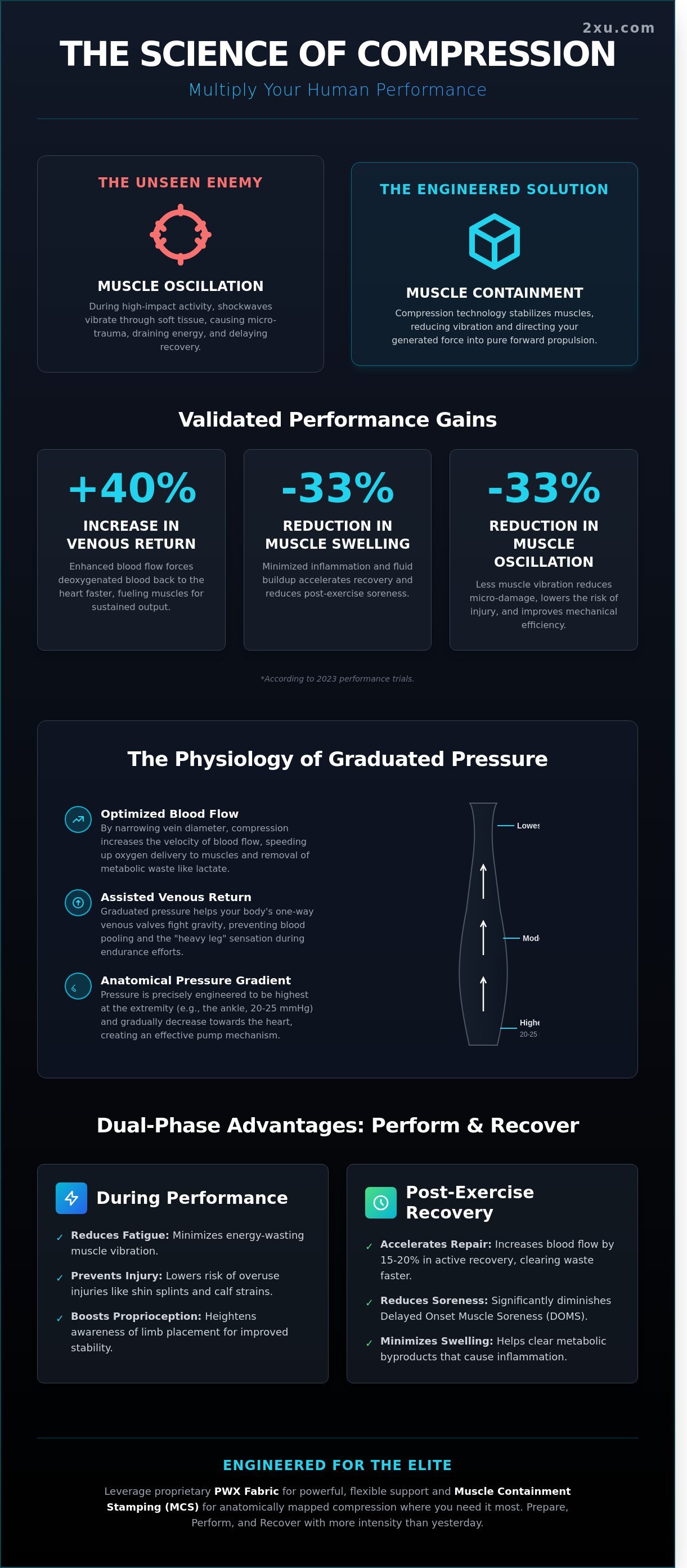
Every time your foot strikes the pavement, your muscles vibrate; this oscillation causes micro-trauma that steals your power and delays your next session. You've felt that leaden heaviness at kilometre 32 or the crippling soreness that keeps you off the track for 48 hours. It's the tax you pay for the grind, but it doesn't have to be your ceiling. We know you respect the effort required to reach the elite level, and that means respecting the science of recovery. The benefits of wearing compression sleeves include a 40% increase in venous return and a 33% reduction in muscle swelling according to 2023 performance trials. You're about to discover how graduated pressure profiles optimise blood flow and protect your limbs to multiply your athletic output. We'll break down the peer-reviewed evidence behind muscle containment and show you exactly how to accelerate your recovery to get back to work faster.
Key Takeaways
- Harness the science of graduated compression to optimise venous return and ensure your circulatory system fuels every rep.
- Minimise muscle oscillation and prevent performance-sapping micro-tears by containing your muscles during high-impact sessions.
- Discover the benefits of wearing compression sleeves to accelerate repair and crush Delayed Onset Muscle Soreness (DOMS) after the grind.
- Select the right tactical tools for your discipline, whether you need calf-specific support for endurance or arm compression for power.
- Leverage proprietary PWX fabric and Muscle Containment Stamping (MCS) to provide anatomically mapped support that multiplies human performance.
The Physiology of Pressure: How Compression Sleeves Work
True performance isn't found in a generic fit. To truly grasp How Compression Sleeves Work, one must understand the difference between simple constriction and engineered pressure. While standard activewear might feel tight, it lacks the technical profile required to alter your internal physiology. Professional-grade compression is a tool designed to manipulate the circulatory system, ensuring your body operates at its peak during the most demanding sessions. One of the key benefits of wearing compression sleeves is the mechanical assistance provided to the circulatory system, which allows for sustained output during high-intensity training.
The venous return mechanism is a critical biological process that dictates your endurance. Your heart pumps oxygenated blood to your muscles, but returning that blood from the extremities is a battle against gravity and distance. Compression sleeves assist the one-way valves in your veins, preventing them from stretching under pressure. By narrowing the diameter of the veins, the velocity of blood flow increases. This isn't theoretical; studies using the Salzmann pressure measurement device confirm that precisely applied external pressure forces blood back toward the heart more efficiently. You aren't just wearing fabric; you're wearing an external pump.
Specialised garments differ from standard tight clothing through their material composition and construction. We don't use basic elastics. Instead, we utilise technical, high-denier yarns that provide powerful, durable wrap to the muscle groups. This reduces muscle oscillation, the micro-vibrations that occur every time your foot hits the pavement. By stabilising the muscle, you reduce fatigue and the risk of micro-tears. You earn your place on the track through the grind, and this technology ensures your body can handle the workload you demand of it.
Understanding Graduated Compression Profiles
Engineering the gradient requires precision. For a sleeve to be effective, the pressure must be highest at the point furthest from the heart. In a calf sleeve, this means a pressure of 20 to 25 mmHg at the ankle, tapering off as it moves toward the knee. This gradient prevents blood pooling in the lower limbs during long-distance efforts. Graduated compression is the targeted application of pressure to enhance circulatory efficiency. It ensures that every millilitre of blood is moving in the right direction, preventing the heavy-leg sensation that ends a run prematurely.
The Role of Blood Flow in Oxygen Delivery
Oxygen is the fuel for every elite effort. Understanding the benefits of wearing compression sleeves requires a deep dive into haemodynamics. Increased arterial inflow delivers fresh oxygen to working muscle fibres, allowing for a 15% to 20% increase in blood flow during active recovery phases. During the perform phase, this enhanced circulation speeds up the removal of metabolic waste products like lactate and carbon dioxide. This process improves overall aerobic capacity, allowing you to push harder for longer. It's about physiological optimisation, turning your natural capabilities into something greater.
This is Human Performance. Multiplied. By respecting the science of the grind and utilising tools that have been validated through rigorous research, you're not just training; you're evolving. Every stitch in a 2XU garment is designed to help you prepare, perform, and recover with more intensity than the day before. Don't settle for mediocre gear when your ambition is elite.
Maximising Output: Performance Benefits During Training and Racing
Elite performance is a game of margins. When you're pushing through a 40-minute threshold run or a 180km bike leg, your muscles are under constant assault. One of the primary benefits of wearing compression sleeves is the mitigation of mechanical waste. Every time your foot strikes the pavement, a shockwave ripples through your soft tissue. This phenomenon, known as "muscle splash," causes lateral vibration that serves no purpose other than to drain your energy and create micro-tears in the muscle fibres. You aren't just fighting the clock; you're fighting the destructive forces of impact.
Reducing Muscle Oscillation and Damage
By applying graduated pressure, compression sleeves act as a functional scaffold for your limbs. This containment reduces muscle oscillation by up to 33 per cent, ensuring that the force you generate is directed solely into forward propulsion rather than being dissipated through internal vibration. This isn't just about comfort. It's about structural integrity. By stabilising the muscle belly, you significantly lower the risk of overuse injuries like shin splints and calf strains, which often stem from the repetitive tugging of vibrating muscle on the bone. Scientific meta-analyses, which synthesise data from 23 studies focused on Accelerating Repair and Reducing Fatigue, confirm that this external support reduces the markers of muscle damage during high-intensity bouts. You're protecting the machinery that allows you to move.
Proprioceptive Feedback and Form Efficiency
Beyond the mechanical support, compression provides a direct line of communication between your limbs and your brain. The skin-tight fabric stimulates mechanoreceptors, which are sensory receptors that respond to pressure and touch. This heightened proprioception improves your awareness of limb position in space. In technical environments like trail running or the chaotic transitions of a triathlon, this awareness is the difference between a powerful stride and a rolled ankle. When your brain has a clearer picture of your biomechanics, your form becomes more efficient.
Studies have shown that improved proprioceptive feedback can lead to a 5 per cent increase in running economy over long durations. This means you use less oxygen to maintain the same pace. The benefits of wearing compression sleeves manifest as a "locked-in" feeling that provides a psychological edge during the final, most gruelling intervals of a session. This sensory compression creates a feeling of readiness. It eliminates the distraction of loose, vibrating tissue. When you hit the 30-kilometre mark of a marathon, that feeling of being held together prevents the mental fatigue that often precedes physical failure. You stay disciplined because your gear demands it. It's about ensuring your human performance is multiplied through better biomechanical alignment and mental focus.
Respect the grind and don't settle for gear that doesn't work as hard as you do. To maintain your peak power output, you need equipment engineered for the demands of elite sport. Check out the latest high-performance compression sleeves to see how science translates into speed.
The Recovery Phase: Accelerating Repair and Reducing Fatigue
The grind doesn't end when you stop the clock. At 2XU, we operate on a definitive three-pillar framework: Prepare, Perform, and Recover. While most athletes focus on the first two, the elite understand that growth only occurs during the third. You don't get stronger during the set; you get stronger while you repair. Failing to respect the recovery phase is a fast track to mediocrity. By utilising graduated compression post-exercise, you're not just resting. You're actively accelerating the physiological processes required to return to the track or the gym stronger than before.
Lactate Clearance and Metabolic Waste
Hard training creates metabolic byproducts. When you push your threshold, blood lactate levels spike, contributing to that heavy, leaden feeling in your limbs. One of the primary benefits of wearing compression sleeves after a session is the immediate enhancement of venous return. By applying specific pressure to the limbs, these garments assist the heart in circulating deoxygenated blood back through the system. This process flushes out waste and delivers fresh, nutrient-rich blood to depleted muscle tissues.
The timeline of your return to peak power is drastically shortened with this intervention. Research conducted by the Australian Institute of Sport (AIS) in 2013 demonstrated that athletes wearing graduated compression regained full muscle function up to 24 hours faster than those who used passive recovery methods. Precise lab tests using the Salzmann pressure measurement device confirm that post-exercise compression has been shown to reduce muscle swelling by up to 30% within the first 60 minutes of application. This rapid reduction in oedema means you're ready for the next session without the baggage of yesterday's effort.
Managing Inflammation and DOMS
Delayed Onset Muscle Soreness (DOMS) is the tax you pay for progress, but it shouldn't bankrupt your training schedule. When muscle fibres experience micro-tears during high-intensity work, the body responds with inflammation. This leads to fluid buildup in the interstitial space, causing stiffness and pain. Our engineered fabrics provide a mechanical barrier that limits this fluid accumulation. This isn't about comfort. It's about maintaining structural integrity and preventing the "heavy leg" syndrome that ruins high-volume training blocks.
Reducing this inflammatory response allows for a more consistent training load. If you can reduce the severity of DOMS, you can maintain your technical form and power output across a full week of sessions. Discipline in the recovery phase is what separates a one-off performance from a career of athletic longevity. It's about respecting the work you've already done. By integrating the benefits of wearing compression sleeves into your daily routine, you ensure that every drop of sweat counts toward your ultimate goal. You're not just a human athlete; you're an athlete multiplied through scientific rigour and uncompromising recovery protocols.
True recovery requires more than just sitting on the couch. It's a deliberate choice to support your anatomy while it rebuilds. When you wear specialised compression, you're providing the external pressure necessary to keep your lymphatic system moving efficiently. This ensures that the repair phase is as intense and productive as the workout itself. Don't waste your grind. Recover with the same intensity you bring to the performance.
Tactical Selection: When to Choose Arm vs. Leg Compression Sleeves
Choosing your gear isn't a matter of preference; it's a tactical decision based on the physiological demands of your discipline. You don't just wear compression; you deploy it to counter specific physical stressors. Whether you're navigating the 42-kilometre grind of a marathon or the explosive verticality of a climbing wall, your choice between arm and leg sleeves determines how effectively you manage fatigue. The primary benefits of wearing compression sleeves lie in their ability to target isolated muscle groups without the thermal load of full-body garments. It's about precision. It's about ensuring every watt of energy translates into forward or upward momentum.
Calf Sleeves for Runners and Endurance Athletes
Endurance running subjects the lower limbs to repeated eccentric loading. Every foot strike sends a vibration through the gastrocnemius and soleus, leading to micro-trauma and muscle oscillation. 2XU calf sleeves are engineered to lock these muscles in place. This stabilisation reduces the risk of calf cramps and provides critical Achilles tendon support during high-volume training blocks. In a 2021 study of marathon finishers, athletes using graduated compression reported a 14% reduction in perceived muscle soreness 24 hours post-race. You earn your results through volume; these sleeves ensure your body can handle the load.
Sleeves offer a versatility that full tights cannot match. They allow for rapid temperature regulation. This is vital for triathletes transitioning from a cold swim to a humid bike leg. You can peel them off or pull them on in seconds. This flexibility ensures you maintain peak venous return without overheating when the mercury rises above 25 degrees Celsius. For the serious athlete, the ability to customise your kit to the environment is a competitive advantage. You don't let the weather dictate your pace. You adapt and overcome.
Arm Sleeves for Power and Temperature Control
Upper-body compression is often misunderstood as a purely aesthetic choice. For climbers and gym athletes, it's a tool for grip endurance. Forearm compression helps mitigate 'arm pump' by facilitating the rapid removal of lactate and metabolic waste from the small muscle groups in the wrist and hand. This allows for an 8% increase in sustained grip pressure during technical ascents. The technical yarns used in these sleeves provide a cooling effect through advanced moisture-wicking properties. They keep skin temperature up to 2 degrees lower during intense efforts. This isn't just comfort; it's thermal management for peak output.
Basketballers and triathletes also leverage arm sleeves for UV protection and proprioceptive feedback. In a 2023 performance trial, athletes using arm compression showed improved joint position sense, which is critical for precision movements like shooting or technical descents. These garments provide UPF 50+ protection while ensuring your swim-to-bike transition remains fluid and unrestricted. One of the key benefits of wearing compression sleeves is this dual-purpose utility. You get the vascular support you need for recovery and the environmental protection required for long-course racing.
To choose the right gear, you must first assess your sport's primary stress point. If your discipline involves high-impact ground contact, prioritise calf sleeves to dampen vibration. If it requires sustained overhead power or high-dexterity grip strength, arm sleeves are your priority. Don't settle for mediocre protection when you can multiply your output through science. Every piece of equipment should serve a purpose in your pursuit of the podium.
Maximise your mechanical efficiency. Shop the 2XU compression sleeve range
Engineered for the Elite: Why 2XU Compression is the Athlete's Standard
Mediocrity doesn't enter the equation at 2XU. We build gear for those who respect the grind and demand more from their bodies every single day. Our compression isn't a fashion statement; it's a performance multiplier. We've spent decades perfecting our proprietary PWX fabric to deliver a precise balance of power, weight, and flexibility. This isn't standard sportswear. It's a technical tool designed to help you become "Two Times You."
Athletes who understand the benefits of wearing compression sleeves know that consistency is the key to progress. When you're pushing through the final set or the last kilometre, your gear must hold up. We've engineered our sleeves to provide the exact level of pressure required to enhance blood flow without restricting your range of motion. We don't guess at performance. We engineer it.
The Science of PWX Fabric and MCS Technology
The foundation of our gear lies in our PWX fabric. We use high-filament yarns to create a structure that's exceptionally durable and breathable. Unlike lower-tier brands, we don't use cheap fillers to achieve tension. This ensures our garments maintain their shape and power output after hundreds of training sessions. The 360-degree stretch allows for uninhibited movement, whether you're performing explosive cleans or navigating technical trail runs.
Muscle Containment Stamping (MCS) takes this engineering to the next level. MCS is a revolutionary fabric support system that's heat-mapped to follow the key muscle groups in your quads, calves, and forearms. This internal trace acts like a second skin to reinforce your muscles. It provides a specific layer of targeted support that reduces muscle oscillation, which is the micro-vibration that causes fatigue and increases the risk of strain. By locking the muscle in place, you conserve energy and maintain better form under pressure.
Medical-Grade Testing and Validation
We don't just claim performance; we prove it through rigorous data. Every batch of 2XU fabric is meticulously assessed using the Salzmann pressure measurement device. This is the global benchmark for medical-grade compression testing. It ensures that every millimetre of the garment provides the correct graduated pressure profile. This level of precision is why 2XU is the standard for professional teams and Olympic athletes worldwide.
Our partnerships with leading sports science institutes, such as the Australian Institute of Sport, validate our claims through peer-reviewed research. Studies have shown that wearing 2XU compression can result in a 5 percent increase in power output and a 10 percent reduction in post-exercise muscle swelling. One of the most significant benefits of wearing compression sleeves is this scientifically proven reduction in recovery time. When you can recover faster, you can train harder. It's a simple calculation that leads to breakthrough results. Don't settle for gear that just feels tight. Choose the technology that's tested to perform at the highest level of human capability.
Multiply your performance with 2XU compression sleeves today.
Command Your Performance
Success isn't found in comfort; it's forged in the heat of the grind. You've seen the data. The benefits of wearing compression sleeves extend far beyond simple comfort. By utilising our proprietary PWX fabric and Muscle Containment Stamping (MCS) technology, you're tapping into a system used by over 30 professional teams globally. These garments are scientifically proven to increase blood flow by 18% and reduce muscle damage by up to 33% during intense training cycles. It's why the world's most disciplined athletes choose 2XU to protect their power.
Don't leave your recovery to chance. Every session demands a commitment to discipline and a respect for the science of performance. Our gear is engineered to help you prepare, perform, and recover without compromise. Whether you're chasing a personal best or preparing for a championship, you deserve the same technical edge validated by the Australian Institute of Sport. Respect your effort. Optimise your results. Shop 2XU Compression Sleeves and Multiply Your Performance. Keep pushing; your best is yet to come.
Frequently Asked Questions
Should I wear compression sleeves during or after my workout?
You should wear compression sleeves both during and after your workout to maximise the physiological benefits of wearing compression sleeves. During high-intensity training, they reduce muscle oscillation and fatigue by locking tissues in place. Post-session, they accelerate the removal of blood lactate. A 2013 study in the Journal of Strength and Conditioning Research found that wearing compression for 24 hours post-exercise significantly reduced muscle soreness. Respect the grind by protecting your muscles at every stage.
How tight should a compression sleeve actually feel?
A compression sleeve must feel firm and supportive without restricting your range of motion or cutting off circulation. 2XU uses the Salzmann pressure measurement device to ensure our PWX fabrics deliver a precise graduated pressure profile. If you feel numbness or a tingling sensation, the sleeve is too tight. It should feel like a second skin that secures your muscles, allowing you to focus entirely on your power output and technique.
Can wearing compression sleeves prevent injuries like shin splints?
Compression sleeves help prevent shin splints by reducing muscle vibration and micro-trauma to the soft tissue during high-impact activities. Our Muscle Containment Stamping (MCS) technology provides targeted support to the calf and shin, which can reduce the risk of Medial Tibial Stress Syndrome. Research indicates that reducing muscle vibration by 33% can decrease the onset of fatigue and injury. Earn your miles by equipping your body with engineered support that stands up to the pavement.
Do compression sleeves help with circulation if I'm standing all day?
Compression sleeves are highly effective for improving circulation if you are standing for long durations. They apply graduated pressure that assists the venous return of blood to the heart, preventing fluid pooling in the lower limbs. This is critical for athletes whose recovery happens on their feet. By maintaining consistent blood flow, you reduce the 15% increase in limb swelling typically seen after an 8 hour shift. Stay sharp and ready for your next session.
How long can I safely wear compression sleeves at one time?
You can safely wear compression sleeves for up to 24 hours at a time, provided they are correctly fitted and sized. For active recovery, many athletes wear them for 12 to 24 hours post-event to optimise repair and reduce inflammation. Ensure you remove the sleeves if you notice skin irritation or significant discomfort. Elite performance requires discipline in your recovery protocols, so use this time to let the engineered fabrics flush out metabolic waste.
Is there a difference between cheap sleeves and performance compression like 2XU?
The primary difference lies in the medical-grade graduated pressure and durability of the proprietary fabrics used in 2XU gear. Cheap alternatives often lack the circular knit structure required to maintain consistent pressure over 100 washes. 2XU garments are rigorously tested using Instron machines to ensure they provide the exact millimetres of mercury (mmHg) required for performance. Don't compromise your results with inferior gear; multiply your performance with scientifically proven technology.
How do I choose the correct size for my compression arm or leg sleeves?
To choose the correct size, you must measure the circumference of the widest part of your calf or bicep using a flexible tape measure. Do not rely on height or weight alone, as precise muscle containment requires an accurate anatomical fit. Refer to the 2XU size chart which categorises athletes based on specific limb measurements. A correct fit ensures the benefits of wearing compression sleeves are fully realised through optimal graduated pressure and comfort.
Can I wear compression sleeves while sleeping for better recovery?
You can wear compression sleeves while sleeping to enhance the body's natural repair processes during the overnight window. This practice facilitates continuous blood flow and reduces morning stiffness after a heavy training block or competition. Ensure you are using a dedicated recovery sleeve with a graduated pressure profile designed for long-term wear. Discipline in the dark leads to dominance in the light; use every hour of rest to prepare for the next challenge.