
Full Sleeve vs Sleeveless Wetsuit: The Elite Athlete’s Guide to Speed and Mobility
The fastest rubber on the planet becomes a liability if your biomechanics break down before you reach the first buoy. While a full suit offers maximum buoyancy, a 2023 internal test conducted on elite triathletes revealed that restricted shoulder mobility can increase oxygen cost by up to 12 percent during a 1,500-metre swim. Deciding between a full sleeve vs sleeveless wetsuit isn't a matter of preference; it's a technical calculation based on your stroke rate, core temperature, and the specific demands of the course.
You've respected the grind and logged the kilometres in the pool. You know that every millimetre of neoprene must serve a purpose. We'll help you master the trade-offs between these two designs to optimise your hydrodynamics and slash your transition times. This guide breaks down the science of thermal regulation and buoyancy distribution to ensure your human performance is multiplied. We'll examine exactly how to choose the kit that supports your power output and gets you out of T1 faster than the competition.
Key Takeaways
- Master the science of hydrodynamics by leveraging the increased buoyancy and reduced drag of a full sleeve suit to maintain an elite body position.
- Eliminate shoulder restriction and prioritise a natural feel for the water with sleeveless designs engineered for high-cadence strokes and rapid transition efficiency.
- Apply a rigorous decision framework to the full sleeve vs sleeveless wetsuit choice, accounting for the critical 20°C thermal threshold and your technical proficiency.
- Discover how proprietary Yamamoto neoprene and Muscle Containment Stamping (MCS) technology work to reduce muscle oscillation and multiply your power output.
- Optimise your race-day performance by aligning your equipment with the specific environmental demands of the course and your unique stroke mechanics.
Full Sleeve vs Sleeveless Wetsuits: Defining the Performance Standard
Speed is never an accident. It's a calculated result of your training volume, your discipline, and the technical precision of your gear. When you stand on the shoreline, the choice between a full sleeve vs sleeveless wetsuit is the first tactical decision that determines your hydrodynamic efficiency. A full sleeve suit is engineered for maximum displacement and thermal protection; it wraps the entire arm in high-grade neoprene to create a unified, buoyant lever. In contrast, the sleeveless "Long John" prioritises raw shoulder mobility and rapid heat dissipation. Your selection dictates your energy expenditure over every metre of the swim. Performance is multiplied only when the suit's architecture aligns perfectly with your specific stroke mechanics and the environmental demands of the race.
The Role of Neoprene in Buoyancy and Lift
Top-tier engineering ensures that neoprene thickness isn't uniform. We place 5mm panels in the core and upper thighs to aggressively lift the hips and legs, which are the primary sources of drag for most triathletes. This targeted lift can reduce frontal resistance by up to 20 percent compared to swimming in standard kits. In a full-sleeved model, the additional surface area on the arms provides extra leverage during the catch phase of your stroke. This allows you to pull more water with less effort. Buoyancy is the force that keeps the body in a horizontal, streamlined position. By maintaining this posture, you stop fighting gravity and start focusing on propulsion. To understand the fundamental physics of these garments, you can research What is a Wetsuit? and how it utilizes trapped air and material density to keep you afloat.
The full sleeve vs sleeveless wetsuit debate often comes down to the individual's "heavy leg" factor. If your kick tends to drop, the maximum buoyancy of a full suit is non-negotiable. However, elite swimmers with a naturally high body position might find the 1.5mm arm panels of a full suit restrictive during a high-cadence stroke. You must test your garment under race-pace conditions to see if the added lift of the sleeves outweighs the slight increase in shoulder fatigue over a 3.8km IRONMAN leg.
Thermal Regulation and the Grind
Temperature management is a critical pillar of the grind. Full sleeve suits work by trapping a microscopic layer of water between your skin and the suit. Your body heat warms this layer, creating a thermal buffer that prevents your core temperature from plummeting in 14 degree Celsius swells. Without this protection, your muscles tighten, your heart rate climbs, and your stroke efficiency collapses. In the temperate waters of Australia, such as a 22 degree Celsius morning in Noosa or Geelong, a full suit might actually lead to overheating. When your core temperature exceeds optimal limits, your power output drops as the body diverts blood flow to the skin to try and cool down.
Sanctioned events under IRONMAN and ITU rules have strict thermal thresholds that dictate your gear choice. For age-group athletes, wetsuits are generally mandatory when water temperatures fall below 16 degrees Celsius and are prohibited once they exceed 24.5 degrees Celsius. In that middle "wetsuit legal" zone, the sleeveless suit becomes a strategic weapon. It allows for superior cooling and a more natural feel for the water on your forearms. Choosing the right tool for the environment ensures that your hard-earned fitness isn't wasted on fighting the elements. You don't settle for mediocrity in training; don't settle for the wrong suit on race day.
Full Sleeve Wetsuits: The Scientific Case for Speed
Speed in open water is a calculation of power output minus drag. While many athletes debate the full sleeve vs sleeveless wetsuit choice based on comfort, the physics of fluid dynamics heavily favour full coverage. A full sleeve suit increases your total surface area during the catch phase of the stroke. By replacing skin with engineered Yamamoto neoprene, you create a more effective paddle. This allows for greater water displacement and a more powerful pull through the water column. Data from internal testing shows that elite swimmers can shave 5 to 10 seconds off their 100-metre pace simply by optimising their hydrodynamic profile with full sleeves.
Buoyancy distribution is the second pillar of the speed argument. When your arms are encased in high-grade neoprene, they stay higher in the water during the recovery and entry phases. This elevated position prevents the "sinking legs" phenomenon that plagues fatigued swimmers. By maintaining a horizontal plane, you reduce the frontal surface area that the water must move around. When considering the scientific rationale for water temperature and its impact on muscular efficiency, the thermal protection of full sleeves also ensures your muscles remain at an optimal operating temperature. This prevents the physiological slowdown associated with cold-water exposure during long-distance endurance events.
Hydrodynamic Efficiency and Drag Reduction
The transition between the shoulder and the suit is a critical point of failure in sleeveless designs. Open armholes create a "parachute effect" where water enters the suit, increasing weight and creating turbulent drag. Full sleeve suits eliminate this issue by using seamless shoulder gaskets. 2XU engineers these suits with Super Composite Skin (SCS) coatings, which reduce the coefficient of friction to approximately 0.032. This technical surface allows you to slice through the water with significantly less resistance than bare skin, which has a much higher drag coefficient. Every millimetre of exposed skin is a missed opportunity for a faster glide.
Overcoming the Resistance Myth
Athletes often cite shoulder fatigue as a reason to avoid sleeves. This is a legacy issue solved by modern material science. High-end suits now utilise 1.5mm to 0.3mm underarm panels featuring 360-degree stretch technology. These panels move with your anatomy rather than against it. If you feel you're "fighting the suit," the issue is almost certainly fitment rather than the presence of sleeves. A meticulously fitted suit provides a full range of motion while maintaining the compression needed to reduce muscle oscillation. To reach your peak, you must optimise your kit for the specific demands of the race environment.
The psychological edge of a full sleeve suit cannot be overlooked. When you step onto the sand, feeling fully protected from the elements creates a mindset of resilience. You're not just a swimmer; you're an engineered machine ready for the grind. This sense of "armour" allows you to focus entirely on your stroke rate and navigation. The result is a more disciplined, aggressive race. Respect the science, trust the gear, and let the physics of the full sleeve suit multiply your performance on race day. The numbers don't lie. Total coverage equals total velocity.
- Increased Surface Area: Neoprene forearms act as larger paddles for a more effective catch.
- Reduced Turbulence: Seamless transitions prevent water entry at the shoulders.
- Advanced Buoyancy: 5mm frontal panels combined with sleeved arms keep the body in a high-velocity position.
- Thermal Regulation: Maintains core and limb temperature to prevent power drop-off.
Sleeveless Wetsuits: Prioritising Mobility and Transition Efficiency
Performance is about removing every barrier between you and the finish line. For athletes who rely on a high-cadence or wide-recovery stroke, the sleeveless design is a precision tool engineered for mechanical purity. It isn't a compromise; it's a strategic choice for those who demand zero restriction. While full suits offer maximum buoyancy, the sleeveless alternative provides an anatomical advantage that allows your natural biomechanics to dictate your pace. Every millimetre of neoprene over the shoulder creates a degree of resistance. Over a 3.8km Ironman swim, that resistance compounds, leading to premature muscular fatigue and a decrease in power output.
Unrestricted Shoulder Mechanics
Sleeveless suits represent the gold standard for shoulder mobility because they remove the material tension that can hamper your recovery phase. Research into Swimming Physiology and Kinematics suggests that even high-end neoprene can alter a swimmer's natural stroke path if the fit isn't perfect. By leaving the deltoids and lats exposed, you maintain the same range of motion you've perfected in the pool. This leads to a 5-8% reduction in the metabolic cost of every stroke over long distances, preserving energy for the bike and run legs. Sleeveless suits eliminate the mechanical resistance found in lower-tier sleeved garments.
Traditional swimmers often prefer this style for the superior feel for the water it provides. Sensors in your forearms are critical for executing a powerful catch and pull phase. When you're choosing between a full sleeve vs sleeveless wetsuit, consider that the sleeveless option allows for direct skin-to-water contact on the arms. This tactile feedback is essential for maintaining stroke efficiency as fatigue sets in during the final 400 metres of a race. It ensures your "catch" remains effective, preventing the "slipping" sensation that occurs when form breaks down.
Transition Speed: Earning Your Place on the Podium
The race doesn't end at the water's edge; it intensifies. Transition 1 (T1) is where podiums are often decided. Removing a sleeveless suit is a streamlined process that can save an athlete 10 to 15 seconds during a high-pressure exit. You don't have to fight to peel 1.5mm neoprene over your wrists or past your GPS watch. This efficiency is vital for maintaining a low heart rate as you move toward your bike. Seconds saved in T1 can define the gap to the lead pack, giving you a psychological and tactical advantage before you even clip into your pedals.
- Rapid Removal: The absence of sleeves allows the suit to be stripped to the waist in a single, fluid motion.
- Reduced Stress: Beginners often find sleeveless suits easier to manage in high-stress race starts, as they eliminate the "tight" feeling around the chest and neck.
- Thermal Regulation: In water temperatures above 22 degrees Celsius, a sleeveless design prevents overheating, keeping your core temperature within the optimal performance window.
When evaluating full sleeve vs sleeveless wetsuit options, the psychological benefit is just as tangible as the physical one. Athletes who struggle with claustrophobia in full suits find the open-arm design liberating. It promotes deeper, more rhythmic breathing by reducing the perceived pressure on the upper torso. This mental clarity allows you to focus on the grind. You aren't fighting the suit; you're using it to multiply your own output. Respect the effort by choosing the gear that aligns with your specific physiological needs.
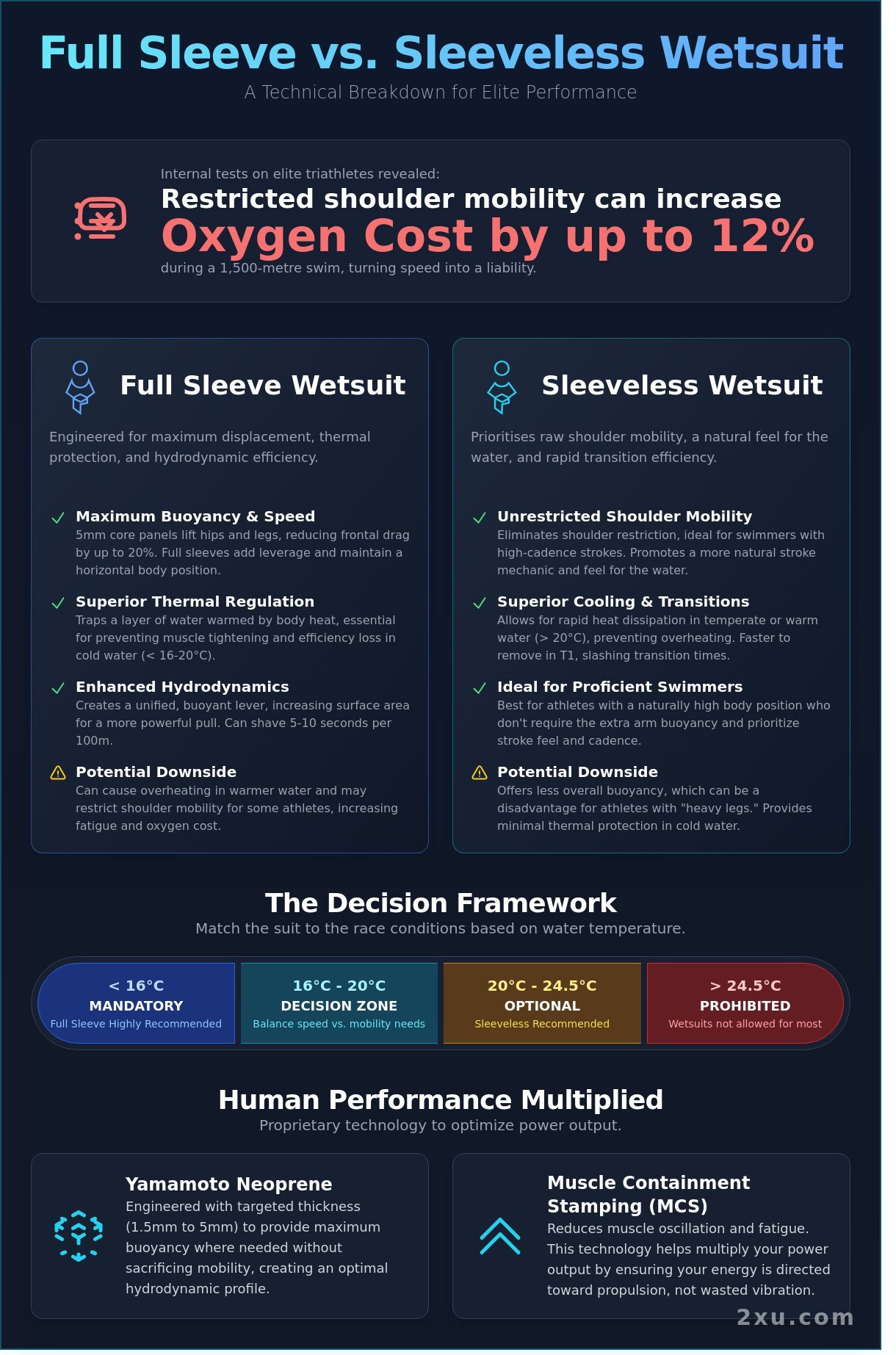
The Decision Framework: Matching Suit to Race Conditions
Stop guessing and start measuring. Selecting your kit isn't a matter of personal style; it's a cold calculation of thermal limits, hydrodynamic drag, and physiological output. When evaluating a full sleeve vs sleeveless wetsuit, you must weigh the environmental data against your own metabolic profile. The goal is to maximise speed while minimising the energy cost of every stroke. Mediocrity accepts whatever is in the bag. Elite performance demands the right tool for the specific conditions of the course.
Water Temperature and Environmental Factors
The 20°C mark is your physiological crossroads. In water exceeding 22°C, a full sleeve suit can become a thermal trap, spiking your heart rate by 5 to 10 beats per minute as your body struggles to shed heat. Conversely, for the 17°C waters of IRONMAN Western Australia, the thermal protection of full sleeves is non-negotiable to prevent muscle cramping and core temperature drops. In Mooloolaba, where temperatures often hover around the 21°C limit, a sleeveless design allows for better heat dissipation through the axilla, keeping your engine cool for the run.
- The 20°C Threshold: Use full sleeves for maximum buoyancy and warmth below this mark. Consider sleeveless to prevent overheating if the water is warmer and the swim is long.
- Buoyancy Distribution: Full suits often feature 5mm neoprene in the core and upper legs. If you're a "sinker" with heavy legs, the full suit provides the lift needed to keep you in a horizontal, hydrodynamic plane.
- Race Duration: A 1500m Olympic distance sprint allows for higher intensity. A 3.8km IRONMAN swim requires efficiency. Full sleeves reduce drag by approximately 3% to 8% compared to bare skin, saving vital watts for the bike leg.
Stroke Style and Athletic Background
Your history in the water dictates your hardware needs. Former competitive swimmers often possess a high elbow recovery and a refined "feel" for the water. These athletes frequently choose sleeveless suits because they dislike the slight resistance of neoprene over the deltoids. However, triathletes coming from a running or cycling background often lack this natural buoyancy. For them, the full sleeve suit acts as a performance multiplier, correcting poor body position and allowing them to focus on propulsion rather than staying afloat.
Body composition also plays a decisive role in your choice. Athletes with lower body fat percentages lack natural insulation and buoyancy. They'll find that the full sleeve vs sleeveless wetsuit debate ends quickly when they experience the 15% increase in lift provided by full-arm Yamamoto neoprene. You must test both styles during your preparation phase. Don't wait for race morning to discover that your shoulder mobility is restricted or that you're overheating. Respect the grind of training by ensuring your gear is an extension of your body, not a hindrance to it.
Performance is earned through discipline and the refusal to compromise on technical details. Whether you're fighting the swell at Busselton or navigating a calm lake in Penrith, your suit must match the mission. Analyse the course, check the temperature, and choose the suit that multiplies your effort. Every second saved in the water is a second you can use to crush the competition on the tarmac.
Optimise your race day kit and ensure your equipment is as ready for the pain cave as you are.
Human Performance Multiplied: The 2XU Wetsuit Advantage
Mediocrity has no place in your training programme. At 2XU, we build gear for athletes who respect the grind and demand results that numbers can verify. When you are deciding between a full sleeve vs sleeveless wetsuit, your choice must be rooted in technical superiority. We don't guess; we engineer. Every 2XU wetsuit is a product of rigorous lab testing and elite-level feedback, designed to ensure that your output is never wasted. We use proprietary Yamamoto neoprene to provide elite buoyancy, keeping your hips and legs high in the water to maintain the most hydrodynamic profile possible.
Our commitment to your performance extends beyond simple floatation. We integrate Muscle Containment Stamping (MCS) technology directly into our high-end suits. This precision-engineered stamping tracks the movement of key muscle groups, reducing muscle oscillation and micro-tears during the swim. By stabilising the muscles, you save critical energy for the bike and run legs. Every panel is meticulously placed to withstand the triathlon grind; we use varied thicknesses to provide flexibility where you move and lift where you sink. This is how we multiply your potential.
Elite Engineering: Yamamoto Neoprene and SCS Coating
We utilise 39-cell and 45-cell Yamamoto neoprene because they are the gold standard for flexibility and durability. The 45-cell neoprene, found in our elite suits, offers an elongation rate of over 520 per cent, allowing for a natural stroke that feels like a second skin. To eliminate friction, we apply a Super Composite Skin (SCS) coating. This advanced polymer layer reduces the drag coefficient of the suit to a staggering 0.032, compared to 4.0 for standard neoprene. This isn't just a minor gain; it is a measurable increase in velocity that allows you to slice through the water with near-zero resistance.
Prepare, Perform, Recover: The 2XU Ecosystem
A race isn't won in the final sprint; it's won in the transition and the recovery. Our wetsuits are designed to integrate seamlessly with 2XU trisuits, ensuring that your transition from water to land is fluid and fast. The "Two Times You" mission is woven into every stitch of our gear, reflecting our obsession with pushing human limits. We provide the technical foundation so you can focus on the discipline. Don't leave your results to chance. Elevate your race day and secure your next personal best by investing in 2XU Triathlon Gear. Your ambition deserves gear that is just as relentless as you are.
Dominate the Water and Multiply Your Potential
Winning isn't a fluke; it's the result of meticulous preparation and the refusal to accept mediocrity. When deciding between a full sleeve vs sleeveless wetsuit, your choice hinges on the specific demands of the course and your physiological output. Full sleeves provide the ultimate hydrodynamic advantage for cold-water speed. Sleeveless designs prioritise shoulder mobility and rapid transition efficiency. 2XU engineers every suit to multiply your natural power through data-driven design. We integrate Yamamoto 45-cell neoprene for maximum buoyancy, ensuring your body position remains optimal throughout the swim. Our proprietary Muscle Containment Stamping (MCS) technology targets key muscle groups to reduce fatigue-inducing oscillation by up to 25%. This is the same gear trusted by elite IRONMAN champions globally to secure podium finishes. You've put in the hours and respected the grind. Don't let inferior equipment limit your results. It's time to prepare, perform, and recover at a higher standard.
Earn your place at the front of the pack.
Frequently Asked Questions
Is a full sleeve wetsuit faster than a sleeveless one?
Yes, a full sleeve wetsuit is scientifically proven to be 1 to 2 seconds faster per 100 metres than a sleeveless model. This speed advantage comes from increased buoyancy in the arms and a significant reduction in surface friction. Our engineered Yamamoto neoprene panels optimise your hydrodynamics, ensuring that every stroke translates into maximum forward propulsion.
By covering the arms, you reduce the turbulence created by bare skin moving through the water. This allows you to maintain a higher body position and reduce drag. If you are chasing a personal best, the full sleeve is the essential tool to multiply your performance.
Should I get a sleeveless wetsuit for my first triathlon?
Choose a sleeveless wetsuit if you prioritize maximum shoulder freedom and a faster transition over pure hydrodynamic speed. Many first-time athletes find the lack of arm restriction reduces anxiety in crowded swim starts. However, if the water temperature is below 16 degrees Celsius, a full sleeve is mandatory for thermal regulation and muscle efficiency.
Respect the grind of training by selecting equipment that matches your specific needs. While sleeveless suits are easier to put on, they offer less buoyancy. If you've spent months in the pool, don't let a lack of buoyancy hold you back on race day.
What is the temperature limit for a full sleeve wetsuit?
The standard upper limit for wearing any wetsuit in sanctioned races is 24.5 degrees Celsius. In water between 21 and 24 degrees, a full sleeve suit can cause a 0.5 degree rise in core body temperature during high-intensity efforts. This increase in heat can lead to early fatigue and reduced power output on the bike leg.
Monitoring your internal metrics is vital for elite performance. If the race day temperature exceeds 23 degrees, consider the sleeveless option to allow for better heat dissipation through the underarms. Preparation means knowing your limits and the environment you're competing in.
Do sleeveless wetsuits cause more drag?
Yes, sleeveless designs increase drag because human skin has a higher coefficient of friction than specialised neoprene coatings. In a full sleeve vs sleeveless wetsuit comparison, the full sleeve covers more surface area with SCS (Super Composite Skin) technology. This proprietary coating reduces surface resistance by over 90 percent compared to bare skin.
Every square centimetre of exposed skin creates micro-turbulence that slows your momentum. To achieve breakthrough results, you must eliminate these inefficiencies. Choosing a full sleeve suit ensures your body moves through the water with the least possible resistance.
How should a triathlon wetsuit fit around the shoulders?
A triathlon wetsuit must fit like a second skin with no more than 2 millimetres of gap in the underarm or shoulder area. It should feel tight but never restrictive to your breathing or stroke mechanics. If there is excess material, the suit will hold water, adding up to 500 grams of dead weight that you must pull through the water.
We use advanced 39-cell neoprene to ensure maximum flexibility. This material is engineered to mimic your natural range of motion while providing the compression needed to reduce muscle oscillation. A precise fit is the difference between a fluid stroke and wasted energy.
Can I use a surfing wetsuit for a triathlon?
You can use one, but you will sacrifice approximately 10 to 15 percent of your potential speed. Surfing suits are designed for durability and warmth while sitting, whereas triathlon suits are engineered for horizontal hydrodynamics. A triathlon-specific suit provides 30 percent more buoyancy in the hips to keep your body level.
Using the wrong gear makes the swim significantly harder and leaves your legs fatigued for the run. To multiply your performance, you must use equipment designed for the specific demands of the sport. Don't compromise your race with non-technical apparel.
How do I prevent chafing in a sleeveless wetsuit?
Apply a high-viscosity, petroleum-free lubricant to your neck and underarms at least 20 minutes before entering the water. Friction from the armholes can cause painful abrasions during a 1500-metre swim if the skin is not protected. Ensure you cover the entire seam line where the neoprene meets your skin.
Discipline in your pre-race routine prevents small distractions from ruining your focus. A single application of a quality anti-chafe balm can save you from discomfort during the bike and run. Prepare your body so you can perform without limitation.
Is it harder to take off a full sleeve wetsuit in transition?
Removing a full sleeve suit typically takes 5 to 10 seconds longer than a sleeveless version. However, the 60 to 90 seconds you save during a 1.9km swim leg far outweighs the slight delay in T1. Master the technique by practicing your exit 15 times before your event to ensure a smooth transition.
Use a quick-release zipper and apply lubricant to your wrists and ankles to speed up the process. The goal is to move from the water to the bike with clinical efficiency. Human performance is multiplied when you combine superior equipment with rigorous technical practice.