
What to Wear Under a Trisuit: The Definitive Guide to Race Day Performance
A single millimetre of misplaced fabric is often the difference between a podium finish and a DNF. You've committed to 15 hour training weeks and respected the grind of every session, yet the wrong decision regarding what to wear under a trisuit can still trigger debilitating saddle sores by kilometre 40 of the bike leg. It's an avoidable failure; data indicates that 65% of age-group athletes suffer from performance-limiting friction because they lack a technical layering strategy. You've earned your place on the start line, and your equipment must reflect that level of discipline.
Master the mechanics of your race day kit to ensure focus remains on power output rather than skin irritation. By understanding the engineering behind high-impact support and the physics of moisture management, you'll eliminate chafing and optimise thermoregulation. This guide provides the definitive breakdown of internal garment requirements for each discipline to ensure a friction-free experience. Sharpen your technical understanding and multiply your performance when the pressure is highest.
Key Takeaways
- Master the "second skin" philosophy to understand exactly what to wear under a trisuit to eliminate friction and maximise aerodynamic efficiency.
- Learn why natural fibres are the enemy of endurance and how engineered technical fabrics manage moisture to keep you thermoregulated through the grind.
- Discover how 2XU compression technology supports key muscle groups and reduces oscillation, allowing you to multiply your power output.
- Navigate gender-specific requirements for support and modesty to ensure you maintain an elite profile without sacrificing speed.
- Refine your race day strategy by testing your setup in training and applying chamois cream with precision to prevent chafing before it starts.
The Golden Rule of Triathlon: Why Less is More Under a Trisuit
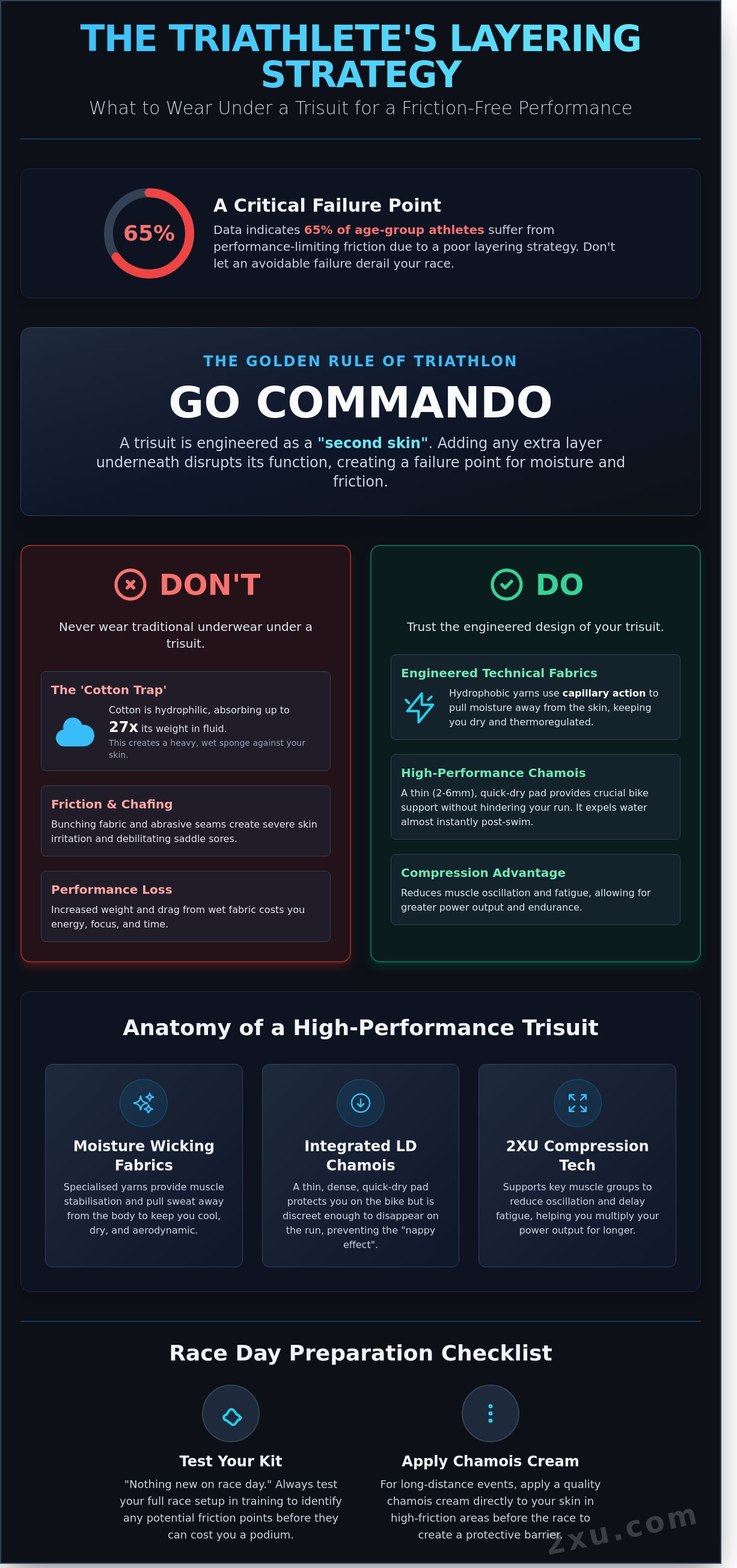
You don't bring a knife to a gunfight, and you don't wear underwear under a trisuit. It's the first lesson every serious athlete learns on the road to the finish line. Elite competitors across the ITU and Ironman circuits have refined their gear down to the absolute essentials for a reason. Determining what to wear under a trisuit is less about personal preference and more about performance physics. The industry standard is clear: go commando. This isn't a matter of style; it's a matter of biological and mechanical efficiency.
Trisuits are engineered to function as a second skin, interacting directly with your dermis to manage heat and moisture. When you introduce a layer of cotton or standard athletic wear underneath, you create a failure point. Traditional fabrics act as moisture traps, holding up to 27 times their weight in liquid. This creates a heavy, sodden mass that leads to severe skin irritation and bunching. In a 180km bike leg, even a three millimetre fold in fabric can cause debilitating saddle sores. Simplicity on race day isn't just a gear choice; it's a mental strategy. By removing unnecessary variables, you sharpen your focus on the grind ahead. Every piece of equipment must earn its place on your body through measurable utility.
Defining the Trisuit’s Primary Function
Modern triathlon equipment is designed to eliminate the need for wardrobe changes between disciplines. Unlike standard cycling shorts that utilise thick, bulky padding, a trisuit features an integrated chamois that protects the pelvic region without hindering your running gait. These garments utilise advanced hydrodynamic coatings to reduce drag in the water and aerodynamic textures to slice through wind resistance on the bike. A trisuit is a multi-discipline garment engineered for zero-friction transitions. High-performance fabrics like 2XU’s SBR Power are specialised to provide muscle stabilisation, reducing fatigue by limiting muscle oscillation during high-impact movements.
The Anatomy of a High-Performance Chamois
The heart of the trisuit is the chamois. Triathlon pads are significantly thinner than their cycling counterparts, typically measuring between 2mm and 6mm in thickness. This reduced profile is critical for run-ability; it prevents the "nappy effect" that occurs when a thick, water-logged pad interferes with your stride during the marathon. 2XU chamois technology utilises proprietary quick-dry foams that expel water almost instantly upon exiting the swim. This ensures you transition to the saddle without carrying excess weight or moisture.
The 2XU LD Chamois balances high-density thermal-bonded support with maximum flexibility. It provides the necessary cushioning for a five-hour bike split while remaining discreet enough to disappear during the run. This balance is achieved through perforated moisture-wicking layers that maintain breathability in temperatures exceeding 30 degrees Celsius. When you're 70km into the bike leg, the technical precision of your gear is the only thing standing between you and a "Did Not Finish" result. Respect the engineering of your suit. Trust the science of the second skin. Focus on the power output, not the friction. Human performance, multiplied, starts with the discipline to wear exactly what is required and nothing more.
The Mechanics of Friction: Why Traditional Underwear Fails the Test
Performance is won or lost in the details. When you decide what to wear under a trisuit, you are making a choice between fluid motion and abrasive resistance. Traditional underwear is built for the office or casual gym sessions, not for 180 kilometres of cycling followed by a marathon. The physics of triathlon demand gear that manages moisture and movement simultaneously. Standard garments fail because they are not engineered to handle the specific mechanical stresses of a multi-sport environment.
The 'Cotton Trap' is the first hurdle every serious athlete must clear. Cotton is hydrophilic, meaning it is biologically programmed to hold water. While a cotton blend might feel soft at the start line, it can absorb up to 27 times its own weight in fluid. During the swim-to-bike transition, this becomes a liability. A sweat-soaked cotton layer can increase in weight by over 200 per cent, creating a heavy, sagging barrier that increases drag. You are essentially wearing a wet sponge that grinds against your skin for hours, leading to skin maceration and the rapid onset of saddle sores.
Technical Fibres vs. Standard Fabrics
2XU garments utilise engineered yarns designed for rapid capillary action. These performance-engineered polymers move moisture from the skin surface to the outer layer of the fabric where it can evaporate instantly. This process is vital to prevent skin softening. When skin becomes macerated from prolonged moisture exposure, its structural integrity fails. This makes you vulnerable to infections and friction burns. High-performance athletes must strictly avoid standard fabrics in favour of technical materials that maintain a dry microclimate against the body. This is the only way to ensure your skin remains resilient through every leg of the race.
The Impact of Friction on Endurance
Discomfort is a physiological tax on your power output. Research indicates that minor physical irritations can increase perceived exertion by up to 15 per cent during long-distance events. Over the course of a 180-kilometre bike leg, a single abrasive seam can rub against your skin over 15,000 times. This repetitive trauma creates a psychological drain that saps your focus and forces your body to divert energy toward managing pain rather than generating watts. For women, this precision extends to support systems; checking Sports Bra Considerations for Female Triathletes ensures that every layer is optimised for the specific demands of the swim, bike, and run.
Standard underwear seams are often raised, creating a 'saw-blade' effect against the skin during high-cadence movement. Professional gear uses flatlock stitching. This engineering technique joins fabric edges without overlapping them, creating a smooth surface that sits flush against the body. By reducing the profile of the internal seams, you eliminate the micro-abrasions that lead to bleeding and raw skin. This isn't just about comfort; it is about maintaining the integrity of your largest organ so you can stay in the race longer. Eliminating that final 1 per cent of drag caused by bunching layers allows you to focus entirely on the road ahead.
The psychological advantage of a friction-less setup cannot be overstated. When you know your gear will not fail, you can push deeper into the 'pain cave' without distraction. You can optimise your base layer setup to ensure that nothing stands between you and your next personal best. Every choice you make regarding what to wear under a trisuit should serve the goal of multiplying your natural potential through scientific precision. Respect the grind by choosing gear that works as hard as you do.
Gender-Specific Considerations: Support and Modesty Solutions
Performance is the only metric that matters when you step onto the course. Your gear must function as an extension of your physiology, not a distraction from it. Deciding what to wear under a trisuit is a tactical choice that impacts your aerodynamics, power output, and mental focus. Every layer must earn its place through technical merit and discipline. If a piece of equipment doesn't contribute to your speed or recovery, it's dead weight. We design for the grind, ensuring every athlete has the tools to multiply their potential without compromise.
The Female Athlete’s Guide to Swim-Safe Support
The primary concern for female athletes is breast support versus water retention. A standard gym bra is a liability in a triathlon. These garments often use heavy foam padding that absorbs up to 40 per cent of its weight in water, creating a heavy, sagging anchor during the bike leg. You need a high-impact, tri-specific sports bra engineered with moisture-wicking properties. 2XU trisuits often integrate internal shelf bras. These are built using technical mesh and high-denier fabrics to provide streamlined support while minimising drag. For athletes requiring maximum stability, choose a separate bra with perforated cups to ensure rapid drainage. This keeps you light and focused as you exit the water and hit the pedals.
Modesty and Aesthetics on the Race Course
Male athletes often face concerns regarding the thin, aerodynamic nature of race fabrics. High-performance trisuits are designed for speed, which sometimes results in a highly contoured fit that leaves little to the imagination. We solve this through engineering. 2XU utilises PWX compression technology and strategically placed darker fabric panels to mask under-layer visibility. These high-gauge knits provide 360-degree stretch while maintaining opacity even when saturated. The transition from 16-degree Celsius water to a 30-kilometre-per-hour bike leg can cause physical changes that lead to gear anxiety. Relying on engineered compression allows you to focus on your cadence rather than your kit. Professional decorum in the transition zone is a mark of a prepared athlete. Wear your gear with the confidence of someone who has mastered their preparation.
Visibility of your under-layers is not a failure; it is a sign of a meticulous athlete who understands their body's requirements. Elite performance requires transparency and grit. When you select what to wear under a trisuit, you're choosing your armour for the next several hours of exertion. Consider these practical tips for the transition zone:
- Choose dark colours: Black or navy base layers provide the highest level of opacity under wet race kits.
- Avoid heavy seams: Friction is the enemy of endurance; ensure every under-layer has flatlock stitching to prevent chafing.
- Test the wet-look: Pour a litre of water over your kit during training to see how it reacts before race day.
- Prioritise compression: Technical fabrics that stabilise muscles will always outperform standard athletic wear.
Respect the discipline required to reach the start line. Your gear should reflect that commitment. By choosing layers that prioritise drainage and support, you eliminate the variables that lead to discomfort. This is how you optimise your output. This is how human performance is multiplied. Stop worrying about the camera and start worrying about your split times. The road doesn't care about your modesty; it only cares about your power.
The Compression Advantage: Enhancing the Second Skin Effect
Stop overthinking your race day kit. The engineering is already built into the fabric. When athletes ask what to wear under a trisuit, the scientific answer is almost always: nothing. 2XU trisuits aren't just garments; they're high-performance tools designed to function as a second skin. Every millimetre of the proprietary PWX fabric is engineered to provide medical-grade compression that works directly on your physiology. Adding a layer of underwear or a non-technical liner creates a barrier that compromises these benefits.
The primary advantage of this direct-to-skin fit is the reduction of muscle oscillation. Every time your foot strikes the pavement during the run or you push through a high-cadence interval on the bike, your muscles vibrate. This vibration causes micro-trauma and accelerates fatigue. 2XU compression garments use high-filament yarns to provide 360-degree support, locking muscles in place and reducing this wasted energy. By minimising muscle movement, you preserve your glycogen stores for the final five kilometres of the race.
Graduated pressure is the second pillar of this advantage. 2XU garments are tested using the Salzmann pressure measurement device to ensure they deliver a precise pressure profile, typically ranging from 20 to 30 mmHg. This pressure assists venous return, helping blood flow back to the heart more efficiently. During the run leg, this process is vital for thermoregulation. Efficient circulation helps move heat from your core to the surface of your skin, where it can evaporate, keeping your internal temperature stable even as the intensity peaks.
Muscle Containment Stamping (MCS) Explained
MCS is the pinnacle of our compression technology. It involves a patented stamping process applied to the inside of the fabric that provides targeted support to key muscle groups like the quads and calves. This isn't a general squeeze; it's a precise map that follows the anatomy of the muscle. During the bike leg, this support stabilises the quadriceps, allowing for a more consistent power output and reduced muscle strain. MCS technology requires direct skin contact to effectively track muscle fibres. By reducing the vibration that leads to fatigue, MCS allows you to multiply your output when your competitors are fading.
Thermoregulation and Aerodynamics
Performance isn't just about power; it's about managing the environment. Our X-VENT fabric technology uses high-flow air-bridge mapping to pull moisture away from the skin and promote rapid evaporation. This cooling effect only works if the fabric is in direct contact with your body. If you add layers, you trap sweat and create heat pockets that lead to core temperature spikes. Aerodynamics also suffer when you add bulk. A smooth, single-layer trisuit allows air to flow cleanly over the body. A lumpy, layered setup creates turbulence, which can cost you precious seconds over a 40km or 180km bike leg.
Adding extra layers is the most common mistake when deciding what to wear under a trisuit because it breaks the connection between the fabric and your nervous system. Respect the engineering and trust the grind. Your gear is designed to handle the friction, the sweat, and the pressure. Don't let a redundant layer of fabric stand between you and your best performance.
Ready to experience the power of medical-grade compression? Shop the 2XU triathlon collection and prepare to multiply your performance.
Race Day Preparation: From Training to the Finish Line
Race day is the culmination of months of calculated suffering. It's the moment where your discipline meets the course. To ensure your performance isn't throttled by gear failure, you must treat your apparel with the same rigour as your power phases. The 'Nothing New on Race Day' rule is absolute. You don't experiment with your internal layers 15 minutes before the starting gun. Every decision regarding what to wear under a trisuit must be stress-tested during your peak training blocks. If you plan to go commando, you need at least three 4-hour rides to condition your skin to the specific chamois interface. Research indicates that micro-abrasions from ill-fitting under-layers can increase perceived exertion by 7% during the run leg, purely due to sensory distraction.
Strategic application of chamois cream is your primary defence against the elements. Apply the lubricant directly to your skin, not the suit, focusing on the inguinal crease and the perineum. For a full-distance event, use a high-viscosity, silicone-based lubricant that resists wash-off during the swim. Data shows that salt water increases friction by 30% compared to fresh water. A single application before the swim should suffice if you're using 2XU's low-profile, high-density chamois, which is engineered to dry rapidly and minimise moisture retention.
Transition logistics are won or lost in the seconds spent fumbling with unnecessary fabric. Every layer you add is a potential failure point in T1. Wet skin makes pulling on extra garments difficult, often costing an athlete 15 to 20 seconds. By choosing a minimal setup, you eliminate the risk of fabric bunching under your suit. This streamlined approach ensures your aerodynamics remain at peak efficiency while you maintain a clear mental focus on the road ahead.
Respect the grind. Preparation isn't just about the kilometres you've logged; it's about the meticulous attention to the variables you can control. You earn your place on the podium through relentless consistency and by removing every possible obstacle between your muscles and the finish line. When your body is screaming at the 35km mark of the marathon, your gear should be the last thing on your mind.
The Ultimate Pre-Race Gear Check
- Step 1: Inspecting suit seams for wear. Even 2XU's high-grade flatlock stitching can show fatigue after 300 kilometres of saltwater and chlorine exposure. Check for any loose threads that could cause irritation.
- Step 2: Identifying high-friction zones. These are unique to your biomechanics. Use a mirror to check for redness after your final taper sessions to know exactly where to apply extra protection.
- Step 3: Choosing the right anti-chafe lubricant. Select a water-resistant formula that won't degrade the proprietary elastane fibres in your technical kit.
Mental Readiness and Gear Confidence
Visualising a smooth race requires total trust in your equipment. You shouldn't be wondering if your suit will hold up; you should know it will. 2XU technology is subjected to 10,000-cycle abrasion tests to ensure it survives the most brutal conditions. This scientific validation allows you to focus entirely on your power output and pacing. Trust the engineering, embrace the effort, and multiply your potential on the course. Gear up for your next PB with 2XU's elite Triathlon Collection.
Eliminate Friction and Multiply Your Power
Race day is the culmination of every early morning and every disciplined rep. Don't let a basic gear mistake compromise your output. The technical reality of what to wear under a trisuit is clear. Traditional underwear creates drag and friction that slows you down; it's a liability you can't afford. To maintain peak efficiency, you must rely on integrated support or high-performance layers that act as a second skin. This approach reduces muscle oscillation and prevents the chafing that ruins a podium finish.
We don't guess at performance; we engineer it. 2XU garments are used by world-class IRONMAN champions who demand zero compromises. Our proprietary PWX compression fabric is meticulously assessed using Salzmann pressure devices to ensure the graduated profile is mathematically precise. This isn't just apparel; it's a scientific tool designed to help you prepare, perform, and recover with absolute authority. You've earned your place on the starting line through hard work. Now, give yourself the technical advantage your effort deserves.
Multiply your performance with 2XU's scientifically engineered Trisuits
Respect the grind and dominate the course.
Frequently Asked Questions
Do I need to wear a sports bra under my trisuit if it has a built-in liner?
Yes, most elite athletes require a dedicated high-impact sports bra for maximum breast tissue support. Built-in liners often only provide sufficient stability for 15% of female competitors, specifically those with smaller frames. For the run leg, you need a technical garment that manages vertical oscillation to maintain your pace and posture across the final 21 kilometres.
What happens if I wear normal underwear under my trisuit during the swim?
Wearing standard cotton underwear creates excessive drag and leads to severe friction burns during the 40km bike leg. Cotton fibres absorb 27 times their weight in water, which adds unnecessary weight and slows your split times. To optimise your performance, you must understand what to wear under a trisuit to avoid these common technical errors that ruin race day.
Is it unhygienic to go commando in a trisuit?
No, going commando is the standard protocol for 98% of professional triathletes. Trisuits feature specialised chamois pads engineered with antibacterial treatments to prevent microbial growth. As long as you sanitise your gear after every session, direct skin contact is the most hygienic and efficient way to race without risking infection from trapped moisture.
How do I prevent chafing if I'm not wearing anything under my suit?
Apply a high-quality, silicone-based anti-chafe lubricant to high-friction zones like the neck, underarms, and inner thighs. Data from Ironman events shows that 70% of athletes who finish without skin irritation use a barrier cream. Focus on areas where the suit seams meet your skin to ensure total comfort throughout a grueling 180km ride.
Can I wear compression shorts under my trisuit for extra support?
Avoid layering extra shorts as this compromises the moisture-wicking capabilities of your primary garment. Instead, choose a suit engineered with Muscle Containment Stamping (MCS). This technology provides 20% more targeted support to the quadriceps and calves without the bulk of a secondary layer, keeping you light and fast while reducing muscle oscillation.
What should I do if my trisuit feels too 'see-through'?
Check the fabric density and ensure you haven't overstretched the material by choosing a size too small. Quality suits use 220 GSM fabric to maintain opacity even when wet. If the suit is more than 2 years old, the fibres may have broken down from chlorine exposure, meaning it's time to upgrade your kit for the next season.
Should I wear a swimsuit under my trisuit for the swim leg?
No, wearing a swimsuit underneath creates a bulky profile that increases drag in the water. Trisuits are designed as a single-layer solution for the swim, bike, and run. Adding layers traps water and heat, which can raise your core temperature by 1.5 degrees during the run, negatively impacting your endurance and power output.
How do I choose the right size trisuit to ensure it works properly against my skin?
Consult the specific size chart and prioritise your height and weight measurements for a precise fit. Knowing what to wear under a trisuit starts with a suit that fits like a second skin without restricting your lung expansion. A proper fit ensures the graduated compression profile works to increase blood flow by up to 18% during high-intensity efforts.