
What is a Trisuit? The Engineering Behind the Ultimate Race Kit
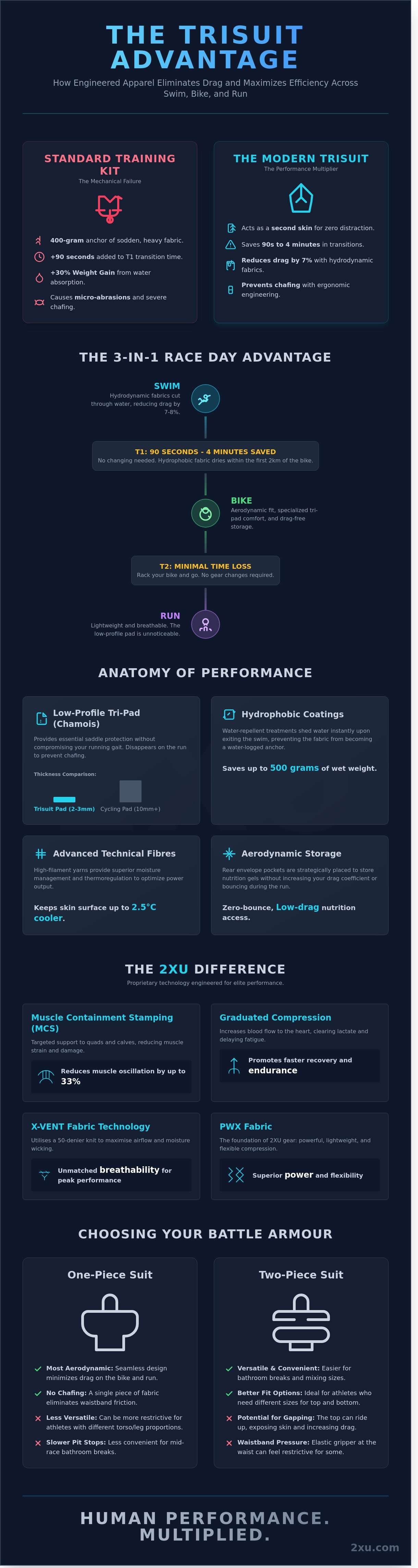
A standard training kit is a mechanical failure waiting to happen on race day. It is a 400-gram anchor of sodden fabric that adds up to 90 seconds to your T1 while causing micro-abrasions across your torso. You have felt that heavy drag during the transition from swim to bike. You have fought the friction of water-logged clothing that refuses to breathe. Every second lost to gear malfunction is a second stolen from your hard-earned training blocks. Professional performance requires a kit that respects the grind of every kilometre.
Understanding what is a trisuit is the first step toward reclaiming that lost time and ensuring your equipment works as hard as your engine. We have engineered these garments to serve as a second skin that thrives in the water and excels on the road. This guide reveals how a specialised trisuit eliminates transition friction and multiplies your performance across the swim, bike, and run. You will discover the data-driven mechanics behind hydro-dynamic fabrics that reduce drag by 7% and the ergonomic engineering that prevents chafing over 180 kilometres of effort. It is time to prepare, perform, and recover with the precision your discipline demands. Human performance, multiplied.
Key Takeaways
- Master the fundamentals of what is a trisuit and discover how this engineered 3-in-1 garment eliminates transition friction to keep your focus on the finish line.
- Analyse the mechanics of advanced technical fibres and specialised tri-pads that provide essential saddle protection without compromising your natural running gait.
- Evaluate the performance trade-offs between one-piece and two-piece configurations to select the optimal battle armour for your specific race distance.
- Learn how to minimise drag across all three disciplines, conserving critical energy reserves and proving that human performance is multiplied through superior engineering.
- Harness proprietary PWX fabric and Muscle Containment Stamping (MCS) to support key muscle groups, reducing oscillation and allowing you to endure the grind longer.
What is a Trisuit? Defining the Three-in-One Advantage
A trisuit is a specialised garment engineered to remain on your body for the entire duration of a race. It is the definitive tool for athletes who refuse to compromise on efficiency. When asking what is a trisuit, you must understand it as a singular piece of high-performance equipment designed to excel in the water, provide stability on the saddle, and offer zero-distraction comfort during the run. You don't change clothes; you simply execute.
The primary advantage is found in the transition zones, T1 and T2. Elite athletes often save between 90 seconds and 4 minutes by eliminating wardrobe changes. In a sport where podiums are decided by fractions of a second, this "no-change" strategy is vital. You wear the suit under your wetsuit for the swim. Once you peel the neoprene away, you're ready to ride. The fabric is engineered to dry rapidly, often within the first 2 kilometres of the bike leg, preventing the heavy, waterlogged feeling that slows down unprepared competitors.
The Evolution of Multi-Sport Gear
The days of wearing modified running shorts and cotton singlets are over. Modern engineering has transformed the what is a trisuit definition into a study of hydrodynamics and aerodynamics. High-tech race suits now utilise advanced fabric blends that reduce drag by up to 8% compared to standard athletic gear. These materials are tested in wind tunnels and flow tanks to ensure they slice through resistance. Traditional gym wear fails because it absorbs salt water and chlorine, leading to a 30% increase in garment weight and severe skin chafing. Our gear is built to resist these elements, maintaining its compressive integrity over 226 kilometres of punishment.
Who is a Trisuit For?
This gear is for every athlete who respects the grind. Whether you're lining up for your first 300-metre club sprint or your tenth Ironman, the requirements remain the same: performance and reliability. There is a profound psychological shift that occurs when you zip up your suit. It is your armour. It signals that your preparation is complete and your performance is about to be multiplied. Choosing professional-grade gear means you trust your equipment won't fail when the heart rate climbs and the legs begin to burn. It's about earning your finish time through discipline and the right tools. Everyone is welcome on the starting line, but only those who prepare with intensity will truly conquer the course.
The Anatomy of Performance: Key Features of a Triathlon Suit
Every second on the race clock represents a battle against physics. When athletes ask what is a trisuit, they aren't just asking about a piece of apparel; they're asking for a technical advantage. A high-performance suit acts as a second skin, engineered to transition from a 3.8km swim to a 180km ride and a 42.2km run without compromise. Performance is earned through the grind, but it's protected by gear that refuses to fail. This is gear designed for those who refuse to settle for mediocrity.
- Advanced Technical Fibres: We utilise high-filament yarns to provide moisture management that outperforms standard textiles. These fibres facilitate thermoregulation, keeping the skin surface up to 2.5 degrees Celsius cooler during intense exertion.
- The Tri-Pad (Chamois): Unlike bulky 10mm cycling pads, a tri-pad is typically 2mm to 3mm thick. This low-profile design provides essential vibration protection on the saddle while disappearing during the run to eliminate the heavy feel and prevent inner-thigh abrasion.
- Hydrophobic Coatings: Drag is the enemy. Technical suits feature water-repellent treatments that ensure the garment sheds water the moment you exit the transition. This prevents the fabric from becoming water-logged, saving up to 500 grams of weight in wet conditions.
- Strategic Storage: Aerodynamics dictate pocket placement. Rear envelope pockets are positioned to store nutrition gels without increasing your drag coefficient or bouncing during the run leg.
The Science of Fabric and Compression
We use advanced polymers to create Muscle Containment Stamping (MCS). This technology provides targeted support to the quadriceps and calves, reducing muscle oscillation by up to 33% during high-impact movement. Graduated compression promotes increased blood flow to the heart, delaying the onset of fatigue. Our X-VENT fabric technology uses a 50-denier knit to maximise airflow, ensuring you optimise your power output even in peak humidity. It's about giving you the tools to multiply your own potential.
Zips, Seams, and Silicon Grippers
Construction details define your comfort over 10 hours of racing. Flatlock stitching is mandatory to eliminate chafing against salt-crusted skin. Internal silicon grippers provide a secure fit on the thigh, ensuring the suit doesn't ride up during the pedal stroke without restricting femoral blood flow. Choose your zip wisely; front-zips offer ventilation for long-course events, while rear-zips are often required for ITU-sanctioned elite races to maintain a streamlined profile. Understanding what is a trisuit means understanding these marginal gains.
One-Piece vs. Two-Piece: Choosing Your Battle Armour
Your choice between a one-piece and a two-piece suit isn't about style. It's about engineering your outcome. A one-piece suit is the benchmark for aerodynamic efficiency. It eliminates the gap between top and bottom, reducing drag by up to 8% compared to traditional separates. This streamlined profile is critical when you're fighting for every watt on the bike. When asking what is a trisuit, consider it a second skin designed to minimise muscle oscillation and maximise power output.
The absence of a waistband in a one-piece garment removes a common failure point. Standard waistbands can restrict diaphragmatic breathing and cause gastrointestinal distress during the run. By removing this restriction, you ensure your core can expand naturally. This allows for better oxygen intake and more efficient digestion during high-intensity efforts. It's a technical advantage that translates directly to your split times.
When to Choose a One-Piece Suit
Short-course racing demands total focus. In a Sprint or Olympic distance event, every second in transition is a heartbeat lost. One-piece suits are the elite choice for athletes prioritising speed and a hydrodynamic profile. You'll gain a 25 to 40-second advantage through superior compression and reduced frontal area. If you're chasing a podium, this is your mandatory equipment. It's built for the 60 to 150-minute grind where compromise doesn't exist.
The Versatility of the Two-Piece
Endurance is a different beast. For the 226-kilometre journey of an Ironman, comfort becomes a performance metric. Two-piece suits offer the versatility to mix sizes; an essential feature for athletes with a 15% variance between chest and waist measurements. They facilitate faster nature breaks during 10-hour races, preventing unnecessary time loss in the portaloo. You can also integrate these pieces into your daily training, using the shorts for specialised brick sessions without wearing out your full race kit.
Consider the impact of sleeves on your performance data:
- Aero-sleeves: These provide a 12-watt saving at 40km/h compared to sleeveless options. They also offer UPF50+ protection, which is crucial for 180km bike legs.
- Sleeveless: This remains the gold standard for athletes prioritising maximum shoulder mobility. If your swim stroke is restricted by fabric, you're wasting energy before you even reach T1.
Every piece of gear must earn its place on your body. Whether you choose the streamlined one-piece or the practical two-piece, the goal remains the same. You're not just wearing a kit; you're wearing a tool designed to multiply your human performance. Respect the distance and choose the armour that lets you execute your race plan without distraction.
Why a Trisuit is Essential: Performance Multiplied
Mediocrity has no place on the racecourse. When you ask what is a trisuit, you are asking for the technical edge that separates finishers from champions. Standard athletic gear fails under the pressure of three distinct disciplines; it absorbs water, creates aerodynamic drag, and causes chafing that breaks your mental resolve. A specialised trisuit is engineered to eliminate these penalties through advanced fabric density and hydrodynamic coatings. Aerodynamic testing confirms that a form-fitting suit can save an athlete up to 20 watts of power at 40 km/h compared to loose-fitting alternatives. This energy conservation is vital for the final leg of the race.
Weight management is equally critical. Non-specialised fabrics can absorb up to 500 grams of water during the swim, forcing you to carry dead weight onto the bike. Technical trisuits utilize hydrophobic fibres that repel moisture, ensuring you remain light and agile. Beyond speed, these garments protect your physical integrity. High-performance fabrics provide UPF 50+ sun protection and advanced moisture-wicking properties that regulate core temperature. This prevents the heat exhaustion that often strikes during the second half of the run.
The Transition Advantage
Efficiency in T1 and T2 defines your final rank. Changing from swim trunks to cycling shorts and then into running gear can cost you 120 to 240 seconds of stationary time. A trisuit stays on from the starting gun to the finish line. This simplifies your mental checklist on race morning; you only need to focus on your pace and nutrition. Eliminating wardrobe changes reduces the risk of equipment failure and keeps your heart rate in the performance zone. Focus on the finish line, not your wardrobe.
Managing the Grind
We use the Prepare, Perform, Recover framework to ensure every movement counts. Advanced compression technology, such as Muscle Containment Stamping (MCS), maps key muscle groups to reduce oscillation by up to 5%. This precision engineering limits muscle damage during the repetitive impact of the run. Choosing elite gear is about respecting the effort you put into training. High-performance garments help manage muscle soreness so you can return to the track sooner. Every second saved through better gear is a second earned on the podium.
The 2XU Difference: Engineered for the Elite
Performance isn't accidental. It's the result of rigorous engineering and a refusal to accept mediocrity. When you ask what is a trisuit, you aren't just asking about a garment; you're asking for a technical tool that multiplies your output. 2XU delivers this through proprietary PWX fabric technology. This material provides 360-degree stretch and unparalleled durability, ensuring your gear survives the most brutal race conditions without losing its shape or compression profile. It's built to withstand the physical demands of the grind.
We take support further with Muscle Containment Stamping (MCS). This isn't a cosmetic design. It's a precise mapping system that follows key muscle groups under extreme strain. By providing targeted support to the quadriceps and calves, MCS reduces muscle oscillation and micro-tears. This allows you to maintain power output for longer periods and recover faster once the race is over. Every stitch and stamp is tested by world-class athletes in environments ranging from the humidity of Kona to the unpredictable currents of the English Channel to ensure performance is never compromised.
Why 2XU Leads the Field
We don't guess; we measure. Our commitment to scientific validation involves testing every compression garment on the Salzmann pressure measurement device. This ensures the graduated pressure profile is exact. Our gear is built for the long haul. These advanced fabrics are engineered to resist the corrosive rigours of salt water and the harsh chemicals of chlorine. 2XU garments are tested to maintain their integrity for over 200 hours of active use. Whether you're a professional or a first-timer, our inclusive sizing ensures a fit that respects the unique anatomy of both male and female triathletes. We provide the same elite technology to every person willing to earn their results.
Get Race Ready
Your gear must match your ambition. Selecting the right suit depends on your specific event requirements. A Sprint or Olympic distance demands high-speed aerodynamics and rapid moisture wicking. For a 70.3 or full Ironman, you need the added endurance support of elite-level compression and ergonomic chamois padding. Don't settle for average when you can have "Human Performance. Multiplied." It's time to sharpen your focus and respect the work required to win.
- Select the right suit for your next event: Sprint, Olympic, or 70.3.
- Experience the tangible difference of elite-level compression.
- Trust in gear proven by data and world-class results.
Explore the 2XU Trisuit Collection and equip yourself for the challenge ahead.
Own the Course and Multiply Your Power
Defining what is a trisuit comes down to one thing: the refusal to compromise. You need a kit that functions as a high-performance second skin across the swim, bike, and run. 2XU trisuits deliver this advantage through advanced PWX compression technology. This proprietary fabric is scientifically proven to reduce muscle oscillation by up to 33%, helping you maintain form when fatigue sets in during the final leg. This is the same engineering used by Ironman World Champions to dominate the world stage. These suits are built for maximum durability across 226 kilometres of the most punishing race conditions on earth. You've put in the hours and respected the grind. Now, it's time to equip yourself with gear that multiplies that effort. Don't let your kit be the weak link in your race day strategy. Trust the data, rely on the research, and prepare to shatter your previous limits. Your best performance is waiting.
Multiply your performance with 2XU Trisuits
Frequently Asked Questions
Do you wear anything under a trisuit?
No, you don't wear underwear under a trisuit. These garments are engineered for direct skin contact to eliminate the friction that causes painful saddle sores and chafing. Adding a layer of cotton or other fabrics increases moisture retention by 40% and destroys the aerodynamic profile. Trust the proprietary chamois to provide protection while you focus on the grind. This is essential for your recovery and long-term comfort.
Can I use a trisuit for just swimming or just running?
You can use a trisuit for individual disciplines, but its true value is revealed during transitions. Understanding what is a trisuit means recognising it as a versatile tool engineered with PWX fabric to support muscles during a 10km run or a 1.5km swim. It reduces muscle oscillation by up to 25% compared to standard gear. Use it to sharpen your performance across every leg of your training programme.
How tight should a trisuit be?
Your trisuit must fit like a second skin with zero fabric bunching. A loose suit creates drag in the water and increases aerodynamic resistance on the bike, costing you up to 15 watts of power at 40kph. It should feel restrictive when standing but comfortable in the aero position. If the leg grippers move during a 60-minute session, the size is incorrect. Achieve your 2XU potential by choosing a firm, compressive fit.
Is a one-piece or two-piece trisuit better for beginners?
Beginners often prefer a two-piece suit for ease of use during transitions and bathroom breaks. However, a one-piece suit is the superior choice for those hunting a personal best. It offers a 3% aerodynamic advantage by eliminating the waist gap where air pockets form. Whether you choose the versatility of separates or the streamlined efficiency of a singlet, ensure the gear reflects your commitment to the grind. Every second earned counts.
Do trisuits have padding for the bike?
Yes, trisuits feature a low-profile, high-density chamois designed for the bike leg. Unlike thick cycling pads, this 2mm to 5mm foam insert won't absorb water or feel like a heavy nappy during the run. It's engineered to provide essential cushioning over a 180km Ironman course while remaining discreet. This balance ensures you maintain maximum power output without sacrificing comfort during the final marathon. Prepare, perform, and recover with the right support.
How do I wash and care for my triathlon suit?
Rinse your suit in cold, fresh water immediately after every session to remove chlorine and salt. Never use a tumble dryer or harsh detergents, as heat destroys the advanced elastane fibres and reduces compression by 30% over six months. Hang it to dry in the shade. Respecting your gear is part of the discipline required to multiply your performance on race day. This meticulous care ensures you stay race ready for the long haul.
What is the difference between a trisuit and a wetsuit?
A trisuit is your primary race kit for all three legs, while a wetsuit is a specialised tool used only for the swim. Wetsuits provide buoyancy and thermal protection in water below 24.5 degrees Celsius. In contrast, what is a trisuit is a garment designed for breathability and hydrodynamics across land and water. A 2XU wetsuit can shave 120 seconds off a 1500m swim time through improved body position and reduced drag.
Are trisuits legal for all Ironman and ITU races?
Yes, trisuits are legal for all Ironman and ITU sanctioned events, provided they meet specific configuration standards. World Triathlon rules state that front zips must not exceed 30cm and must remain closed during the race. For non-wetsuit legal swims, your suit must be 100% textile material. 2XU garments are engineered to meet these 2024 regulations, ensuring you can focus on the podium without worrying about technical disqualifications. Human performance, multiplied through compliance.