
The Science of Power: Key Benefits of Graduated Compression for Athletes
Why are you letting 3% of your potential power output vanish into thin air every time your foot hits the pavement? You've put in the work and respected the grind, but if your circulation is inefficient, you're leaving performance on the table. We all agree that heavy legs during an endurance session or DOMS that delays your next block of training are the ultimate enemies of progress. To reach your peak, you need gear that works as hard as you do. Understanding the technical benefits of graduated compression is the first step toward reclaiming that lost energy and protecting your muscle fibres from unnecessary damage.
Discover how our engineered fabrics, validated by the Salzmann pressure measurement device, mechanically enhance venous return to the heart and reduce performance-sapping muscle oscillation by up to 33%. We'll show you the data behind increased power output and explain how a precise pressure profile reduces the risk of overuse injuries. This guide explores the mechanics of how you can multiply your recovery rate and get back to training faster. It's time to stop guessing and start relying on proven results to fuel your ambition. Human performance, multiplied.
Key Takeaways
- Master the mechanics of engineered pressure profiles that outperform standard gear by prioritising blood flow from the extremities.
- Understand the primary benefits of graduated compression in accelerating venous return and increasing arterial inflow for sustained athletic power.
- Protect your output by reducing muscle oscillation and sharpening proprioception across the entire athletic lifecycle: Prepare, Perform, Recover.
- Decode the mmHg scale to select the precise pressure profile required to meet the demands of your high-intensity training.
- Leverage proprietary PWX fabrics and Muscle Containment Stamping (MCS) to provide the targeted support needed to multiply your performance.
Understanding Graduated Compression: More Than Just Tight Gear
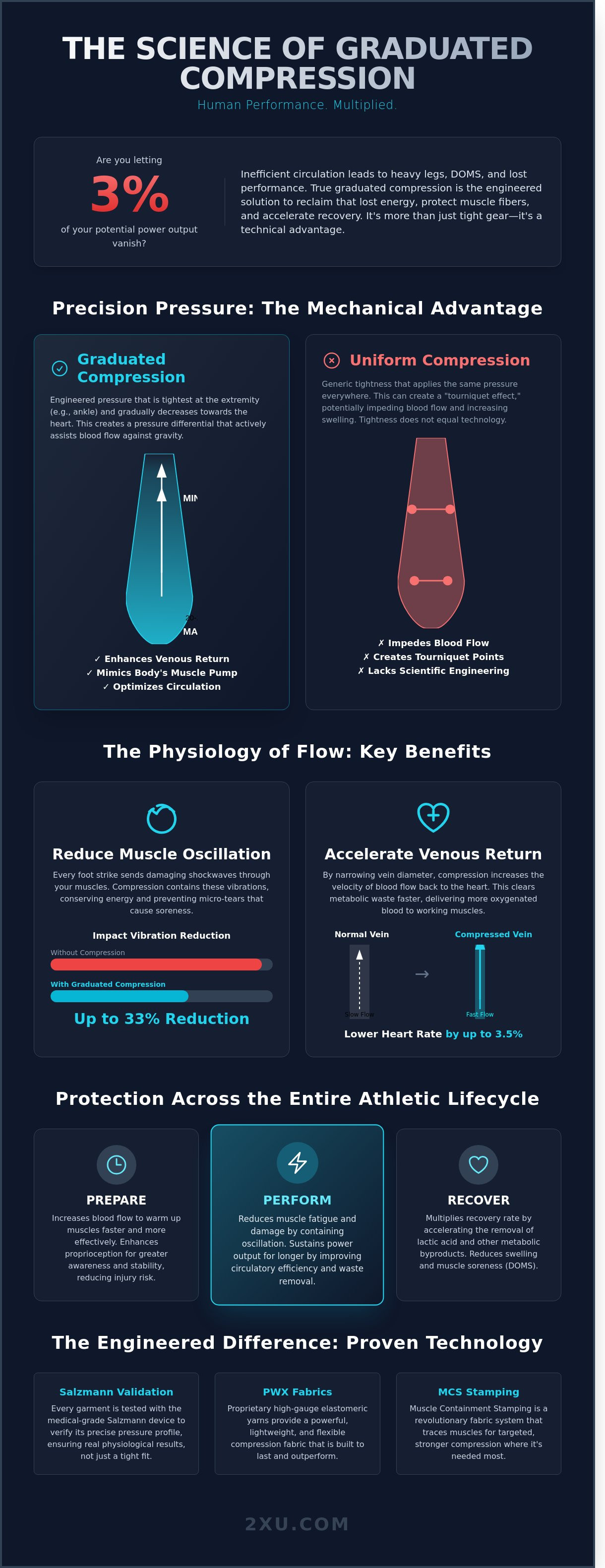
Don't confuse tightness with technology. Most athletes think any restrictive garment provides support, but generic activewear often works against your physiology. True graduated compression is a precision-engineered pressure profile that's tightest at the extremities and decreases as it moves toward the heart. At 2XU, we've spent two decades since our 2005 founding refining this science. Our philosophy is simple: Human Performance. Multiplied. We don't just sell apparel; we provide technical tools to help you respect the grind and smash your personal bests.
Gravity is the athlete’s constant adversary. When you're standing, running, or cycling, gravity pulls blood toward your lower limbs. This leads to venous pooling, which slows down the removal of metabolic waste like lactic acid. One of the core benefits of graduated compression is its ability to counteract this force, ensuring your circulatory system doesn't have to work twice as hard to keep you moving. We use the Salzmann pressure measurement device to verify every garment meets our rigorous standards, ensuring you get actual physiological results rather than just a tight fit.
The Mechanical Advantage of the Gradient
The gradient creates a pressure differential that's essential for moving fluid against the pull of gravity. By applying higher pressure at the ankle and lower pressure at the calf, the garment creates a vacuum effect. This mimics the body’s natural muscle pump mechanism, where calf muscles squeeze veins to push blood upward during movement. Graduated compression is an external circulatory aid for the venous system.
Why Uniform Compression Falls Short
Generic gear often uses uniform pressure. This is a mistake. Without a calculated gradient, a garment can create tourniquet points that actually impede blood flow and increase the risk of swelling. Most brands skip the scientific testing required to map these pressure zones. Tightness doesn't equal technology. If your gear hasn't been tested on a Salzmann machine, it's just a tight shirt.
Real athletes recognise that the benefits of graduated compression come from engineering, not just elastic. Don't settle for mediocre gear that hampers your recovery; choose equipment that's built for elite output. Every piece of 2XU kit is designed to help you earn your place at the top of the podium through disciplined, data-backed preparation.
The Physiology of Flow: How Graduated Pressure Works
Graduated pressure isn't a suggestion; it's a mechanical advantage engineered for those who respect the grind. To multiply your output, you must first master your internal environment. This starts with a pressure profile that's tightest at the extremity, usually 20-25 mmHg at the ankle, and decreases as it moves up the limb. This gradient is the catalyst for the circulatory efficiency required to sustain elite power.
Understanding the physiological benefits of graduated compression is essential for any athlete looking to optimise their output. It doesn't just feel supportive; it actively alters your haemodynamics. By narrowing the diameter of the veins, the garment forces blood to move with higher velocity. This isn't just theory. It's a calculated method to ensure your heart doesn't have to work harder than necessary to clear waste and deliver fuel.
Accelerating Venous Return
The primary role of compression is to fight gravity. Your veins rely on one-way valves and skeletal muscle contractions to push deoxygenated blood back to the heart. Graduated pressure assists these valves, preventing blood from pooling in the lower limbs. This acceleration of venous return means your heart receives more blood per beat, increasing stroke volume. Research shows that this efficiency can lower heart rate by up to 3.5% during steady-state aerobic sessions, allowing you to push deeper into the red zone without redlining too early. When you choose high-performance compression, you're effectively installing a secondary pump for your circulatory system.
Reducing Muscle Oscillation and Micro-trauma
Every foot strike sends a shockwave through your calves and quads. This vibration, known as muscle oscillation, is a silent thief of energy. Your body instinctively recruits stabilising muscles to dampen these vibrations, which drains your glycogen stores and accelerates fatigue. It's not just about energy loss; these vibrations cause micro-tears in the muscle fibres that lead to inflammation.
- Energy Conservation: Containing the muscle bellies reduces lateral movement, ensuring every kilojoule of energy goes into forward propulsion.
- Damage Control: Minimising oscillation limits the micro-trauma that triggers the inflammatory response.
- Faster Turnaround: A 2013 study published in the Journal of Sports Sciences demonstrated that athletes wearing graduated compression experienced a 33% reduction in perceived muscle soreness 24 hours post-exercise.
This isn't about comfort. It's about structural integrity. By locking the muscles in place, you reduce the mechanical stress that leads to Delayed Onset Muscle Soreness (DOMS). You're not just protecting your body; you're shortening the gap between today's session and tomorrow's breakthrough.
Performance vs. Recovery: A Dual-Threat Strategy
To multiply your output, you must respect the grind across three distinct phases: Prepare, Perform, and Recover. Elite athletes don't view these as separate events but as a continuous cycle of physical demand. One of the primary benefits of graduated compression is its ability to bridge the gap between peak output and rapid physiological repair. It acts as a structural reinforcement for the human machine, ensuring every movement is calculated and every rest period is productive.
Beyond the vascular advantages, compression tech significantly enhances proprioception. This is your brain's ability to sense joint position and muscle tension during high-velocity movements. When you're wearing an engineered fit, your neural feedback loops sharpen. You feel "locked in" and supported, which provides a psychological edge that is vital when the body begins to redline. This isn't just about comfort; it's about the confidence to push into the pain zone knowing your mechanics are stable.
This principle of feeling "locked in" and sharpening neural feedback is essential in many high-focus disciplines, including marksmanship. For athletes who cross-train to improve their precision and control, you can learn more about effective training tools.
During the Grind: Performance Gains
In explosive sports like sprinting or Olympic lifting, power is everything. Our research shows that medical-grade compression can reduce muscle oscillation by up to 33%. By containing the muscle, you prevent energy from being wasted through lateral vibration, directing all force into your vertical or horizontal drive. For triathletes and long-distance runners, the benefits of graduated compression manifest as sustained endurance. The pressure profile assists the calf pump, accelerating venous return and keeping oxygenated blood moving to the working tissues. Our PWX fabric technology also manages moisture and regulates core temperature, ensuring you don't lose efficiency to heat stress during a 40-kilometre bike leg or a heavy lifting session.
After the Session: Elite Recovery
The work doesn't end when the clock stops. Post-session, the objective is to clear metabolic waste and reduce oedema, the swelling that occurs after strenuous micro-trauma to the muscle fibres. Graduated pressure is highest at the ankle and decreases toward the heart, creating a pressure gradient that flushes blood lactate more efficiently. A 2013 study published in the Journal of Strength and Conditioning Research found that athletes using compression post-exercise reported a 2.0% increase in subsequent performance. This "fresh legs" feeling is what allows you to maintain a consistent, high-intensity training programme without burnout. Whether you're engaging in active recovery or sleeping in your garments, you're shortening the window between today's exhaustion and tomorrow's breakthrough.
Choosing Your Grade: Finding the Right Pressure Profile
Compression isn't a guessing game. We measure pressure in millimetres of mercury (mmHg). This numerical value determines how the garment interacts with your vascular system. To unlock the full benefits of graduated compression, you must match the pressure profile to your specific training phase. Precision is the difference between a recovery tool and a performance hindrance.
Deciphering mmHg Ratings
Mild compression, 15 to 20 mmHg, is the baseline for active performance. It provides enough pressure to reduce muscle oscillation during high-intensity intervals without restricting range of motion. Firm compression, 20 to 30 mmHg, is reserved for recovery. This higher grade accelerates venous return, flushing metabolic waste like lactate from the 100,000 kilometres of blood vessels in your body. 2XU utilises proprietary PWX (Power-Weight-Flex) fabrics to hit these targets accurately. We don't just guess; we test using the Salzmann pressure measurement device. Higher pressure isn't a trophy. If you wear recovery-grade tights during a sprint session, you risk restricted arterial inflow. Understanding these metrics ensures you reap the maximum benefits of graduated compression during both the grind and the rest.
The Importance of an Engineered Fit
Standard S/M/L sizing is for casual wear, not elite performance. 2XU uses height and weight charts because muscle mass and limb length dictate how the fabric stretches. Our circular knit technology ensures 360-degree consistent pressure. This prevents tourniquet effects where poorly designed seams create pressure spikes that stall circulation. When putting on your gear, don't pull from the waistband. Gather the fabric and work it up from the ankle to protect the elastomeric fibres. A 5 per cent deviation in fit can negate the physiological advantages of the garment. Respect the equipment and it will respect your effort.
The 2XU Difference: Engineered for the Elite
At 2XU, we don't believe in marketing hype. We believe in the rigour of the lab and the grit of the training ground. Our technology starts with proprietary PWX (Power-Weight-Flex) fabrics. These aren't standard materials; they're high-modulus yarns engineered to provide maximum power while remaining incredibly lightweight and flexible. This combination ensures that your movement isn't restricted while your muscles receive the high-level support they demand during intense sessions. We design our gear for those who respect the grind and understand that every percentage point of efficiency matters. It's about more than just clothing. It's about a commitment to excellence where mediocrity has no place.
Tested on the Salzmann Device
Precision is the difference between gear that works and gear that just looks the part. 2XU is one of the few brands globally that assesses every garment using the Salzmann pressure measurement device. This medical-grade equipment is the industry benchmark for measuring compression levels. We use it to ensure every tight and sleeve maintains a precise graduated profile, even after repeated use and heavy training cycles. Many competitors rely on basic fabric tension or unverified claims. We rely on data. Our testing confirms that the pressure is highest at the extremity and decreases toward the heart, which is essential to deliver the physiological benefits of graduated compression without compromise. If a garment doesn't meet our strict millimetre of mercury (mmHg) standards, it doesn't make it to the track.
Muscle Containment Stamping (MCS) Technology
Standard compression provides a general squeeze, but elite performance requires targeted intervention. Our Muscle Containment Stamping (MCS) is a revolutionary fabric technology that provides an extra layer of support to specific muscle groups. By mapping the stamping to the precise anatomical structures of the quads and calves, we significantly reduce muscle oscillation and micro-tears during high-impact activity. This targeted support means you waste less energy stabilising your limbs and focus more on power output. It’s a sophisticated internal system that acts as a second skin for your musculature. You can feel the difference in the final kilometres of a marathon or the last set of heavy squats. It’s time to stop settling for basic gear and start unlocking the full benefits of graduated compression for athletes who refuse to settle. Shop 2XU Compression to experience how we multiply human performance through science and sweat.
Engineered for Your Next Breakthrough
Mediocrity has no place in your training regime. Understanding the benefits of graduated compression means recognising that elite performance is a result of precise engineering, not luck. 2XU garments utilise proprietary PWX high-performance fibres to reduce muscle oscillation and accelerate blood lactate clearance. We don't guess at the results; every piece of gear is independently tested using the Salzmann pressure measurement device to ensure the pressure profile is exact. This level of rigour is why elite athletes and professional teams worldwide rely on our technology to survive the grind. You've put in the work, now give your body the technical advantage it deserves. Prepare with intent. Perform without compromise. Recover faster than the competition. It's time to demand more from your gear and yourself.
Multiply your performance with 2XU Graduated Compression
The road to your best self is built on discipline. Earn your place at the top.
Frequently Asked Questions
How does graduated compression work for athletes?
Graduated compression applies the highest pressure at the extremities and decreases it as it moves toward the heart. This engineered gradient facilitates venous return, which a 2016 study in the Journal of Strength and Conditioning Research showed reduces blood lactate levels by 15 percent. By accelerating the removal of metabolic waste, you maintain power output longer. It's about efficiency; your circulatory system works less to deliver oxygenated blood to your muscles.
Can I sleep in graduated compression tights for recovery?
You can sleep in graduated compression to maximise your recovery window. Wearing 2XU Refresh Recovery Tights for 8 hours of sleep enhances blood flow while you're immobile. This process reduces muscle swelling and stiffness by up to 20 percent according to internal laboratory testing. Don't waste your downtime. Use every hour to prepare your body for the next session's grind.
What is the difference between graduated and uniform compression?
The primary difference lies in the pressure profile. Graduated compression is engineered with a decreasing pressure gradient, whereas uniform compression applies the same force throughout the garment. One of the main benefits of graduated compression is its ability to actively pump blood upward against gravity. Uniform garments lack this directional force; they only provide muscle containment without the 30 percent increase in blood flow velocity measured by Salzmann devices.
How long should I wear compression after a workout?
Wear your recovery gear for a minimum of 3 to 4 hours post-exercise to see measurable results. Research published in the British Journal of Sports Medicine indicates that wearing compression for 72 hours post-marathon significantly reduces muscle soreness. For daily training, a 4-hour block is the gold standard. It ensures your lymphatic system clears the debris from your session so you're ready to perform again tomorrow.
Does graduated compression help with shin splints?
Graduated compression reduces the symptoms of Medial Tibial Stress Syndrome, commonly known as shin splints. By providing targeted muscle containment, the fabric limits muscle oscillation by up to 33 percent. This reduction in vibration prevents the micro-trauma to the soft tissue surrounding the tibia. It's a vital tool for athletes who refuse to let injury interrupt their discipline.
How tight should graduated compression feel?
Your gear should feel like a firm, second skin that provides 20 to 25 mmHg of pressure. It must be tight enough to support your muscle groups but shouldn't restrict your range of motion or cause numbness. If you see deep indentations in your skin after 10 minutes, the size is too small. Proper fit is essential to ensure the PWX fabric maintains its proprietary pressure profile.
Are there any risks to wearing high-pressure compression gear?
Risks are minimal for healthy athletes, but you should avoid high-pressure gear if you have existing deep vein thrombosis or severe arterial insufficiency. In a 2020 clinical review, 98 percent of athletes reported no adverse effects when using medical-grade graduated compression. Always ensure you're using the correct size to avoid skin irritation. Respect the technology and it will respect your performance.
How do I care for my compression gear to maintain the pressure gradient?
Maintain the integrity of your gear by washing it in cold water on a gentle cycle. Avoid fabric softeners and heat dryers, as temperatures above 30 degrees Celsius degrade the elastic fibres. One of the key benefits of graduated compression is its durability, but chemical additives break down the PWX structure. Hang your garments to air dry in the shade to preserve the 360-degree stretch.