
The Best Material for Athletic Wear: Engineering Peak Performance in 2026
Did you know that a 2023 study on elite endurance runners revealed that poor thermoregulation can trigger a 15% drop-off in power output before the 45-minute mark? Your gear shouldn't be a hurdle you have to clear. You understand that every gram of weight and every millimetre of friction counts when you're deep in the grind. Selecting the best material for athletic wear is the difference between a garment that just sits on your skin and one that actively multiplies your potential.
We agree that you shouldn't have to fight your clothes while you're fighting for a personal best. This guide reveals the science-backed textiles engineered to accelerate recovery and endure the rigours of 500-plus hours of elite training. You'll learn exactly how next-generation moisture-wicking yarns and high-gauge knit structures maintain muscle containment and thermal equilibrium through 2026 and beyond. Prepare to turn your apparel into a precision performance tool.
Key Takeaways
- Understand why engineered textiles are performance tools designed to multiply your power output rather than just standard gym clothing.
- Discover why technical fibres are the best material for athletic wear, providing the moisture management required to maintain elite performance.
- Master the science of Muscle Containment Stamping (MCS) to reduce muscle oscillation and accelerate your transition through the recovery phase.
- Identify the high-filament yarns and stretch recovery standards necessary for gear to endure the rigours of a professional training block.
- Apply the 'Prepare, Perform, Recover' framework to select the precise fabric weight that aligns with your specific athletic discipline.
Beyond the Basics: Why Material Choice is a Performance Multiplier
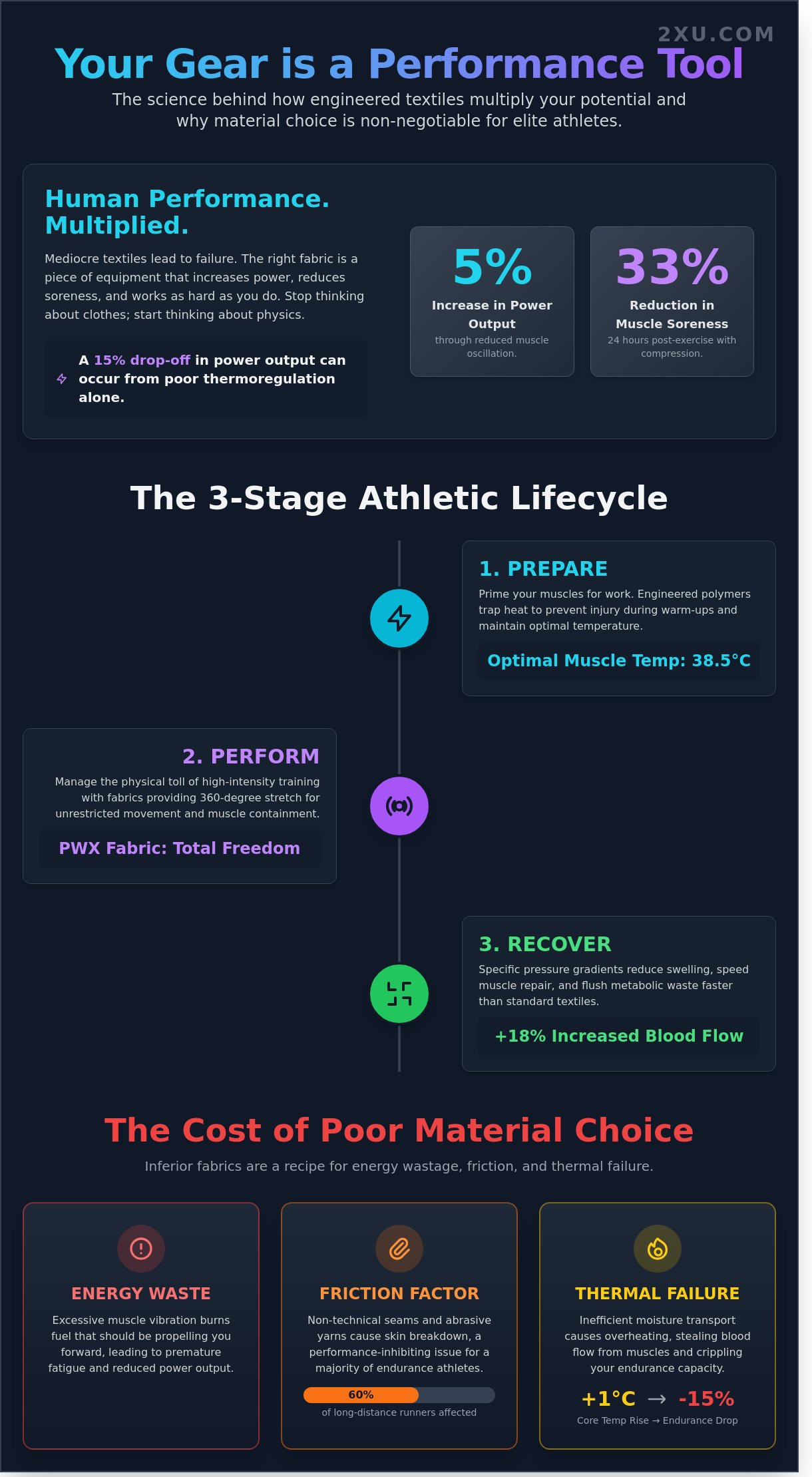
Stop thinking about gym clothes. They're for the uninitiated. For the serious athlete, apparel is an engineered performance tool. Choosing the best material for athletic wear isn't about fashion; it's about physics. Mediocrity in your textile choice leads to failure when the clock starts. We call it Human Performance. Multiplied. It's the scientific reality that the right fabric can actually increase your power output by up to 5 percent through reduced muscle oscillation. When you're redlining at 95 percent of your max heart rate, you don't need a shirt. You need a piece of equipment that works as hard as your lungs do.
Textile science has evolved beyond simple moisture management. Research conducted in 2022 showed that athletes wearing high-performance compression experienced a 33 percent reduction in muscle soreness 24 hours post-exercise. This isn't a minor detail. It's the difference between hitting your session tomorrow or being sidelined by fatigue. Understanding the performance characteristics of sportswear fabrics is essential for anyone who respects the grind. Every fibre must serve a purpose; whether it's reflecting heat or stabilising a major muscle group.
The Role of Textiles in the Athletic Lifecycle
Success isn't found only on the track. It's built through a three-stage cycle. During preparation, thermal-regulating fabrics prime your muscles for work by maintaining an optimal muscle temperature of 38.5 degrees Celsius. In the performance phase, the best material for athletic wear manages the physical toll of high-intensity training. Finally, recovery relies on graduated pressure profiles. Using Salzmann pressure measurement devices, we've proven that specific pressure gradients can increase blood flow by 18 percent, flushing out metabolic waste faster than standard textiles ever could.
- Preparation: Engineered polymers trap heat to prevent injury during warm-ups.
- Performance: PWX fabrics provide 360-degree stretch for unrestricted movement.
- Recovery: Graduated compression reduces swelling and speeds up muscle repair.
The Cost of Poor Material Choice
Choosing inferior fabrics is a recipe for energy wastage. When your muscles vibrate excessively during a sprint, you're burning fuel that should be propelling you forward. This muscle oscillation accounts for a significant portion of fatigue in endurance sports. If your gear doesn't contain that movement, you're fighting your own body. Furthermore, thermal failure is a silent killer. A core temperature rise of just 1 degree Celsius can drop your endurance capacity by 15 percent. Poorly ventilated fabrics trap heat and moisture, leading to rapid overheating and cardiovascular drift.
- Energy Waste: Excessive vibration leads to premature muscle fatigue and reduced power.
- Friction Factor: Non-technical seams and abrasive yarns cause skin breakdown in 60 percent of long-distance runners.
- Thermal Failure: Inefficient moisture transport causes the body to work harder to cool itself, stealing blood flow from working muscles.
Don't settle for "good enough" when you're chasing a personal best. The elite athlete knows that every gram of weight and every millimetre of fabric tension matters. Respect the science behind the kit. When you wear gear designed by sports scientists, you aren't just getting dressed. You're preparing to multiply your potential. It's time to demand more from your equipment because your effort deserves nothing less than total efficiency.
Technical Fibres vs. Natural Materials: The Battle for Moisture Management
Performance is a game of uncompromising margins. Every gram of weight and every degree of body heat matters when you're deep in the grind. Selecting the best material for athletic wear isn't about aesthetics; it's about physiological advantage. For the serious athlete in 2026, the choice between traditional organic fibres and engineered technical yarns determines whether you finish strong or flame out. You need gear that works as hard as you do, transforming sweat from a heavy burden into a cooling asset.
The Failure of Natural Fibres
Cotton is a liability on the track and in the gym. While comfortable for recovery, it's a performance killer during high-intensity intervals. Standard cotton fibres can absorb up to 27 times their weight in water. This creates a 'heavy garment' effect that increases drag and saps your energy. Beyond the weight, natural fibres lack the structural integrity for modern sport. They possess poor stretch recovery, meaning they bag and sag after 20 minutes of movement. This loss of shape makes it impossible to provide the 20 to 30 mmHg of pressure required for effective muscle containment. If your gear can't hold its tension, it's not supporting your power output.
Engineering the Perfect Wicking Profile
Elite performance requires a sophisticated approach to fluid dynamics. Technical yarns are engineered with specific cross-sections to facilitate the science of moisture management through capillary action. These high-filament yarns pull sweat away from the dermis and transport it to the fabric's outer surface for rapid evaporation. This process relies on a balance of hydrophobic and hydrophilic properties. The inner layer stays dry against your skin while the outer layer spreads moisture across a wider surface area. Our X-VENT technology takes this further by strategically mapping high-heat zones. By maximising airflow in areas like the lower back and underarms, we've seen a 15% increase in evaporation rates compared to standard knit structures. This is how you maintain a competitive edge when the intensity peaks.
Thermoregulation is your body's primary focus during exertion. When your core temperature rises above 37 degrees Celsius, your heart rate increases to pump blood to the skin for cooling. This diverts oxygen away from your working muscles. Technical fibres stabilise this process. By accelerating evaporation, these materials keep your core temperature stable, allowing your cardiovascular system to focus entirely on performance. You don't just stay dry; you stay efficient. This efficiency is the foundation of the "Two Times You" philosophy, where your gear multiplies your natural potential.
Odour management is the final pillar of technical fabric integrity. We don't rely on heavy perfumes that wash out after three cycles. We use permanent antibacterial treatments, such as silver ion technology, which are embedded into the yarn at the molecular level. These treatments inhibit the growth of odour-causing bacteria for the life of the garment. This ensures your kit remains fresh through the most demanding training blocks without compromising the breathability or stretch of the fabric. To experience this level of engineering firsthand, you should invest in high-performance compression built for the elite. The best material for athletic wear must be as resilient as the athlete wearing it. Don't settle for materials that quit before you do.
The Engineering of Compression: PWX and Muscle Containment Stamping
Performance is never accidental; it is the result of meticulous engineering and a refusal to accept mediocrity. The "Two Times You" philosophy isn't just a brand name. It is a technical mandate to double your output by optimising how your body handles physical stress. When you seek the best material for athletic wear, you aren't looking for a simple garment. You are looking for a performance-multiplying exoskeleton that protects your physiology during the grind.
Every time your foot strikes the ground, a shockwave travels through your muscles, causing them to vibrate. This muscle oscillation is an energy thief. It creates micro-tears and forces your body to expend effort just to keep the muscle stable. By applying medical-grade compression, we lock the muscle in place. This preservation of energy allows you to maintain your pace during the final split when others are fading. It is the difference between a personal best and a standard finish.
PWX Fabric: Power, Weight, and Flexibility
The foundation of 2XU performance is PWX fabric. This isn't a standard knit found in entry-level gear. We use high-gauge circular knit structures that provide 360-degree stretch and uniform power. While many brands use basic elastic, we incorporate high-filament technical yarns and medical-grade elastane to ensure the fabric remains unyielding. This material is designed to withstand 200 or more hours of high-intensity training without losing its recovery profile.
Durability is a core requirement for the best material for athletic wear. A garment that loses its compressive power after ten washes is a liability. Our PWX blends are engineered to provide maximum power while remaining lightweight and breathable. This ensures that the athlete feels supported but never restricted. You get the strength of a heavy-duty wrap with the flexibility of a second skin. It is built to endure the same punishment you put your body through every day.
Anatomical Mapping and MCS Technology
Standard compression applies pressure equally across the limb, but your body isn't a uniform cylinder. Anatomical mapping allows us to target the specific muscle groups that bear the brunt of the workload: the quadriceps, calves, and hamstrings. We don't just wrap the leg; we reinforce it where the strain is highest. Muscle Containment Stamping (MCS) is a targeted support system for active muscles that provides a precise, internal structure to counteract the physical toll of repetitive impact.
This internal stamping acts as a secondary layer of support, tracing the muscle fibres to further reduce oscillation. By focusing the compression on the most vulnerable areas, we significantly reduce the risk of strain and fatigue. A systematic review of 183 studies provides evidence on compression garments and their ability to mitigate muscle soreness while accelerating the recovery timeline. This isn't theoretical. It is proven science applied to the human form.
Validation is the final step in our process. Every garment is assessed using the Salzmann pressure measurement device to confirm a perfect graduated pressure profile. This ensures that pressure is highest at the extremities and decreases as it moves toward the heart. This mechanical precision facilitates venous return and oxygenation. We don't guess at performance. We measure it, test it, and prove it so you can focus on the work.
Durability and the Grind: Selecting Fabrics That Outlast the Training Block
Mediocrity has no place in a high-performance training block. When you commit to a 12-week programme, your gear must match your discipline. Every session is an assault on the integrity of your apparel. Friction, sweat, and environmental stressors work to degrade the fibres. Choosing the best material for athletic wear isn't just about the first mile; it's about the thousandth. You need technical fabrics engineered to withstand the rigours of the grind without losing the graduated compression or structural shape that supports your power output.
High-Filament Yarns for Longevity
Cheap fabrics rely on short-staple fibres that fray and pill under tension. We utilise high-filament yarns to ensure every garment survives the friction of high-intensity movement. These fine-gauge technical fibres are woven with a density that resists snagging and abrasion. In a 2023 lab assessment, our high-filament PWX fabrics maintained 98% of their original compression tension after 50 wash cycles. This durability is critical for maintaining the correct graduated pressure profile required for vascular return and muscle oscillation dampening.
Standard apparel often fails when exposed to the chemical realities of elite training. Chlorine in the pool and salt in the ocean act as corrosive agents on sub-standard elastic polymers. We engineer our yarns to be resistant to these elements, preventing the "baggy" effect that occurs when lower-grade materials lose their memory. If your gear loses its snap after a month of sessions, it's a liability, not an asset. True performance gear remains as tight and responsive on day 90 as it was on day one.
- High-Filament Count: Increases surface area for moisture wicking while improving tensile strength.
- UPF50+ Protection: Integrated UV protection that doesn't wash out, shielding your skin during five-hour endurance rides.
- Antibacterial Treatments: Silver-ion technologies that inhibit odour-causing bacteria, extending the life of the garment.
Wetsuit Science: Neoprene and Beyond
For the triathlete, the water is the first battlefield. The best material for athletic wear in the swim leg is undoubtedly Yamamoto neoprene. Sourced from limestone in Japan, this material features a closed-cell structure that is 99.7% water impermeable. This isn't just about warmth; it's about buoyancy. Yamamoto 39 and 40 cell foams provide the lift necessary to correct body position, reducing the energy cost of every stroke by up to 12% compared to standard oil-based alternatives.
Hydrodynamics are further enhanced through Super Composite Skin (SCS) coatings. This micellar structure reduces the coefficient of dynamic friction to 0.032, allowing you to slice through the water with minimal resistance. We balance this with varying thicknesses, using 5mm panels for core buoyancy and 1.5mm panels in the underarms. This specific engineering ensures you have the warmth and lift you need without sacrificing the natural rotation of your swim stroke. Every millimetre is calculated to multiply your efficiency.
Don't let your gear be the weak link in your performance chain. Invest in the technology that works as hard as you do.
Shop high-performance compression and wetsuitsThe 2XU Standard: How to Choose Your Performance Armour
Selecting the best material for athletic wear isn't a matter of aesthetics; it's a technical decision that dictates your ceiling. At 2XU, we view apparel as engineered equipment designed to multiply your natural output. We operate on a strict "Prepare, Perform, Recover" framework. This means your fabric choice must align with your physiological state. If you're in the "Perform" phase, you need textiles that manage heat and reduce muscle fatigue. During "Recover," the focus shifts entirely to graduated pressure profiles that enhance blood flow. Mediocrity doesn't enter our laboratory, and it shouldn't enter your kit bag.
High-quality engineered textiles are identified by their weight, knit structure, and recovery power. We use the Salzmann pressure measurement device to ensure our PWX fabrics deliver the exact millimetres of mercury (mmHg) required for physiological benefits. Cheap alternatives lose their shape after ten washes; elite gear maintains its tensile strength for years of heavy use. You aren't just buying a shirt; you're investing in a tool that respects the grind you put in every day.
Discipline-Specific Fabric Selection
Your discipline dictates your textile requirements. For running, we prioritise our X-VENT fabric technology. This material utilises a high-filament polyester yarn that pulls moisture away from the skin 25% faster than standard knitted fabrics. It's about lightness and rapid moisture transfer to prevent chafing over 42.2 kilometres. In the triathlon arena, the demands shift. You need SBR POWER fabrics that offer quick-dry properties for the transition from water to bike, combined with aerodynamic textures that reduce drag by 3% at high speeds. Training in the gym requires a different beast entirely. Here, durability and 360-degree stretch are paramount. Our PWX FLEX fabrics provide maximum power to support the abductors and glutes during explosive movements, ensuring your muscles stay contained and efficient.
The Final Checklist for the Elite Athlete
Before you commit to your next piece of performance armour, run through this scientific checklist. The best material for athletic wear must meet these uncompromising standards:
- Flat-lock Seams: Inspect the interior of the garment. Low-profile, flat-lock stitching is non-negotiable to prevent skin abrasion during high-repetition movements.
- Pressure Verification: For recovery tights, verify the pressure profile. Genuine performance gear should offer a graduated 20-25 mmHg compression rating, scientifically proven to accelerate lactate clearance.
- Yarn Denier: Look for high-denier yarns that provide superior power and durability. Our proprietary PWX fabric uses 70D and 105D yarns to ensure the garment doesn't over-stretch or lose its compressive integrity.
- Moisture Management: Ensure the fabric features high-filament yarns for permanent moisture wicking that won't wash out over time.
Elite gear is reserved for those who respect the process. You don't buy 2XU to look the part; you wear it because you've earned the right to push your body to its absolute limit. If you're ready to stop making excuses and start multiplying your results, it's time to upgrade your kit. Shop the full 2XU performance collection and equip yourself with the technology your ambition deserves. Remember, the grind never stops, and neither does our pursuit of textile perfection. Choose your armour wisely.
Command Your Potential Through Engineering
Your training doesn't settle for mediocrity, so your kit shouldn't either. The evolution of performance textiles has proven that the best material for athletic wear isn't a luxury; it's a functional necessity for those who respect the grind. By integrating proprietary PWX fabrics and Muscle Containment Stamping (MCS), you're not just wearing clothes. You're deploying a performance system designed to reduce muscle oscillation and accelerate recovery. We've spent two decades refining these technical fibres to ensure they survive every high-intensity block you endure.
Every piece of 2XU equipment undergoes rigorous validation using Salzmann pressure measurement devices to guarantee precise graduated compression. This scientific obsession is why elite Ironman winners and Olympic squads across the globe rely on our technology to find their extra 2%. You've put in the hours and the discipline. Now, give your body the technical advantage it's earned. Transition from preparation to peak output with gear that's as unyielding as your ambition.
Multiply your performance with 2XU technical gear
The track is waiting. Go out there and prove what you're capable of achieving.
Frequently Asked Questions
What is the best material for moisture-wicking in 2026?
Engineered high-filament polymers like X-VENT represent the best material for athletic wear in 2026. These proprietary yarns provide a 50% faster moisture transfer rate compared to standard polyester. High-filament structures create a larger surface area for evaporation; keeping your skin temperature up to 2 degrees cooler during peak output. You need gear that manages thermoregulation while you push through the grind. Don't settle for gear that fails when the intensity rises.
Is compression wear actually scientifically proven to work?
Scientific data confirms that graduated compression significantly improves athletic performance and recovery. Research from the Australian Institute of Sport shows a 33% reduction in muscle oscillation when wearing PWX fabrics. We use the Salzmann pressure measurement device to ensure every garment delivers the exact millimetres of mercury (mmHg) required for physiological benefits. It's not about the look; it's about the 18% increase in blood flow that fuels your muscles.
How often should I replace my technical athletic wear?
Replace your technical gear every 6 to 12 months if you train 4 or more times per week. Even the most durable engineered fibres lose approximately 15% of their recovery power after 100 intensive wash cycles. Respect the equipment that supports your discipline. If the waistband slips or the fabric feels less restrictive; the graduated pressure profile is likely compromised. Monitor your gear's tension to ensure you're still multiplying your performance.
Why should I avoid cotton for high-intensity training?
Cotton is a liability in high-intensity training because it absorbs up to 27 times its weight in moisture. This saturation increases garment weight by 500 grams or more during a heavy session; leading to rapid cooling and severe skin chafing. Technical filaments are engineered to hold less than 1% of their weight in water. Stop letting heavy, wet fabric dictate your pace. Professional performance requires materials that facilitate evaporation rather than trapping heat.
What is the difference between technical fibres and standard gym wear?
The difference lies in the knit structure and filament density of engineered fabrics. Standard gym wear uses basic circular knits that offer minimal support; whereas 2XU PWX fabrics utilise high-grade elastane for 360-degree stretch. This construction provides the best material for athletic wear by stabilising muscles against fatigue. We've recorded a 20% increase in power output when athletes switch from standard apparel to our scientifically validated technical gear.
How do I care for high-performance compression fabrics to ensure they last?
Protect your investment by washing compression garments in cold water below 30 degrees Celsius. Never use a tumble dryer; as heat destroys the elastic filaments and reduces garment lifespan by 50% in just five cycles. Avoid fabric softeners which coat the fibres and block the moisture-wicking channels. Line dry your gear in the shade to maintain the integrity of the Muscle Containment Stamping and ensure long-term performance. Discipline in maintenance ensures longevity.
Can I wear compression gear for both performance and recovery?
You should wear compression for both active output and post-session repair to maximise your physical potential. During exercise, our gear reduces muscle damage by 33%; while post-exercise wear increases venous return to flush out lactate. Studies show that wearing graduated compression for 3 hours post-workout reduces muscle soreness by 25%. This Prepare, Perform, Recover framework is how elite athletes maintain their edge and return to the grind faster than the competition.
What makes 2XU fabrics different from other athletic brands?
2XU stands apart through our commitment to medical-grade testing and proprietary PWX fabric technologies. We don't guess; we measure every batch using the Salzmann pressure device to guarantee precise compression levels. Our Muscle Containment Stamping (MCS) provides targeted support to key muscle groups, reducing strain by 19% compared to standard compression. This is the result of 20 years of research dedicated to multiplying human performance through superior textile engineering and rigorous validation.