
Triathlon Race Day Nutrition Plan: Engineer Your Fourth Discipline
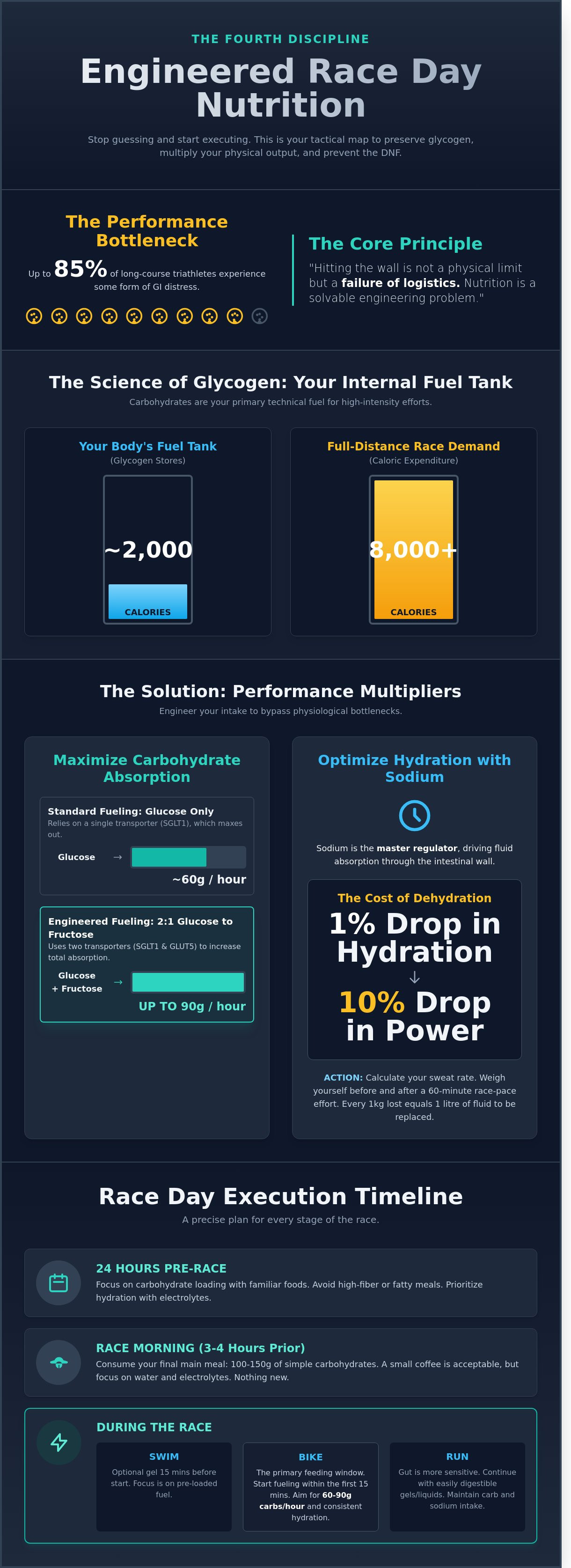
Your fitness is a waste of potential if your metabolic engine stalls 10 kilometres from the finish line. Research indicates that up to 85% of long-course triathletes experience some form of GI distress; this is often because they treat nutrition as an afterthought rather than an engineered system. You've spent 15 hours a week grinding through intervals and respecting the process. Don't let a simple electrolyte imbalance or a missed gel ruin your result. This triathlon race day nutrition plan is designed to eliminate the guesswork and ensure your performance is truly multiplied through rigorous science. We agree that hitting the wall is not a physical limit but a failure of logistics that can be solved with discipline. You will learn a precise timeline for every stage of the race, the mechanics of training your gut to process 90 grams of carbohydrates per hour, and the elite methods for carrying your fuel with zero aerodynamic penalty. It is time to stop guessing and start executing your fourth discipline with the same intensity as your swim, bike, and run.
Key Takeaways
- Understand why nutrition is the "fourth discipline," acting as a tactical map to preserve glycogen and multiply your physical output.
- Master the technical role of sodium as a master regulator for fluid absorption to prevent dehydration when the intensity is red-lined.
- Engineer a precise triathlon race day nutrition plan that manages the final 24-hour fuelling window without compromising your gut comfort.
- Discover how to execute the grind by matching your carbohydrate intake to the specific metabolic demands of Sprint and Olympic distances.
- Learn how engineered apparel and intelligent pocket design facilitate blood flow and streamline the logistics of mid-race fuelling.
The Fourth Discipline: Why an Engineered Nutrition Plan Multiplies Output
You've spent 20 weeks logging kilometres in the pool and on the tarmac. You've built a high-performance engine through discipline and sweat. However, without a precise triathlon race day nutrition plan, you're essentially driving a Formula 1 car with low-grade fuel. We view nutrition as the fourth discipline. It's a tactical map designed for glycogen preservation, ensuring your engine doesn't seize when the podium is within reach. Training provides the mechanics, but your fuel dictates the ceiling of your potential. Mediocrity in your fuelling strategy leads to the inevitable "bonk" at mile 18 of the run. You haven't worked this hard to crawl to the finish. You must earn your result through meticulous preparation and a total respect for the grind.
The Biological Cost of the Triple-Threat
Transitioning between swimming, cycling, and running forces a radical metabolic shift that most athletes fail to calculate. During high-intensity efforts, your body prioritises movement over digestion through a process called blood shunting. Up to 80% of your blood flow is redirected from the gastrointestinal tract to the working muscles, which significantly reduces your capacity to process calories under load. The Science of Sports Nutrition illustrates how glycogen depletion accelerates when your intensity exceeds aerobic thresholds without a replenishment strategy.
Metabolic efficiency is the physiological capacity to oxidise fat as a primary fuel source at higher power outputs, thereby preserving limited muscle glycogen for the closing stages of the race.
Fueling as a Performance Multiplier
Precision in your triathlon race day nutrition plan is the difference between a podium finish and a DNF. Validated sports data shows that a 1% decrease in hydration can result in a 10% reduction in power output. This isn't just a physical decline; it's a neurological collapse. When your hydration and electrolyte levels fail, your central nervous system throttles your output to protect your organs.
Stable blood glucose provides a psychological edge that is often overlooked. It prevents the cognitive fatigue and "brain fog" that sets in during the dark miles of the marathon. When your glucose levels are engineered for stability, you stop surviving the race and start attacking the course. Human Performance. Multiplied. This is the standard required to turn months of labour into a breakthrough performance.
The Science of Glycogen: Optimising Your Internal Fuel Tank
Precision is the difference between a podium finish and a DNF. Your body stores roughly 2,000 calories of glycogen, but a full-distance triathlon demands upwards of 8,000. Carbohydrates are your primary technical fuel for high-intensity efforts. When your heart rate climbs, fat oxidation is too slow to maintain elite power. You must master the science of glycogen optimization to prevent hitting the wall. Avoid "fluff" calories like complex fibres or fats that sit heavy in the gut. Focus on high-density glucose and fructose blends that enter the bloodstream with maximum efficiency.
Sodium is the master regulator. It drives fluid absorption through the intestinal wall. Without it, you are merely sloshing water in your stomach while your cells dehydrate. Calculate your sweat rate to build a triathlon race day nutrition plan that actually holds up under pressure. Weigh yourself before and after a 60-minute race-pace effort. Every 1kg lost equals 1 litre of fluid. Aim to replace 70% to 80% of that total loss to maintain blood volume and cooling efficiency throughout the bike and run legs.
Carbohydrate Ratios: 2:1 Glucose to Fructose Explained
Your gut has physiological bottlenecks. Glucose relies on SGLT1 transporters, which typically cap out at 60g per hour. By adding fructose, which uses the independent GLUT5 pathway, you bypass this limit. This engineered dual-source approach allows you to process up to 90g of carbs per hour without gastric distress. For Olympic and Half-Iron distances, this 2:1 ratio is your performance baseline. Engineered sports fuels outperform whole foods because they are designed for rapid gastric emptying, ensuring your muscles receive fuel while you maintain peak power output in the aero tuck.
Training the Gut: A 4-Week Protocol
Metabolic adaptation requires relentless discipline. You don't just train your legs; you train your stomach. Start a 4-week protocol where you incrementally increase carb intake during your long rides. By week three, your "Race Pace Fuelling" sessions must be exact nutritional dress rehearsals. If you don't practice 90g per hour in training, your gut will fail on race day. Identify triggers like dairy or high-fibre solids now. Eliminate them. Respect the grind of preparation so your body doesn't betray you at the 30km mark of the run.
Distance-Specific Strategies: Comparing Fueling Needs
Your metabolic requirements shift as the race clock extends. A sprint distance event demands raw power and threshold tolerance; a full Ironman is a calculated battle against glycogen depletion. To multiply your performance, you must tailor your triathlon race day nutrition plan to the specific physiological tax of the distance. Prepare your gut with the same discipline you apply to your track sessions.
Short-Course Intensity vs. Long-Course Endurance
Sprint distance racing is an all-out assault. Because your heart rate often sits at 90 percent of its maximum, blood is diverted from the gut to the working muscles. Digestion effectively stalls. Focus on pre-race loading two hours before the gun. A single 25g carbohydrate gel taken 15 minutes before the swim provides the necessary glucose spike without causing gastrointestinal distress.
Olympic distance events require a more tactical approach. You're balancing high speed with a 1500-metre swim, 40-kilometre bike, and 10-kilometre run. Aim for 40 to 60 grams of carbohydrates per hour during the bike leg. This maintains blood glucose levels so you can attack the run with a full tank.
For 70.3 and Full Ironman distances, the math dictates the result. Research from the University of Birmingham suggests elite athletes can oxidise up to 90 grams of multi-transportable carbohydrates per hour. The "300-calorie-per-hour" rule is a baseline, but it often fails athletes who haven't trained their gut. Use the bike as a moving buffet. It's the only time your body is stable enough to process complex fuel. Once you hit the run, focus shifts to survival and rapid-absorption liquids.
The Electrolyte Matrix: Sodium, Potassium, and Magnesium
Hydration is not just about water volume. It's about maintaining the electrical charge of your cells. Sweat-heavy athletes can lose over 1,500mg of sodium per litre of fluid. If you see white salt streaks on your tri-suit, you're a "salty starter" and need aggressive replacement.
- Sodium: Maintains fluid balance and prevents hyponatremia.
- Potassium: Supports intracellular pressure and nerve transmission.
- Magnesium: Critical for reducing muscle oscillation and preventing the micro-tears that lead to cramping.
Environmental factors demand immediate adjustments. In temperatures exceeding 30 degrees Celsius, increase your fluid intake by 250ml per hour to compensate for evaporative cooling. At high altitudes, the dry air increases respiratory fluid loss by up to 15 percent. Don't wait for thirst. Thirst is a trailing indicator of a system already in deficit. Execute your programme with clinical precision to ensure human performance is multiplied.
Executing the Grind: Your Race Day Fueling Timeline
Execution is where the amateur separates from the elite. Your triathlon race day nutrition plan isn't a suggestion; it's a rigid protocol. Success depends on your ability to fuel under duress. This is the grind. It requires meticulous timing and zero compromises. You've done the work in training; now you must manage the engine.
The Pre-Race Loading Window
The final 24 hours are about saturation without stagnation. Focus on low-residue, high-density carbohydrates like white rice or peeled potatoes. You need fuel that moves through the gut quickly. Avoid high fibre or high fat options that cause bloating. Your performance breakfast must be finished exactly 180 minutes before the klaxon. This 3-hour rule ensures your blood flow is directed to your muscles, not your digestion, during the swim. Prime your system with 500ml of electrolyte-rich fluid in the final 60 minutes to maintain plasma volume and sodium levels.
In-Race Execution: The 20-Minute Alarm
Discipline on the bike dictates your survival on the run. You cannot wait until you feel hungry. Set a repeating 20-minute alarm on your cycling computer. Every beep is a command to consume 20 to 30 grams of carbohydrates. This systematic approach targets a total intake of 60 to 90 grams per hour. Maintaining this cadence prevents the "gut shutdown" that occurs when blood flow is diverted away from the stomach during high-intensity efforts. If you miss a window, don't double up; stay the course.
- Transition 1 (T1): Take a 30g carbohydrate hit immediately to replace glycogen used during the swim before you find your rhythm on the pedals.
- The Bike Leg: Prioritise solids or semi-solids in the first half. Transition to liquids in the final 30 minutes to ease the burden on your digestive tract.
- The Run Leg: Shift entirely to gels and fluids. Your gut's absorption capacity drops by approximately 20 percent once you start running due to vertical oscillation.
- Caffeine Strategy: Time your final intake for 45 minutes before the finish line. Aim for 3 to 6mg of caffeine per kilogram of body weight to sharpen focus and reduce perceived exertion for the final push.
Hard work earns your place on the course, but data-driven fueling keeps you there. Respect the process and optimise your performance with gear designed for the elite. Every gram of fuel and every watt of energy counts when you are chasing a personal best. Human performance, multiplied, starts with the discipline to follow the plan.
The Integrated Athlete: How 2XU Gear Supports Your Nutrition
Your triathlon race day nutrition plan is only as effective as your ability to execute it under extreme physiological duress. 2XU doesn't just make clothing; we engineer performance environments that facilitate survival and speed. When your core temperature spikes or muscle oscillation creates unnecessary fatigue, your digestive system redirects oxygenated blood away from the gut to the working muscles. This physiological shift often leads to the "brick in the stomach" sensation that ruins a race. We solve this through precision textiles and graduated pressure profiles.
Trisuit Engineering for Fuel Storage
Efficiency is everything when you're 140 kilometres into an Ironman. 2XU trisuits feature pocket placements meticulously tested to ensure zero drag penalty. We've positioned these storage zones to allow for aerodynamic fuel access without compromising your profile. These rear pockets utilise a high-tension elastic opening. This design prevents nutrition loss when you hit a 40km/h bump on a rough road section. You carry exactly what you need to multiply your power output. Don't carry excess weight. Carry the fuel that earns the finish.
Compression for Recovery-in-Motion
Digestion requires blood flow. Our proprietary PWX fabric uses a 360-degree circular knit to reduce muscle vibration by up to 33%. By minimising this micro-trauma, your body expends less energy on peripheral muscle stabilisation. This leaves more metabolic energy for processing your triathlon race day nutrition plan. Muscle Containment Stamping (MCS) provides an extra layer of targeted support to the quadriceps and calves. This is critical during the high-impact run phase. It keeps your form tight when your mind wants to quit.
Heat management is the final piece of the gut-health puzzle. 2XU fabrics utilise high-filament yarns to pull moisture away from the skin, which can help drop surface temperature by up to 2 degrees Celsius. This cooling effect keeps your internal systems stable. It ensures the stomach continues to process carbohydrates rather than shutting down due to heat stress. We provide the advanced apparel. You provide the grit and the discipline. Equip yourself for the Grind with 2XU Triathlon Apparel.
Master Your Fourth Discipline
You've sacrificed months to the grind. Don't let a 2% drop in hydration or a depleted glycogen tank derail your output. A meticulously engineered triathlon race day nutrition plan transforms your physiology into a high-performance engine. You must hit a precise threshold of 60 to 90 grams of carbohydrates every hour to keep your muscle fibres firing through the final kilometres. This isn't just a suggestion; it's a scientific requirement for any athlete targeting a personal best. Your gear must support this biological mission. 2XU triathlon suits are tested by world-class triathletes and proven to reduce muscle oscillation by up to 33% using advanced PWX compression technology. We've engineered every suit for maximum aerodynamics and integrated storage that keeps your gels accessible without increasing drag. This technology is validated by the Salzmann pressure measurement device to ensure your graduated pressure remains optimal from the first buoy to the final tape. When your fueling and equipment align, your potential is realised. Respect the science, trust your preparation, and go earn your finish.
Shop 2XU High-Performance Triathlon Gear
Your breakthrough is waiting. Go get it.
Frequently Asked Questions
What is the best thing to eat the night before a triathlon?
Consume 2 to 3 grams of carbohydrates per kilogram of body weight the evening before your event. Stick to simple, low-fibre starches like white rice or pasta paired with lean protein to protect your gut. This strategy ensures your glycogen stores are fully loaded for your triathlon race day nutrition plan. Avoid high-fat sauces or fibrous vegetables that slow digestion. Data from a 2017 study shows pre-loading increases endurance capacity by 15 percent.
How many grams of carbohydrates per hour should I aim for?
Aim for 60 to 90 grams of carbohydrates per hour to execute a successful triathlon race day nutrition plan. This volume is the benchmark for maintaining blood glucose during efforts exceeding 150 minutes. Use a 2:1 ratio of glucose to fructose to increase absorption rates through multiple transport pathways. Start this intake 20 minutes into the bike leg. Elite athletes often test these limits during 4 hour training rides to ensure gut tolerance.
Can I rely solely on the nutrition provided at aid stations?
Don't rely on aid stations because consistency is the foundation of elite performance. Race organisers often provide products that may not align with your specific gut microbiome or training protocol. Carry your own engineered gels and electrolytes to eliminate the 20 percent risk of gastrointestinal distress caused by new ingredients. Use aid stations only for plain water or emergency fuel. Control every variable to ensure your hard work isn't wasted by a logistical error.
How do I prevent stomach cramps during the run?
Prevent stomach cramps by managing your pace and monitoring fluid osmolarity. Cramps often occur when the gut stops absorbing nutrients due to high-intensity spikes or dehydration. Reduce your power output by 10 percent if you feel a stitch forming. Ensure your fluid intake matches the sweat rate you calculated during your 60 minute threshold tests. Maintaining a steady sodium concentration prevents the cellular shifts that trigger abdominal pain during the run phase.
Is caffeine recommended for triathlon race day?
Caffeine is a potent ergogenic aid that reduces perceived exertion by approximately 6 percent. Consume 3 milligrams per kilogram of body weight 45 minutes before the swim start to sharpen your focus. Use a secondary dose of 1.5 milligrams per kilogram during the final 15 kilometres of the run to sustain power output. Research from the Australian Institute of Sport confirms this protocol improves time-trial performance in 80 percent of tested endurance athletes.
What should my first meal be after crossing the finish line?
Your first meal must be a recovery shake with a 4:1 carbohydrate-to-protein ratio within 30 minutes of crossing the line. This immediate intake jumpstarts glycogen replenishment and muscle tissue repair. Aim for 1.2 grams of carbohydrates per kilogram of body weight to maximise the recovery window. Following this with 25 grams of high-quality protein ensures your body begins rebuilding after the 226 kilometre grind. Don't neglect this step; recovery is where performance is built.
How much water should I drink if I am using high-carb gels?
Drink 200 to 250 millilitres of water with every high-carb gel to facilitate rapid gastric emptying. Gels are highly concentrated; without adequate fluid, they draw water from your blood into the gut. This causes bloating and slows down nutrient delivery to your working muscles. Maintain a total fluid intake of 600 to 800 millilitres per hour depending on ambient temperature. Precision in hydration ensures your engineered fuel actually reaches your muscle fibres.
Should I use salt tablets during an Ironman?
Use salt tablets if your sweat rate exceeds 1.2 litres per hour or if you notice salt crusting on your kit. Aim for 500 to 700 milligrams of sodium per litre of fluid to maintain plasma volume and prevent hyponatremia. This condition can degrade power output by over 20 percent in long-distance events. Use a clinical sweat test to determine your exact loss. Proper electrolyte management is essential to multiply your performance during the final stages of the race.