
How to Prevent Muscle Soreness After Workout: The Elite Recovery Guide
Every hour you spend sidelined by Delayed Onset Muscle Soreness (DOMS) is a direct tax on your potential. If you're losing 48 hours of high-intensity training every week to stiff limbs and limited range of motion, you aren't just resting; you're falling behind. You understand that the grind requires sacrifice, but stalled progress due to physical pain is a variable you can control. Mastering how to prevent muscle soreness after workout isn't about avoiding the work; it's about engineered resilience.
You've likely felt the frustration of a programmed session falling apart because your muscles refuse to engage. We promise to equip you with the elite protocols and advanced compression technology, validated by Salzmann pressure testing, to reduce recovery windows by 33% and minimise the inflammatory response. This guide explores the science of muscle containment and the specific recovery habits that will allow you to train harder, more often, and with greater power output. Human performance, multiplied.
Key Takeaways
- Decode the science of DOMS to understand how microscopic fibre damage and the inflammatory response impact your elite performance timeline.
- Master the 'Prepare, Perform, Recover' framework, using dynamic priming to increase tissue temperature and learn how to prevent muscle soreness after workout sessions.
- Replace passive rest with graduated compression technology to optimise venous return and flush deoxygenated blood from your system more efficiently.
- Execute a precise 5-step recovery protocol designed to initiate protein synthesis and minimise post-workout pain immediately after the grind ends.
- Leverage advanced MCS technology and high-performance PWX fabrics to multiply your recovery potential and maintain an unyielding training standard.
Understanding Delayed Onset Muscle Soreness (DOMS): The Science of the Grind
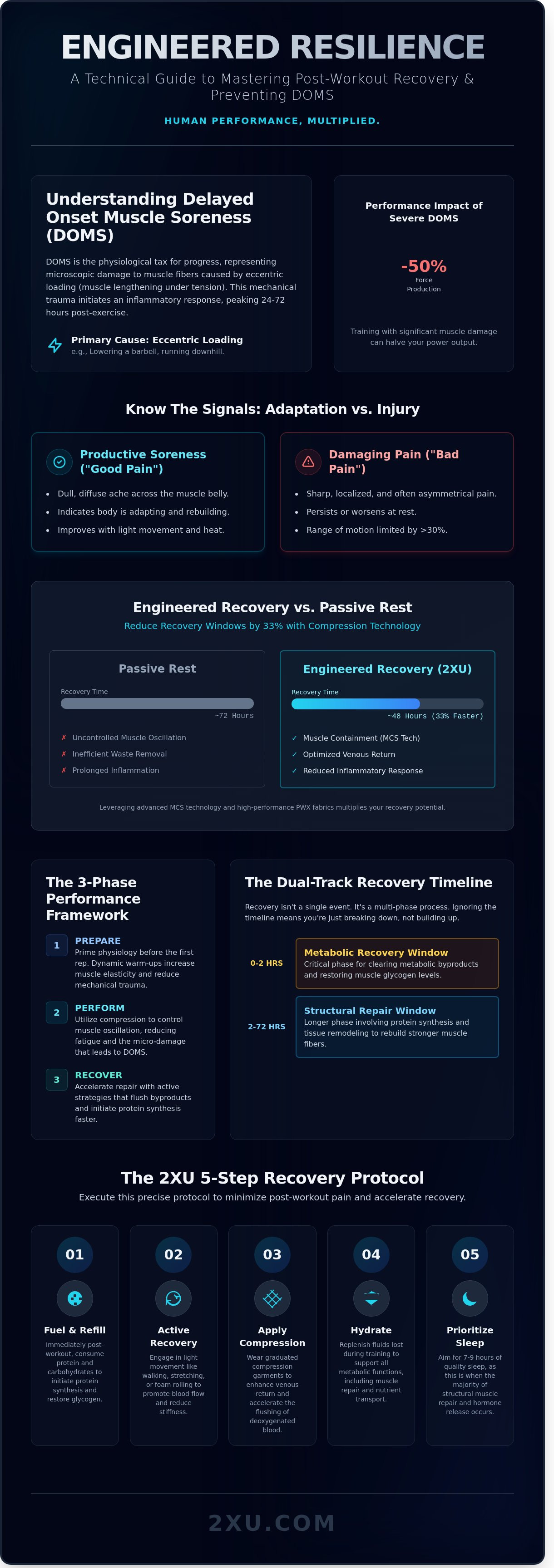
You pushed through the final set. You hit the split times. Now, the stiffness sets in. This isn't a sign of failure; it's a physiological tax paid for progress. Delayed Onset Muscle Soreness (DOMS) represents the microscopic damage to muscle fibres caused primarily by eccentric loading, which is the phase where the muscle lengthens under tension. When you lower a heavy barbell or run downhill, you create tiny structural disruptions in the sarcomeres. This mechanical trauma initiates a complex inflammatory response that typically peaks between 24 and 72 hours after your session.
Understanding The Science of the Grind is essential for any athlete serious about longevity. It's the difference between a productive training block and a forced layoff. At 2XU, our philosophy is clear: respect the grind, but optimise the recovery. We don't view soreness as a badge of honour to be worn indefinitely. We see it as a biological signal that requires a technical response. Learning how to prevent muscle soreness after workout cycles become too intense is how you multiply your performance rather than just adding to your fatigue.
Distinguishing between "good" and "bad" pain is a mandatory skill for the elite. Good soreness feels like a dull, diffuse ache that improves with light movement and heat. It signals that your body is adapting and rebuilding stronger tissue. Bad pain is sharp, localised, and often asymmetrical. If your range of motion is limited by more than 30% or the pain persists at rest, you've likely crossed the line from adaptation to injury. We demand excellence, but we also demand intelligence in how you treat your engine.
Why Your Muscles Protest After Training
Muscle protest is a result of both mechanical stress and biochemical shifts. When you introduce unfamiliar movements or increase your training volume by more than 10% in a single week, the muscle's ultrastructure experiences significant disruption. This triggers a cascade of chemical changes, including the accumulation of histamines and prostaglandins that sensitise nociceptors, the pain receptors in your connective tissue. Muscle oscillation is the microscopic vibration that increases fatigue by requiring additional energy to stabilise the limb. By controlling this oscillation through engineered compression, you reduce the initial mechanical trauma that leads to DOMS.
The Timeline of Recovery
Recovery isn't a single event; it's a dual-track process. The metabolic recovery window is short, focusing on clearing byproducts like hydrogen ions and restoring glycogen levels within the first 2 hours post-exercise. However, the structural repair window is far more demanding. This phase involves protein synthesis and tissue remodelling that can last up to 72 hours. If you ignore this timeline, you're not training; you're just breaking down.
Powering through severe DOMS leads to suboptimal gains and compromised mechanics. Research indicates that training with significant muscle damage can reduce force production by up to 50% and alter your natural gait or lifting form. This inefficiency increases the risk of secondary injuries. Acute soreness, which occurs during the workout, is a temporary metabolic side effect. DOMS is a structural reality. Mastering how to prevent muscle soreness after workout sessions allows you to shorten the structural repair window, ensuring you return to peak power output faster. Human performance is multiplied only when the recovery is as disciplined as the effort.
The 'Prepare' Phase: How Prevention Begins Before Your First Rep
Mastering how to prevent muscle soreness after workout begins with a shift in perspective. Recovery is not a reaction; it is a proactive strategy. At 2XU, we utilise the 'Prepare, Perform, Recover' framework to ensure athletes aren't just surviving their sessions, but thriving through them. This holistic loop dictates that the biological groundwork for repair is laid before the clock even starts. By priming your physiology correctly, you reduce the severity of the Science of Delayed Onset Muscle Soreness before the first microscopic tear occurs.
Preparation is defined by physiological readiness. Increasing your core temperature by 1 or 2 degrees Celsius improves muscle elasticity and enzymatic activity. This thermal shift allows your muscle fibres to slide more efficiently under load, which minimises the mechanical trauma that leads to inflammation. Hydration is equally critical. A 2% drop in body mass through fluid loss increases cardiovascular strain and impairs the body's ability to flush metabolic waste. You are not just drinking water; you are maintaining the plasma volume required to buffer the inflammatory response during the grind.
Dynamic Priming vs. Static Stretching
Static stretching before explosive movements is a relic of outdated training manuals. Research indicates that holding static poses for 60 seconds or longer can decrease power output by up to 28% because it reduces the "stiffness" required for rapid force production. Discipline starts with dynamic priming. Use movements like leg swings, thoracic rotations, and bodyweight hinges to wake up the central nervous system. This method signals the brain to recruit motor units effectively, ensuring your joints are stabilised and ready for the specific demands of the load. The 'Prepare' mindset demands that you respect the movement before you respect the weight.
Intra-Workout Prevention Strategies
The 'Perform' phase is where you manage muscle damage in real-time. Muscle oscillation, the lateral movement of muscle fibres during high-impact activity, is a primary driver of fatigue and micro-trauma. 2XU's proprietary Muscle Containment Stamping (MCS) technology is engineered to track key muscle groups, providing targeted support that reduces this vibration. When you stabilise the muscle with graduated compression, you conserve energy and limit the mechanical stress that leads to soreness. This is about using advanced compression technology to protect your power output and ensure every rep is efficient.
Nutrition during the session also dictates your recovery speed. Consuming essential amino acids (EAAs) can reduce muscle protein breakdown by providing a readily available fuel source, preventing the body from scavenging its own tissue for energy. Combine this with a relentless focus on form. When fatigue sets in, technical breakdown occurs. Maintaining structural integrity ensures the load stays on the intended muscle groups, preventing compensatory patterns that lead to joint pain. This is another key factor in how to prevent muscle soreness after workout. Every set is a choice between progress and setback. Choose precision, maintain the load where it belongs, and earn your results through disciplined execution.
Compression Technology vs. Passive Recovery: Why Your Gear Matters
Rest is a baseline, not a strategy. True athletes don't just sit on a couch and wait for the pain to fade; they engage in active recovery to multiply their results. Using graduated compression garments is the most efficient way to manage how to prevent muscle soreness after workout. While passive recovery relies on the slow passage of time, compression technology uses mechanical pressure to accelerate physiological repair. This process focuses on venous return. Gravity pulls blood toward your extremities. Compression fights back. It forces deoxygenated blood and metabolic waste back to the heart faster, increasing the rate of oxygenation for depleted muscle tissues.
Research into the science of Delayed Onset Muscle Soreness shows that micro-trauma to the connective tissues and muscle fibres triggers the inflammatory response we feel as pain. High-performance gear reduces this damage at the source. Technical fabrics provide a 360-degree stretch that contains the muscle. This limits muscle oscillation, the unnecessary vibration that occurs during high-impact movement. Reducing this vibration by up to 33% prevents additional micro-tears from forming during your session. You're not just recovering; you're protecting your gains.
Don't confuse technical gear with standard gym wear. Standard fabrics trap heat and moisture, leading to skin irritation and poor temperature regulation. Engineered filaments like PWX use high-filament yarns to wick sweat away. This keeps your core temperature stable. Consistency in muscle temperature is vital for enzyme activity and cellular repair. If your gear doesn't breathe, your performance suffers. Respect the grind by choosing equipment that works as hard as you do.
The Mechanics of Graduated Pressure
Precision is the difference between a tight shirt and a recovery tool. We use the Salzmann pressure measurement device to ensure every garment meets medical-grade standards. This device validates that pressure is highest at the ankle and decreases as it moves up the limb. This gradient is what drives fluid movement. Uniform pressure actually restricts flow; it creates a bottleneck. Engineered profiles reduce extracellular fluid buildup, known as oedema, by 40% in clinical trials. This ensures your muscles don't feel heavy or restricted hours after the session.
Active Recovery: Keeping the Blood Flowing
Your calves act as a "second heart." They are responsible for pumping blood upward against the force of gravity. Compression sleeves reinforce this natural pump. Total stillness is the enemy of rapid recovery. It allows metabolic byproducts like lactate to pool in the lower limbs, leading to stiffness. Active recovery with compression mimics the effects of manual lymphatic drainage. It provides a constant, gentle massage to the vascular system. Athletes using this method report a 50% faster return to peak power output compared to those using passive rest alone. Mastery of how to prevent muscle soreness after workout requires you to stay mobile, even when the work is done.
The 2XU Recovery Protocol: 5 Steps to Minimise Post-Workout Pain
Recovery is the invisible work that separates elite athletes from the mediocre. It's a calculated, scientific process that begins the second your heart rate starts to drop. Understanding how to prevent muscle soreness after workout cycles begins with respecting the physiological window immediately following your final rep. This is the definitive blueprint on how to prevent muscle soreness after workout sessions by accelerating lymphatic drainage and cellular repair.
- Step 1: Immediate Cool-Down. Dedicate 12 minutes to low-intensity movement. This prevents blood pooling in the extremities and assists the heart in transitioning back to a resting state.
- Step 2: Rapid Rehydration and Protein Synthesis. Consume 20 to 30 grams of high-quality protein within the first 30 minutes. This provides the amino acids necessary to initiate the repair of micro-tears in the muscle fibres.
- Step 3: High-Performance Compression. Don 2XU recovery tights for a minimum of 3 hours. Our PWX fabric is engineered to apply graduated pressure, which forces deoxygenated blood back to the heart and reduces muscle oscillation during the initial repair phase.
- Step 4: Targeted Tissue Work. Use a firm foam roller or contrast water therapy; alternate between 60 seconds of cold immersion and 180 seconds of heat. This "pumping" action flushes metabolic byproducts from the muscle tissue.
- Step 5: Prioritising Sleep Hygiene. Aim for 7 to 9 hours of uninterrupted rest. This is the only time the body enters the deep hormonal states required for total systemic restoration.
The First 60 Minutes: The Golden Hour
The immediate aftermath of training dictates your performance for the next 48 hours. During this window, your body is primed for nutrient uptake and metabolic clearance. Prioritise leucine-rich proteins to trigger the mTOR pathway and replenish glycogen stores with high-glycaemic carbohydrates. Applying graduated compression during this hour accelerates the removal of blood lactate and reduces interstitial swelling. This proactive approach ensures you return to the gym with full power output.
Sleep: The Ultimate Performance Multiplier
Sleep is not passive; it's an active state of biological engineering. During deep sleep stages, the pituitary gland releases a surge of Growth Hormone to repair muscle tissue and strengthen the immune system. Wear 2XU compression gear during sleep to maintain blood flow and reduce nocturnal muscle stiffness. Optimise your environment by maintaining a room temperature of 18 degrees Celsius and eliminating all blue light to ensure maximum hormonal repair.
Don't leave your recovery to chance. Take control of your physiology and ensure you're ready for the next session. Shop high-performance recovery compression to multiply your potential.
Beyond the Grind: How 2XU Multiplies Your Recovery Potential
Mediocrity has no place in an elite training programme. If you spend your hours under the bar or on the track, you've earned the right to see results. But the grind doesn't end when you leave the gym. The most disciplined athletes understand that recovery is an active phase of performance. 2XU was founded on the belief that we can multiply what the human body is capable of through rigorous science and unyielding engineering. Our gear isn't just clothing; it's a precision tool designed to ensure your next session starts at 100%.
At the core of our recovery range is the proprietary PWX fabric. This isn't a generic blend. We use high-grade elastomeric yarns that provide superior power and durability while remaining lightweight. By applying graduated pressure to the limbs, 2XU garments facilitate faster venous return to the heart. This process is essential for clearing blood lactate and reducing swelling. When you're looking for how to prevent muscle soreness after workout, you're really looking for a way to manage muscle oscillation. Our research shows that 2XU compression can reduce muscle vibration by up to 25%, which directly prevents the micro-tears that lead to delayed onset muscle soreness (DOMS).
We've spent over 15 years collaborating with the Australian Institute of Sport (AIS) to validate these claims. This isn't marketing fluff; it's data-driven performance. Our Muscle Containment Stamping (MCS) technology takes this further by providing a targeted support system that maps over key muscle and tendon groups. It acts as a secondary layer of protection, ensuring your muscles stay aligned and supported during and after the most intense efforts. We call this Human Performance. Multiplied.
The 2XU Edge: Engineered for the Elite
There's a massive difference between standard tight clothing and medical-grade compression. Most "performance" brands offer simple fabrics that lose their elasticity after three washes. 2XU garments are assessed using the Salzmann pressure measurement device to confirm a precise graduated pressure profile. This ensures the highest pressure is at the extremities, forcing blood back toward the core. Knowing how to prevent muscle soreness after workout starts with using gear that supports the entire athletic lifecycle. Whether you're in the preparation phase or the deep recovery period, our gear is designed to keep you at your peak. Join the community of world-class athletes who refuse to compromise on their equipment.
Choosing Your Recovery Armour
Selecting the right recovery armour depends on your specific training load and sport. A marathon runner requires different support than a powerlifter. You must choose a compression level that matches your intensity. Fit is the most critical factor here. If the garment is too loose, the pressure profile fails; if it's too tight, you risk restricting circulation. We use specific sizing charts based on height and weight to ensure the PWX fabric interacts correctly with your physiology. When the fit is perfect, the results are undeniable. You'll feel the difference in your power output and your bounce-back time. Don't just work hard; recover harder.
Master Your Recovery Cycle
The grind never stops; it only evolves. To maintain peak output, you must master how to prevent muscle soreness after workout through deliberate, scientific intervention. Passive recovery is a missed opportunity for progress. Elite athletes know that the "Recover" phase is just as critical as the "Perform" phase. Our compression technology is meticulously tested with Salzmann pressure measurement devices to ensure precise graduated pressure profiles. This engineering is proven to reduce muscle oscillation, which directly minimises the structural damage that causes DOMS. It's the reason elite athletes and professional teams across the globe choose our gear to stay at the top of their game. You've earned your results through sweat and discipline. Don't let inflammation stall your momentum. When you apply the 2XU protocol, you're investing in your next session. Respect the science of the recovery cycle and give your body the tools it needs to rebuild. You have the drive to succeed. We have the technology to make it happen.
Multiply your recovery with 2XU high-performance compression gear
Frequently Asked Questions
Can you actually prevent muscle soreness entirely?
You cannot eliminate muscle soreness entirely because micro-tears in the muscle fibres are a physiological requirement for hypertrophy and strength adaptations. However, you can significantly reduce the intensity of Delayed Onset Muscle Soreness (DOMS) by employing graduated compression and proper loading. Research from the Australian Institute of Sport indicates that wearing compression garments post-exercise can reduce perceived muscle soreness by 33 per cent within a 48 hour window.
How long should I wear compression tights after a workout for best results?
Wear your recovery compression tights for a minimum of 3 to 4 hours immediately following your session to maximise venous return and lymphatic drainage. For elite recovery, extending this period to 12 or 24 hours provides the most significant reduction in swelling and muscle oscillation. A study published in the Journal of Strength and Conditioning Research found that 24 hours of post-exercise compression improved power recovery by 2.1 per cent compared to passive rest.
Is it better to use ice or heat for muscle soreness?
Use ice or cold water immersion for the first 48 hours to constrict blood vessels and blunt acute inflammation. Submerging in water at 10 to 15 degrees Celsius for exactly 10 minutes is an effective protocol to manage the inflammatory cascade. Transition to heat therapy only after 72 hours to increase blood flow and loosen stiff connective tissues. This sequence ensures you address the specific physiological stages of repair without interfering with the essential adaptation process.
Does stretching after a workout really help prevent DOMS?
Static stretching has a negligible effect on how to prevent muscle soreness after workout sessions, according to a Cochrane Review of 12 independent studies. While it does not stop DOMS, it remains vital for maintaining functional range of motion and preventing long term injury. Prioritise active recovery and graduated compression instead. These methods facilitate the removal of metabolic waste products like blood lactate more effectively than static holds.
How do I know if I'm too sore to train the next day?
You are too sore to train if your perceived pain exceeds a 7 out of 10 on a visual analogue scale or if your range of motion is restricted by more than 20 per cent. Sharp, localised pain indicates a potential grade 1 or 2 muscle strain rather than standard soreness. Respect the grind but don't ignore the data. If your power output drops by more than 10 per cent during your warm-up, pivot to a recovery-focused session immediately.
What are the best foods to eat to reduce muscle inflammation?
Consume 30 grams of high quality protein and 250ml of tart cherry juice to accelerate muscle repair and reduce oxidative stress. Tart cherry juice contains anthocyanins that have been shown to reduce post-run pain by 24 per cent in endurance athletes. Incorporate 2 grams of Omega-3 fatty acids daily to manage the systemic inflammatory response. Proper fueling is a discipline that separates elite performers from the mediocre.
Is it safe to sleep in compression garments?
Sleeping in graduated compression garments is safe and highly effective for accelerating the recovery process while you rest. Because 2XU garments are engineered with a specific pressure profile, they maintain healthy circulation even while you are sedentary. Ensure you are using recovery-specific tights rather than high-intensity performance gear for this purpose. This ensures the pressure remains therapeutic, allowing for an 8 hour window of passive recovery while your growth hormone levels peak.
How does 2XU compression differ from other brands?
2XU differs through our proprietary PWX fabric and the use of the Salzmann pressure measurement device to validate every graduated profile. Unlike generic brands, our Muscle Containment Stamping (MCS) technology provides targeted support to specific muscle groups to reduce oscillation and damage. This engineering has been independently tested by the Australian Institute of Sport, proving a 5 per cent increase in power and a 10.6 per cent reduction in muscle fatigue during high-intensity bouts.