
Wetsuit Buoyancy for Beginner Swimmers: Engineering Your Hydrodynamic Alignment
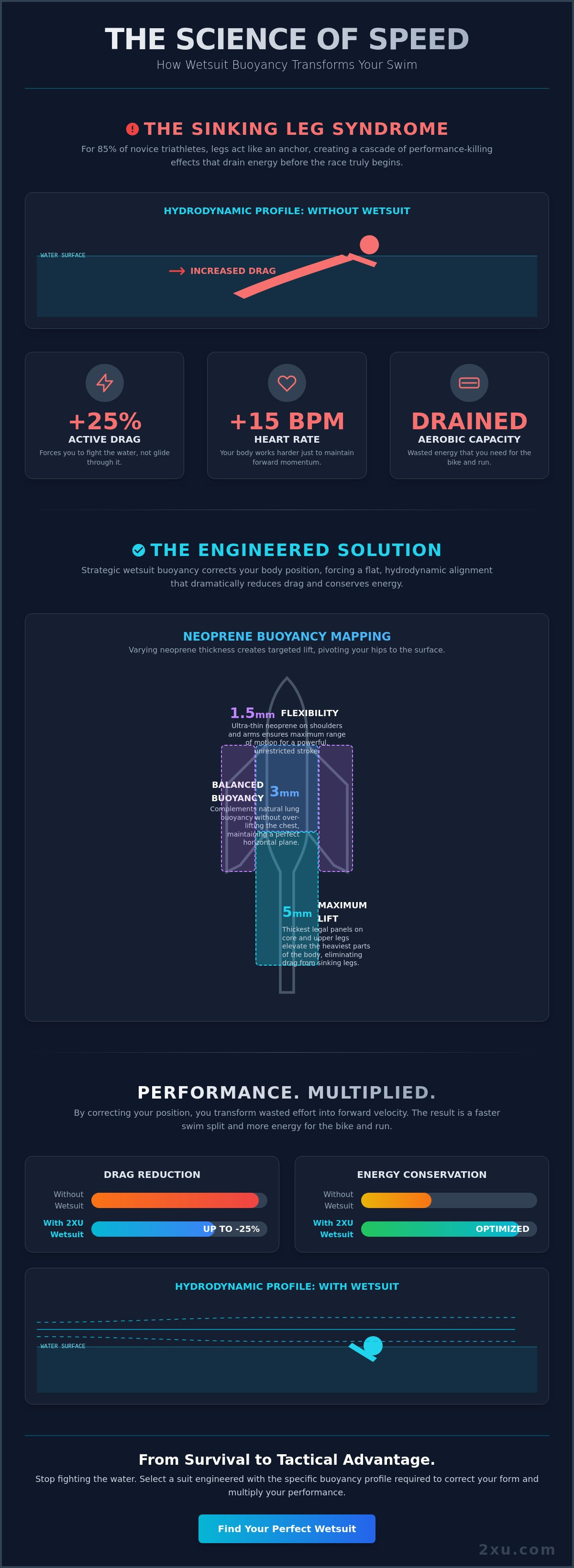
Your legs are not your engine in open water; they are a 5 kilogram anchor dragging your performance into the depths. Research indicates that 85% of novice triathletes suffer from sinking legs, a biomechanical failure that increases drag by up to 25% and forces the heart to work 15 beats per minute harder just to maintain forward momentum. You've felt that heavy, dragging sensation 400 metres into a session, fighting a losing battle against gravity. It's an exhausting cycle that drains your aerobic capacity before you even reach the first buoy.
By mastering the science of wetsuit buoyancy for beginner swimmers, you can re-engineer your hydrodynamic alignment to sit higher in the water column. This article provides the technical blueprint to correct your body position, reduce drag coefficients, and significantly lower your heart rate during the swim leg. We'll examine the engineered buoyancy profiles required to transform your swim from a survival exercise into a tactical advantage. Prepare to multiply your efficiency and start the bike leg with a full tank. Human Performance. Multiplied.
Key Takeaways
- Eliminate the drag caused by sinking legs by understanding the upward force required for elite hydrodynamic alignment.
- Learn how to evaluate neoprene thickness maps to find the ideal wetsuit buoyancy for beginner swimmers, ensuring maximum lift where you need it most.
- Optimise energy conservation by using strategic buoyancy to preserve your power for the high-intensity bike and run segments.
- Identify your swimmer profile to select a suit engineered with the specific 5mm panels required to correct your body position.
- Leverage proprietary 39 Cell engineering to move beyond the survival phase and focus on maintaining a high-output stroke rate.
Understanding Buoyancy: The Foundation of Open Water Performance
Buoyancy is the vertical force exerted by water that opposes the weight of a submerged object. In the context of high-performance swimming, it's the primary variable that determines your position in the water column. Gravity pulls your mass down while buoyancy pushes it up. When these forces are misaligned, performance suffers. For many, this manifests as "Sinking Leg Syndrome," a condition where the hips and legs drop below the horizontal plane. This creates a massive increase in frontal surface area, effectively turning your lower body into an anchor. Research in fluid dynamics indicates that a dropped hip position can increase active drag by more than 60 percent, forcing the athlete to expend precious energy just to maintain forward momentum.
Training in a freshwater pool often provides a false sense of security. Freshwater is less dense than saltwater, meaning you have to work harder to stay level, yet the presence of lane ropes and frequent wall pushes masks technical flaws. Open water offers no such assistance. Without the engineered lift provided by wetsuit buoyancy for beginner swimmers, the transition to the ocean often results in immediate fatigue and mechanical breakdown. The goal of a performance wetsuit is not merely to keep you afloat; it's to achieve Hydrodynamic Alignment. This is the precise engineering of your body’s position to ensure you move through the water with the lowest possible resistance profile.
The Physics of Drag and Torque
When your lower body sinks, you create a larger cross-sectional area that the water must move around. This increases frontal drag and destroys efficiency. A significant issue is the torque created when the upper body remains buoyant due to air in the lungs while the dense muscle of the legs begins to submerge. This rotational force forces the core to work overtime to keep the body flat. Understanding how wetsuits provide buoyancy is essential to counteracting this effect. Archimedes’ Principle states that the upward buoyant force on an object is equal to the weight of the fluid it displaces, and by using varying thicknesses of neoprene, we can strategically displace water to lift the hips and equalise that torque.
Why Beginners Struggle with Natural Flotation
Natural buoyancy is dictated by lung volume and body composition. Beginners often carry higher muscle density in their legs, a trait common in triathletes who come from cycling or running backgrounds. Muscle is approximately 12 percent denser than fat and significantly denser than water, which explains why the legs are the first part of the anatomy to fail during a long swim. Wetsuit buoyancy for beginner swimmers acts as a corrective tool to balance these physical variances. By placing high-buoyancy materials around the core and upper legs, the suit compensates for high muscle density, allowing the athlete to focus on propulsion rather than survival. We don't accept mediocrity in form; we engineer the suit to ensure your hard work results in maximum velocity.
Neoprene Thickness Mapping: How Wetsuits Correct Your Body Position
Efficient swimming is a game of physics. For the novice, the greatest obstacle isn't strength; it's drag. Engineering wetsuit buoyancy for beginner swimmers requires a precise distribution of neoprene thickness to force the body into a hydrodynamic plane. Most high-performance beginner suits utilise a variable mapping strategy, typically featuring 3mm panels in the chest and 5mm panels in the core and upper legs. This targeted lift compensates for the common "sinking leg" syndrome that increases surface area and creates massive resistance.
The science relies on air-trapping cells within the neoprene structure. Advanced materials use nitrogen-injected cells to create internal buoyancy without relying on low-grade fillers. Understanding how a wetsuit helps beginner swimmers involves recognising that this lift isn't uniform. By placing the thickest material in the lower body, the suit acts as a lever. It pivots the hips toward the surface and can reduce drag by up to 25% compared to standard swimwear. This correction allows you to focus on propulsion rather than survival.
The 5mm Rule: Maximum Lift where it Matters
The 5mm threshold is the maximum thickness permitted under IRONMAN and World Triathlon regulations. This limit exists because 5mm neoprene provides a massive mechanical advantage. We strategically place these 5mm panels in the core and thigh regions to drive the hips upward. This alignment does more than just keep you afloat; it stabilises the lateral roll. When your core is locked into a stable, elevated position, you eliminate the "snake-like" wiggle that wastes energy. You stay straighter, move faster, and conserve oxygen for the later stages of your race. This is about discipline in the water.
Flexibility vs. Flotation: Finding the Balance
Maximum lift is useless if you can't rotate your shoulders. While the core demands 5mm of support, the underarms require as little as 1.5mm to 2mm of material. This graduated thickness ensures an unrestricted reach and a clean catch phase. Advanced neoprene wetsuit technology integrates these varying densities through seamless bonding, preventing the friction that causes neck chafing. This balance allows for 100% stroke efficiency while maintaining the wetsuit buoyancy for beginner swimmers need to stay horizontal. To dominate your first open water event, you must select gear engineered for your specific power output. Respect the grind, and the technology will do the rest.
The Performance Multiplier: Why Beginners Need Strategic Lift
For the novice athlete, the open water is often an adversary. Strategic buoyancy transforms this relationship. It moves the swimmer from a state of aquatic survival to a state of mechanical execution. When your hips are elevated by advanced neoprene, you stop fighting the downward pull of gravity on your lower limbs. This allows you to shift your cognitive focus toward increasing your stroke rate rather than merely keeping your head above the surface. Wetsuit buoyancy for beginner swimmers creates a stable, horizontal platform. This stability is the foundation for a more aggressive catch and pull phase. You aren't just swimming. You're engineering a faster split through superior positioning.
The psychological impact of this lift is immediate. Feeling high in the water reduces the cortisol spikes associated with race-day anxiety. It provides a sense of command over the environment. When you trust your equipment to maintain your buoyancy, you can commit fully to your race strategy. This isn't about comfort. It's about removing the mental friction that leads to technical breakdown under pressure.
Reducing the Metabolic Cost of Swimming
Efficiency is measured in heart beats and oxygen uptake. A horizontal profile reduces the metabolic cost of movement by approximately 12 to 15 percent compared to a swimmer with sinking legs. This isn't just about swimming faster. It's about tactical energy conservation. Every joule of energy saved during the swim is a joule available for the bike and run segments. Proper alignment eliminates "snaking." Lateral movement is wasted energy that adds unnecessary metres to your race. 2XU engineering ensures a stable core, reinforcing our mission: Human Performance. Multiplied. We use rigorous testing to ensure our garments provide the exact lift required to optimise your output. We don't guess. We measure.
The Grind: Earning Your Speed
The suit is a high-performance tool, not a shortcut. It removes the physical obstacles to your progress so you can focus on the discipline of the sport. Buoyancy allows for longer, more effective training sessions. It delays the point where technical breakdown occurs due to fatigue. You can now complete a 2,500 metre set with precise form instead of seeing your technique crumble at 1,500 metres. Respect the discipline of open water practice. The suit doesn't do the work for you; it ensures your hard work isn't wasted on poor hydrodynamics. You must still earn your speed through the grind. We provide the technology to make sure your effort translates into tangible results on the leaderboard.
Selecting Your First Suit: Assessing Buoyancy Profiles and Fit
Choosing your first suit is a technical decision, not a lifestyle choice. You're engineering a hydrodynamic system designed to fix your mechanical flaws. To achieve optimal wetsuit buoyancy for beginner swimmers, you must follow a systematic selection process that prioritises lift over comfort. This isn't about feeling relaxed; it's about being fast.
Step 1 requires an honest assessment of your "swimmer type." Most beginners are leg-sinkers. Your hips drop, your legs drag, and your heart rate spikes as you fight to stay level. Step 2 is evaluating the neoprene thickness map. Look for suits with 5mm panels in the legs and core. This is the maximum thickness allowed by World Triathlon and IRONMAN regulations. It provides the necessary torque to keep your lower body high in the water column, effectively "fixing" your body position while you focus on the catch.
Step 3 is the most critical: prioritise a performance fit. If the suit feels comfortable while you're standing in the shop, it's likely too large. In Step 4, test the range of motion in the shoulders while the suit is dry. You should be able to complete a full rotation without the suit pulling down on your neck or restricting your reach. Finally, Step 5 is verifying race compliance. Ensure the suit meets the 5mm thickness limit for your 2024 or 2025 event calendar to avoid disqualification at the gear check.
The Importance of a Performance Fit
A suit that's too large becomes a heavy anchor. When a suit doesn't sit flush against the skin, it traps a layer of water that exceeds the intended thin film. This excess water can add 2.5 kilograms of dead weight, dragging you down and negating the buoyancy panels. You must meticulously pull the suit up into the crotch and armpits. This eliminates air pockets and ensures the engineered lift points align with your anatomy. For specific sizing nuances, consult our triathlon wetsuit guide to ensure your gear multiplies your effort rather than hindering it.
Decoding Neoprene Grades
Not all neoprene is created equal. Standard grades are often too heavy and lack the flexibility required for a high-performance stroke. High-cell-count versions, such as Yamamoto neoprene, use a limestone-based structure that's 99.7% water impermeable. Higher cell density equals more trapped air and more lift. Surface coatings like Super Composite Skin (SCS) further enhance this. SCS reduces the coefficient of dynamic friction to 0.032, which is significantly lower than the 4.0 found in standard materials. This reduces drag and allows the wetsuit buoyancy for beginner swimmers to feel more pronounced by letting you glide further with every stroke.
Stop settling for mediocrity in the water. Shop the 2XU wetsuit range and transform your swim profile today.
2XU Engineering: Wetsuits Built for the Beginner’s Grind
The grind in open water is relentless. For the aspiring athlete, the barrier to entry isn't just fitness; it's physics. 2XU engineered the P:1 Propel and P:2 Propel series to dismantle those barriers. These aren't entry-level suits in the traditional sense. They're precision tools designed to provide the highest degree of wetsuit buoyancy for beginner swimmers who refuse to compromise. By utilising 39 Cell front buoyancy panels, 2XU achieves maximum elevation in the water column. This isn't just about floating. It's about maintaining a hydrodynamic profile when your lungs are burning and your technique starts to fray.
Fatigue is the enemy of form. When exhaustion sets in, the hips drop and the stroke widens, increasing drag exponentially. 2XU solves this with proprietary Rollbar technology. This feature reinforces the core and maintains body position on the longitudinal axis. It acts as an external coach, forcing your body into the correct rotation even during the final 400 metres of a heavy session. We provide the gear to match your ambition, ensuring that every watt of energy you produce translates into forward velocity.
Propel Series: Maximum Buoyancy for the Aspiring Athlete
We don't settle for mediocrity. The Propel series features specific buoyancy inserts that target the lower core and hips, the areas most prone to sinking in novice athletes. This targeted lift can reduce drag by up to 20% compared to standard neoprene. Velocity Strakes on the front of the suit further improve hydrodynamics by directing water flow, much like the hull of a high-performance racing vessel. Stop settling for gear that holds you back. The P:1 and P:2 series are built to ensure wetsuit buoyancy for beginner swimmers is a performance advantage, not a crutch.
- 39 Cell Neoprene: Maximises lift and flexibility.
- SCS Coating: Hydrodynamic silicone coating reduces resistance.
- 520% Stretch Lining: Ensures lateral flexibility for an uninhibited stroke.
The 2XU Ecosystem: Prepare, Perform, Recover
Performance doesn't end when you unzip the neoprene. A high-quality triathlon suit worn underneath the wetsuit ensures a seamless transition and continuous muscle support throughout the race. 2XU views the athlete's journey through a three-part lens: prepare, perform, and recover. After a heavy session, our graduated compression gear accelerates blood flow to clear lactate and repair tissue. Multiplied performance starts with the right foundation. It's time to invest in the science of speed. Your potential is waiting; earn it with the right gear.
Command Your Position and Conquer the Open Water
Efficiency in the water isn't a gift; it's engineered. For those starting their journey, wetsuit buoyancy for beginner swimmers provides the essential correction needed to transform a dragging lower body into a streamlined, hydrodynamic weapon. By utilising strategic neoprene mapping, you eliminate the technical deficit that leads to premature fatigue. You're not just wearing a suit; you're adopting a technical advantage that allows you to focus on the power of your stroke rather than fighting the sink.
2XU technology is built for the grind of training and the intensity of race day. Our proprietary 39 Cell neoprene delivers maximum lift, a feature scientifically proven to reduce drag and muscular fatigue. This is the same gear relied upon by elite IRONMAN champions worldwide to secure podium finishes. We've meticulously tested these profiles to ensure every athlete can access professional-grade displacement. Don't settle for mediocrity when you can multiply your output.
Your potential is waiting for the right equipment to unlock it. Respect the effort you put into every lap and equip yourself with the tools to win. Shop 2XU Triathlon Wetsuits and Multiply Your Performance. Step into the water with the confidence of an elite athlete and earn your progress.
Frequently Asked Questions
Is a more buoyant wetsuit better for beginners?
Yes, a high-buoyancy suit is essential for beginners because it corrects the heavy leg drag that plagues 90 percent of new swimmers. Beginners often lose 25 percent of their propulsion efficiency due to sinking hips. High-buoyancy neoprene lifts the lower body to reduce frontal resistance. Engineered wetsuit buoyancy for beginner swimmers provides a mechanical advantage that allows you to focus on stroke mechanics rather than survival.
How thick should a beginner swimming wetsuit be?
A beginner suit should feature 4mm to 5mm neoprene in the core and upper legs to maximise lift. This thickness is scientifically calibrated to offset the lower bone density or muscle mass distributions that cause sinking legs. Ensure the shoulders remain at 1.5mm to 2mm to maintain a full range of motion. Precision in thickness ensures you don't sacrifice power for flotation; it's about engineered efficiency.
Can a wetsuit be too buoyant for a new swimmer?
No, it's nearly impossible for a beginner to have too much lift in the hips and legs. Excessive buoyancy only becomes a hindrance for elite swimmers with a 95 percent efficient kick who need to feel the water for precise timing. For the novice, more lift equals a flatter profile. You're fighting 800 times the density of air; every millimetre of lift reduces that drag and multiplies your output.
Do wetsuits help you stay horizontal in the water?
Wetsuits act as a physical lever to force your body into a hydrodynamic, horizontal plane. By placing high-buoyancy cell neoprene in the lower chassis, the suit counteracts the natural tendency of the legs to drop. Optimising wetsuit buoyancy for beginner swimmers ensures the body stays in a horizontal plane; research shows this reduces drag by up to 35 percent compared to a diagonal swimming posture.
What is the difference between a surfing wetsuit and a swimming wetsuit for buoyancy?
Surfing suits are built for warmth and abrasion resistance, while swimming suits are engineered for hydrodynamic speed and specific lift. Surfing neoprene is often uniform in thickness, which can actually impede a swimmer’s rotation. Swimming-specific suits use varied panels, like 5mm in the legs and 2mm in the arms, to optimise the swim stroke. A surfing suit is a drag anchor; a swimming suit is a performance tool.
Will a buoyant wetsuit help with my swimming anxiety in open water?
Yes, the psychological security provided by 5mm of buoyancy acts as a safety net during the grind of open water training. Knowing the suit will keep you afloat even if you stop moving reduces heart rate spikes in 85 percent of novice athletes. This confidence allows you to commit to the effort required to improve your pace. It's about removing the fear factor so you can focus on the work.
How do I know if my wetsuit has enough lift in the legs?
You have sufficient lift when your heels break the surface of the water naturally during the recovery phase of your kick. If you feel a constant strain in your lower back to keep your hips up, the suit is failing you. Test your suit in a controlled environment; you should feel the 39-cell neoprene actively pushing your pelvis toward the surface. If your legs feel heavy after 500 metres, you need more buoyancy.
Does buoyancy in a wetsuit wear out over time?
Neoprene buoyancy degrades by approximately 5 to 10 percent per year depending on usage and maintenance. The nitrogen bubbles trapped within the rubber structure eventually compress or escape, especially if the suit is left in 30-degree heat or direct UV light. To protect your investment, rinse with fresh water after every session. Respect the gear that supports your performance and helps you achieve human performance multiplied.