
Triathlon Wetsuit vs Surfing Wetsuit: Why Engineering Matters for Your Swim Split
Your surfing wetsuit is designed to keep you alive in the impact zone, but it is actively sabotaging your triathlon swim split. It's a common mistake to assume all neoprene is created equal. You've likely experienced the heavy, water-logged drag of a surf suit or the debilitating shoulder fatigue that sets in long before the first buoy. You are grinding through the water, fighting against gear engineered for thermal survival rather than mechanical output.
Understanding the technical divergence in a triathlon wetsuit vs surfing wetsuit is essential for any athlete obsessed with results. This article explores the scientific differences between survival-based gear and performance-engineered suits designed to multiply your speed. We will analyse the impact of Yamamoto #39 and #40 neoprene, the physics of the 5mm thickness limit, and how proprietary buoyancy panels optimise your body position. You will discover how to reduce energy expenditure and shave minutes off your transitions through lab-validated engineering. It is time to stop surviving the swim and start dominating it.
Key Takeaways
- Master the engineering divergence between survival-based thermal insulation and performance-led hydrodynamic propulsion.
- Identify how surface friction and water absorption in non-specialised neoprene increase drag and compromise your speed.
- Leverage the "5mm Rule" to correct body positioning and eliminate the heavy-leg syndrome that plagues amateur swimmers.
- Discover why the biomechanics of a high-elbow freestyle catch require a different architecture than a surfboard paddle in the triathlon wetsuit vs surfing wetsuit comparison.
- Optimise your gear selection by aligning suit buoyancy and flexibility with your specific swimming proficiency and technical goals.
Survival vs. Speed: The Core Engineering Divergence
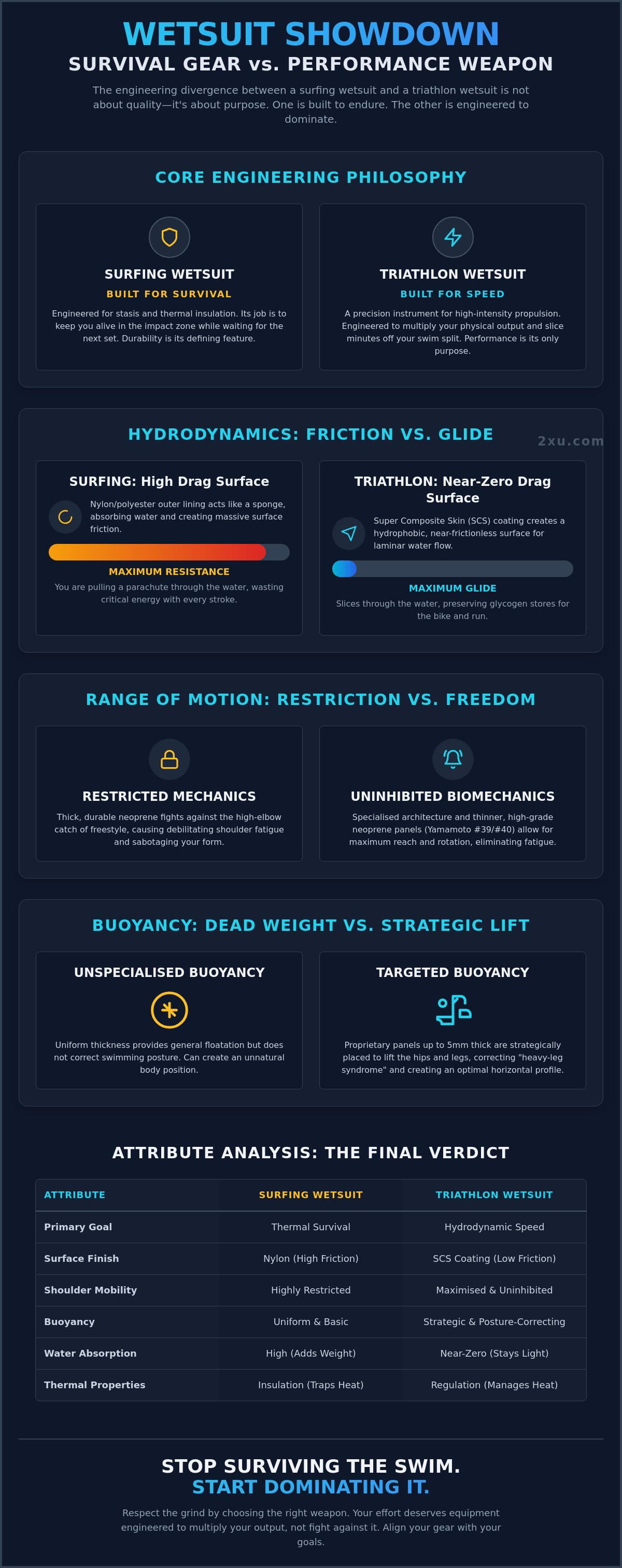
The fundamental difference in the triathlon wetsuit vs surfing wetsuit debate is not one of quality; it's a question of specialised engineering. A surf suit is designed for stasis. It's built to keep a surfer warm while they wait for a set in a lineup. Conversely, a triathlon wetsuit is a precision instrument designed for constant, high-intensity propulsion. While both garments utilise the basic concept of the Wetsuit, the molecular density of the neoprene and the internal lining materials are worlds apart. You're comparing a suit meant for survival against one built to multiply your physical output.
Respect the grind of the 3.8km swim. In an Ironman or half-distance event, your body is a furnace generating massive internal heat for over an hour. A surfing wetsuit, engineered for intermittent bursts and long periods of inactivity, can't handle this thermal load. It lacks the hydrodynamic surface coating necessary to reduce drag. Every stroke in a surf suit is a battle against unnecessary resistance. You're fighting the gear instead of the clock. Performance requires a tool that works with your biology, not against it.
Thermal Protection vs. Thermal Regulation
Surf suits are engineered to trap a significant layer of water against the skin. This water is warmed by the body to provide a thermal buffer during periods of bobbing in the ocean. In a race, this is a liability. Triathlon wetsuits utilise thinner, high-tech membranes that focus on thermal regulation rather than pure insulation. Overheating is a performance killer. It leads to increased heart rates and premature biological fatigue. You need a suit that maintains your core temperature without crossing the threshold into hyperthermia. Optimise your output by managing heat, don't just trap it.
Durability vs. High-Performance Output
Durability is the hallmark of surf gear. These suits feature abrasive-resistant outer layers designed to withstand contact with surfboard wax, sand, and reef. This ruggedness comes at a steep price: friction. Triathlon suits prioritise high-performance output with delicate, smooth-skin surfaces. These specialised coatings are engineered to slice through the water column with a drag coefficient far lower than any nylon-lined surf suit. You trade the ruggedness of the beach for the raw speed of the race. It's a calculated sacrifice for the athlete who demands the absolute best results from their effort.
Hydrodynamics: Why Surface Friction Steals Your Seconds
The drag coefficient is a dimensionless quantity used to quantify the resistance of an object in a fluid environment. For a swimmer, reducing this number is the most efficient way to increase velocity without increasing metabolic cost. When evaluating the triathlon wetsuit vs surfing wetsuit, the surface finish is the primary deciding factor. Surfing suits typically feature a nylon or polyester outer lining. This material is designed for abrasion resistance against boards and wax, but in the water, it acts as a micro-porous sponge. It traps water molecules and creates a high-friction boundary layer that increases total drag. You are essentially pulling a parachute through the water.
Elite triathlon gear utilises Super Composite Skin (SCS) technology to solve this mechanical failure. This is a specialised coating applied to high-grade neoprene that drastically alters the material's interaction with the water column. Peer-reviewed research on wetsuit buoyancy effects and hydrodynamic efficiency confirms that reducing surface resistance allows for significant energy savings. By lowering the drag coefficient, an athlete can maintain a specific pace with a lower heart rate. This preserves critical glycogen stores for the bike and run legs. You aren't just faster; you are more efficient.
SCS Coating and the Physics of Slip
SCS technology employs a microrigidity structure that mimics the dermal denticles of aquatic predators. This ensures that water flows over the suit with laminar efficiency rather than turbulent chaos. Because the coating is non-porous, it prevents water from permeating the neoprene cells. SCS is a hydrophobic layer that reduces surface resistance to near-zero levels. This keeps the suit light and fast from the first stroke to the final exit of the water. Speed is a byproduct of superior physics.
The Cost of Water Absorption
Every gram of water absorbed by your gear is dead weight you must accelerate with every stroke. Standard surf suit linings can soak up several litres of water during a session. This adds significant mass, disrupting your stroke cadence and increasing the force required for every recovery phase. Over a 1500m or 3.8km distance, this cumulative weight leads to profound shoulder fatigue. 2XU engineers its triathlon wetsuits to avoid heavy internal fabrics, ensuring a constant power-to-weight ratio throughout the entire swim. You are maintaining a calculated mechanical advantage that your competitors are wasting through poor gear choices. Discipline in your equipment selection is just as vital as discipline in your training.
Neoprene Architecture: Buoyancy as a Performance Multiplier
Regulatory compliance dictates the architecture of elite performance gear. Both IRONMAN and World Triathlon mandate a maximum thickness of 5mm for any part of the wetsuit. In the triathlon wetsuit vs surfing wetsuit comparison, surf gear typically adheres to uniform thickness, such as a standard 4/3mm configuration, to ensure consistent thermal protection across the body. This is a mechanical disadvantage for the competitive athlete. A triathlon suit uses strategic panelling to place maximum buoyancy exactly where the human body is least efficient. By concentrating 5mm of premium neoprene in the lower body, the suit acts as a lever to lift the hips and legs into a hydrodynamic horizontal plane. You are essentially using material science to fix a biological flaw.
Buoyancy isn't just about safety; it is a tool for correcting technical deficiencies. Most amateur swimmers suffer from 'heavy legs', a condition where the lower body sinks and creates massive drag. Engineering the suit to provide lift in the legs and hips allows the athlete to maintain an elite body position without the metabolic cost of a heavy kick. This preserves your leg muscles for the bike and run phases that follow. You are not just floating; you are being mechanically optimised for speed.
Variable Density Panelling
Modern suit architecture relies on extreme thickness differentials to balance buoyancy with range of motion. 2XU engineers utilise 5mm panels for the core and lower limbs while reducing underarm and shoulder panels to as little as 1.5mm. This isn't just about flexibility; it's about mechanical stability and rotation. Incorporating wetsuit hydrodynamics research, this variable density architecture supports Rollbar technology. This proprietary design assists in torso rotation, ensuring that as you roll through the freestyle stroke, your core remains elevated and stable. This reduces your frontal area, allowing you to move through the water with less resistance and higher velocity. It's about maintaining a streamlined profile even as your intensity increases.
Correcting Your Horizontal Profile
The 'sinky leg' phenomenon is the single greatest cause of drag for amateur and intermediate swimmers. When your legs drop below the surface, your body's profile increases, forcing you to push significantly more water aside. This drag increases exponentially with every degree of deviation from the horizontal axis. Targeted buoyancy in a triathlon-specific suit serves as a mechanical aid, forcing the body into an elite posture that would otherwise require years of technical discipline to master. This allows you to focus your energy on propulsion rather than staying afloat. Every centimetre your legs sink costs you seconds in the T1 transition because you've wasted metabolic energy fighting gravity. Respect the physics of the water and keep your legs high.
Range of Motion: Eliminating Shoulder Fatigue
Don't fall for the fallacy that surfing proficiency translates to swimming efficiency. Many athletes believe that because they can paddle a board for hours, their surf gear is adequate for a race. This is a fundamental misunderstanding of biomechanics. In the triathlon wetsuit vs surfing wetsuit comparison, the shoulder construction reveals a massive performance gap. A surf paddle is a prone movement with a relatively straight arm and low overhead extension. Freestyle swimming requires a high-elbow catch and a full overhead reach. If your suit is built with thick, uniform neoprene in the shoulders, you are performing a resistance band rep with every single stroke. Premature muscle failure is the inevitable result.
Restrictive neoprene in the shoulder girdle leads to what athletes describe as 'heavy arms'. This sensation is actually the result of your deltoids and lats fighting the elastic memory of the rubber. In a standard 1500m swim, you will take approximately 1,000 to 1,200 strokes per arm. If the suit resists your reach by even a fraction, the cumulative energy cost is staggering. High-performance gear utilises high-stretch liners and ultra-thin panels to allow for a full 360-degree range of motion. You need gear that facilitates your biomechanics, not gear that imposes a physical tax on your movement.
The 360-Degree Stroke Mechanics
Engineering for the swim requires a 'floating zip' and specialised underarm gussets to reduce tension during the reach phase. 2XU optimises flexibility by using 1.5mm Yamamoto neoprene in the shoulder and underarm zones. This ensures the suit moves with the athlete, not against them. Respect the grind of the water. Fighting your own gear for 2,000 plus strokes is a recipe for a mediocre bike leg. Precision engineering eliminates this internal resistance, allowing you to focus your power on external propulsion. Maximise your energy economy by choosing triathlon wetsuits designed for the mechanics of the stroke.
Transition Efficiency: The T1 Exit
Speed is not just about what happens in the water; it is about how fast you can get out of it. Surfing wetsuits are built for durability and thermal protection, often featuring small ankle openings and heavy-duty zippers that are difficult to manipulate with cold, tired fingers. Triathlon suits are engineered with 'quick-release' leg panels and long-reach zippers. This allows for a five-second exit compared to the minute-long struggle of a thick surf suit. Saving 60 seconds in transition is free speed that requires no extra fitness. It is simply the result of disciplined gear selection. Every second counts when you are chasing a personal best. Don't waste your effort on a slow exit.
Selecting Your Weapon: The 2XU Performance Framework
You've put in the hours at the pool. You've respected the grind of early morning sessions and high-volume sets. Now, your gear must match your ambition. The concept that human is multiplied only holds true when your equipment acts as a precision extension of your biology. In the triathlon wetsuit vs surfing wetsuit comparison, choosing surf gear is a compromise that respects neither the sport nor the discipline you've shown in training. A surfing suit is an anchor of drag and dead weight. A performance-engineered suit is a weapon designed to validate every watt of energy you produce.
Precision fit is non-negotiable. A suit that is too large allows for water 'pooling' inside the neoprene, creating a heavy, internal reservoir that destroys your buoyancy and adds massive resistance. You need a second-skin fit that prevents water ingress while maintaining a streamlined profile. Engineering excellence ensures that the suit remains light and responsive from the first buoy to the T1 exit. Don't let poor equipment choices negate your physical output. Demand gear that is as meticulous as your preparation.
Matching Neoprene to Your Swim Level
Your technical proficiency should dictate your suit architecture. Athletes who identify as 'sinkers' require maximum buoyancy in the core and legs to correct a heavy-leg profile and reduce the frontal area of drag. These swimmers benefit from 5mm panels that force the body into a horizontal plane, providing mechanical assistance for a more efficient stroke. Conversely, elite swimmers who already possess a high body position should prioritise maximum shoulder flexibility and a 'natural' feel in the water. These athletes require thinner, high-stretch neoprene that allows for uninhibited rotation and a precise feel for the water. For a detailed breakdown of which architecture suits your specific needs, consult our Triathlon Wetsuit Guide. Align your gear with your current technical requirements to maximise your results.
The Final Verdict: Why 'Good Enough' Isn't
The mathematical reality is clear. A triathlon suit is a performance investment designed to yield a specific return in speed and energy conservation. Settling for 'good enough' gear is a tactical error that costs you minutes on the clock and heartbeats on the bike leg. You've earned the right to be fast through your effort; don't let a surf suit steal that advantage. Respect your training by using gear that is scientifically validated to perform under race conditions. It's time to stop fighting the water and start slicing through it. Shop the 2XU Wetsuit Collection to multiply your performance and dominate your next swim split.
Optimise Your Output: The Science of the Split
The data is undeniable. Your decision in the triathlon wetsuit vs surfing wetsuit debate determines whether you're fighting the water or slicing through it with laminar efficiency. We've analysed how surf gear is engineered for static thermal survival, whereas elite triathlon equipment is a precision instrument designed for mechanical output. By leveraging proprietary Yamamoto neoprene technology and scientifically validated buoyancy panelling, you eliminate the "heavy leg" syndrome and drastically reduce surface friction. These are the same technical advantages utilised by world-champion triathletes to dominate the field and preserve critical energy for the bike and run legs.
Respect the discipline of your training programme by selecting gear that multiplies your potential rather than anchoring it. Every stroke is a calculation of force and resistance; ensure your equipment is working in your favour. You've earned your place on the starting line through months of grit and determination. Now, give yourself the technical edge that validates that effort. Your fastest swim split is not a matter of luck, but a result of superior engineering.
Engineered for the elite: Explore 2XU Triathlon Wetsuits
Frequently Asked Questions
Can I wear a surfing wetsuit in an IRONMAN or sanctioned triathlon?
You can wear a surfing wetsuit in IRONMAN or sanctioned events provided no part of the suit exceeds 5mm in thickness. Most surf suits comply with this dimension; however, you are accepting a massive hydrodynamic penalty. It's legal, but it's not competitive. You are choosing a garment designed for thermal survival over one engineered for high-performance speed.
Will a surfing wetsuit make me slower than no wetsuit at all?
A surfing wetsuit can be slower than swimming without a suit if the water temperature is high enough to avoid thermal shock. The porous outer lining of a surf suit absorbs water and adds significant dead weight to your stroke. This increases your frontal drag and forces your shoulders to work harder against the gear, potentially negating the benefits of buoyancy.
How much faster is a triathlon wetsuit compared to a surfing wetsuit?
Athletes typically see a reduction of several seconds per 100 metres when switching to a triathlon-specific model. This isn't just about raw speed; it's about energy economy. By reducing surface friction, you maintain your target pace at a significantly lower heart rate, preserving critical glycogen stores for the bike and run legs.
Does a triathlon wetsuit help with buoyancy if I am a poor swimmer?
Triathlon suits are engineered specifically to assist swimmers with poor body position by lifting the lower body. The strategic placement of high-buoyancy neoprene in the hips and legs corrects the "sinky leg" syndrome. This allows you to glide through the water in a horizontal plane with less effort, focusing your energy on propulsion rather than staying afloat.
Why do triathlon wetsuits have a smooth skin while surf suits are fabric-covered?
Smooth skin is a hydrodynamic requirement for reducing surface friction to near-zero levels. Surfing suits use fabric covers to prioritise durability against the constant abrasion of boards and wax. In the triathlon wetsuit vs surfing wetsuit debate, you are choosing between the ruggedness required for the beach and the hydrodynamic efficiency required for the race.
What happens if my wetsuit is thicker than 5mm during a race?
Exceeding the 5mm thickness limit results in immediate disqualification from sanctioned triathlons under World Triathlon and IRONMAN regulations. Technical officials enforce this rule to ensure a level playing field. Even if the extra thickness is only located in the lower body panels, it is a violation of international racing standards.
Are triathlon wetsuits more fragile than surfing wetsuits?
Triathlon wetsuits are precision tools and are inherently more fragile than standard surf gear. The specialised Yamamoto neoprene used in these suits is soft and can be easily damaged by fingernail nicks during a hurried T1 transition. You must prioritise careful handling and proper storage to maintain the hydrodynamic integrity of the suit.
Can I use my triathlon wetsuit for surfing occasionally?
Using a triathlon suit for surfing will lead to rapid material failure and is not recommended. Surfboard wax acts as an abrasive that will strip the delicate smooth skin coating from your chest and stomach panels. Reserve your performance gear for the race and use a dedicated surf suit for board-based activities to protect your investment.