
Running Tights vs Leggings: Engineering the Ultimate Performance Layer
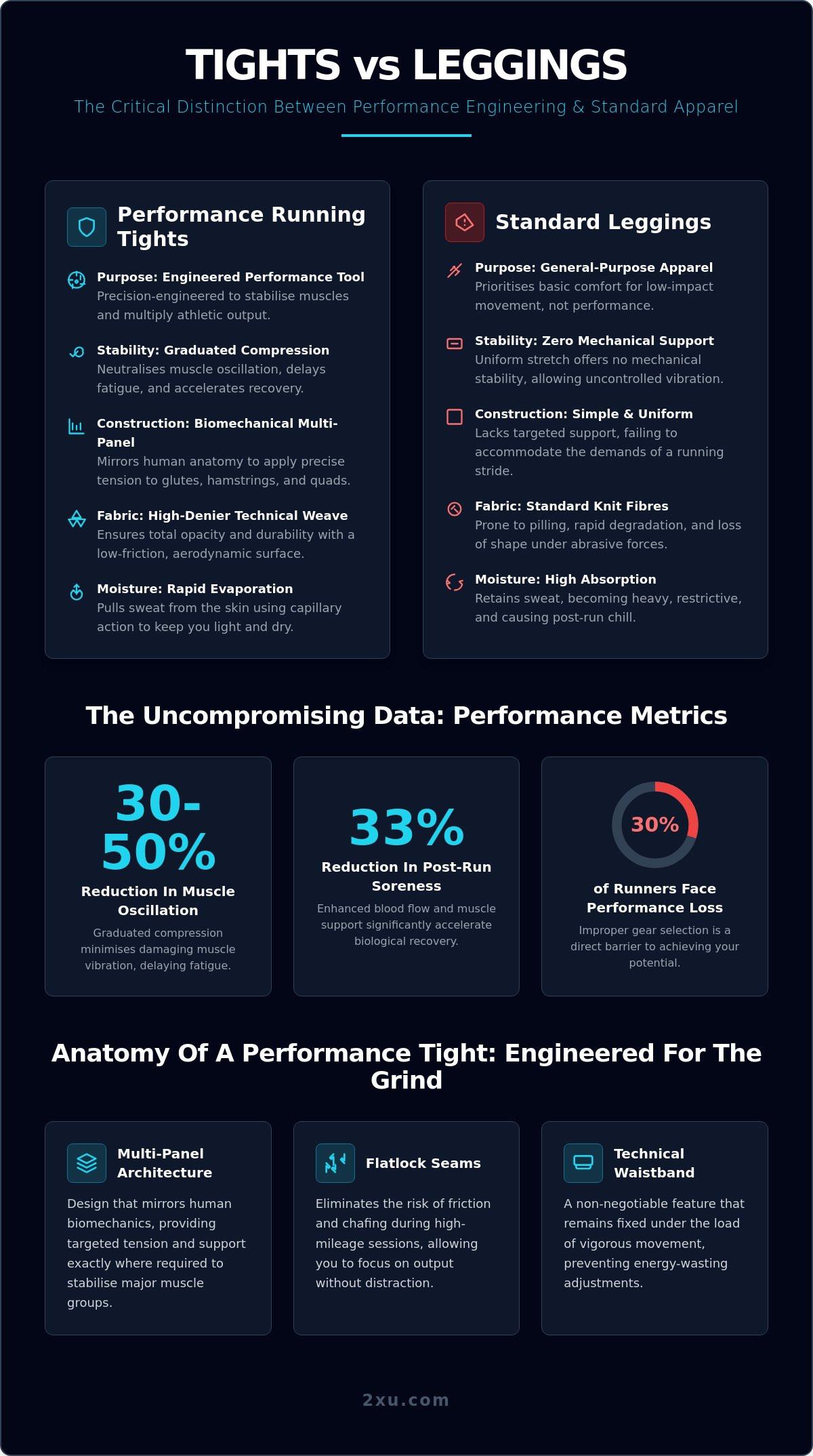
If you believe your standard gym leggings are sufficient for high-intensity endurance sessions, you are voluntarily sacrificing your power to the laws of physics. Most athletes view their lower-body layer as a simple matter of coverage, yet research from 2025 suggests that over 30% of runners suffer performance decrements due to improper gear selection. The debate of running tights vs leggings is not a question of style; it is a critical decision regarding the engineering of your mechanical stability.
We understand the frustration of gear that slips mid-run or the debilitating muscle fatigue caused by uncontrolled vibration. This article will demonstrate how to optimise your kit to achieve a 30% to 50% reduction in muscle oscillation and multiply your athletic output. You will discover the technical distinctions between basic leisurewear and performance-grade equipment, focusing on how graduated compression and advanced textile architecture reduce post-run soreness by up to 33%. We are going to break down the laboratory-validated data on venous return and aerodynamic profiles to ensure your gear survives the relentless grind of daily training.
Key Takeaways
- Distinguish between running tights vs leggings to ensure you're equipping yourself with performance tools rather than standard apparel.
- Master the use of high-denier technical fibres and streamlined silhouettes to minimise aerodynamic drag.
- Understand the mechanics of gradient compression and how it neutralises muscle oscillation to delay fatigue.
- Utilise the Tripartite Athletic Framework to match your gear selection to specific training intensities and environmental factors.
- Leverage laboratory-validated textile engineering to multiply your physical output and accelerate biological recovery.
Running Tights vs Leggings: Distinguishing Performance Tools from Apparel
Stop treating your training kit like a casual wardrobe. In the high-stakes environment of endurance training, the choice between running tights vs leggings represents the difference between engineered support and mere coverage. Leggings are general-purpose athletic wear. They prioritise comfort and uniform flexibility for low-impact movement. Running tights are precision-engineered tools. They are a specific class of Compression garment designed to stabilise major muscle groups during the repetitive, high-impact cycle of the running stride.
Ignore the "translucency myth" perpetuated by entry-level reviews. Some claim that tights are sheer under-layers that require shorts for modesty. This is a relic of inferior manufacturing. Elite running tights are constructed from high-denier technical yarns that ensure total opacity and structural integrity. They are built for standalone use. In this arena, every piece of kit must earn its place on your body through functional utility. If a garment does not multiply your output or protect your mechanics, it has no business being in your rotation. Discipline starts with the gear you choose to wear during the grind.
The Functional Anatomy of a Running Tight
Success is found in the details of construction. High-performance tights utilise a multi-panelled design that mirrors human biomechanics. This architecture ensures that tension is applied exactly where it is required to support the glutes, hamstrings, and quads. We utilise flatlock seams to eliminate the risk of friction and chafing during high-mileage sessions. A secure, technical waistband is non-negotiable; it must remain fixed under the load of vigorous movement. This prevents the constant adjustments that break your focus and waste energy.
Why Leggings Fall Short for High-Intensity Endurance
Leggings fail because they offer uniform stretch. While this feels comfortable in a yoga studio, it provides zero mechanical stability during a sprint. Standard apparel fibres often suffer from pilling and rapid degradation when subjected to the abrasive forces of long-distance running. Technical tights use high-denier yarns that maintain their compressive power over hundreds of training hours. Leggings also lack the moisture-wicking speed required for elite output. When sweat saturates standard fabric, it becomes heavy and restrictive. Engineered tights accelerate evaporation to keep you light and focused on the objective. When you compare running tights vs leggings, the data shows that apparel cannot compete with engineering.
Engineering for the Grind: Fabric Density and Aerodynamics
Peak performance is a game of millimetres. If you're serious about the grind, you don't settle for "good enough." The technical gap between running tights vs leggings becomes evident the moment you transition from a jog to a sustained threshold pace. While standard leggings rely on simple elasticated knits, high-performance tights utilise high-denier technical fibres. These fibres create a low-friction surface area that slices through the air. In the pursuit of elite results, we respect the "hundredth of a second" principle. Every gram of weight and every millimetre of drag is a barrier to your potential. You need gear that facilitates speed rather than resisting it.
Thermoregulation is another area where engineering triumphs over basic apparel. Standard cotton-blend leggings trap heat and moisture against the skin, leading to rapid overheating and discomfort. In contrast, technical weaves are designed for active heat dissipation. This is supported by research on compression technology, which highlights how advanced garments assist in physiological regulation during intense exertion. By maintaining an optimal thermal environment, you can sustain a higher power output for longer durations. This is the essence of multiplying your physical capability through data-driven design.
Moisture Management and Evaporative Cooling
Engineered fibres use capillary action to pull sweat away from the skin surface instantly. This process keeps the garment lightweight even during high-sweat sessions. Standard leggings often retain moisture, which increases their weight and causes the fabric to sag under load. Quick-dry technology is also vital for preventing the "chilling" effect that occurs during post-run recovery when damp fabric sits against the body. You want gear that works as hard as you do. You can find this level of engineering in our latest Running Apparel, built to survive the most demanding training cycles.
The Science of Aerodynamic Drag
Aerodynamic drag is the primary resistance force an athlete must overcome at speed. A streamlined silhouette isn't just about aesthetics; it's a matter of fluid dynamics. The specific surface texture of technical tights is designed to trip the boundary layer of air. This reduces the wake behind your legs, allowing you to maintain speed with less energy expenditure. This aligns with the mission of multiplying human output through superior mechanical stability. When comparing running tights vs leggings, the aerodynamic advantage is a mathematical certainty that cannot be ignored by the serious athlete.
The Science of Mechanical Stability: Why Compression Matters
Every foot strike is a collision with the ground. This impact sends kinetic energy through your limbs, causing micro-vibrations known as muscle oscillation. If you're comparing running tights vs leggings, this is where the engineering gap becomes a physiological reality. While leggings allow your muscles to move laterally with every stride, technical tights act as an external stabiliser. They dampen these vibrations, preventing the unnecessary energy expenditure required to keep your muscles in place. Data indicates that compression gear can reduce muscle vibration by up to 30% to 50%, which directly improves your proprioception and mechanical efficiency.
Gradient compression is the core mechanism of a high-performance tight. By applying pressure that is firmest at the ankle and decreases as it moves up the leg, these garments facilitate venous return. This process accelerates the movement of deoxygenated blood back to the heart, clearing lactate and metabolic waste more efficiently. In this context, compression gear is not just a post-run luxury. It is an active recovery tool that functions while you are deep in the grind, delaying the onset of fatigue and protecting your mechanical integrity. You are not just wearing clothes; you are wearing a physiological upgrade.
Reducing Muscle Oscillation and Damage
Wrapping the muscle groups tightly prevents the violent lateral movement that leads to micro-tears in the fibres. Peer-reviewed data from 2025 suggests that graduated compression can reduce muscle displacement and subsequent soreness by up to 33% after high-intensity intervals. This is the "human multiplied" philosophy in action. When you spend less energy on internal stabilisation, you have more available for forward propulsion. It's about protecting your calves and quads from the repetitive strain that leads to long-term injury. Demand more from your gear so you can demand more from yourself.
Proprioception: The Mind-Muscle Connection
The pressure applied by technical tights does more than support tissue; it sharpens your neurological feedback. This is proprioception, the body's ability to sense its position in space. By stimulating sensory receptors in the skin and muscles, the garment enhances your brain's awareness of your limb position. This improved feedback loop leads to better running form and increased efficiency, especially as fatigue sets in. Respect the science of the grind. Choose gear that forces your body to remain precise, even when your mind wants to quit. Precision is the path to exponential growth.
Selection Framework: Matching Gear to Your Training Intensity
Your training intent determines your textile requirements. If your objective is a twenty-minute recovery walk, standard leggings provide adequate coverage. However, once you cross the threshold into high-intensity endurance, the debate of running tights vs leggings is settled by the data. The Tripartite Athletic Framework requires you to consider the specific physiological demands of your session: readiness, action, and recovery. For the Action phase, you need a layer that supports the biomechanics of your stride and manages the thermal load of peak exertion. Choosing gear that lacks these properties is a tactical error that compromises your output.
Respect the grind. An elite athlete does not choose gear based on aesthetics; they choose it based on mathematical advantage. Technical tights are an investment in your mechanical longevity. They allow you to train harder, recover faster, and push the boundaries of your physical potential. If your ambition is to multiply your output, your gear must be capable of surviving the journey. Match your intensity with engineering that is built to endure the same pressure you apply to yourself.
Training Intensity and Duration
High-intensity thresholds demand mechanical stability. Standard leggings often suffer from the "sag factor" during long-duration endurance runs. As you sweat and move, basic fibres lose their elastic memory and begin to slip. This creates a distraction that breaks your focus during the grind. Technical tights are engineered with high-denier yarns that maintain their structural integrity for the duration of a marathon. For recovery-focused sessions, the compression levels assist in clearing metabolic waste. For race-day output, they provide the aerodynamic profile required to maximise speed. Don't let inferior gear dictate your pace.
Environmental Engineering
Environmental factors dictate specific gear requirements. In sub-zero temperatures, you need thermal regulation that does not compromise your aerodynamic profile. Technical fabrics provide a barrier against wind-chill while maintaining the breathability required for heat dissipation. Summer training requires high UV protection factors and accelerated moisture-wicking to prevent skin irritation. Total body thermoregulation is enhanced when you pair your lower-body gear with compression shirts to manage core temperature. Respect the science of the environment and equip yourself accordingly.
Optimise your training kit today by exploring our full range of Compression Clothing.
Multiplication of Effort: The 2XU Performance Advantage
Average standards are the enemy of progress. When you evaluate the functional gap between running tights vs leggings, the ultimate differentiator is the depth of scientific validation behind the textile. We don't produce apparel; we engineer high-performance equipment designed to serve as a force multiplier for the human body. Every garment in our range is the result of rigorous laboratory testing and a refusal to compromise on mechanical integrity. If you're committed to the grind, you deserve gear that is as unyielding as your ambition.
The 2XU mission is built on the Multiplication Promise. This is our commitment to providing the exponential enhancement of your physical potential through data-driven design. We collaborate with elite sports institutes and academic research teams to verify that our gear delivers tangible physiological benefits. By choosing equipment grounded in peer-reviewed science, you're not just buying a layer; you're investing in a system that protects your muscles and optimises your energy expenditure. Trust the numbers. Respect the science. Multiply your output.
The PWX Fabric Advantage
Our proprietary PWX (Power, Weight, Flexibility) fabric philosophy is the foundation of our engineering excellence. We utilise high-filament technical yarns to create a textile with an unmatched power-to-weight ratio. This fabric provides firm, consistent pressure while remaining exceptionally lightweight and breathable. Unlike the "disposable" nature of mass-market leggings that lose their shape after a few training cycles, PWX is built for durability. The multi-directional stretch architecture ensures that the compression integrity remains constant over hundreds of washes. This is gear designed to survive the most demanding training programmes on the planet.
Laboratory Validated Results
We validate our claims through intensive testing using specialised industrial instrumentation. This ensures that our graduated compression levels meet the Class 2 medical-grade standards required to significantly assist venous return. While competitors rely on generalised marketing claims, we rely on collaborations with world-leading sports scientists to prove our efficacy. This rigorous approach is why elite athletes globally trust our technology to manage their preparation, action, and recuperation. You've earned your place on the track through hard work; now equip yourself with the tools to dominate it. If you are also looking for high-performance track and field equipment, discover FiberSport USA.
Stop settling for standard apparel. Shop 2XU Running Tights and engineered performance gear to experience the mathematical advantage of true compression technology.
Optimise Your Output with Precision Engineering
You now understand that the choice between running tights vs leggings is a fundamental decision between engineered performance and basic coverage. We've analysed how laboratory-validated compression technology reduces muscle oscillation by up to 50% and accelerates biological recovery. These are not mere garments; they are essential tools for maintaining mechanical stability during high-intensity endurance sessions. Every training cycle requires gear that can withstand the relentless grind without compromising your aerodynamic profile. If your equipment doesn't multiply your capability, it has no place in your rotation.
Trusted by elite triathletes and endurance runners, this technology ensures you remain focused on the objective rather than your kit. Every athlete has the opportunity to earn their place through discipline and effort, provided they equip themselves with the correct physiological upgrades. Don't leave your results to chance when you can trust the science of multiplication to sharpen your focus and protect your mechanics. Respect the work. Trust the process. Go out and earn your results.
If you are a retailer looking to offer premium branded athletic wear and designer products to your clientele, visit StockFashionB2B to browse our wholesale stock lots.
Multiply your performance with 2XU Running Tights
Frequently Asked Questions
Is it better to run in tights or leggings for long distances?
Tights are the definitive choice for long distance endurance sessions. In the technical comparison of running tights vs leggings, standard leggings fail to provide the graduated compression required to mitigate muscle oscillation over high mileage. Technical tights ensure your mechanical stability remains intact as fatigue sets in, protecting your muscles from the repetitive impact of every stride.
Do running tights actually make you faster?
They improve your speed by optimising your aerodynamic profile and reducing metabolic cost. By dampening muscle vibrations, you waste significantly less energy on internal stabilisation. This allows a higher percentage of your physical output to be directed toward forward propulsion. They don't just provide coverage; they act as a force multiplier for your existing power.
Should you wear anything under your running tights?
High performance tights are engineered for direct skin contact to ensure moisture wicking technology functions at peak efficiency. Wearing additional layers underneath increases the risk of friction and heat entrapment, which can lead to severe chafing during the grind. Most technical designs include internal liners and flatlock seams to provide total comfort and support without the need for extra layers.
What is the difference between compression tights and standard running tights?
The primary difference lies in the application of graduated pressure and laboratory validation. Standard tights provide basic thermal protection and coverage. Compression tights utilise specific technical knits to apply firm pressure that is tightest at the ankle and decreases up the leg. This specific architecture is essential for assisting venous return and clearing metabolic waste during and after exertion.
Can I wear running tights for recovery after a marathon?
Wearing compression gear post marathon is a scientifically backed strategy for biological recovery. It assists in reducing lower limb oedema and accelerating the return of deoxygenated blood to the heart. This is a vital component of the tripartite athletic framework, ensuring your body transitions efficiently from the action phase into full recuperation after extreme physical stress.
How tight should running tights actually feel?
They should feel like a second skin with firm, uniform pressure across your major muscle groups. You must feel distinct support around the calves and quads without experiencing restricted blood flow or limited range of motion. If the fabric sags or bunches behind the knees, the mechanical stability is compromised and the garment will not function as intended.
Do running tights help with muscle soreness (DOMS)?
Technical tights are highly effective at mitigating Delayed Onset Muscle Soreness. By limiting micro tears in the muscle fibres during your run, you reduce the subsequent inflammatory response. Peer reviewed data suggests that using graduated compression can lead to a 33% reduction in perceived soreness, allowing you to return to the grind much faster.
Are running tights more durable than standard gym leggings?
Technical running gear is engineered to survive the most demanding training programmes. When comparing running tights vs leggings, standard apparel often uses lower denier fibres that pill or lose elasticity under high impact stress. High performance tights maintain their compressive power and structural integrity over hundreds of training sessions and washes, making them a superior investment for serious athletes.