
Triathlon Wetsuit Rental vs Buy: Engineering Your Fastest Swim Split
Your choice in the triathlon wetsuit rental vs buy debate is the difference between surviving the water and dominating it. A rental suit is often a generic thermal barrier designed for the average body, whereas a precision-engineered suit acts as a mechanical advantage that multiplies every stroke. You have spent hundreds of hours in the pool refining your technique; it is only natural to feel anxiety about whether a temporary suit will restrict your range of motion or trap water. Every watt of energy you produce must translate into forward propulsion, not drag.
We agree that your gear should be an extension of your ambition, not a limitation. This article provides the definitive framework for deciding when to rent and when to invest in high-performance neoprene to maximise your athletic output. We will examine the specific buoyancy math of 5mm panels, the hydrodynamic efficiency of SCS coatings with their 0.026 drag coefficient, and the exact threshold where ownership becomes a performance necessity. By the end of this breakdown, you will have the data-driven confidence to select gear that won't fail you on race day.
Key Takeaways
- Understand why rental neoprene often loses its material memory, compromising the critical buoyancy required to lift your hips and minimise drag.
- Resolve the triathlon wetsuit rental vs buy dilemma using a performance-math framework that calculates the break-even point between temporary convenience and long-term mechanical advantage.
- Discover how Yamamoto neoprene provides the scientific gold standard for flexibility, allowing for an uninhibited range of motion that prevents premature shoulder fatigue.
- Evaluate the hygiene and degradation factors of communal gear to ensure your equipment remains a sterile, high-performance extension of your body.
- Learn how to select an elite suit that multiplies your physical output, turning every stroke into measurable gains on your swim split.
The Triathlon Wetsuit Dilemma: Convenience vs Performance Multiplication
A triathlon wetsuit is not a mere garment; it is a high-performance mechanical tool designed to alter your interaction with the water. Settling for a rental suit because it is "good enough" is a psychological concession that compromises your physical output before you even hit the water. In the context of The Science of Speed, every millimetre of neoprene must be engineered to reduce drag and enhance buoyancy. The decision in the triathlon wetsuit rental vs buy debate represents your first real test of race-day discipline. Are you here to participate, or are you here to conquer the distance?
Our philosophy is built on a single, unyielding principle: human is multiplied. We don't engineer gear for casual fitness; we create technical advancements that amplify your raw effort. A rental suit is a basic thermal barrier. A 2XU triathlon wetsuit is a performance-engineered advantage that transforms your body position, ensuring your energy is spent on propulsion rather than staying afloat. Choosing to own your gear is a commitment to the grind and a refusal to accept average standards.
The Rental Reality: What You Are Actually Paying For
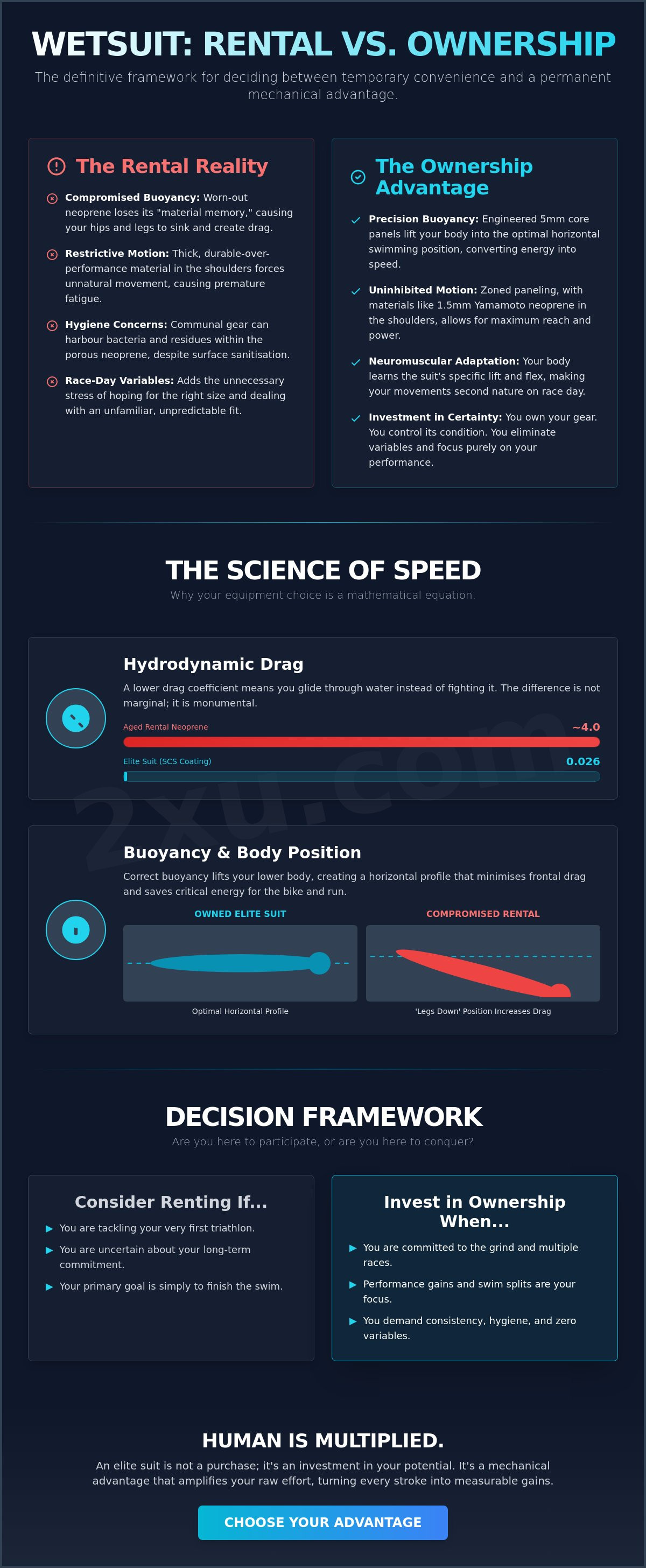
Rental fleets prioritise durability over velocity. To survive hundreds of different users, these suits often utilise heavier, less flexible materials that resist tearing but increase resistance during the recovery phase of your stroke. This additional thickness in the shoulders forces your deltoids to work harder, leading to premature fatigue. There is also a biological cost. Even "sanitised" rental suits can harbour residues and bacteria in the porous cellular structure of the neoprene. Finally, relying on a rental adds unnecessary variables. The anxiety of hoping your specific size is available during a chaotic race week is a distraction you do not need.
The Ownership Advantage: Mastering Your Mechanics
Owning your gear allows for critical neuromuscular adaptation. Your brain and muscles must learn exactly how the suit’s buoyancy affects your centre of mass and stroke rate. Training in your own suit ensures that your body understands the specific lift provided by 5mm core panels. A consistent, personalised fit eliminates the risk of unexpected chafing or restrictive movement that often plagues those who choose to rent. When you own your suit, you remove a major variable from the chaotic environment of the transition area. You aren't just buying gear; you are investing in the certainty that your equipment will perform exactly as expected when the gun goes off.
The Science of Speed: Why Rental Neoprene Compromises Your Mechanics
Speed in the water is a mathematical equation where drag is the primary variable. When evaluating the triathlon wetsuit rental vs buy decision, you must consider the structural integrity of the material. Neoprene is composed of thousands of microscopic nitrogen-filled cells. In a rental suit, these cells have been subjected to hundreds of expansion and contraction cycles. This repeated stretching kills the material's "memory," leading to a permanent loss of buoyancy. You aren't just wearing a used suit; you're wearing a structurally compromised one that sits lower in the water column and increases your frontal surface area.
Buoyancy and the Drag Coefficient
A scientifically engineered wetsuit utilises advanced coatings to manipulate fluid dynamics. High-performance models feature Super Composite Skin (SCS) technology, which boasts a drag coefficient of 0.026. In contrast, the standard neoprene found in aged rental fleets can have a coefficient as high as 4.0. This discrepancy means you are fighting the water rather than gliding through it. Rental suits also suffer from "water logging" as the internal cell structure breaks down, causing the suit to gain weight mid-race. This added mass forces your body into a "legs down" position, significantly increasing your VO2 cost. Buoyancy directly translates to saved energy for the bike leg by reducing the metabolic demand of maintaining a horizontal profile.
Flexibility and Stroke Efficiency
Efficiency requires an uninhibited range of motion, particularly during the catch and pull phases of your stroke. Elite suits employ precise panel thickness zoning, using 1.5mm neoprene in the shoulders to maximise flexibility while maintaining 5mm panels in the core for lift. Rental suits often utilise uniform thickness throughout to prioritise durability. This mechanical resistance forces your deltoids to fight the suit with every stroke, leading to rapid fatigue and a shortened reach. We reject generic materials in favour of engineered polymers that provide superior elongation. This ensures your mechanics remain crisp from the first buoy to the final exit ramp. If you are ready to stop fighting your gear and start multiplying your output, it is time to invest in your own triathlon wetsuit. Ownership ensures your suit’s material memory remains intact, providing the consistent lift your performance demands.
Analysing the Investment: Long-Term ROI and the Hygiene Factor
The financial logic of the triathlon wetsuit rental vs buy debate is often misunderstood by those who only look at the immediate race fee. Efficiency in the water is a long-term investment, not a one-off expense. When you rent, you are essentially paying for the depreciation of someone else's equipment without gaining the performance equity of a suit tailored to your specific biomechanics. Ownership is the first step in eliminating the variables that lead to race-day failure. Human is multiplied when the gear you wear is an asset, not a temporary liability.
The Math of the Season
Current market data indicates that a standard weekend rental typically averages between $35 and $70, while a month-long commitment can reach $150 for high-performance models. If you compete in just three events over a two-year cycle, your cumulative spend has already approached the investment required for a high-quality entry-level suit. The math becomes even more compelling when you factor in the hidden liabilities of communal gear. Neoprene is a delicate material. Rental agreements often include steep damage fees for small fingernail tears or seam stress. A single slip during the high-stress environment of a transition can result in a repair bill that exceeds the original rental cost. Conversely, owning an elite 2XU suit provides a tangible asset with high liquidity. Because our engineering is the global benchmark, 2XU suits retain exceptional resale value in the second-hand market. You aren't just spending money; you are storing value in an asset that multiplies your physical output.
Hygiene and Personal Standards
Professional standards dictate that your gear must be a sterile, high-functioning extension of your body. Neoprene is a porous material by design. Its cellular structure is intended to trap a thin layer of water to provide thermal insulation, but this matrix also traps biological residues and bacteria from previous users. While industrial cleaning processes attempt to sanitise these suits, they often fail to reach the deep cell layers of the material. Elite athletes understand that skin health and psychological readiness are non-negotiable. There is a profound mental advantage in wearing a suit that has only ever been yours. You aren't wearing someone else's sweat or history; you are wearing your own discipline and your own grind. Respecting your body means controlling every surface that touches it. Ownership is the ultimate expression of race-day discipline.
Decision Framework: When to Transition from Rental to Ownership
The triathlon wetsuit rental vs buy decision is ultimately a reflection of your competitive intent. If your objective is merely to complete the distance, a rental may suffice as a temporary buoyancy aid. However, if you are here to test the limits of your physical output and achieve a personal best, ownership is the only logical path. High-performance gear is not a luxury; it is a prerequisite for those who respect the grind of preparation. You must decide whether you are a participant or a competitor before you select your equipment.
Professional standards dictate that you should secure your own gear at least 8 to 12 weeks before your target event. This window is essential for neuromuscular adaptation. Your brain needs time to calibrate your stroke mechanics to the specific lift provided by your suit's internal cell structure. Weak swimmers, in particular, benefit from ownership more than elites. While a professional may have the core strength to maintain a horizontal profile in a sub-par rental, a developing athlete requires the consistent, engineered buoyancy of a premium suit to prevent their hips from sinking. Ownership ensures that every training session contributes to race-day mastery.
Step 1: Define Your Performance Goals
Success in the water requires more than raw power. It demands technical precision that can only be developed through repetition in the same equipment. When you own your gear, you can conduct multiple open-water sessions to master sighting and pacing in the exact buoyancy profile you will face on race day. This familiarity removes cognitive load, allowing you to focus entirely on your stroke rate and tactical positioning. Our research into triathlon wetsuits proves that psychological certainty is just as critical as hydrodynamic efficiency. If your goal is a breakthrough mathematical improvement in your split, you must eliminate the variables of temporary gear.
Step 2: The Fit Test
A performance-engineered suit must feel like a second skin, providing compression without restricting your pulmonary expansion. Rental sizing is often a best guess based on height and weight, which frequently results in water flushing through the neck or pooling in the small of the back. This creates an anchor of drag that no amount of effort can overcome. To optimise your transition, you should always wear a high-performance triathlon suit underneath your wetsuit. This layered approach ensures mechanical stability across all three disciplines, preventing chafing and accelerating your T1 exit. If you are ready to stop guessing and start engineering your results, explore our range of triathlon wetsuits today.
The 2XU Advantage: Multiply Your Output on Race Day
The transition from rental to ownership is a tactical upgrade that separates the participants from the competitors. While the triathlon wetsuit rental vs buy debate often centres on immediate cost, elite athletes focus on the delta between average and exceptional results. Our Propel Series is not a collection of swimwear; it is a suite of hydrodynamic tools designed to maximise your physical output. Every seam and panel is laboratory-validated to ensure that your energy translates directly into forward velocity.
Proprietary Tech: Beyond the Surface
We utilise Yamamoto neoprene, the undisputed scientific gold standard for flexibility and buoyancy. Unlike generic materials found in mass-market rental fleets, Yamamoto’s closed-cell structure provides superior thermal efficiency and lift. We strategically place 39 Cell and 45 Cell neoprene panels to ensure maximum mobility where you need it most. The 45 Cell neoprene in the shoulders allows for an uninhibited reach, while the 39 Cell panels in the core provide the structural stability required to maintain a high body position. Our Nano SCS (Super Composite Skin) coating reduces hydrodynamic resistance to a coefficient of 0.026, allowing you to slice through the water with minimal drag. To further amplify your power, our suits feature a concave water entrapment zone on the forearm. This specialised feature increases your feel for the water, effectively turning your arm into a more efficient paddle.
Your Race Day Partner
Mechanical stability is the foundation of a powerful stroke. Our proprietary Rollbar technology runs through the core of the suit, enhancing body rotation and ensuring you maintain a streamlined profile even as fatigue sets in. This isn't just about speed; it's about efficiency and biological recovery. By improving your rotation, we reduce the metabolic cost of every stroke. When selecting your gear, consider your specific performance requirements. The Propel P:1 is the ultimate entry-point for those moving beyond the triathlon wetsuit rental vs buy cycle, offering essential buoyancy and flexibility. The P:2 provides enhanced power through its rollbar and specialised coating, while the Propel Pro is our pinnacle engineering achievement for athletes demanding zero compromise. Stop renting your potential and start owning your results. Invest in a 2XU triathlon wetsuit and experience the multiplication of human capability.
Master the Water Column: Finalise Your Race Day Strategy
You have analysed the data and understood the mechanical cost of settling for average gear. The triathlon wetsuit rental vs buy debate isn't just about finance; it's about whether you're willing to compromise your biomechanics on the most chaotic leg of the race. Rental suits suffer from cellular degradation and lack the hydrodynamic coatings required to slice through the water. By choosing to own your equipment, you secure the neuromuscular adaptation and hygiene standards necessary for elite performance.
2XU wetsuits are engineered with Yamamoto 45 Cell Neoprene for ultimate flexibility and proprietary Rollbar technology to maintain an optimal body position. This is the same technical advantage used by world-champion triathletes to dominate the field. Stop fighting the drag of communal gear and start multiplying your physical potential.
Maximise your swim split with 2XU Triathlon Wetsuits
You've put in the hours and respected the grind of every training session. Now, give yourself the mechanical advantage you've earned through your discipline. The water is waiting; go out and claim your new personal best.
Frequently Asked Questions
Is it better to rent or buy a wetsuit for my first triathlon?
Buying is the professional choice if you intend to master the discipline. While renting offers a lower entry cost, it denies you the 8 to 12 weeks of neuromuscular adaptation required to calibrate your stroke mechanics. Ownership ensures you train in the exact buoyancy profile you will face on race day.
How much does it cost to rent a triathlon wetsuit for a weekend?
Weekend rentals for triathlon-specific models generally range from $35 to $70 according to 2026 market benchmarks. These rates fluctuate based on the specific neoprene grade and duration of the contract. Always verify the latest pricing with your local provider before committing to a temporary solution.
Can I use a surfing wetsuit for a triathlon instead of buying one?
You should never use a surfing wetsuit for competitive triathlon. Surfing gear is engineered for thermal insulation and abrasion resistance, resulting in a high drag coefficient and restricted shoulder mobility. Triathlon suits use specialised coatings and zoned thickness to multiply your propulsion.
How should a triathlon wetsuit fit compared to a regular wetsuit?
A triathlon wetsuit must fit significantly tighter than a standard wetsuit to eliminate water pockets. It should feel like a second skin, providing compression that stabilises your core without restricting your breathing. This precision fit prevents water flushing, which is a primary cause of drag.
What happens if I tear a rental wetsuit during my race?
Tearing a rental suit usually triggers a damage fee or full replacement charge. Neoprene is susceptible to fingernail nicks during the high-intensity environment of a transition. When you own your gear, you control the maintenance and avoid the financial risk of these common mechanical failures.
How many races do I need to do to make buying a wetsuit worth it?
Three races is the standard mathematical break-even point for the triathlon wetsuit rental vs buy comparison. By your third event, the cumulative cost of rentals often exceeds the investment in a high-performance entry-level suit. Ownership also allows you to retain value through the second-hand market.
Is it hygienic to rent a wetsuit that others have used?
Neoprene is a porous material that can retain bacteria and biological residues despite industrial sanitisation processes. For athletes who prioritise personal standards and skin health, renting is a compromise. Ownership provides a sterile, dedicated performance tool that has only ever been yours.
How do I care for my new 2XU wetsuit to ensure it lasts for years?
Rinse your suit in fresh water after every session and dry it inside out in a shaded area. Direct UV exposure degrades the nitrogen-filled cells and compromises flexibility. Use a wide-shouldered hanger to prevent seam fatigue and maintain the material memory of your Yamamoto neoprene.