
Triathlon Shorts vs Running Shorts: The Science of Multiplied Performance
Choosing the wrong apparel is a mathematical error that actively degrades your total power output. The technical divide in triathlon shorts vs running shorts isn't about aesthetics; it's about engineering a mechanical advantage across three distinct biological states. You've felt the grind of a water-logged run or the searing friction of a transition gone wrong when gear fails to adapt. These aren't just inconveniences. They're performance leaks that drain your energy and focus when you can least afford it.
We're here to plug those leaks by dissecting the precise architecture that separates elite tri-gear from standard running apparel. You'll learn how to optimise your kit to handle the unique demands of swimming, cycling, and running without compromise. This guide examines the laboratory-validated benefits of specialised compression and low-profile chamois technology. We'll show you how the right technical platform eliminates saddle sores, manages moisture, and multiplies your efficiency from the first stroke to the final stride. Prepare to sharpen your discipline and turn your gear into a force multiplier.
Key Takeaways
- Analyse the technical architecture of triathlon shorts vs running shorts to ensure your gear supports multi-plane movement across all three disciplines.
- Eliminate performance leaks by choosing apparel engineered for hydrodynamic efficiency and moisture management to prevent the weight of water-logged fabrics.
- Maximise transition efficiency by leveraging a kit that performs seamlessly from the water to the finish line without the need for a wardrobe change.
- Utilise graduated compression to stabilise muscle groups and accelerate biological recovery during the intense physical output of the grind.
- Optimise your output by matching specific fabric technologies to your race distance, prioritising either raw speed or sustained mechanical comfort.
Defining the Gear: The Multi-Sport Hybrid vs. The Pure Runner
Performance is a choice of precision. While standard running apparel serves a purpose on the track, the multi-discipline athlete requires a platform that bridges three distinct environments. The Grind demands gear that maintains its integrity when the context shifts from the water to the road. You earn your place through discipline and hard work; your kit should reflect that commitment. Using the wrong equipment is an avoidable tax on your energy reserves that compromises your mechanical output. When comparing triathlon shorts vs running shorts, the distinction lies in the engineering of adaptability. One is a specialist for the road; the other is a force multiplier for the entire race.
The Anatomy of a Running Short
Running shorts are engineered for single-plane motion. They prioritise maximum ventilation and freedom of movement during the gait cycle. These garments typically feature lightweight, loose-fit technical fibres designed to facilitate airflow and manage heat during vertical oscillation. While effective on land, these loose structures are a liability in the water. They create a "parachuting" effect, trapping water and increasing drag. This mechanical failure forces the athlete to work harder to maintain velocity, wasting precious energy before the cycle leg begins. A pure runner's kit is a specialist tool, but it lacks the biometric versatility required for the multi-sport transition.
The Anatomy of a Triathlon Short
Triathlon shorts are multi-environment tools. They are designed with a form-fitting silhouette to eliminate drag in both water and air. Modern Triathlon equipment relies on advanced fabrications that repel moisture and maintain a compressive fit. The integrated low-profile chamois provides essential protection on the saddle without the bulky feel that hinders your running stride. When evaluating triathlon shorts vs running shorts, the most critical factor is the ability to shed water weight instantly. Quick-dry technology ensures that your kit is light and dry by the time you leave T1. This allows you to focus entirely on the power phase of your pedal stroke without the distraction of heavy, water-logged fabric.
Choosing the right tool ensures your effort is never wasted on fighting your own apparel. Every second lost to drag or discomfort is a second you can't recover. Elite performance is about removing every possible barrier to your maximum output. By selecting gear designed for the unique demands of the triathlon, you align your physical effort with technical superiority. This is how you sharpen your discipline and turn your gear into a strategic advantage.
The Technical Architecture: Hydrodynamics, Friction, and the Chamois
Performance is a calculation of fluid dynamics. In the water, every millimetre of fabric surface area contributes to your total drag coefficient. Triathlon shorts are engineered with advanced polymers that repel water to maintain buoyancy and minimise surface friction. This is a critical distinction in the triathlon shorts vs running shorts debate. Running shorts, designed for maximum air permeability on land, absorb water and create a heavy, drag-inducing anchor. By contrast, tri-gear utilises a high-gauge mechanical structure that remains sleek and hydrophobic, ensuring your energy is spent on propulsion rather than overcoming resistance.
Fabric Engineering: Beyond Basic Textiles
Elite-grade polymer engineering replaces standard textiles to provide unmatched mechanical stability for the active athlete. These high-gauge performance fibres lock muscle groups in place, significantly reducing the micro-oscillations that lead to premature muscle fatigue and damage. This is not basic clothing. It is a calibrated technical tool designed to withstand the chemical rigours of intense pool sessions through specialised chlorine-resistant coatings. We focus on the molecular level to ensure the fabric does not degrade when you are deep into the grind. If you want to see how these advanced materials are integrated into professional-grade kits, explore our latest training apparel.
The Chamois Factor: Protection Without Bulk
The chamois is often the most misunderstood component of the multi-sport kit. A standard cycling pad is too bulky for the run-leg transition, while running shorts offer zero protection for the saddle. The solution is a thinner, high-density foam engineered specifically for the frontal aero position favoured by triathletes. This specialised padding provides targeted support where pressure mapping indicates the highest load during the cycle leg. Unlike traditional bike pads, as discussed in this comparison of Tri Shorts Vs. Bike Shorts, a tri-specific chamois is designed to "disappear" once you hit the pavement. It offers enough protection for a long ride but won't cause the "nappy effect" or chafing during a marathon.
Managing the friction equation is what eliminates "the burn" in T2. When you transition from the bike to the run, moisture management becomes your primary metric for success. Triathlon shorts move vapour away from the skin at an accelerated rate, regulating your core temperature and preventing fabric-on-skin friction. This technical architecture ensures that the transition is a moment of tactical acceleration, not a struggle against skin irritation. When you weigh up triathlon shorts vs running shorts, the advantage goes to the gear that adapts to your biological state in real-time.
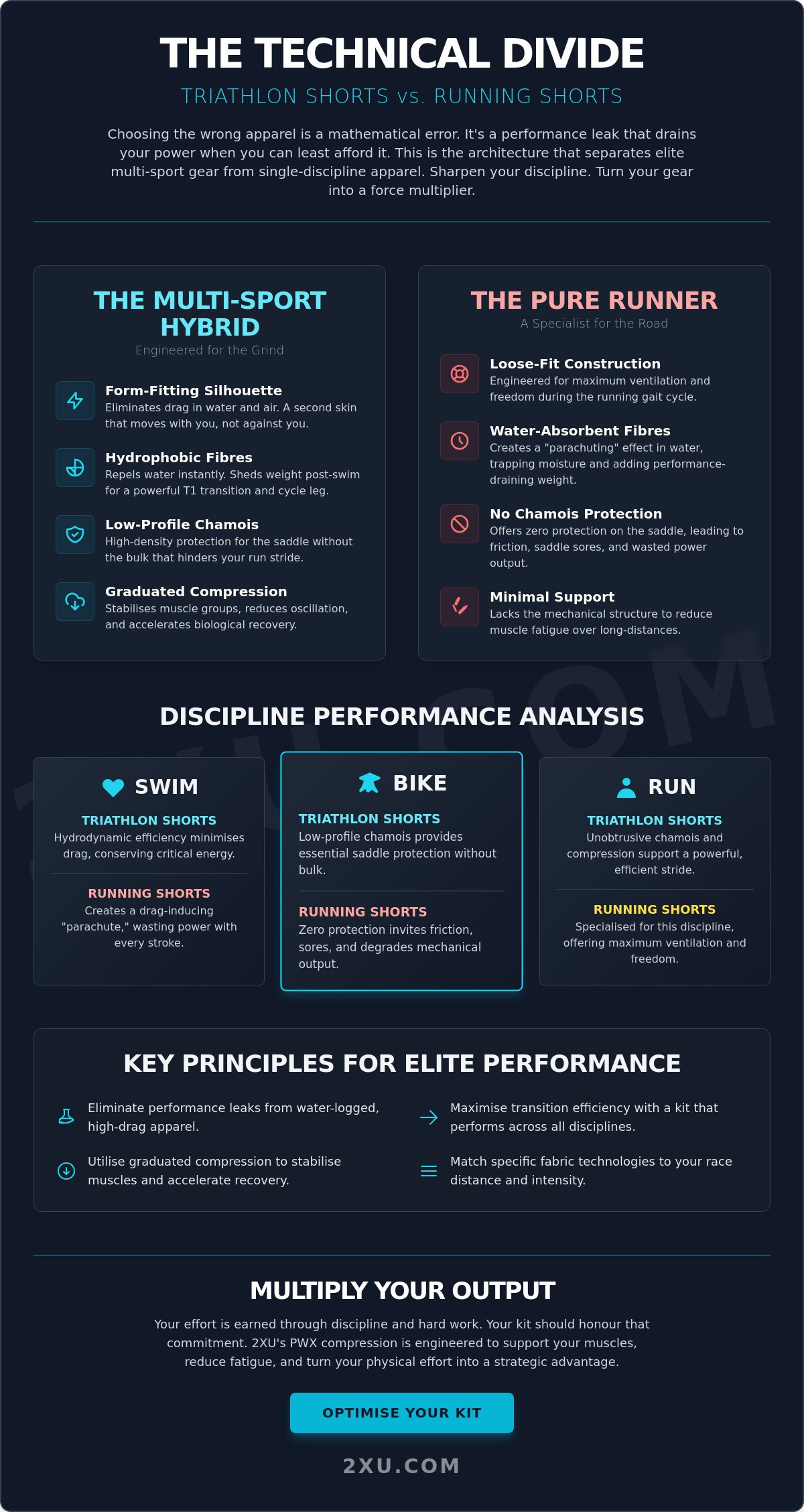
Performance Trade-offs: Transition Speed vs. Mechanical Comfort
Performance is measured in seconds and watts. Choosing between triathlon shorts vs running shorts often feels like a debate between comfort and speed, but this is a false dichotomy. In reality, the wrong gear choice forces you to pay a metabolic tax that compounds throughout the race. Every transition is a high-pressure environment where cognitive load and heart rate spikes are already at their peak. Forcing a full wardrobe change in T1 or T2 isn't just a 30-second delay; it's a disruption of psychological momentum that can derail your entire pacing strategy. You've trained too hard to let a clothing change break your focus.
The "Wet-Dog" effect is a primary example of mechanical failure. When you attempt to run in standard running shorts that have been submerged, the fabric absorbs water and sags. This leads to catastrophic chafing, often referred to as "the burn" in transition. This isn't just about discomfort. It's about a physical breakdown that forces a change in your gait, increasing the metabolic cost of every step. Respect the grind by choosing gear that supports the focus required for a PB.
Transition Efficiency (T1 & T2)
Maximising your efficiency means eliminating unnecessary variables. You can bypass the requirement for a changing tent by utilising a high-performance triathlon suit. This keeps you in the "zone" and maintains your psychological focus. Every movement should be purposeful. Integrated pockets in tri-shorts allow for streamlined nutrition management, ensuring you don't fumble with gear when your heart rate is redlining. Sharp transitions are earned in training but executed through superior equipment choice.
Aerodynamic Drag and Fluid Dynamics
Aerodynamics isn't just for the bike frame. Flapping fabric is a significant source of drag. Laboratory validation shows that skin-tight triathlon gear offers a massive advantage over loose running shorts. The Science of Aerodynamics confirms that garment fit is a critical factor in reducing drag. By switching to a form-fitting kit, you can save between 5-10 watts on the cycle leg. This is a "multiplication" of your physical output that requires zero extra effort from your muscles. It reduces the overall metabolic cost of the cycle-to-run transition, leaving you with more reserves for the final push. When you compare triathlon shorts vs running shorts, the mathematical advantage of aerodynamics is undeniable.
Strategic Selection: Matching Your Kit to the Discipline and Distance
Tactical gear selection is a force multiplier. The requirements of the "Grind" shift as you move from the explosive power of a sprint to the sustained resilience of an Ironman. When you evaluate triathlon shorts vs running shorts, the decision must be dictated by the specific metabolic and mechanical demands of your goal distance. Every athlete earns their place through hard work, but only the prepared athlete maximises that effort through calibrated gear selection. Choosing the wrong tool for the distance is an unforced error that compounds as the race progresses.
The Sprint Athlete’s Blueprint
In short-course racing, transition efficiency is your primary metric. A sprint distance allows no room for wardrobe adjustments or fumbling with gear. You need a form-fitting kit that prioritises hydro-aerodynamics for the swim and raw speed for the run. Minimalist padding is the standard here. It provides just enough protection for a 20km cycle while feeling completely invisible during the final 5km leg. This "all-in-one" approach ensures you maintain psychological momentum and physical velocity without compromise. Speed is the only currency that matters in a sprint; your kit should be a vehicle for that speed.
Long-Course Endurance Requirements
As the distance increases to 70.3 and beyond, the architecture of your kit must pivot toward stability and comfort. Long-course racing is a battle against muscle oscillation and biological fatigue. Understanding the specific advantages of triathlon shorts vs running shorts ensures you have the storage and compression required to survive the second half of the race. High-performance compression fabrics lock muscle groups in place, which reduces the energy cost of every movement over several hours. Storage is another critical factor. Integrated pockets must hold gels and salt tabs securely, eliminating the disruptive bounce found in standard running apparel. Additionally, the Australian climate demands UV-rated fabrics to manage thermal load and protect the skin during extended exposure.
The work you do in the shadows determines your performance in the light. Training volume requires gear that facilitates rapid recovery between sessions. While you might save your most aerodynamic trisuit for race day, your daily programme should include compression shirts and training-specific shorts to manage inflammation and accelerate blood flow. This ensures you can hit your power targets day after day without breaking down. Excellence is inclusive; whether you are chasing a world championship or your first finish line, your kit should be a technical extension of your ambition. Align your apparel with your discipline to ensure your output is always multiplied. Explore our full range of high-performance athletic sportswear to find your specific edge.
The 2XU Advantage: Multiply Your Output with PWX Compression
Excellence is not a matter of chance; it is a result of meticulous engineering. When you choose between triathlon shorts vs running shorts, you are selecting the technical platform that will either support or hinder your biological potential. We don't settle for average standards because the grind doesn't respect mediocrity. The 2XU signature is built on the mathematical promise of multiplication: doubling your capacity through superior mechanical support and accelerated recovery. This is where proprietary fabric technology meets the unyielding discipline of the elite athlete.
The Science of PWX Technology
PWX (Power, Weight, Flexibility) represents a breakthrough in high-performance textile engineering. Unlike standard athletic wear, PWX utilises high-filament yarns that provide a durable, moisture-wicking surface while maintaining extreme tensile strength. This fabric is designed to manage the primary cause of fatigue: muscle oscillation. Every time your foot hits the pavement, your muscles vibrate, creating micro-tears that lead to inflammation and power loss. Our laboratory-validated compression provides 360-degree stretch and mechanical stability, locking muscle groups in place to minimise this damage. This ensures your power output remains consistent from the first kilometre to the final sprint. When comparing triathlon shorts vs running shorts, the 2XU advantage lies in this ability to protect your physical architecture under load.
Ready, Action, Recovery: The Holistic Kit
Our tripartite athletic framework ensures you are supported through every phase of the race. While our tri-shorts are engineered for peak action across the swim, bike, and run, the mission to multiply your output continues after you cross the finish line. Recovery is where the next victory is earned. We recommend transitioning from race-day gear into specialised flight pressure socks for post-race travel or downtime. This graduated compression technology enhances blood flow, reduces swelling, and flushes metabolic waste from the limbs at an accelerated rate. It is a no-fluff approach to performance that sharpens your competitive edge for the next session.
The technical divide in triathlon shorts vs running shorts is clear. One is designed for a single discipline; the other is a calibrated tool for the multi-sport professional. By choosing 2XU, you align yourself with the world's most disciplined athletes who demand tangible results from their equipment. Don't let your gear be the limiting factor in your performance equation. Invest in the science of compression, respect the work you've put in, and earn your place on the podium. It's time to multiply your results and redefine what your body is capable of achieving.
Master the Transition and Multiply Your Power
The technical divide between triathlon shorts vs running shorts is a matter of mechanical efficiency and metabolic conservation. Gear is a force multiplier. Choosing the correct technical platform determines how effectively you manage the transition from water to land without leaking energy. We've established that technical architecture, from low-profile chamois to PWX compression technology, is essential for reducing muscle micro-tears and maintaining mechanical stability during the grind. This isn't about mere comfort; it's about laboratory-validated results that sharpen your competitive edge. Every garment is Australian-engineered to withstand the most demanding conditions and support your ambition.
You've done the work in the shadows; now ensure your apparel matches your discipline. Elite performance requires gear that stabilises muscle groups and accelerates biological recovery across every discipline. You've earned the right to chase a PB through grit and resilience. Now, equip yourself with the technology to make it a reality. Don't compromise on your output when the science of multiplication is within reach.
Multiply your performance—Shop 2XU Triathlon Gear now
The podium is waiting for those disciplined enough to take it. Keep pushing.
Frequently Asked Questions
Can I wear running shorts under my wetsuit for a triathlon?
Wearing running shorts under a wetsuit is a mechanical liability. The loose fabric traps water and creates a heavy, drag-inducing anchor that compromises your buoyancy and velocity. Triathlon shorts are engineered with form-fitting polymers that remain sleek and hydrodynamic, ensuring your effort is spent on propulsion rather than fighting water resistance during the swim leg.
Do I need to wear underwear under triathlon shorts?
Underwear should never be worn under triathlon shorts. These garments are engineered to be worn directly against the skin to allow the moisture-wicking fibres and specialised chamois to function without interference. Adding a layer of non-technical material increases friction and moisture retention, which leads to catastrophic chafing during the cycle and run legs of the race.
Will the padding in tri-shorts be uncomfortable during the marathon leg?
A high-quality tri-chamois is designed to be invisible during the run. Unlike bulky cycling pads, tri-specific padding uses high-density, low-profile foam that provides essential saddle protection without impeding your gait cycle. This architecture ensures you maintain maximum velocity during the marathon leg without the discomfort or "nappy effect" associated with standard bike gear.
Are triathlon shorts worth the investment for a beginner?
Investing in specialised gear is a strategic move for athletes at every level. When comparing triathlon shorts vs running shorts, the technical advantage of a single-kit solution reduces transition stress and prevents the weight of water-logged fabrics. This allows a beginner to focus entirely on the discipline of the race rather than managing gear failure during the grind.
How should triathlon shorts fit compared to standard running tights?
Triathlon shorts require a firmer, more compressive fit than standard running tights. This graduated compression is essential for stabilising muscle groups and ensuring the garment does not shift or "parachute" in the water. A secure, skin-tight fit is a prerequisite for mechanical efficiency and the reduction of muscle micro-tears during high-intensity physical output.
Can I use triathlon shorts for regular pool swimming and training?
You can use triathlon shorts for pool training if they feature chlorine-resistant coatings. These garments are ideal for brick sessions where you transition directly from the pool to the bike or treadmill. Regular exposure to harsh chemicals requires a kit engineered with durable, high-filament yarns to prevent premature degradation of the fabric's elastic properties and compression levels.
How do I prevent chafing when transitioning from the swim to the bike?
Preventing chafing starts with moisture management and a precise fit. High-performance triathlon gear utilises hydrophobic polymers to shed water instantly upon exiting the swim. Ensure your kit is fitted correctly to eliminate skin-to-fabric movement, and consider using a specialised anti-chafe lubricant on high-friction zones to maintain your focus through the transition and into the cycle leg.
What is the lifespan of high-performance triathlon gear with regular use?
The lifespan of elite-grade gear depends on training volume and maintenance. With regular use in harsh environments, a high-performance kit typically maintains its mechanical integrity for one to two seasons of heavy racing. Always rinse your gear in fresh water after every session to protect the specialised fibres from salt, sweat, and chlorine damage to ensure long-term performance.