
Engineering Speed: The Ultimate Aerodynamic Triathlon Suit Buying Guide 2026
Over 60% of triathletes now prioritise specialised gear for its proven performance benefits, acknowledging that aerodynamics is a mathematical equation where your apparel is the most critical variable. You've respected the grind and endured the discipline of a brutal training block; yet, even the most conditioned engine is throttled by inefficient equipment. Selecting the right aerodynamic triathlon suit isn't a luxury. It's a technical requirement for any athlete demanding to eliminate the invisible drag that saps power during the bike split.
You know that race day is an uncompromising test of resilience, where skin irritation during the marathon or muscle fatigue from vibration can dismantle months of preparation. Discover the scientific principles and technical features that define the world’s fastest suits to multiply your race-day performance. This guide provides a rigorous analysis of 2026's technical innovations, from textured fabrics that create a turbulent boundary layer to hydrophobic treatments that ensure rapid moisture management and significant watt savings. We will break down the precise engineering required to reduce muscle oscillation and maintain mechanical stability from the first transition to the final stride.
Key Takeaways
- Understand why the athlete represents 80% of total drag and how to neutralise this inefficiency through precision-engineered boundary layers.
- Identify the dimpled fabric architectures and high-filament yarns that define a world-class aerodynamic triathlon suit and multiply your mechanical output.
- Master the second-skin fit protocol to eliminate fabric flutter and suppress power-sapping muscle oscillation during high-intensity efforts.
- Discover how to select the optimal suit configuration by matching specific technical features to your race distance and environmental conditions.
The Physics of Performance: Why an Aerodynamic Triathlon Suit is Essential
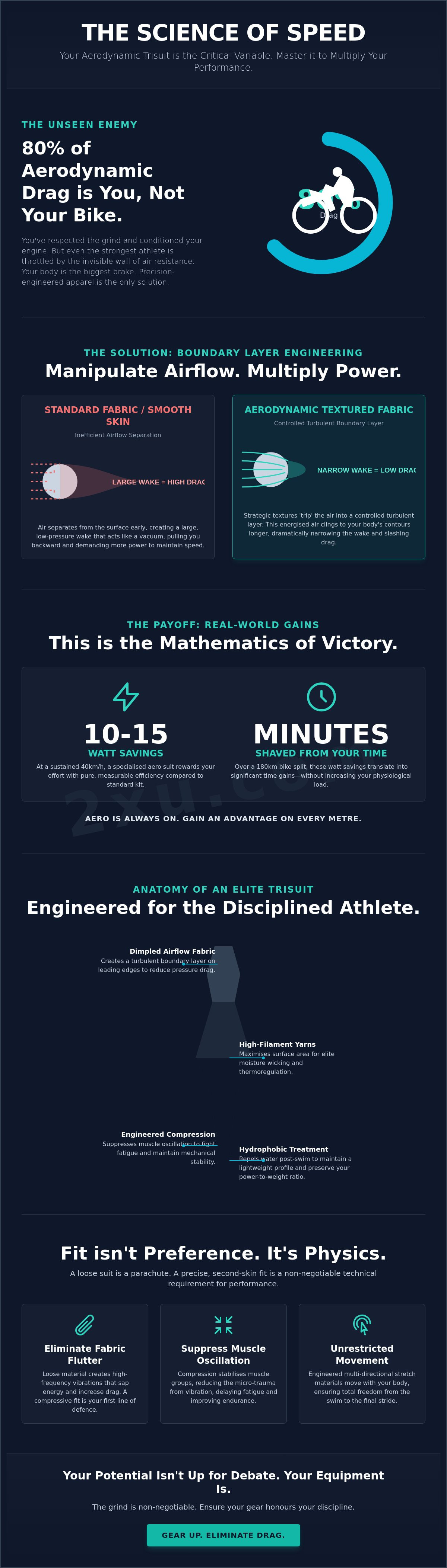
Speed is a calculation. You've prioritised the grind, logged the hours, and mastered your discipline. Yet, many athletes ignore the most significant variable in the race-day equation. In non-drafting competition, wind resistance is your primary antagonist. While it's tempting to focus on frame geometry, physics proves that 80% of total aerodynamic drag is caused by the athlete, not the bike. An aerodynamic triathlon suit functions as a precision-engineered boundary layer. It's designed to manipulate air before it forces you to work harder. By utilising specific surface roughness, these garments maintain laminar airflow longer, preventing the premature separation that creates speed-killing turbulence.
The Mathematics of Drag Reduction
Every component of Triathlon equipment is subject to the Drag Coefficient (Cd). This mathematical value represents how effectively an object slices through the air. Fabric texture is your primary tool for reducing this number. The boundary layer is the microscopic region of air directly interacting with the textile surface where fluid friction is most intense. When air flows over smooth skin or basic fabrics, it separates quickly, creating a large, low-pressure wake behind you. High-performance technical fabrics use strategic dimpling or 3D structures to transition the air from laminar to a controlled turbulent flow. This "tripped" air stays attached to your limbs longer, narrowing the wake and effectively multiplying your speed for the same energy cost.
Watt Savings: Real-World Gains for the Disciplined Athlete
The laboratory data is clear. At a sustained velocity of 40km/h, a specialised aerodynamic triathlon suit can provide watt savings between 10 and 15 watts compared to standard training apparel. For a disciplined athlete, these numbers are transformative. Over the course of a 180km IRONMAN bike split, this technical advantage can shave several minutes off your finishing time without increasing your physiological load. Remember that "aero is always on." Unlike weight-savings, which only provide a measurable benefit on significant gradients, aerodynamic efficiency rewards you on every metre of the course. Don't leave your potential in the wind tunnel. To refine your complete approach, read our ultimate triathlon suit guide to ensure every piece of your kit is working as hard as you are.
Anatomy of an Elite Trisuit: Fabric Technology and Construction
Your speed is dictated by the architecture of your equipment. An elite aerodynamic triathlon suit is not merely a garment; it's a complex assembly of technical fibres designed to manipulate fluid dynamics. The sleeves and shoulders are the first points of contact for oncoming air. By integrating dimpled airflow technology into these zones, engineers create a controlled turbulent boundary layer. This specific surface roughness allows air to cling to the body’s contours longer, reducing the low-pressure wake that acts as a physical brake on your momentum. Every millimetre of fabric is a deliberate choice in the pursuit of mechanical advantage.
Thermoregulation is equally critical to sustaining high wattage. High-filament yarns are utilised to maximise surface area, which accelerates the wicking of moisture away from the skin. This isn't just about comfort; it's about biological efficiency. When your core temperature remains stable, your heart rate doesn't have to compensate for cooling, allowing more oxygenated blood to reach your working muscles. Technical elastane blends further enhance this by providing UV protection and heat-reflective properties, ensuring that the sun’s radiation doesn't degrade your performance during the exposed segments of the bike and run.
Textile Engineering vs. Standard Materials
Precision requires more than basic polyester. We utilise engineered polymer-based yarns that offer multi-directional stretch, a necessity for the unencumbered movement required in the swim-bike-run transition. These fabrics are treated with hydrophobic coatings to ensure they repel water rather than absorbing it. A suit that gains water weight in the swim becomes a heavy, non-breathable liability on the bike. By maintaining a dry, lightweight profile, you preserve the power-to-weight ratio you've worked so hard to achieve during training. If you're ready to upgrade your kit, explore our range of triathlon trisuits to find your specific match.
Seams and Closures: Eliminating Mechanical Drag
Traditional stitching is an aerodynamic failure. Every raised seam creates a micro-disturbance in airflow, multiplying drag across the entire surface of the suit. Elite construction relies on ultrasonic bonding or low-profile flatlock stitching to create a zero-drag silhouette. This meticulous attention to detail extends to the "Grind" of the marathon leg. Seam placement is mathematically determined to avoid high-friction zones, preventing the chafing that can derail a podium finish. Even nutrition storage is engineered; hidden pocket architectures are designed to sit flush against the lower back, ensuring you can carry essential fuel without breaking the laminar flow of air over your torso.
The 2XU Aero Collection: Precision Tools for the Disciplined Athlete
Your commitment to the grind is absolute. You don't settle for average in training, so your equipment must reflect that same unyielding standard. The 2XU Aero collection represents the pinnacle of our aerodynamic research, serving as a suite of precision tools engineered to multiply your race-day potential. This range isn't designed for casual participation; it's forged for the athlete who demands a mathematical improvement in their split times through rigorous scientific validation. When you step onto the course, you need the confidence that your gear is an asset, not a liability.
Central to this collection is the integration of the TMF® Aero Tri Chamois. Engineered specifically for long-distance events, this 90-density high-impact foam provides essential mechanical stability without adding unnecessary bulk. It allows you to maintain an aggressive aero position for hours, ensuring that your physical output remains focused on propulsion rather than managing discomfort. When every watt counts, your interface with the bike becomes a critical performance variable that can dictate the outcome of your race.
Standout Products: The Aero Hex Series
The Aero Hex Sleeved Trisuit is the definitive aerodynamic triathlon suit for the data-driven competitor. Its specific dimpled sleeve architecture utilises the boundary layer principles we've established to ensure air remains attached to your limbs longer, drastically reducing pressure drag. This suit is an investment in your speed, offering the technical foundation required to suppress power-sapping muscle oscillation during high-intensity efforts. It represents the ultimate fusion of comfort and velocity.
For athletes requiring versatile race-day layering, the Aero Hex Tri Sleeved Top provides the same advanced textile engineering in a flexible format. It utilises the same drag-reducing textures found in our flagship suits, allowing you to customise your kit without compromising on velocity. These garments are more than clothing; they are the catalysts for the multiplication of human potential, ensuring your hard-earned fitness is never wasted against the wind. Every stitch is a testament to the discipline you bring to the sport.
The Aero Tri Short: Stability and Speed
Not every race requires a one-piece configuration. The Aero Tri 9 Inch Shorts provide a high-performance alternative for athletes who prefer the adjustability of a two-piece setup. These shorts feature proprietary muscle-mapping compression to reduce fatigue by dampening the vibrations that lead to muscle damage over long distances. High-quality Italian-made leg grippers ensure a secure, second-skin fit that prevents fabric flutter, maintaining your aerodynamic profile through every pedal stroke. Success in triathlon is earned through discipline and the refusal to accept compromise. Shop the full 2XU Aero Collection here to equip yourself with the technology required to dominate your next finish line.
Achieving the Perfect Race-Day Fit: Compression and Ergonomics
An aerodynamic triathlon suit only delivers its theoretical watt savings if it adheres perfectly to your physiology. Loose fabric is a mechanical liability. It creates drag-inducing pockets and fabric flutter that destroy laminar flow, turning your high-performance kit into a parachute. To multiply your output, the suit must function as a second skin. It provides essential mechanical stability while allowing for the dynamic range of motion required across three distinct disciplines. If the fit is compromised, the engineering is irrelevant.
The Science of Compression in Triathlon
Compression is more than a tight fit; it's a physiological tool for the disciplined athlete. By applying graduated pressure, our technical fabrics enhance venous return and accelerate oxygen delivery to working muscle groups. This process is vital for reducing muscle oscillation, the micro-vibrations that cause structural damage and premature fatigue during the high-impact run leg. For a deeper understanding of how this technology supports upper-body stability, consult the science of compression shirts. This structural support is critical during the transition from the bike to the run, where maintaining postural integrity determines your ability to hold a target pace through the final kilometres.
Sizing for Aerodynamics: Common Mistakes to Avoid
Wrinkles are watt-killers. On the bike split, any bunching of fabric around the shoulders or chest creates micro-disturbances in airflow that negate the engineering of your kit. However, an elite fit is a precise balance. You must ensure the torso length allows for an aggressive aero tuck without restrictive pulling, yet provides enough expansion for full lung capacity during the swim. Avoid these common errors to ensure your kit is race-ready:
- The Parachute Chest: Fabric bunching at the sternum when in the aero position.
- Restrictive Diaphragm: A suit so tight it limits deep ribcage expansion during high-intensity breathing.
- Torso Compression: Excessive vertical tension that forces a rounded posture or causes "sausage-suit" ridges at the leg grippers.
- Muscle Vibration: Loose leg panels that fail to dampen quadricep oscillation during the run.
During the grind of the marathon, your suit's fit dictates metabolic heat loss. A precision fit ensures that moisture is pulled directly from the skin to the fabric surface for rapid evaporation, preventing the thermal redlining that forces a pace reduction. Don't settle for "close enough" when your performance is on the line. Optimise your race-day profile with our elite range of trisuits.
Strategic Selection: Choosing Your Suit Based on Race Distance
Choosing an aerodynamic triathlon suit is the final tactical decision in your preparation cycle. A tool that excels in a sixty-minute sprint may fail during a ten-hour endurance test. Your selection must align with the specific mechanical and physiological demands of your target distance. Success isn't found in a one-size-fits-all approach. It's found in the precise application of technology to the variables of your event. Every kilometre on the course is a data point; ensure your gear is calibrated to match the intensity of the grind.
Short Course vs. Long Course Requirements
In Sprint and Olympic distances, the margin for error is microscopic. Your focus must be on transition speed and lightweight moisture wicking. For these high-intensity efforts, a suit that allows for rapid heart rate spikes and aggressive cooling is paramount. You need a garment that disappears on the body, providing zero resistance during the explosive movements of a short-course race. Here, the priority is a minimalist profile that ensures you remain unencumbered through every turn and transition.
Conversely, IRONMAN events require a focus on maximum aerodynamics and sustained mechanical stability. You need integrated nutrition storage that doesn't compromise your profile and a chamois engineered for the 180km bike leg. The Light Speed React series is designed for these full-distance PR attempts, providing the structural support required to maintain form when fatigue sets in. While a 20km bike leg can be managed with minimal padding, the 180km split demands the high-impact foam density found in our elite long-course garments. This padding ensures you arrive at the second transition with your running economy intact.
Environmental Factors: Heat, Wind, and UV
Course conditions dictate your textile requirements. On exposed long-distance courses, light-coloured technical fabrics are essential to reflect solar radiation and manage core temperature. Sleeved suits offer a dual advantage in these environments; they provide superior UV protection and a proven aerodynamic benefit in crosswind conditions. By smoothing the airflow over the shoulders and upper arms, sleeves reduce the lateral force on the rider. This allows for a more stable and efficient aero tuck, even when the wind attempts to disrupt your line.
Your choice of gear is the physical manifestation of your discipline. It's the final multiplier in the quest for peak human output. Selecting the right suit is about respecting the work you've put in and ensuring nothing is left to chance. Choose the tool that matches your ambition and the specific demands of your race day. Explore the Aero Collection and prepare for your fastest race.
Master the Air: Secure Your Mechanical Advantage
Success in triathlon isn't a matter of chance; it's a result of rigorous discipline and the strategic application of science. You've learned that 80% of total drag comes from your body and that a precision-engineered aerodynamic triathlon suit is your primary tool for neutralising that resistance. By utilising proprietary Aero Hex fabric technology and ensuring a second-skin fit, you suppress power-sapping muscle oscillation and maintain laminar airflow when it matters most. These tools are tested in world-class wind tunnels and trusted by elite IRONMAN athletes globally to ensure every watt you produce translates into forward momentum.
Don't let your hard-earned fitness be wasted against invisible barriers. Your commitment to the grind deserves equipment that can keep pace with your ambition. Multiply your race-day potential with the 2XU Aero Collection. The course is waiting for the fastest version of you. Step onto the start line with the confidence that your potential has been multiplied by the world's most advanced textile engineering. Respect the effort. Demand the results.
Frequently Asked Questions
Do sleeved triathlon suits actually make you faster on the bike?
Sleeves provide a definitive aerodynamic advantage by smoothing airflow over the shoulders and upper arms. Technical fabrics with dimpled textures "trip" the air into a controlled turbulent boundary layer, which keeps the air attached to your body longer and reduces the pressure drag in your wake. This engineering is a requirement for any athlete seeking a mathematical improvement in their bike split velocity.
Can I wear an aerodynamic triathlon suit under a wetsuit?
You can wear your suit under a wetsuit to ensure your transition is efficient and disciplined. High-performance technical fabrics are treated with hydrophobic coatings to prevent them from gaining water weight if moisture enters your wetsuit. Ensure the sleeves are pulled flush against your skin to avoid bunching, as any fabric ridges can restrict your shoulder mobility and increase fatigue during the swim leg.
How much time can I save with an aero trisuit in an IRONMAN?
Testing in world-class wind tunnels confirms that an aerodynamic triathlon suit can save between 10 and 15 watts at a speed of 40km/h. Over a 180km bike split, this efficiency can shave several minutes off your finishing time. These gains are constant throughout the race, meaning your equipment is working to multiply your output even when your physical energy begins to deplete during the grind.
Should I choose a one-piece or two-piece triathlon suit for long distances?
One-piece suits are the superior choice for athletes prioritising maximum velocity and mechanical stability. The absence of a waist seam eliminates a significant source of aerodynamic drag and prevents the top from riding up during the run. While two-piece kits offer convenience, the one-piece architecture provides better muscle-mapping compression and a streamlined silhouette that is essential for elite performance in long-distance events.
How do I care for my aerodynamic triathlon suit to maintain its performance?
Rinse your suit in cold, fresh water immediately after every race or training session to neutralise salt and chlorine. You must avoid the tumble dryer; heat destroys the technical elastane fibres and degrades the hydrophobic treatments that keep the suit lightweight. Hand wash with a mild detergent and air dry in the shade to ensure the garment maintains its compressive strength and aerodynamic integrity.
Are aerodynamic triathlon suits legal for all IRONMAN and World Triathlon races?
Current 2026 regulations permit sleeved suits in all distances, provided the sleeves do not extend past the elbow. For World Triathlon events, elite athletes are often restricted to back-zipper configurations, while age-group athletes can typically use front zippers in long-course racing. Always confirm that your torso remains fully covered, as failing to adhere to these technical standards can lead to disqualification on race day.
Does the chamois in an aero suit feel bulky during the run?
Elite suits utilise low-profile, high-density foam like the TMF® Aero Tri Chamois to provide support without the bulk. These pads are designed to provide mechanical stability on the bike while remaining flexible enough to be unnoticeable during the marathon. This engineering ensures you don't experience chafing or a restrictive range of motion, allowing you to focus entirely on maintaining your target pace.
How tight should an aerodynamic triathlon suit be?
Your suit must fit like a second skin to be effective. Any wrinkles or loose fabric act as watt-killers by creating drag-inducing turbulence across your body. It should feel intensely compressive, dampening muscle oscillation without restricting your lung expansion or diaphragm movement. If you can see fabric fluttering in the wind, the suit is too large and is sapping your hard-earned power.