
Open Water Swimming Wetsuit: The Performance Checklist
The margin between a new personal best and debilitating fatigue is measured in millimeters of neoprene. Yet the market is saturated with confusing jargon and hollow marketing claims, leaving athletes to guess which technical features actually translate to speed and which lead to restriction and chafing. A high-performance open water swimming wetsuit is not a purchase; it is a calculated investment in your power output and endurance. Compromise is not an option when every second counts.
Forget subjective reviews. This is your definitive, scientifically-backed performance checklist. We will deconstruct the essential technology-from proprietary hydrodynamic coatings and zoned buoyancy panels to the biomechanics of an engineered fit. This guide is engineered to arm you with the data-driven knowledge required to select a wetsuit that minimizes drag, optimizes thermoregulation, and ultimately multiplies your human performance in the water. Prepare to make your most intelligent gear decision yet.
Key Takeaways
- Learn how advanced surface coatings are engineered to minimize drag, directly increasing your velocity through the water.
- Understand the science behind variable buoyancy profiles and how they optimize your body position for maximum efficiency and reduced energy expenditure.
- Discover why unrestricted shoulder flexibility is the non-negotiable factor for maximizing power output in every stroke.
- A precision fit is the foundation of performance; a poorly fitted open water swimming wetsuit negates all advanced features by creating drag.
Checklist Item 1: Hydrodynamics and Speed Engineering
In open water, velocity is paramount. A superior open water swimming wetsuit is not merely for buoyancy or warmth; it is a piece of high-performance equipment engineered to overcome the single greatest obstacle to your speed: hydrodynamic drag. Every element of its design is meticulously calibrated to minimize water resistance and maximize your power output, transforming your effort into pure, unimpeded forward motion. From advanced surface coatings to the precise placement of every seam, the ultimate goal is to make you faster. Mediocrity has no place in a race against the clock.
Super Composite Skin (SCS) Coating
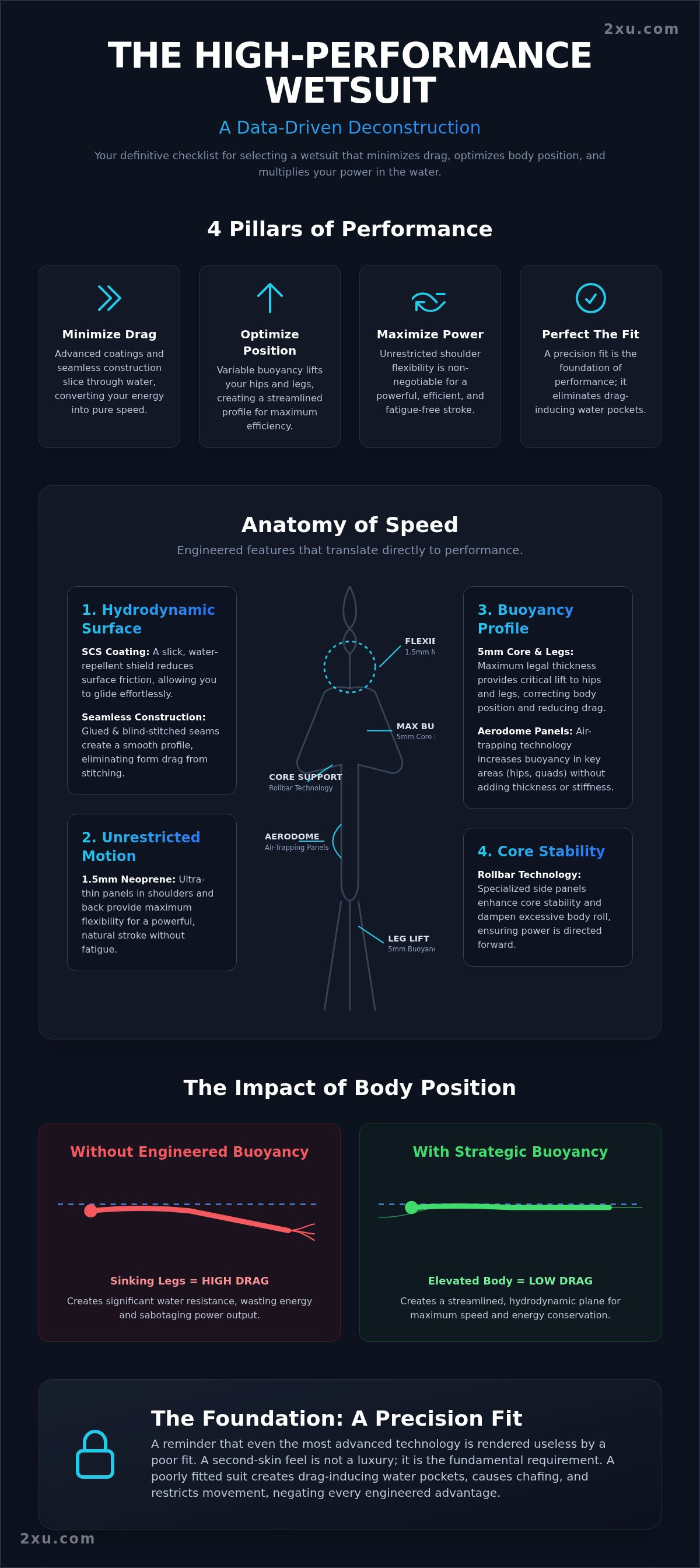
The first line of defense against drag is the suit's exterior. Super Composite Skin (SCS) is a proprietary hydrodynamic coating applied to the neoprene surface, creating an incredibly slick, water-repellent shield. Its hydrophobic properties mean it actively sheds water instead of absorbing it. This advanced layer is scientifically proven to reduce the coefficient of friction as you move through the water, allowing you to glide with unparalleled efficiency. The result is less energy expended fighting resistance and more power dedicated to propulsion. Beyond pure speed, this coating also enhances durability against abrasions and simplifies transitions by allowing the suit to slide off with ease-a critical advantage in triathlon.
Engineered Seam and Panel Construction
The construction of a wetsuit is a science of fluid dynamics. Unlike basic suits that use bulky, drag-inducing flatlock stitching, elite designs utilize glued and blind-stitched seams. This advanced method creates a completely smooth, watertight seal that eliminates external ridges, presenting a seamless surface to the water to further reduce form drag. This construction principle elevates the fundamental design of a Wetsuit into a tool for competitive advantage.
Furthermore, the panel layout of a premium open water swimming wetsuit is strategically mapped to follow your body’s kinetic chain. Panels of varying thickness and flexibility are placed to support key muscle groups and allow for maximum range of motion in the shoulders and back. Specialized features like embossed forearm catch panels are engineered to increase your feel for the water-a form of proprioception enhancement-maximizing the power and efficiency of every single pull through the water.
Checklist Item 2: Buoyancy Profile and Body Position
An optimal body position is the foundation of an efficient swim stroke. In the water, your greatest enemy is form drag-the resistance created by your own body. A superior open water swimming wetsuit is engineered not just for warmth, but to fundamentally correct your position, lifting your hips and legs to create a streamlined, hydrodynamic plane. This elevation minimizes drag, conserves critical energy, and directly translates to increased speed and endurance. The key is not simply adding buoyancy, but strategically distributing it for a balanced, powerful swim.
Strategic Neoprene Thickness (mm)
The most advanced wetsuits are not constructed from a single sheet of neoprene; they are meticulously engineered with variable thickness panels. This multi-thickness design places buoyancy precisely where it multiplies performance. The core principle is simple and scientifically validated:
- Maximum 5mm Neoprene: The thickest, most buoyant panels are placed through the chest, hips, and upper legs. This provides maximum elevation to your core and lower body, preventing the common issue of "sinking legs" that sabotages power output.
- Thinner 1.5-2mm Neoprene: The shoulders, back, and armpits feature significantly thinner neoprene. This is non-negotiable for an unrestricted range of motion, allowing for a full and powerful stroke without fatigue. As noted in Swim England's wetsuit guide, flexibility in these key areas is paramount to performance.
Aerodome and Air-Trapping Panels
To achieve maximum lift without compromising flexibility, elite wetsuit technology incorporates proprietary air-trapping panels. Often referred to as Aerodome or similar technologies, these panels feature a unique construction that sandwiches a layer of air bubbles between layers of neoprene. This innovative design provides a dramatic increase in buoyancy compared to standard neoprene of the same thickness. These panels are typically integrated into the quads and hips of a high-performance open water swimming wetsuit to provide targeted, powerful lift where athletes need it most.
Rollbar and Core Support
A streamlined body position is useless without core stability. Uncontrolled body roll wastes energy and diminishes the power of your pull. Advanced features like Rollbar technology utilize specialized, less-buoyant side panels that wrap the torso. This engineered support system increases core stability and dampens excessive rotation, forcing you to engage your core for a more efficient stroke. By locking your core in, every movement is channeled into forward propulsion, ensuring no power is wasted. GET FASTER. SWIM STRONGER.
Checklist Item 3: Flexibility and Range of Motion
In the pursuit of maximum power output and endurance, uninhibited shoulder movement is non-negotiable. This is the single most critical design element that separates a high-performance open water swimming wetsuit from a restrictive surfing or diving suit, which is engineered for warmth and durability over mobility. A suit that fights your natural stroke mechanics will not only slow you down but will also induce premature muscle fatigue in the shoulders and lats.
Achieving superior flexibility is a function of advanced material science and anatomical engineering. True range of motion is dictated by two interconnected components: the external neoprene rubber and the internal jersey liner. A wetsuit is only as flexible as its most restrictive layer. Therefore, look for suits that pair high-stretch neoprene with equally elastic inner fabrics in key mobility zones.
Yamamoto Neoprene Grades (#39 and #40)
Yamamoto is the globally recognized benchmark for performance neoprene, prized for its lightweight, low-absorption, and high-elongation properties. Within their range, Yamamoto #40 is scientifically engineered to be more flexible and buoyant than the still-excellent #39. Consequently, this premium material is strategically placed in the shoulders, arms, and lats of elite wetsuits to minimize fatigue and maximize stroke efficiency with every pull.
Anatomical Shoulder and Arm Design
The most advanced open water swimming wetsuit designs utilize single-piece, anatomically contoured shoulder panels. By eliminating restrictive seams across the lats and deltoids, this construction allows for unparalleled reach and extension. This is often paired with thinner 1.5mm neoprene and a proprietary high-stretch inner liner to deliver a 'second-skin' feel, ensuring your swimming mechanics are never compromised.
Checklist Item 4: Thermal Regulation for Peak Performance
Your body's core temperature is a critical performance metric. In open water, energy wasted on shivering is energy stolen from your stroke and power output. An effective open water swimming wetsuit doesn't just keep you warm; it achieves optimal thermal regulation, preventing both hypothermia and performance-sapping overheating. This is a non-negotiable component for maximizing endurance and achieving your fastest swim splits. A failure in thermal control is a failure in preparation.
The system is comprised of three critical elements: neoprene thickness, internal liner technology, and impenetrable seals. Each must be engineered to work in concert.
Matching Thickness to Water Temperature
Selecting the correct neoprene thickness is the foundational step. This choice must be scientifically matched to the environment to prevent thermal degradation of your performance. While personal cold tolerance and exertion level are variables, adhere to these proven guidelines as your baseline for peak operational efficiency.
- 3/2mm Wetsuits: Engineered for temperate water, typically 65-75°F (18-24°C). This construction offers an ideal balance of warmth and flexibility for the majority of triathlon and open water races.
- 4/3mm or 5/3mm Wetsuits: Required for colder conditions, 55-65°F (13-18°C). The thicker neoprene panels are strategically placed to protect the core, ensuring your muscles remain warm and functional when the water temperature drops.
- Sleeveless Wetsuits: Reserved for warmer water, generally above 70°F (21°C), providing core insulation while allowing for maximum freedom of movement in the arms.
Advanced Thermal Liners
Neoprene thickness is only part of the equation. An elite open water swimming wetsuit incorporates proprietary thermal liners engineered to trap body heat with maximum efficiency. This advanced technology allows for the construction of a thinner, lighter, and more flexible suit that delivers the thermal protection of a thicker, more restrictive garment. The result is superior warmth without compromising mobility-a true performance multiplier. These advanced liners also feature quick-drying properties, enhancing comfort and accelerating recovery between sessions.
Finally, thermal integrity is lost without a perfect seal. An impenetrable barrier at the neck, wrists, and ankles is crucial to prevent cold water flushing through the suit, which would instantly negate all technological benefits. A secure, comfortable seal maintains the suit's thermal efficiency and hydrodynamic profile, ensuring every ounce of your energy is dedicated to forward propulsion. Explore wetsuits engineered for peak thermal performance.
Checklist Item 5: Fit and Essential Construction Features
All the advanced buoyancy panels and hydrodynamic coatings in the world are rendered ineffective without the single most critical element: a perfect fit. The fit of your open water swimming wetsuit is not a matter of comfort, but a core component of its performance engineering. A suit that is too loose will scoop cold water, creating significant drag and compromising your thermal regulation. Conversely, a suit that is too tight will constrict your chest, limiting lung capacity and restricting shoulder mobility, which directly inhibits your power output and stroke efficiency.
Achieving a 'Second Skin' Fit
An elite wetsuit must function as a second skin. This requires meticulous attention to sizing, which goes far beyond generic small, medium, or large designations. Always consult the brand-specific size chart, as these are developed from extensive athlete data. On land, the suit should feel compressive and snug-a sign that it will perform correctly in the water. Critically, assess these key areas for a precise fit:
- Lower Back: There should be no gap or air pocket where water can collect.
- Armpits and Crotch: The neoprene should be snug against the skin with no bunching or excess material that could cause chafing and restrict movement.
High-Performance Neckline and Cuffs
Inferior wetsuits often fail at the entry points. A high-performance neckline is engineered with a low profile to form a watertight seal that prevents chafing during repetitive head-turning for sighting. Likewise, the cuffs at the wrists and ankles must be precisely tapered or feature a silicone seal. This crucial detail prevents water from flushing into the suit on the catch phase of your stroke and allows for rapid, snag-free removal in T1.
Zipper Design and Durability
The zipper is a critical mechanical component. Look for a reverse-zip configuration, where the zipper closes from the bottom up. This design is standard in triathlon-specific suits as it allows for a quick, downward pull of the long lanyard for immediate removal during a race. The component itself must be of the highest quality-a durable, corrosion-resistant YKK zipper is the industry standard for reliability. Anything less is a compromise on performance and longevity. Your entire race performance depends on these engineered details. Find your scientifically engineered fit. Explore 2XU wetsuits.
Engineer Your Advantage: The Final Verdict
Your performance in the water is a direct result of your equipment's engineering. A superior open water swimming wetsuit is not merely an accessory; it is a scientifically calibrated tool for victory. Mastering your selection requires a critical analysis of key performance metrics: a hydrodynamic profile for minimal drag, a precision-engineered buoyancy to optimize your body position and conserve energy, and advanced material flexibility that allows for an unrestricted, powerful stroke. These elements are non-negotiable for any serious athlete.
Mediocrity has no place in your training or on race day. That is why world champion athletes and IRONMAN competitors trust 2XU. Our wetsuits are meticulously engineered with scientifically proven Yamamoto neoprene, delivering maximum hydrodynamic efficiency and unparalleled flexibility. This is not just equipment; it's a calculated investment in your performance. It's time to stop fighting the water and start commanding it.
Engineer Your Swim: Explore the 2XU Wetsuit Collection and prepare to multiply your human performance.
Frequently Asked Questions
What is the main difference between an open water swimming wetsuit and a surfing wetsuit?
The engineering objective is entirely different. A surfing wetsuit is designed for durability and warmth, often using thick, less flexible neoprene. In contrast, a swimming wetsuit is an advanced performance tool engineered for speed. It utilizes strategically placed panels of varying thickness and superior flexibility through the shoulders and lats to enable an unrestricted, powerful stroke. Its design is focused on minimizing drag and optimizing buoyancy to elevate your position in the water, a function a surfing wetsuit cannot perform.
How do I choose the right wetsuit thickness for the water temperature I swim in?
Selecting the correct wetsuit thickness is a calculated decision based on thermal regulation for peak performance. For water temperatures below 12°C (54°F), a 4-5mm core thickness is essential to prevent performance degradation from cold. In the 12-18°C (54-64°F) range, a versatile 3:5mm or 2:3mm combination offers a balance of warmth and flexibility. For waters above 18°C (64°F), a thinner 1.5-2mm suit or sleeveless option prevents overheating while maintaining a hydrodynamic advantage.
Can I use a sleeveless wetsuit for open water swimming, and what are the trade-offs?
A sleeveless wetsuit is a strategic choice for specific conditions. Its primary advantage is absolute freedom of movement in the shoulders, providing a natural stroke sensation that many elite swimmers prefer. However, this comes at the cost of buoyancy and thermal protection in the arms. This makes it an optimal weapon for warmer water swims (above 18°C / 64°F) or for athletes who are prone to overheating, but a significant performance compromise in colder conditions where warmth is critical.
How tight should my swimming wetsuit be, and how do I know if I have the right size?
A correct fit is non-negotiable for hydrodynamic efficiency. Your wetsuit must feel like a second skin-snug with no gaps or air pockets, especially around the lower back, crotch, and armpits. It will feel restrictive on land; this is by design. The definitive test is function: you should be able to perform a full arm rotation without excessive impingement, and your breathing should not be constricted. If you see significant folds of neoprene, the suit is too large and will create drag.
What is the best way to care for my open water wetsuit to maximize its lifespan?
Meticulous care is mandatory to preserve the engineered integrity of your equipment. Immediately after every swim, rinse your suit thoroughly inside and out with fresh, cold water. Never use hot water, detergents, or washing machines, as they will degrade the neoprene and its bonded seams. Hang the suit inside-out to dry on a wide, supportive hanger away from direct sunlight or heat. This protocol ensures the material’s elasticity and hydrodynamic properties are maintained for sustained high performance.
Are more expensive wetsuits actually faster?
Yes. The price of an elite open water swimming wetsuit directly reflects the advanced materials and hydrodynamic engineering invested in its creation. Premium suits utilize the most flexible grades of Yamamoto neoprene, proprietary surface coatings that reduce water friction, and precisely mapped buoyancy panels to optimize your bodyline. These scientifically validated features translate to reduced drag, increased power output per stroke, and quantifiable improvements in speed. A higher investment yields a superior performance advantage.