
How to Store a Wetsuit Properly: The Elite Athlete’s Guide to Gear Longevity
Your $700 high-performance wetsuit is a precision-engineered extension of your biological output that degrades every second it is handled with mediocrity. Most athletes treat their gear as an afterthought, yet learning how to store a wetsuit properly is the only way to maintain the mechanical integrity of the neoprene over its expected two to four season lifespan. You have put in the work to sharpen your swim split; don't let a cracked shoulder panel or a loss of buoyancy from improper folding neutralise your gains.
You recognise that elite performance requires discipline in every phase, including the recovery of your equipment. This guide provides the rigorous storage protocols required to protect your neoprene and ensure your gear is race-ready for years. We will examine the mechanical requirements for off-season preservation, focusing on weight-distribution physics using specialised hangers and the chemical necessity of fresh-water rinsing to prevent cellular breakdown of the fabric. It is time to treat your gear with the same intensity you bring to the grind.
Key Takeaways
- Understand the mechanical science of "compression set" and how improper folding permanently compromises the buoyancy of nitrogen-blown neoprene cells.
- Master the precise "inside-out" drying sequence and fresh-water immersion protocols required to neutralise corrosive salt and chlorine immediately after every session.
- Learn how to store a wetsuit properly using the flat-lay method to eliminate permanent creases and preserve the high-level shoulder flexibility required for an elite swim split.
- Optimise your gear's environment by maintaining a climate-controlled range of 15 to 20 degrees Celsius to protect delicate SCS coatings from atmospheric degradation.
- Implement the 2XU standard of maintenance to ensure your high-performance gear maintains peak technical integrity for four full seasons of competitive output.
Protect Your Investment: Why Wetsuit Storage Dictates Race Day Speed
Your triathlon wetsuit is a technical membrane engineered for one purpose: reducing drag to multiply your velocity. It is not a standard garment. Every time you finish a session, your equipment has endured high-velocity friction, chlorine or salt exposure, and mechanical stress. Respecting the gear that respects your effort during the swim split is a non-negotiable part of the elite athlete's routine. If you fail to master how to store a wetsuit properly, you are effectively choosing to enter your next race with a compromised tool.
Neoprene is a sophisticated material. The Science of Neoprene dictates that its cellular structure is designed to trap gas for buoyancy and thermal insulation. When you store it carelessly, you create micro-cracks in the outer skin. These cracks disrupt the hydrodynamic flow of water over your body, creating turbulence where there should be laminar flow. Every crease in your suit represents a failure in performance engineering. You wouldn't leave a high-end bike out in the rain. Don't leave your neoprene crumpled in a transition bag.
The High Cost of Neglect
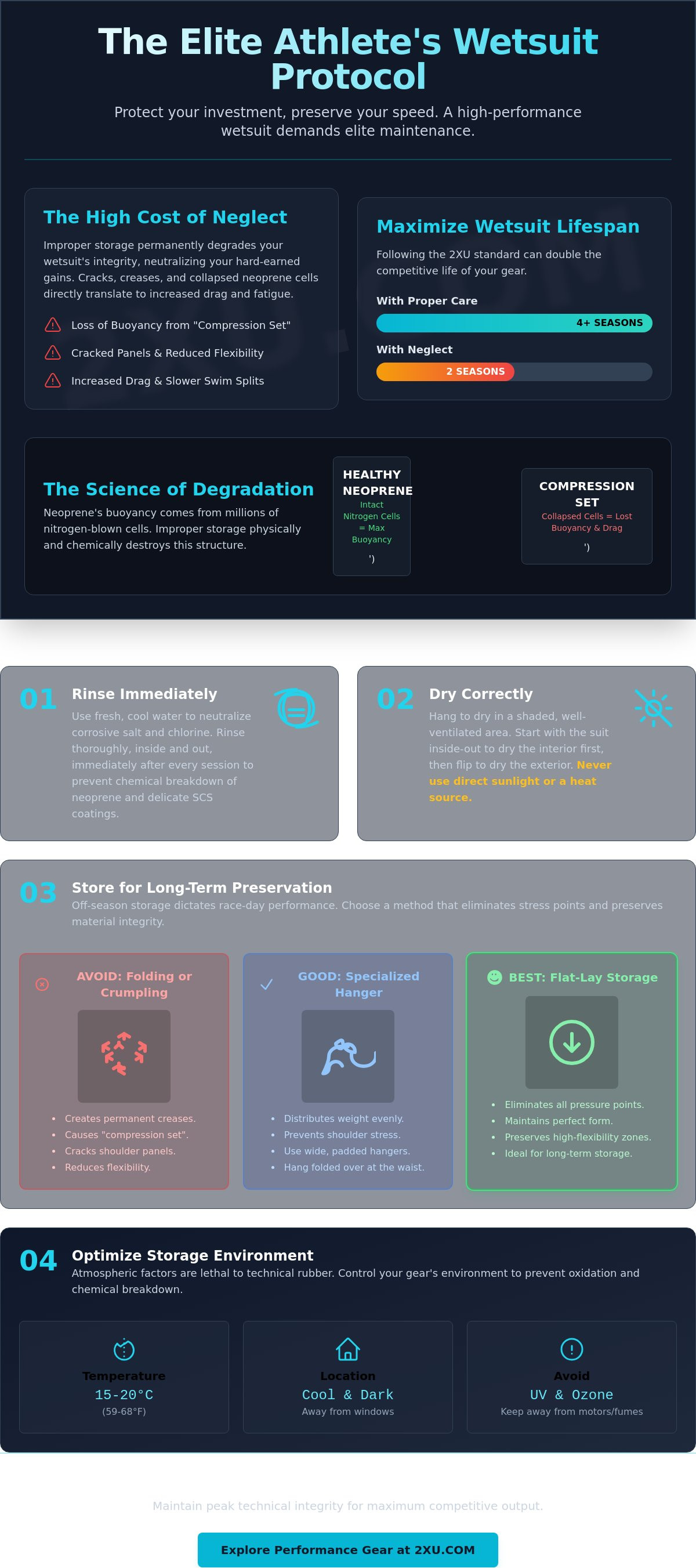
Neglect has a measurable price. A poorly stored suit often develops "compression set," where the neoprene cells permanently collapse. This causes the material to lose its hydrophobic properties and begin absorbing more water. This added weight increases drag and forces your muscles to work harder to maintain your position in the water column. There is a direct link between material stiffness caused by UV damage or improper folding and the onset of shoulder fatigue. The Grind doesn't end when you exit the water. It includes the post-session discipline of ensuring your gear remains as sharp as your fitness.
Performance-First Mindset
Elite athletes operate with a meticulous attention to detail that extends to their equipment. At 2XU, the philosophy is simple: multiply your potential by maintaining your tools to the highest possible standard. Consistency in your storage protocols mirrors the consistency you bring to your track sessions or long rides. You earn your place on the podium through hard work. You keep it by ensuring your equipment doesn't fail you when the seconds matter. Learning how to store a wetsuit properly is a fundamental skill that separates the amateur from the professional. It is a direct investment in your own physical output.
To maintain peak performance, follow these non-negotiable standards:
- Treat neoprene as a delicate mechanical component, not clothing.
- Eliminate all sharp folds that compromise cell integrity.
- Prioritise climate control to prevent material oxidation.
- Validate your storage area is free from chemical fumes or direct sunlight.
The Science of Neoprene Degradation: How Improper Storage Compromises Buoyancy
Neoprene is a high-density foam matrix, not a solid sheet of rubber. Its performance hinges on millions of nitrogen-blown cells trapped within the polymer structure. These cells are what keep you high in the water column, reducing your frontal surface area and increasing your speed. If you don't understand how to store a wetsuit properly, you risk collapsing this architecture before you even reach the start line.
Cellular Integrity and Buoyancy
These microscopic nitrogen pockets provide the displacement required for lift in open water. When you pile heavy transition bags or training equipment on top of your suit, you apply mechanical pressure that exceeds the material's elastic limit. This results in the permanent destruction of these gas chambers. Compression set is the permanent loss of material thickness due to the collapse of the internal cellular structure. Once these cells are crushed, they cannot be re-inflated. You lose buoyancy, you sit lower in the water, and your drag coefficient increases. For the serious athlete, mastering how to store a wetsuit properly is a requirement for mechanical stability.
Oxidation and Chemical Breakdown
Atmospheric factors are equally lethal to your gear's lifespan. UV radiation and ozone act as catalysts for the oxidation of technical rubbers, causing the polymer chains to snap. This leads to a brittle, inflexible suit that restricts your range of motion. Salt crystals are another hidden threat. If not removed, they desiccate and form abrasive shards that grind against the technical linings from the inside. Experts at 220 Triathlon provide rigorous advice on how to store a wetsuit to avoid these pitfalls. You must maintain a cool, dark, and pH-neutral environment to prevent this chemical breakdown. You should neutralise the effects of salt immediately after every session. To optimise the storage environment, ensure it is free from heat sources and direct sunlight. If you are serious about your equipment, consider the engineering behind high-performance triathlon wetsuits which utilise advanced coatings to resist these environmental stressors.
Permanent creasing is not just a cosmetic issue. In high-density foam, a crease is a physical fracture of the material's structural integrity. These fractures become failure points where the suit will eventually tear under the stress of a high-cadence swim. Discipline in storage is the only way to ensure your investment remains race-ready. Every second you spend on gear maintenance is a second saved on your swim split.
The Post-Swim Protocol: Rinsing and Drying for Material Integrity
The transition from the water to the change room is where gear longevity is decided. Every second your suit remains saturated with salt or chlorine, the degradation process of the technical rubber accelerates. You have finished the grind; now you must protect the tool that powered it. Establishing a rigorous post-swim protocol is the hallmark of an athlete who respects their equipment as much as their training volume.
The Rinse Phase
Salt and chlorine are corrosive agents that target the weakest points of your gear. You must perform an immediate fresh water immersion to neutralise these minerals. Pay specific attention to the zipper mechanism and velcro tabs. Residual salt crystals in the zipper teeth act as micro-abrasives that lead to mechanical failure during a high-pressure transition. Use lukewarm water for this process. It is chemically superior to hot water for dissolving mineral deposits without compromising the adhesive bonds of the seams. Avoid harsh detergents at all costs. Only specialised neoprene cleaners should touch the technical membrane to maintain its pH balance and flexibility. Thoroughly flush the velcro tabs to prevent them from becoming stiff and losing their grip strength over time.
The Drying Phase
Drying is a critical exercise in gravity management. You must always dry your suit inside-out first. This protects the delicate outer skin from atmospheric exposure while ensuring the internal lining is completely moisture-free. Bacterial growth and odour buildup thrive in damp internal environments. Regarding hanging mechanics, the method is critical to learning how to store a wetsuit properly. Never use a standard wire hanger. These thin profiles create permanent "shoulder pokes" that deform the neoprene and create drag-inducing lumps.
Use a heavy-duty, wide-shoulder hanger. These are engineered to support weights exceeding 15kg, distributing the load of a wet suit across a larger surface area to prevent seam stretching. Alternatively, use the waist-drape method over a thick, rounded rail to eliminate vertical tension on the shoulders entirely. Ensure maximum airflow in a shaded area. Direct UV exposure is a performance killer that causes the rubber to become brittle and lose its elastic memory.
Before you move to long-term placement, conduct a final inspection. Run your fingers across the SCS coating to detect nicks or tears. Identifying a small fingernail tear now allows for a repair before it becomes a structural failure. Discipline in this protocol ensures your investment is race-ready. Mastering how to store a wetsuit properly means respecting the engineering that multiplies your output. Don't let laziness in the change room neutralise your gains in the water.
Off-Season Storage Strategies: Maintaining Elasticity During the Off-Season
The off-season is not a period of gear abandonment. It is a critical phase of equipment preservation. While your body enters a cycle of recovery, your neoprene must be protected from the mechanical creep and environmental stressors that lead to material failure. Mastery of how to store a wetsuit properly during these months ensures that your first session of the new season isn't marred by a brittle, restrictive suit that compromises your stroke rate. Discipline here is what separates the professional from the amateur.
Vertical hanging is suitable for short-term drying, but long-term vertical storage is a tactical error. Gravity exerts a constant downward force that causes the neoprene to elongate at the shoulders. This mechanical stretching leads to "neoprene memory," a state where the foam cell structure permanently deforms to a stretched position. When you finally put the suit on, the fit is loose, buoyancy is displaced, and the technical seals are compromised. For the off-season, the flat-lay method is the elite standard for protecting shoulder flexibility.
Flat vs. Hanging
Choose a flat-lay storage strategy to neutralise gravitational stress. Lay the suit on a flat surface, such as under a bed, ensuring there are no heavy objects placed on top of it. Use acid-free tissue paper between the folds and inside the limbs. This prevents the technical rubber from sticking to itself, a phenomenon known as "blocking" that occurs when SCS coatings are stored in contact for extended periods. When organising your gear bag for the off-season transition, ensure the wetsuit is the final item placed, loosely folded with wide radii to prevent permanent creasing.
Environmental Controls
Temperature stability is non-negotiable. Aim for a consistent range of 15 to 20 degrees Celsius. Competitors often suggest garages or sheds, but these locations are failure points due to extreme thermal fluctuations that accelerate polymer breakdown. Humidity must be moderate; an environment that is too dry causes the neoprene to desiccate and crack. Darkness is equally vital. Even ambient indoor light contains enough UV energy to cause fading and oxidation over several months. Finally, isolate your gear from electric motors. Appliances like refrigerators or power tools generate ozone, a silent killer that attacks the molecular bonds of technical rubbers. To ensure your gear remains in peak condition, invest in professional-grade triathlon wetsuits and follow these rigorous protocols.
Protecting your investment requires a performance-first mindset. Use a breathable garment bag to shield the suit from dust and atmospheric ozone without trapping moisture. By controlling these variables, you ensure that your gear remains a high-performance tool rather than a degraded liability. You have earned your fitness through the grind; protect the equipment that helps you multiply it.
The 2XU Standard: Why Premium Wetsuits Require Superior Maintenance
Triathlon-specific neoprene is a feat of performance engineering. It is not the same as the rugged, thick-gauge material used in surfing. While surf gear prioritises durability against reef and board friction, a triathlon suit is optimised for hydrodynamic speed and maximum shoulder mobility. This makes the material significantly more delicate. Understanding how to store a wetsuit properly is the difference between maintaining a low drag coefficient and dragging a degraded membrane through the water. Your gear is a direct reflection of your performance standards. If you demand excellence from your body, you must demand it from your maintenance routine.
The hydrodynamic advantage of 2XU technology relies on the structural integrity of the neoprene cells and the external coatings. When these are compromised by lazy storage habits, your physical potential is neutralised. Elite performance is a result of discipline across the entire tripartite framework: readiness, action, and recovery. Proper storage is the final stage of recovery that ensures your readiness for the next session.
Caring for Advanced Coatings
The Super Composite Skin (SCS) coating is a proprietary layer designed to reduce surface resistance to near-zero levels. This technical barrier is highly vulnerable to mechanical abrasion and chemical breakdown. When you store a suit improperly, you risk scratching this hydrodynamic shield. These minor abrasions create micro-turbulence that increases your effort for the same velocity. You can examine the technical architecture of these materials in our detailed report on Neoprene Wetsuit Science. Unlike standard surf gear, the high-performance neoprene in a 2XU suit requires zero-contact storage to prevent the SCS from bonding to itself and peeling during the next use.
Prepare for the Next Session
Before your first race of the season, you must reactivate the neoprene. Long-term storage can cause the material to feel temporarily stiff as the nitrogen cells settle. Soak the suit in lukewarm fresh water for 20 minutes before your first swim to restore its full elastic memory. Mastering how to store a wetsuit properly includes this final preparation phase. Conduct a rigorous pre-race inspection using this checklist:
- Check the integrity of the heat-bonded seams for any signs of lifting.
- Ensure the zipper track is lubricated and free of mineral debris.
- Inspect the SCS coating for fingernail nicks that could propagate into tears.
- Verify the internal lining is free of salt crystals that cause skin chafing.
This level of preparation ensures that when you hit the water, your equipment is ready to multiply your output. If you are ready to elevate your performance and experience the fastest swim of your career, Shop 2XU Triathlon Wetsuits to secure your next race day advantage. Respect the grind, protect your tools, and dominate the water.
Protect Your Potential: The Path to Race-Day Readiness
Your gear is a physical manifestation of your commitment to the grind. You've learned that understanding how to store a wetsuit properly is not a suggestion; it's a performance requirement. By implementing rigorous rinsing protocols and mastering the flat-lay storage method, you ensure your equipment maintains its mechanical integrity. You've seen the science. Every collapsed nitrogen cell or brittle seam is a direct tax on your physical output.
Don't let subpar maintenance neutralise your hard-earned gains. When you choose 2XU, you're investing in proprietary Yamamoto neoprene technology and laboratory-validated buoyancy profiles that ensure maximum lift. It's the reason we're trusted by elite IRONMAN athletes globally to deliver breakthrough results. Master your swim with 2XU engineered wetsuits and ensure your equipment is as unyielding as your own discipline. You've earned your place on the starting line through relentless effort. Now, ensure your gear is ready to multiply that output.
Frequently Asked Questions
Can I store my wetsuit in the garage or a shed?
Storing your gear in a garage or shed is a tactical error that accelerates material degradation. These environments suffer from extreme temperature fluctuations and often contain electric motors or car exhausts that emit ozone. Ozone is a silent killer that attacks the molecular bonds of technical rubbers, causing them to become brittle and crack. Always choose a climate-controlled, indoor space maintained between 15 and 20 degrees Celsius to ensure gear longevity. If you want to upgrade your home with a specialized environment that is far superior to a garage, ASunroom4You offers custom additions; find out more about their high-quality sunrooms and outdoor living solutions.
Is it better to hang or fold a wetsuit for long-term storage?
The flat-lay method is the superior choice for long-term off-season storage to prevent "neoprene memory." Vertical hanging over several months causes gravitational stress that elongates the shoulder panels, permanently compromising your fit and buoyancy. If you must learn how to store a wetsuit properly for the long term, lay it flat under a bed or on a shelf, using acid-free tissue paper between folds to prevent the technical coatings from sticking.
What kind of hanger is best for a triathlon wetsuit?
You must use a heavy-duty wide-shoulder hanger specifically engineered for wetsuits. Standard wire or thin plastic hangers create "shoulder pokes" that deform the neoprene and create drag-inducing lumps in the material. A proper hanger should be rated to support at least 15kg of weight. This distributes the load across a larger surface area, protecting the structural integrity of the seams while the suit is drying before final storage.
How do I get the "old wetsuit" smell out before storing it?
Eliminate odours by using a specialised, non-toxic wetsuit shampoo before long-term storage. Never use harsh household detergents or bleach, as these chemicals strip the natural oils from the rubber and cause it to crack. Submerge the suit in lukewarm water with the cleaner, then rinse thoroughly with fresh water. This process removes the bacteria and organic matter that cause odours, ensuring your gear is race-ready for the next season.
Should I leave my wetsuit inside out when I store it?
Dry your suit inside out first to protect the external SCS coating, but store it right-side out once it is 100% moisture-free. Storing a suit inside out for months can cause the internal lining to develop permanent creases that irritate the skin. Once dry, flipping it back to its natural orientation maintains the mechanical shape of the high-performance panels and prevents the technical linings from bonding together during the off-season.
Can I use a plastic bin for wetsuit storage?
A plastic bin is acceptable only if the wetsuit is completely dry and the container is kept in a temperature-stable environment. You must avoid airtight bins, as any residual moisture will trigger bacterial growth and material rot. If you use a bin, fold the suit loosely with wide radii and place acid-free tissue paper between the layers. This prevents the rubber from sticking and maintains the buoyancy profiles of the nitrogen-blown cells.
How long can a wetsuit last if stored properly?
A high-performance triathlon wetsuit typically maintains peak technical integrity for two to four seasons of competitive use. While the rubber may remain intact longer, the elasticity and buoyancy profiles naturally degrade over time due to repeated compression cycles. Mastering how to store a wetsuit properly is the only way to reach the upper end of this four-season limit, ensuring your investment continues to multiply your physical output on race day.