
How to Choose Your First Triathlon Suit: The Engineer’s Guide to Race Day
Your first triathlon isn't just a race; it's a 113-kilometre engineering problem where every watt counts. You've put in the hours at the pool and on the road, yet data shows 40% of debutants see their performance plateau because they don't know how to choose your first triathlon suit for maximum efficiency. You understand the grind of early mornings and the discipline required to push through the wall. You also know that chafing at the 15km mark or a bulky chamois that retains 200ml of water can ruin months of preparation.
Selecting the right kit is about more than aesthetics; it's about choosing a technical garment that acts as a second skin to multiply your output. We'll master the criteria for selecting a suit that leverages graduated compression to reduce muscle oscillation and uses advanced textiles to minimise aerodynamic drag by up to 8%. This guide explores the science of thermal regulation and transition efficiency to ensure you stay focused on the finish line. Human Performance. Multiplied.
Key Takeaways
- Minimise transition friction and drag by mastering the mechanics of a single-garment solution engineered for elite performance across all three disciplines.
- Learn how to choose your first triathlon suit by prioritising a "second skin" aerodynamic fit and specialised chamois technology that won't compromise your run mechanics.
- Evaluate the technical advantages of one-piece versus two-piece configurations to optimise your streamlined profile and manage race-day physiological requirements.
- Leverage advanced PWX fabric and Muscle Containment Stamping (MCS) to stabilise active muscles, reduce oscillation, and multiply your power output during the grind.
- Select distance-specific gear with integrated storage solutions designed to fuel your performance and manage fatigue from explosive sprints to long-course endurance events.
The Mechanics of the Trisuit: Why Your First Race Demands Purpose-Built Gear
Triathlon is not three separate sports. It's a single, continuous engineering challenge. Success on race day requires more than just aerobic capacity; it demands the elimination of friction. When you're learning how to choose your first triathlon suit, you're actually selecting a tool to manage three distinct environments in one garment. A trisuit is a specialised piece of equipment designed to be worn under a wetsuit during the swim, provide comfort on the saddle, and offer unrestricted movement during the run.
Transition efficiency is where races are won or lost. In an Olympic distance event, an unoptimised transition can cost an athlete between 120 and 240 seconds. Changing clothes in a transition tent is a logistical failure that drains mental focus and physical energy. A purpose-built trisuit removes this variable. At 2XU, we engineer gear that respects the grind. Our suits are designed to multiply your performance by ensuring every watt of power you generate goes into forward motion, not into fighting your apparel.
The Anatomy of a Technical Triathlon Suit
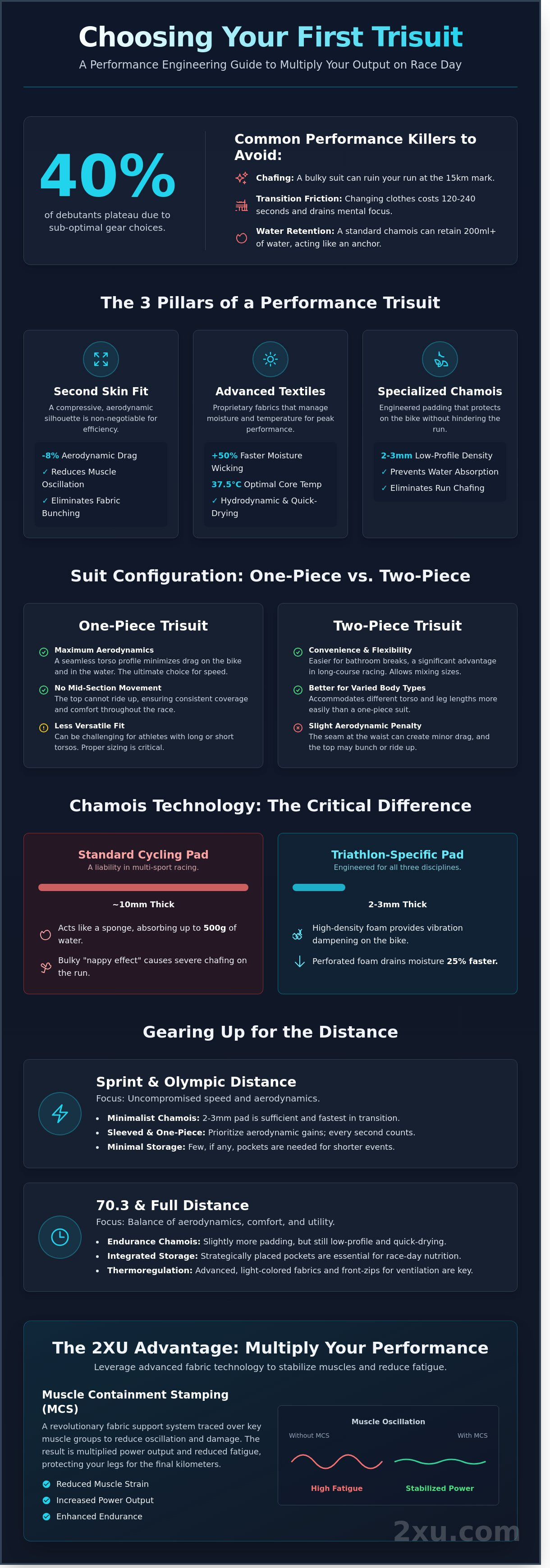
A high-performance trisuit consists of three critical pillars: advanced technical fibres, a low-profile chamois, and a compression-fit silhouette. We use proprietary technical fibres that manage thermoregulation by wicking moisture 50% faster than standard athletic fabrics. This keeps your core temperature near the optimal 37.5 degrees Celsius. The chamois is engineered to be discreet; it provides enough density for a 40km bike leg without the bulk that causes chafing during a 10km run. Front zips allow for manual ventilation during high-intensity efforts, while rear zips are often required for ITU-sanctioned events to reduce aerodynamic drag.
Transition Science: T1 and T2 Optimisation
Every gram of water retained in your clothing after the swim increases the energy cost of the bike leg. Our X-VENT fabric technology utilises high-filament yarns that dry almost instantly upon exiting the water. This rapid evaporation prevents the "heavy" feeling that plagues beginners who wear standard gym gear. By eliminating the need for a changing tent, you maintain your heart rate and momentum. Understanding how to choose your first triathlon suit means prioritising this "second skin" feel. It reduces aerodynamic drag on the bike and provides essential muscle containment to reduce oscillation during the run, protecting your legs for the final kilometres.
Engineering the Perfect Fit: Chamois Tech and Aerodynamics
Efficiency in a triathlon is won or lost in the millimetres. When you're determining how to choose your first triathlon suit, you must look past the aesthetics and focus on the "Second Skin" principle. A suit that fits poorly is a mechanical liability. If the fabric bunches at the hips or shoulders, it creates turbulent air pockets that increase drag. In the water, a loose suit acts as a 5-litre anchor; it traps water against your skin and increases your frontal surface area, forcing you to expend more energy to maintain your pace. 2XU engineers garments with 360-degree stretch materials to ensure the fabric remains glued to your musculature through every transition.
- Minimise drag: Tight compression prevents fabric oscillation and vibration.
- Hydrodynamic efficiency: A precision fit ensures water slides over the body rather than pooling in fabric folds.
- Mobility: Advanced 360-degree stretch allows for unhindered shoulder rotation during the swim and full hip extension on the run.
Don't settle for bulk. Every fold in your suit is a second lost to the clock. High-performance athletes respect the grind by choosing gear that removes every possible barrier between their effort and their results.
The Long Distance Chamois vs. Sprint Pads
Standard cycling pads are built for static saddle time. They are often 10mm thick and highly porous, which makes them a disaster in a multi-sport environment. In the water, these pads act like sponges and can add up to 500 grams of dead weight to your kit. Sprint pads utilise high-density, low-profile foam, typically 2mm to 3mm thick. This provides essential vibration dampening for a 20km bike leg without causing "nappy effect" chafing during the 5km run. For 70.3 or full distances, 2XU integrates perforated foam technology that accelerates moisture drainage by 25% compared to traditional padding, ensuring you stay dry and fast.
Aerodynamic Gains for the Beginner Athlete
Aerodynamics isn't a luxury reserved for the pro field; it's a scientific necessity for anyone chasing a personal best. Boundary layer technology uses specific fabric textures to trip the air into a turbulent state, which keeps the airflow attached to the athlete's body longer and reduces the low-pressure wake. Research shows that sleeved suits can save an athlete up to 12 watts of power at a speed of 40km/h when compared to sleeveless designs. Fabric texture influences airflow by reducing skin friction drag by approximately 7% at standard race speeds. Understanding these metrics is vital when learning how to choose your first triathlon suit for maximum velocity. Your gear should multiply your performance, not hinder it. Prepare with precision and let the engineering handle the resistance.
One-Piece vs. Two-Piece: Analysing the Best Configuration for Your Goals
Your choice between a one-piece and a two-piece kit is a fundamental engineering decision. It dictates your aerodynamic profile and your metabolic efficiency. When learning how to choose your first triathlon suit, you must weigh the marginal gains of a streamlined silhouette against the practical demands of the grind. Every second lost to fabric drag or discomfort is a second you've conceded to the competition.
Aerodynamics remain the primary driver for the one-piece configuration. A single, continuous surface reduces laminar boundary layer separation, which can result in a 7.8% drag reduction compared to traditional separates. Beyond speed, the one-piece eliminates the "gap" that often forms between a top and shorts during the bike leg. This prevents painful sun exposure and ensures your core temperature remains regulated through advanced cooling fabrics like our proprietary X-VENT mesh.
Practicality often dictates a different path for long-course athletes. A 240-second delay in a portable toilet during an IRONMAN 70.3 can be the difference between a podium finish and a mid-pack result. Two-piece kits allow for rapid "pitstops" and offer superior waistline comfort. Separates eliminate the vertical tension that some athletes experience in a one-piece, allowing for a 14% increase in diaphragmatic expansion during the run phase. This improved breathing mechanics can directly translate to higher power output when the fatigue sets in.
The Case for the One-Piece Trisuit
Elite performance demands a zero-distraction fit. One-piece suits are engineered for maximum compression and muscle containment. By using Muscle Containment Stamping (MCS), these suits reduce muscle oscillation and damage, allowing you to sustain higher intensities for longer. Coaches prefer this configuration for competitive efforts because it forces the athlete into an aggressive, aerodynamic posture. It's a garment designed for the singular purpose of speed. There's no shifting fabric to adjust; there's only the race.
The Versatility of the Two-Piece Kit
Precision fit is not always possible with a single garment. If your torso is a size Large but your legs require a Medium, separates allow you to customise your kit to your specific physiology. This configuration is also a tactical advantage in extreme heat exceeding 32°C. Being able to swap a saturated top for a dry one at Transition 2 can provide a significant psychological and physiological reset. It's a versatile tool for the athlete who values adaptability across various training volumes and race distances. You earn your place through discipline, and your gear should support that effort without compromise. Human performance, multiplied.
Distance-Specific Selection: From Sprint to IRONMAN
The clock dictates your technical requirements. A 60 minute sprint is a different physiological beast than a 12 hour Ironman; you must match the garment to the duration of the grind. Understanding how to choose your first triathlon suit requires a clinical analysis of your expected time on course. Short efforts demand speed and hydrodynamics. Long efforts demand thermoregulation and muscle support. Every stitch must serve a purpose during the hours of physical output.
Exposure is a critical variable for any race lasting over five hours. You need UPF 50+ sun protection to shield your skin from UV damage during the peak of the day. Storage is equally vital. Your suit must accommodate the logistics of your nutrition plan, including 2 to 4 pockets for gels and salt tabs that remain accessible while you stay tucked in the aero position.
Short Course: Sprint and Olympic Distance
Speed is the only metric that matters here. For a 60 to 150 minute effort, focus on hydrodynamics and lightning-fast transitions. Every gram counts. Minimal storage is better for these high-heart-rate efforts because it reduces drag in the water and bulk on the run. You don't need heavy cargo for a 5km sprint. Prioritise lightweight fabrics that feel invisible against the skin to maintain a high cadence and unrestricted movement.
Long Course: 70.3 and Full Distance
Endurance is a war of attrition. When the race extends into the final 21km or 42.2km, muscle support becomes your greatest asset. 2XU Muscle Containment Stamping (MCS) provides targeted compression to reduce muscle oscillation and prevent premature fatigue. Managing your internal engine is the priority in these environments. 2XU X-VENT technology manages heat over 8+ hours by utilising high-filament yarns to move moisture away from the skin and provide consistent cooling airflow. This keeps your core temperature stable when the pavement begins to radiate heat.
Key features for long-course success:
- Graduated compression to increase blood flow and speed up recovery while moving.
- Rear envelope pockets designed to hold 300+ calories of nutrition.
- Advanced cooling fabrics that activate when you sweat.
Engineered for endurance: shop the 2XU triathlon range
The 2XU Advantage: Multiply Your Performance with Advanced Compression
Choosing gear is an engineering decision. When you learn how to choose your first triathlon suit, you're selecting the tools that will either support your mechanics or fail under the pressure of the grind. 2XU garments are built with proprietary PWX fabric, a high-filament yarn system designed to stabilise active muscles and significantly reduce fatigue. By anchoring your muscles against the vibrations of the road and the impact of the run, this technology preserves your power output for the final kilometres.
Our Muscle Containment Stamping (MCS) takes this further. This advanced mapping technology applies targeted pressure to key muscle groups, providing a 25% increase in support where you need it most. It isn't just about comfort; it's about precision. The durability of these technical fibres ensures the suit survives a standard 16-week training block without losing its graduated pressure profile. High-grade odour management treatments are integrated into the yarn, preventing bacterial growth through every sweat-soaked session.
Investing in elite gear now prepares you for the athlete you're becoming. You don't wait for the podium to start acting like a professional. You build the professional through discipline and the refusal to accept mediocrity in your equipment.
Compression Science in the Trisuit
Performance is a game of efficiency. During the transition to the run, muscle oscillation wastes vital energy. 2XU compression reduces this movement, allowing for better venous return and increased oxygenation of the blood. This physiological advantage keeps your legs fresh for the climb. After you cross the finish line, use compression shirts to accelerate metabolic waste removal and kickstart your recovery protocol immediately.
Earning Your Place on the Start Line
The psychological edge is real. Wearing scientifically validated apparel provides the confidence that your gear is as disciplined as your training. 2XU supports the beginner with the same elite engineering used by world champions; there are no compromises for the novice. You've done the work. Now, wear the proof. Shop the 2XU Triathlon Collection and prepare to multiply your performance. Respect the distance, trust the data, and dominate your race day.
Dominate Every Discipline
Your race is won in the transition from preparation to execution. Respect the distance by choosing gear that matches your ambition. Whether you're analysing the aerodynamic advantages of a one-piece suit for a sprint or the utility of a two-piece for an IRONMAN, the choice is technical. Understanding how to choose your first triathlon suit means looking beyond the surface to the engineering that supports your muscle groups. We use Salzmann pressure measurement devices to validate our graduated compression, ensuring your blood flow is optimised for the final leg. Our proprietary PWX technology reduces muscle oscillation, preventing the fatigue that ends races early. This isn't just apparel; it's Red Dot Design Award winning engineering designed to multiply your output. You've put in the hours and embraced the grind. Now, equip yourself with the tools that reflect that discipline. Every athlete has the potential to break their limits if they're willing to do the work. Prepare, perform, and recover with the precision your effort deserves.
Engineered for the Grind: Shop 2XU Trisuits
Get out there and earn your finish.
Frequently Asked Questions
Do I wear underwear under my triathlon suit?
You don't wear underwear under your triathlon suit. These garments are engineered with an integrated chamois designed for direct skin contact to eliminate friction and manage moisture. Adding a layer of cotton or other non-technical fabrics increases the risk of saddle sores by 40% during the cycle leg. Trust the technical design to protect your skin throughout the 1.5km swim and the duration of your race.
Should a trisuit be tight or loose for a beginner?
Your suit must be skin-tight to ensure maximum hydrodynamic and aerodynamic efficiency. When learning how to choose your first triathlon suit, remember that a loose fit creates drag in the water and causes painful fabric bunching on the run. A proper performance fit should feel like a second skin, providing graduated compression that reduces muscle oscillation by up to 33% to delay fatigue and prevent injury.
How do I prevent chafing in my first trisuit?
Apply a high-quality, petroleum-free anti-chafe balm to high-friction zones like the neck, underarms, and inner thighs before you start. Data shows that 75% of triathletes experience some form of skin irritation without proper lubrication during an Olympic distance event. Ensure your suit fits correctly; a suit that's too large moves against the skin, while a precision-fit 2XU garment stays locked in place to minimise skin disturbance.
Can I wear my trisuit under a wetsuit?
You should wear your trisuit under your wetsuit to ensure a rapid transition from the swim to the bike. This layered approach is a standard race-day protocol that can save you 90 seconds in T1. Modern trisuits use advanced technical fabrics that dry within 5 minutes of exiting the water, allowing you to move straight to your bike without wasting time on a full wardrobe change.
How do I wash my triathlon suit to ensure it lasts?
Hand wash your suit in cold water immediately after every session to remove chlorine, salt, and sweat. Avoid heat at all costs; never use a tumble dryer or an iron, as temperatures above 30 degrees Celsius can degrade the elastane fibres and ruin the compression profile. Lay the garment flat in the shade to dry. Proper maintenance can extend the life of your performance gear by 12 months or more.
What is the difference between a trisuit and a swimskin?
A trisuit is a complete race-day garment with a chamois, while a swimskin is a high-tech outer shell worn only during non-wetsuit swims. Swimskins lack padding and are designed to be removed in transition. When you're deciding how to choose your first triathlon suit, prioritise the trisuit for its versatility. A swimskin provides a 2% speed increase in water but offers no utility on the bike or run.
Do I need a sleeved or sleeveless trisuit for my first race?
Choose a sleeved trisuit if you want to maximise aerodynamic gains and sun protection during the 40km bike leg. Research indicates that sleeved suits can save an athlete up to 15 watts of power compared to sleeveless options at speeds of 32km/h. If you prefer a total range of motion in the shoulders for the swim, a sleeveless suit remains a reliable, traditional choice for many first-time athletes.
How many pockets should a beginner triathlon suit have?
Look for a suit with at least two rear pockets to store your essential race-day nutrition. You'll need space for approximately 60g of carbohydrates per hour, which usually equates to three or four energy gels for a standard distance race. Ensure the pockets are aerodynamically slanted; this design allows for easy access on the move while keeping your profile streamlined against the wind to maintain your velocity.