
How to Acclimate to Cold Water Swimming: The Elite Performance Protocol
Your body is a precision instrument, yet sub-15°C water can reduce it to a shivering, gasping mess in seconds. Most athletes fear the cold because they haven't mastered the biological recalibration required to weaponise it. You have likely felt that crushing involuntary cold shock response where your lungs seize and your manual dexterity vanishes. It is a frustrating barrier that limits your duration and destroys your race strategy. Mastering how to acclimate to cold water swimming is not about toughing it out; it is about systematic physiological conditioning and the mental discipline of the Grind.
This protocol will teach you how to eliminate the gasp reflex and extend your high-intensity output in extreme conditions. We are going to explore the scientific framework of thermal adaptation, from the 530 per cent dopamine surge triggered by 14°C immersion to the technical integration of advanced Yamamoto limestone materials found in the 2026 Propel wetsuit range. You will learn to bypass the panic and multiply your performance through a three-part framework of readiness, action, and recovery. Prepare to transform the water from an adversary into your greatest performance multiplier.
Key Takeaways
- Understand the biological mechanics of cold shock and peripheral vasoconstriction to regain immediate control over respiratory and muscular function.
- Master how to acclimate to cold water swimming by dampening your sympathetic nervous system response and activating non-shivering thermogenesis.
- Execute a systematic, tiered training protocol that builds from daily cold shower foundations to calculated, high-intensity open water immersions.
- Develop the elite mental discipline of sensory awareness to treat extreme cold as a performance-multiplying sparring partner rather than a distraction.
- Integrate physiological adaptation with advanced neoprene science to maximise buoyancy and extend your competitive output window in sub-15°C conditions.
The Physiology of Cold Shock: Understanding the Biological Barrier
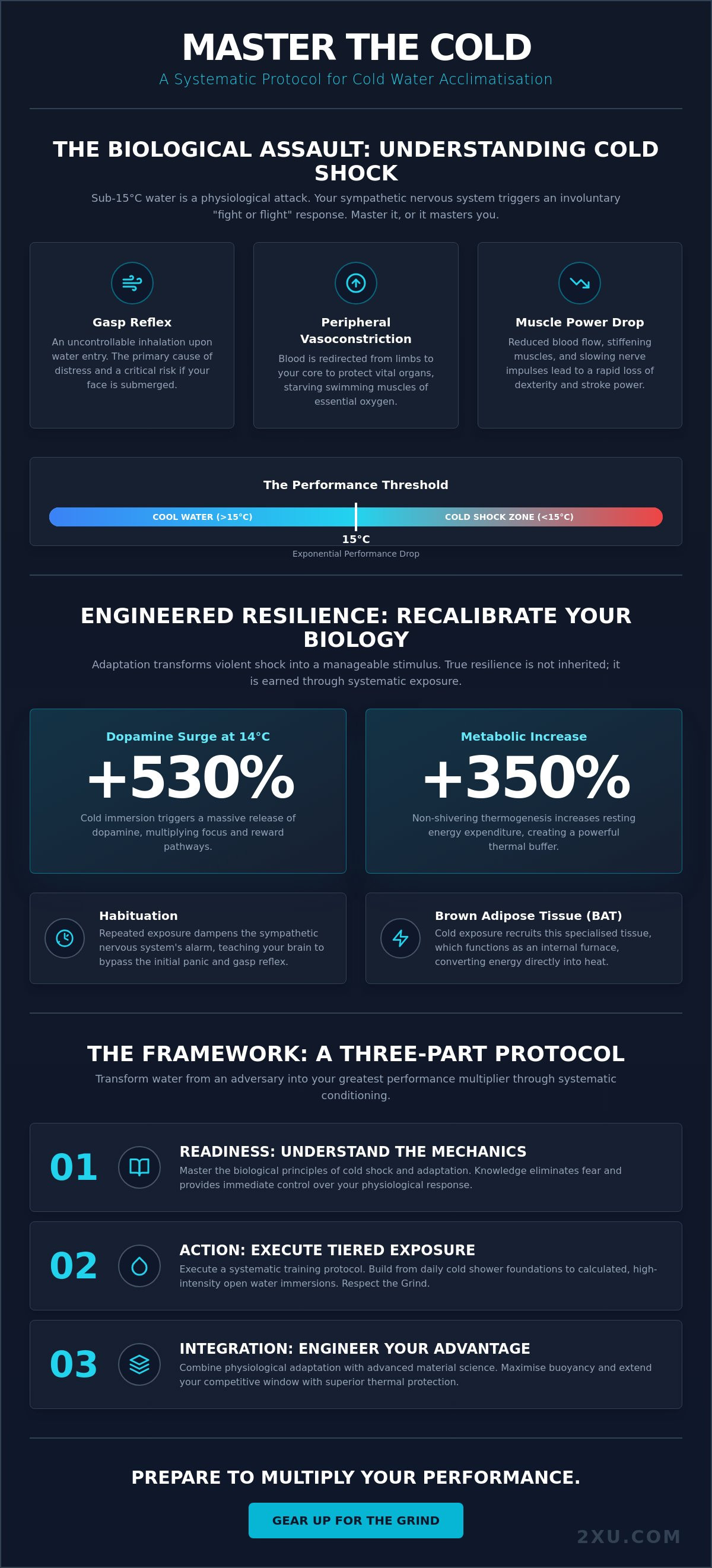
Sub-15°C water is not merely a temperature; it is a physiological assault. The moment your skin hits the water, your body initiates the cold shock response. This is an immediate, involuntary reaction that can compromise even the most elite athlete's performance in seconds. Understanding how to acclimate to cold water swimming begins with identifying this biological wall. Your sympathetic nervous system enters a state of "fight or flight," triggering a massive spike in heart rate and blood pressure as your body attempts to survive a perceived threat.
The most immediate hurdle is the "gasp reflex." This uncontrollable inhalation is the primary cause of distress in open water. If this gasp occurs while your face is submerged, the risk of aspiration is high. Simultaneously, your body initiates peripheral vasoconstriction. This mechanism redirects blood flow from your extremities to your core to protect vital organs. While this preserves your life, it starves your swimming muscles of oxygenated blood. The Physiology of Cold Shock dictates that this reduction in limb blood flow leads to a rapid loss of manual dexterity and a significant drop in muscle power. You aren't just fighting the water; you're fighting a body that is actively shutting down its performance systems to stay warm.
The Thresholds of Performance
Water temperatures between 15°C and 20°C are classified as "cool." In this range, most athletes can maintain a standard stroke rate with minimal discomfort. Once you drop below the 15°C threshold, the impact becomes exponential. Cold water reduces your stroke rate and destroys your power output as muscles stiffen and nerves slow down. For the modern triathlete, mastering cold shock is the definitive 2026 performance benchmark for open water dominance. You must learn to override the primitive urge to panic to maintain your mechanical stability.
Biological Baselines vs. Engineered Resilience
Genetics provide your starting point, but they do not define your limit. Factors like Body Mass Index and the distribution of subcutaneous fat influence your thermal inertia, providing a natural buffer against the cold. However, relying on biology alone is a mistake. True resilience is engineered through the daily grind of systematic exposure. You don't inherit the ability to thrive in sub-15°C water; you earn it through disciplined training and the refusal to accept average standards. Resilience is a calculated outcome, not a lucky trait. Mastering how to acclimate to cold water swimming is the only way to multiply your natural baseline and achieve breakthrough results.
Mechanisms of Adaptation: How Your Body Recalibrates for the Cold
Adaptation is the process of transforming a violent shock into a manageable stimulus. While the initial cold shock response is a primitive survival mechanism, repeated exposure forces the central nervous system to habituate. Habituation is the strategic dampening of the sympathetic nervous system's alarm bells. Over time, your brain learns to ignore the immediate danger signal sent by skin thermoreceptors. This neurological recalibration is essential for anyone learning how to acclimate to cold water swimming because it prevents the frantic gasp reflex. It allows you to maintain a rhythmic, efficient stroke from the second you enter the water. This metabolic surge can increase your resting energy expenditure by up to 350 per cent, providing a massive thermal buffer against the elements.
The Role of Brown Adipose Tissue (BAT)
Forget the myth that subcutaneous fat is your only defence. Elite cold water performance relies on Brown Adipose Tissue (BAT), a specialised type of fat that functions more like a furnace than a blanket. Unlike white fat, which stores energy, BAT contains high concentrations of mitochondria that convert chemical energy directly into heat through non-shivering thermogenesis. Consistent cold exposure recruits more BAT, essentially upgrading your internal heating system. Research into Mental Discipline and the Cold Water Grind highlights how this biochemical shift provides the thermal inertia required to sustain core stability when temperatures plummet. This is not passive insulation; it is active, biological engineering that multiplies your endurance capacity.
Habituation and the Vagus Nerve
Your ability to endure sub-15°C water is governed by the vagus nerve, which acts as the throttle for cold resilience. By engaging in systematic exposure, you improve your heart rate variability (HRV). This is a key metric of your body's ability to switch between intense stress and recovery. High HRV indicates a nervous system that can handle the intensity of cold immersion without losing mechanical control. The brain eventually classifies the cold as a non-threat, allowing you to focus on power output rather than survival. This neural efficiency multiplies your time-to-incapacitation, giving you a distinct advantage in the final kilometres of a race. To support this biological adaptation, integrating advanced neoprene wetsuits into your training ensures you maintain the critical balance between heat retention and hydrodynamics.
Recalibration is not a one-off event. It is a cumulative result of the Grind. Every session where you choose the cold over comfort builds your metabolic and neural capacity. By the time you reach the starting line, your body is no longer reacting to the water; it is dominating it. You have moved beyond the biological baseline and into the realm of engineered performance. Mastering how to acclimate to cold water swimming ensures that when others are fighting to breathe, you are already accelerating.
The 2XU Protocol: A Systematic Approach to Cold Water Acclimatisation
Acclimatisation is not an act of bravado; it is a deliberate engineering of your nervous system. To dominate sub-15°C water, you must follow a structured progression that prioritises consistency over raw intensity. The goal is to move from the initial shock response to a state of controlled performance. Research into the physiological and psychological adaptations to cold confirms that repeated, brief exposures are more effective than infrequent, long-duration plunges. This is where you earn your resilience through the daily Grind. Understanding how to acclimate to cold water swimming requires a phased approach that respects biological limits while relentlessly pushing them forward.
The protocol is divided into four distinct phases. Phase 1 establishes the Cold Shower Foundation (Weeks 1-2). Phase 2 moves to Brief Immersions and the 5-Minute Rule (Weeks 3-4). Phase 3 introduces Sustained Swimming and Interval Work (Weeks 5-6). Finally, Phase 4 focuses on Race-Pace Integration in open water. Discipline is the only variable that matters here. If you skip the foundation, you will fail when the temperature drops. Your body requires time to damp down the sympathetic response and recruit the metabolic heat production systems discussed earlier.
Step-by-Step Training Schedule
- Weeks 1-2: End every daily shower with 30 seconds of maximum cold. Focus on rhythmic, deep breathing to override the gasp reflex. Do not rush out; stand and control the sensation.
- Weeks 3-4: Graduate to 2-minute "dips" in open water. Do not attempt to swim laps yet. Walk in until the water reaches your chest, submerge your shoulders, and maintain total composure. This habituates the brain to the thermal transition.
- Weeks 5-6: Introduce 10-minute active swims. Your focus must remain entirely on stroke mechanics and power output. If your form breaks down due to shivering, the session is over.
Monitoring the Recovery Phase
The workout does not end when you exit the water. You must account for the "Afterdrop" phenomenon. This occurs because cold blood from your extremities begins to circulate back to your core once you stop moving, causing your internal temperature to continue falling for up to 45 minutes. Immediate post-swim protocols are mandatory. Dry yourself quickly, apply heavy layers, and consume warm liquids. To assist with post-swim circulatory support and mitigate the fatigue of temperature regulation, many elite athletes utilise flight pressure socks to enhance venous return. This accelerates the transition from action to recovery, ensuring your body is ready for the next session of the Grind. Mastering how to acclimate to cold water swimming is as much about the exit strategy as it is about the entry.
Beyond the Physical: Mental Discipline and the Cold Water Grind
Amateurs try to distract themselves from the chill. They tell themselves the water isn't cold or attempt to think of something else to avoid the discomfort. This is a fundamental mistake. In elite performance, distraction is a vulnerability that leads to mechanical breakdown and a loss of stroke awareness. Mastering how to acclimate to cold water swimming requires total presence and sensory awareness. You must lean into the cold. Treat it as a sparring partner that demands your absolute focus and tests your technical stability under pressure. If you cannot remain present in the chill, you will lose your rhythm when the race intensity spikes and the involuntary shock response takes over.
Controlled Breathing Techniques
Breath is the bridge between panic and performance. Upon entry, the 4-count box breathing method is your primary tool for regaining autonomic control. Inhale for four seconds; hold for four; exhale for four; hold for four. This sequence forces your nervous system to stabilise. When your face first hits the water, execute a deliberate, long exhale. This acts as a psychological release of the shock response, signaling to your brain that you are the one in control. Maintaining a rhythmic breathing pattern prevents the hyperventilation that often plagues unconditioned swimmers. Consistent breath control ensures your muscles receive the oxygen required for high-intensity output while keeping your heart rate within a manageable range.
The Psychology of Resilience
Resilience is a calculated outcome of the Grind. You must learn to visualise the thermal barrier as a physical plane you move through with intent, rather than a wall that stops your progress. Every session in sub-15°C water builds your "cold water resume." This is a mental database of every morning you chose discipline over comfort. On race day, when the water temperature threatens your confidence, you look back at this resume for proof of your capability. This is the "Human Multiplied" philosophy. You are using the cold to sharpen your mental focus until it becomes a competitive advantage. To ensure your physical equipment is as resilient as your mindset, equip yourself with neoprene wetsuits engineered for maximum thermal protection.
The hardest days build the most resilient athletes. When the wind is up and the water is grey, that is when the real adaptation happens. Embracing the Grind means accepting that discomfort is the price of entry for elite results. You aren't just training your body; you are hardening your mind. By the time you reach the starting line, you won't just be ready to swim. You will be ready to dominate.
Engineering Your Advantage: Neoprene Science and Thermal Protection
Biology provides the foundation, but engineering provides the edge. While the previous sections established the metabolic and neurological framework for performance, high-level success in sub-15°C water requires a technical interface. Relying on equipment alone is a tactical error. However, when you combine a body that has mastered how to acclimate to cold water swimming with elite-tier materials, you create a physiological multiplier. Gear does not replace the Grind; it amplifies the results of your discipline.
Synergy of Gear and Biology
An acclimated body performs fundamentally better inside a wetsuit. When your nervous system has already habituated to the cold, your heart rate remains stable upon entry, allowing the suit to function as a thermal regulator rather than a survival tool. This synergy reduces the metabolic cost of maintaining core temperature. By dampening the initial entry shock, you can immediately transition into your race-pace stroke. Selection of material thickness must be data-driven, based on your specific thermal threshold and the expected duration of the event. A non-acclimated swimmer will experience peripheral vasoconstriction regardless of their suit, but an adapted athlete maintains blood flow to the primary movers for longer durations.
Buoyancy is the silent performance driver in cold conditions. Cold water is more dense, and the energy required to maintain a horizontal plane increases as muscles stiffen. Advanced neoprene wetsuits provide the necessary lift to reduce drag, effectively lowering the oxygen demand of every stroke. This allows you to redirect precious energy from buoyancy maintenance to propulsion. In extreme conditions, protection must extend to the extremities. Neoprene caps, gloves, and booties are essential accessories. These protect the areas with high surface-area-to-volume ratios where heat loss is most rapid, preventing the loss of manual dexterity that ruins transitions.
The 2XU Performance Edge
The engineering challenge in elite wetsuit design is the trade-off between thermal insulation and joint mobility. 2XU addresses this through advanced cell structures that trap a thin layer of water, which your body heat quickly warms, without adding restrictive bulk. A precision fit is non-negotiable. Any gap in the seal leads to "flushing," where cold water enters the suit and resets the thermal layer, forcing your body back into an energy-draining heating cycle. Every seam and panel is designed to move with the athlete, ensuring that protection never comes at the cost of power output. If you have done the work to learn how to acclimate to cold water swimming, your gear should be the final piece of the performance puzzle. Explore the 2XU Triathlon Wetsuit Collection to engineer your fastest swim and prove that human is multiplied.
Dominating the Sub-15°C Threshold
Mastering the transition from cold shock to controlled output is the hallmark of the elite athlete. You now possess the scientific framework to recalibrate your nervous system and recruit the metabolic power of Brown Adipose Tissue through consistent discipline. By implementing a phased protocol and rejecting the weakness of distraction, you have learned how to acclimate to cold water swimming at a level that multiplies your natural baseline. The Grind has prepared your body; now you must protect that progress with the highest standard of engineering.
Ensure your technical interface is as resilient as your mindset. 2XU offers elite-level neoprene technology and scientifically validated compression benefits that are trusted by IRONMAN champions globally. Don't leave your thermal stability to chance when you can command it through superior design.
Multiply your performance with 2XU High-Performance Wetsuits
The water does not care about your excuses, but it respects your preparation. You have the protocol and the proof. Now, get in and earn the results your hard work deserves.
Frequently Asked Questions
How long does it take to acclimate to cold water swimming?
It typically takes between six and ten consistent exposures to achieve a 50 per cent reduction in the cold shock response. For a full physiological recalibration, you should allow four to six weeks of systematic training. This timeframe ensures your body has recruited sufficient Brown Adipose Tissue and habituated the nervous system to sub-15°C conditions.
Can you acclimate to cold water in the shower?
You can initiate the habituation process in the shower by finishing every session with 30 to 60 seconds of maximum cold. This triggers the initial gasp reflex and forces you to practice autonomic control through rhythmic breathing. While it builds the foundation for how to acclimate to cold water swimming, it cannot replicate the hydrostatic pressure or the metabolic demands of active propulsion in open water.
What is the "afterdrop" and how do I manage it?
The afterdrop is a phenomenon where your core temperature continues to plummet for up to 45 minutes after you exit the water. This happens as cold blood from your extremities returns to your core once you stop moving. Manage this by drying off immediately, applying heavy layers, and consuming warm liquids. Never take a hot shower immediately after exiting as this can cause a dangerous drop in blood pressure.
Is it better to jump in or walk slowly into cold water?
You should walk steadily into the water rather than jumping or diving. Jumping causes a massive, instantaneous skin cooling that maximises the cold shock response and increases the risk of involuntary aspiration. Walk in until the water reaches your chest, pause to regain control of your breathing, and then submerge your shoulders with intent to signal to your brain that the stimulus is managed.
How many times a week should I swim to maintain cold tolerance?
Maintenance of cold tolerance requires at least two to three exposures per week. Physiological adaptations like Brown Adipose Tissue activation begin to fade within seven to ten days of inactivity. Consistency is the only way to ensure your performance baseline remains multiplied. If you stop the Grind, your body will revert to its primitive, unconditioned state.
What should I wear for my first cold water swim?
Your first cold water swim should be performed in a high-performance triathlon wetsuit paired with a neoprene cap. These items provide the thermal insulation and buoyancy needed to focus on stroke mechanics rather than survival. As the temperature drops below 12°C, you should integrate neoprene gloves and booties to protect your extremities from losing manual dexterity and power output.
Does cold water acclimation help with weight loss or recovery?
Cold water immersion increases metabolic rate by up to 350 per cent through non-shivering thermogenesis, which can assist with weight management. From a recovery perspective, the vasoconstriction helps flush metabolic waste and reduces systemic inflammation. This is a primary reason why elite athletes use cold exposure as a tripartite tool for readiness, action, and recuperation.
At what temperature is water considered dangerous for swimmers?
Water below 15°C is considered high-risk for unconditioned swimmers due to the severity of the cold shock response. World Aquatics has set the minimum safety standard for competition at 16°C as of April 2026. Swimming in temperatures lower than this requires specific training in how to acclimate to cold water swimming and the use of engineered thermal protection to prevent incapacitation.