
Best Wetsuit Brands 2026: Engineering Speed and Hydrodynamic Power
Your choice of neoprene isn't just a gear decision; it's a mathematical calculation of your potential velocity in the water. Many athletes mistakenly believe that any suit will suffice, yet they find themselves battling restricted shoulder mobility and slow transition times that bleed seconds off their splits. Identifying the best wetsuit brands requires you to look past marketing aesthetics and into the laboratory where hydrodynamic power is engineered. You deserve a suit that doesn't just float; it must multiply your physical output.
We understand the frustration of a suit that feels like a lead weight after the first kilometre. This article promises to reveal the world's leading wetsuit brands and the specific engineering required to multiply your performance in open water. We will examine how proprietary 45 Cell Yamamoto neoprene and SCS coatings reduce drag to optimise your speed. You'll discover how to select a suit that ensures faster swim splits and reduced fatigue, providing the mechanical stability and durability needed to last through multiple seasons of the grind.
Key Takeaways
- Learn the critical engineering differences between surfing and triathlon suits to avoid gear that restricts your shoulder mobility and slows your splits.
- Discover how Yamamoto 39 and 45 cell neoprene work with SCS coatings to reduce hydrodynamic drag and multiply your velocity.
- Compare the best wetsuit brands based on their ability to provide buoyancy and mechanical stability under high-intensity conditions.
- Use a data-driven approach to match your body morphology with the correct buoyancy profile for reduced fatigue and faster transitions.
- Explore how 2XU uses proprietary technology to ensure every stroke delivers maximum distance through the water, helping you master the grind.
Elite Wetsuit Brands: Understanding the Performance Landscape
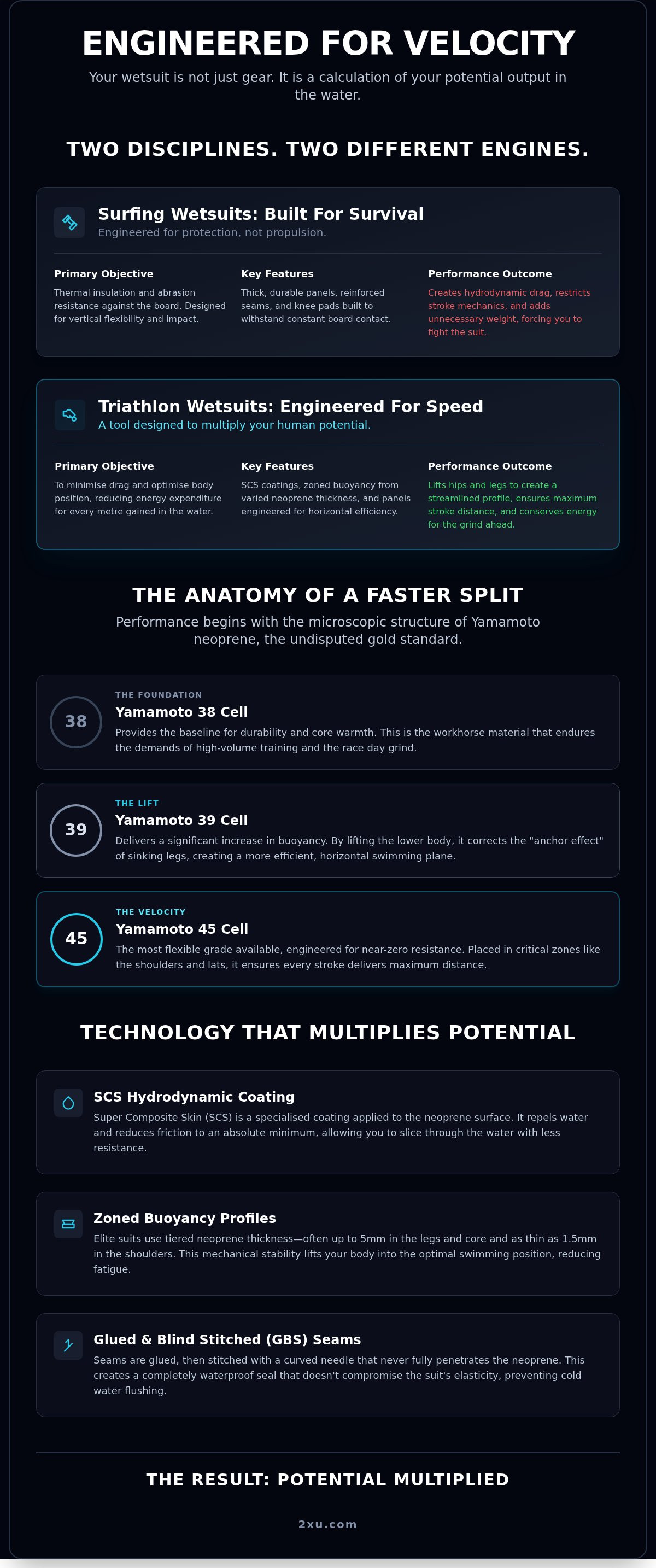
The market for the best wetsuit brands is bifurcated by two radically different engineering objectives: survival in the surf and speed in the lane. If you're a serious athlete, you must understand that a "top-tier" surfing suit is fundamentally compromised for competitive swimming. Surfing requires vertical flexibility and protection from board impact. Triathlon requires horizontal hydrodynamic efficiency and buoyancy. Choosing the wrong brand results in increased hydrodynamic drag, which forces your cardiovascular system to work harder for every metre gained. When investigating The Science of Neoprene, it becomes clear that the cell structure determines the suit's primary function. You don't need a suit that merely protects you from the cold; you need a tool that sharpens your output.
Hydrodynamic drag is the silent killer of performance. Every seam, logo, and textured panel on a suit creates turbulence. Leading triathlon brands spend thousands of hours in laboratory settings to ensure their suits present a smooth, low-friction surface to the water. This isn't about comfort. It's about physics. A suit that reduces drag by even a small percentage can shave minutes off your personal best by allowing your muscles to focus on propulsion rather than overcoming resistance. Fit philosophy also plays a critical role. Each brand uses unique patterns for body morphology, meaning the "best" suit is the one that eliminates water pockets without restricting your lung expansion.
Surfing Brands: Flexibility and Abrasion Resistance
Brands like O'Neill and Rip Curl dominate the surf industry by prioritising vertical movement and durability. Their suits feature reinforced seams and thick knee pads to withstand constant board contact. While essential for surfing, these features add unnecessary friction for a swimmer. These brands focus on thermal insulation rather than minimising the drag coefficient. If you wear these for a long-distance split, you're fighting the suit's own weight. They are built for the casual environment of the waves, not the disciplined grind of the race course.
Triathlon Brands: Buoyancy and Stroke Efficiency
Performance-driven brands like 2XU engineer suits specifically for the competitive swimmer. The goal is simple: optimise body position to reduce energy expenditure. Most swimmers suffer from leg sink, which creates an anchor in the water. Triathlon-specific engineering uses tiered neoprene thickness to lift the hips and legs. This mechanical stability allows you to maintain your form through the grind of a race split. These suits multiply your efficiency by reducing your cross-sectional area. Every feature, from floating zip panels to graduated compression, exists to ensure your human potential is multiplied through the water.
The Science of Neoprene: What Defines a Leading Brand?
The difference between mediocrity and a podium finish often lies in the microscopic structure of your suit's rubber. For the best wetsuit brands, engineering begins with the source material. We evaluate performance through a Tripartite Athletic Framework: Readiness, Action, and Recovery. Readiness ensures the suit allows for maximum lung expansion and pre-race mobility. Action focuses on the mechanical stability and drag reduction during the swim. Recovery addresses how the suit's buoyancy reduces muscle fatigue, allowing you to transition into the run with fresh legs. This holistic view is why elite athletes demand specific neoprene grades rather than generic materials.
Construction methods further separate the elite from the average. Glued and Blind Stitched (GBS) seams involve gluing the edges and then using a curved needle that never fully penetrates the neoprene, preventing water leakage. Some brands use liquid taping for a total seal, though this can sometimes compromise the suit's natural elasticity. To truly excel, you need a suit that balances these technical elements to support your individual grind.
Yamamoto Neoprene: The Gold Standard
Unlike standard petroleum-based materials, Yamamoto neoprene is derived from limestone, featuring a closed-cell structure that is 99.7% water-impermeable. The hierarchy of these cells determines your velocity. Yamamoto 38 is the baseline for durability and core warmth. Yamamoto 39 cell neoprene provides a significant increase in buoyancy, lifting the lower body to correct the "anchor" effect of sinking legs. For the most critical zones, such as the shoulders and lats, the best triathlon wetsuits utilise Yamamoto 45 cell. This is the most flexible grade available, engineered to offer near-zero resistance during the recovery phase of your stroke. By strategically placing these different densities, brands can optimise the suit for both lift and uninhibited movement.
Hydrodynamic Coatings and Drag Reduction
A suit's skin is just as vital as its core. Leading brands apply SCS (Super Composite Skin) coatings to the exterior surface. SCS coating is a drag-reducing polymer layer. In laboratory testing, this coating reduces the coefficient of dynamic friction to 0.032, compared to 4.0 for standard neoprene. This means you move through the water with exponentially less resistance. While high-end coatings provide a massive performance advantage, they require discipline to maintain. The trade-off for this speed is a thinner, more delicate surface that demands respect during the transition. Identifying the best wetsuit brands means finding the ones that refuse to compromise on these technical specifications.
Top Wetsuit Brands of 2026: A Performance Comparison
Identifying the best wetsuit brands requires a rigorous evaluation of mechanical stability and athletic output. You cannot judge a suit by its aesthetics; you must judge it by its ability to maintain your hydrodynamic profile through the grind of a long-distance split. In 2026, the market is split between those pioneering pure vertical flexibility for the surf and those engineering mathematical improvements in horizontal swim velocity. We evaluate these entities based on their capacity to reduce energy expenditure while maximising propulsion.
2XU stands as the definitive leader in hydrodynamic multiplication. While other brands focus on general warmth, 2XU engineers its triathlon wetsuits to lift the hips and reduce drag through proprietary Yamamoto 39 and 45 Cell neoprene. By integrating SCS coatings and floating zip panels, they ensure that every stroke translates into maximum distance. This is the expert choice for athletes who refuse to compromise on speed. Conversely, O'Neill remains a powerhouse for pioneering the modern wetsuit. Their Hyperfreak series sets the standard for vertical flexibility in the surfing world. However, this design often lacks the buoyancy profiles required for competitive open water swimming. Patagonia leads the industry in environmental accountability. Their shift to non-petroleum, natural rubber alternatives proves that performance and sustainability can coexist. For the athlete prioritising ecological impact, they offer the premier solution.
Comparing the Giants: 2XU vs. The Field
Contrast 2XU's focus on horizontal propulsion with the vertical-movement philosophy of traditional surf brands. A surf suit prioritises the ability to pop up and paddle, whereas 2XU optimises the catch and pull phases of the swim stroke. When you analyse the cost-to-performance ratio, competitive racing demands a suit that provides specific lift. Most surf brands fail to provide the tiered buoyancy required to correct leg sink. While a high-end surf suit offers incredible mobility, it often lacks the thermal protection needed for sustained immersion in cold open water without sacrificing the thinness required for a fast stroke rate.
Sustainability and Innovation in 2026
The industry is witnessing a massive shift toward non-petroleum based materials across all leading brands. Innovation in recycled liners is changing how we perceive durability. These liners now offer the same tensile strength as traditional materials without the environmental cost. Despite these advancements, elite performance still relies on high-grade limestone neoprene. This material provides the superior cell density and water impermeability required for the highest levels of competition. The best wetsuit brands are those that can integrate these sustainable practices without degrading the mechanical stability of the final product.
Engineering Your Selection: How to Choose Your Brand
Selecting from the best wetsuit brands requires more than a casual glance at a size chart. It demands a rigorous analysis of your body morphology and swim mechanics. Your suit is a piece of high-performance machinery. If the "cut" does not align with your skeletal structure, you are fighting the material rather than the water. Start by matching the suit's architecture to your frame. Broad-shouldered athletes require specific panelling to prevent the material from pulling tight across the chest, which restricts lung expansion and limits oxygen intake during high-intensity intervals.
Buoyancy profiles are the next critical variable. "Sinkers", athletes with high muscle density in the legs, require maximum lift in the hips and thighs to maintain a horizontal profile. Natural swimmers, who already possess a high body position, may prefer a more neutral buoyancy to maintain a better "feel" for the water. Before you commit, test for shoulder restriction. Put the suit on and perform a full rotation. If you feel resistance at the apex of the stroke, the suit will induce premature fatigue. For multi-sport athletes, transition features like quick-release zips and silicone-coated wrist panels are non-negotiable. These engineering details ensure you move from action to the next phase of the grind without losing precious seconds.
Matching Suit Thickness to Your Environment
Temperature management is a balancing act between insulation and mobility. While surfers often rely on uniform thickness, the best wetsuit brands for triathletes use variable thickness to optimise performance. A 5mm core provides the buoyancy and warmth needed for the torso, while 2mm arms allow for uninhibited stroke mechanics. Refer to our 4/3 Wetsuit thickness guide for a detailed breakdown of temperature thresholds. This strategic distribution of material ensures you remain thermally stable without the bulk of a standard diving suit.
Finding the Perfect Fit: The Coach's Perspective
A wetsuit must feel like a second skin. If there is a gap at the small of your back or under your arms, the suit will "flush" with cold water, instantly increasing drag and destroying your thermal efficiency. Common sizing mistakes often lead to chafing at the neck and underarms, which can derail your longest training sessions. Respect the grind by choosing gear that supports your endurance rather than hindering it. Optimise your performance by selecting from the best triathlon wetsuits engineered for your specific body type.
Why 2XU Multiplies Your Open Water Potential
2XU is more than a manufacturer; it is an engineering powerhouse dedicated to the multiplication of human performance. While traditional surf brands focus on general flexibility, 2XU's architecture is rooted in the "Human Multiplied" philosophy. This means every stitch and panel is validated by scientific data to ensure your physical output is mathematically increased. By utilising proprietary Yamamoto 39 Cell and 45 Cell neoprene, 2XU provides elite-level buoyancy that traditional rubber cannot match. This lifting effect corrects your body position in real-time, allowing you to maintain velocity even when fatigue sets in during the final stages of the grind.
The engineering extends to the mechanics of the stroke itself. 2XU integrates specific propulsion panels on the forearms that increase water displacement and distance per stroke. These panels allow for a more aggressive catch, ensuring that every movement of your arm translates into forward momentum. This focus on mechanical stability is what identifies 2XU as the expert choice among the best wetsuit brands for serious competitors. You aren't just wearing a suit; you're wearing a laboratory-tested tool designed to optimise your biological output.
Hydrodynamic Supremacy and T1 Speed
Performance is often won or lost in the seconds between the water and the bike. 2XU's Super Composite Skin (SCS) coating provides a measurable advantage by reducing the coefficient of dynamic friction, effectively allowing you to slice through the water with minimal resistance. This drag reduction is coupled with specific engineering for T1 speed. Quick-release panels and silicone-coated cuffs ensure the suit peels away instantly, preventing the struggle often associated with lower-grade gear. For a deeper analysis of these mechanics, consult our Triathlon Wetsuit Guide. Every second saved in transition is a second gained on the course.
Built for the Elite, Accessible to All
We believe that every athlete can earn their place through hard work and discipline. 2XU scales its elite technology so that the same hydrodynamic advantages used by world champions are accessible to every swimmer on the starting line. A key feature across the range is the floating zip panel. This innovation enhances reach and mobility by allowing the back of the suit to move independently of the zipper, eliminating the restriction that often plagues standard designs. This ensures you maintain a full, uninhibited range of motion from the first bell to the final transition. Refuse to compromise on your potential. Shop 2XU Wetsuits and experience the power of performance multiplication.
Master the Open Water with Engineered Precision
The distinction between standard rubber and high-performance equipment is measured in seconds and energy saved. You now understand that identifying the best wetsuit brands requires looking beyond the surface to the specific cell structure of the neoprene. Whether you're battling leg sink or seeking to minimise hydrodynamic drag, your gear must align with the physics of your sport. Average standards won't suffice when you're pushing for a personal best during the grind of a race.
2XU brings a Red Dot Design Award winning heritage to every suit, utilising proprietary Yamamoto neoprene to ensure you sit higher and move faster. Our technology is trusted by world-class triathletes because it doesn't just provide warmth; it multiplies your capacity for speed. Your potential is finite unless you optimise the mechanics of your performance. Every session in the water is an opportunity to sharpen your output and prove that human capability can be multiplied through scientific validation.
Maximise Your Swim Split with 2XU Engineering
Earn your place on the podium through discipline and the right engineering. The water is waiting; make sure you're ready to dominate it.
Frequently Asked Questions
Is a surfing wetsuit brand okay for a triathlon?
A surfing suit is suboptimal for competitive triathlon because it lacks the buoyancy profiles required to correct leg sink. While surf brands prioritise vertical flexibility for paddling and standing, triathlon engineering focuses on horizontal hydrodynamics. Using a surf suit increases drag and forces your muscles to work harder. You need a suit designed for the mechanics of the swim stroke rather than board protection to achieve your best results.
Can I use a triathlon wetsuit for surfing?
You should avoid using a triathlon wetsuit for surfing because the delicate SCS coatings are not designed for board contact. Surfing involves constant abrasion that will tear the high-performance outer layer of a swim-specific suit. Additionally, triathlon suits lack the reinforced knee pads and heavy-duty seams needed for the surf. Protecting your investment means using the correct tool for the specific athletic environment and respecting the gear.
How much should I spend on a high-quality wetsuit brand?
Price is a secondary metric to engineering value. When evaluating the best wetsuit brands, you should look for the inclusion of Yamamoto 39 or 45 cell neoprene and advanced hydrodynamic coatings. Entry-level suits often use lower-grade rubber that provides less lift. Investing in a mid-to-high range suit ensures you receive the mechanical stability and buoyancy required to significantly reduce your swim splits and overall fatigue during the grind.
What happens if my wetsuit is too tight in the shoulders?
Restriction in the shoulders induces premature muscle fatigue and compromises your stroke mechanics. If the material pulls tight at the apex of your reach, your body must expend extra energy to overcome the suit's resistance. This leads to shorter, less efficient strokes and an increased heart rate. A proper fit ensures uninhibited rotation, allowing you to maintain your pace and power through the entire duration of your session.
What is the best wetsuit brand for cold water swimming?
The best wetsuit brands for cold water swimming utilise limestone-based Yamamoto neoprene for superior thermal insulation. 2XU engineers suits with variable thickness, such as a 5mm core, to maintain your internal temperature while keeping the limbs flexible. This ensures you stay thermally stable without the bulk that traditional suits require. You must choose a brand that balances insulation with the hydrodynamic power needed for elite open water performance.
How long should a premium wetsuit brand last with regular use?
A premium suit should last between two and four seasons if you maintain a disciplined care routine. This involves rinsing the suit in fresh water after every session and avoiding direct sunlight during the drying process. While high-performance materials are engineered for durability, the delicate outer coatings require respect. Regular use in chlorinated pools will degrade the rubber faster than open water sessions, so limit pool training where possible.
Do different wetsuit brands have different buoyancy levels?
Buoyancy levels vary significantly between brands based on their specific panelling and neoprene density. High-performance triathlon brands use tiered thickness to lift the hips and legs, which corrects the body position of athletes with higher muscle density. Some brands offer more neutral buoyancy for natural swimmers who already maintain a high profile. You must choose a brand that provides the specific mechanical stability your body morphology requires to optimise velocity.
Is Yamamoto neoprene better than standard neoprene?
Yamamoto neoprene is scientifically superior to standard petroleum-based rubber due to its limestone-derived structure. It features a much higher closed-cell content, reaching 99.7% water impermeability. This results in a suit that is lighter, warmer, and more buoyant than standard alternatives. For an athlete, this translates to reduced drag and increased lift, providing a tangible multiplication of your physical output in the water. It is the elite standard.