
What to Wear for a Brick Workout: Engineering the Bike-to-Run Transition
Your brick workout isn't just a physical test; it's a mechanical engineering problem where the most common point of failure is your kit. You know the sensation of "dead legs" during the initial 2km of the run, where muscle oscillation and the friction of a saturated cycling pad compromise your biomechanics. This is a physiological bottleneck that many athletes accept as an inevitable part of the grind, but elite performance demands a more rigorous approach to gear selection.
Mastering what to wear for a brick workout allows you to eliminate these variables and multiply your transition efficiency. This guide delivers a gear strategy designed to optimise neuromuscular adaptation and maintain mechanical stability when shifting from circular power to linear impact. We will examine how technical compression and specialised trisuits reduce fatigue while mimicking race-day conditions, ensuring your training results in a mathematical improvement in speed, power, and physical output.
Key Takeaways
- Analyse the neuromuscular transition and deploy gear that mitigates the "jelly legs" phenomenon during the critical first 2km of the run.
- Determine exactly what to wear for a brick workout to ensure your chamois provides sufficient bike support without causing friction during running mechanics.
- Leverage the science of active compression to dampen muscle oscillation and accelerate biological recovery during high-impact transitions.
- Optimise thermal regulation using specialised technical fabrics designed to manage heat across both the high-velocity bike leg and high-intensity run.
- Bridge the gap between training and racing by selecting a trisuit that validates your performance through superior engineering and transition efficiency.
The Purpose of the Brick: Why Your Gear Choice is Tactical
A brick workout is the foundation of multisport success. It is a back-to-back session engineered to train neuromuscular memory, forcing your central nervous system to recalibrate from the high-cadence, circular mechanics of cycling to the high-impact, linear load of running. To understand what is a triathlon is to understand that the transition isn't a break; it's the fourth discipline. Every session is an opportunity to sharpen your mechanical output and prove your discipline. If you treat your training kit as an afterthought, you are sabotaging the physiological adaptations required for elite performance.
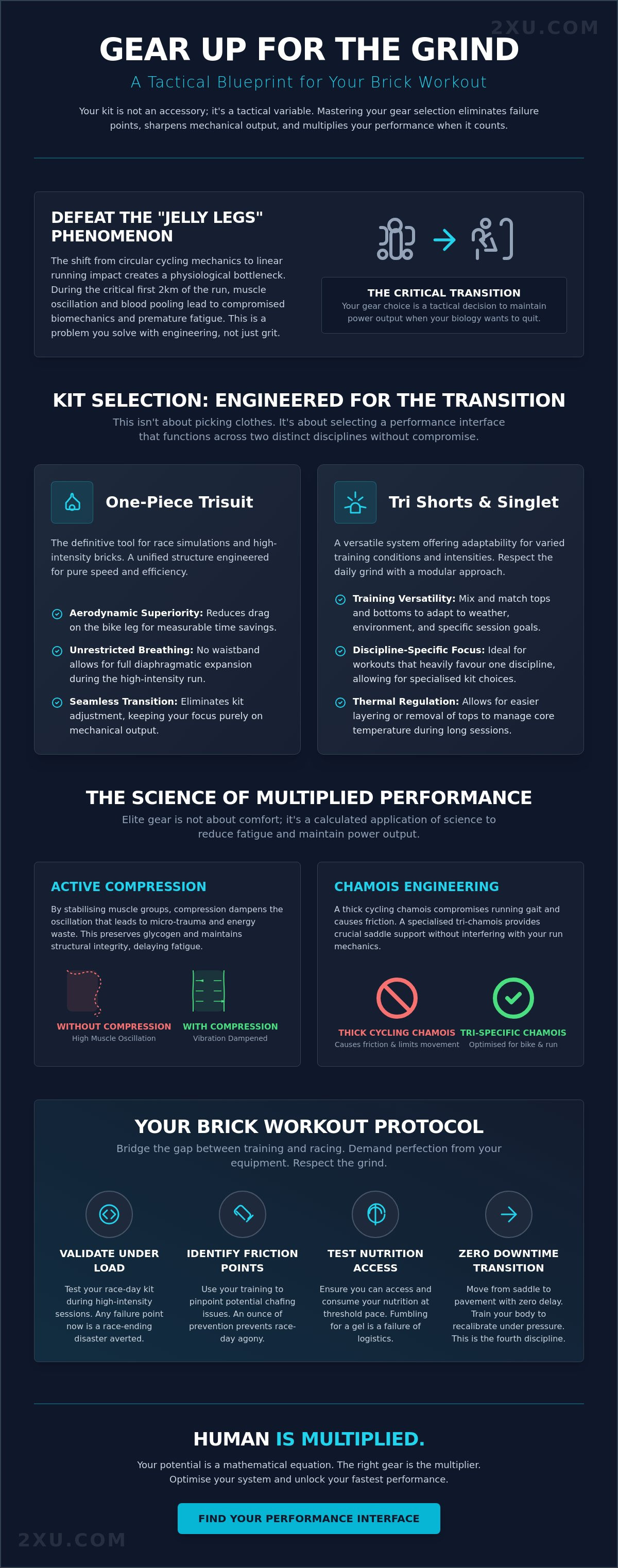
The "jelly legs" phenomenon occurs when blood pools in the quadriceps and the body struggles to recruit the specific motor units required for a vertical gait. Your choice of what to wear for a brick workout is a tactical decision to mitigate this sensation. High-performance compression clothing and specialised trisuits stabilise the muscle groups, reducing the oscillation that leads to premature fatigue during those first critical kilometres. By dampening these vibrations, you preserve glycogen and maintain structural integrity. This isn't about comfort; it's about maintaining power output when your biology wants to quit.
Simulating the Race Day Environment
Testing your race-day kit during high-intensity bricks is a non-negotiable requirement for serious athletes. You must validate your gear under load to ensure there are no surprises on the course. Use these sessions to test your nutrition storage and accessibility while moving at threshold. Identifying potential chafing points now prevents race-ending injuries later. If your triathlon suit isn't performing perfectly in the heat of a training session, it will fail you on the race course. Reject average standards and demand perfection from your equipment.
The Logistics of the Training Transition
Every second saved in transition builds the discipline required for the podium. Changing clothes during a brick workout is a failure of logistics that breaks the physiological chain of the session. You must move from the saddle to the pavement with zero downtime. This forces your body to adapt within the first 15 minutes of the run, which is the most critical window for mechanical recalibration. Efficiency in training translates to mathematical advantages on race day. Respect the grind by ensuring your transition is as seamless as your performance. Focus on the mechanics, eliminate the friction, and multiply your potential.
Trisuit vs. Separates: Selecting Your Training Kit
Your selection of what to wear for a brick workout determines whether you are training for speed or merely surviving the friction. This is a calculation of aerodynamic drag versus mechanical freedom. You aren't just picking clothes; you're selecting a performance interface that must function across two distinct movement patterns. Amateur athletes often make the mistake of wearing standard cycling shorts, but the mechanical interference of a thick cycling chamois on running gait is a primary cause of transition fatigue. You need a kit that facilitates the shift from seated power to upright impact without compromise.
Technical fabrics in elite kits are engineered to manage moisture in high-friction areas, preventing the saturation that leads to heavy, abrasive gear. These materials use high-filament yarns to provide UV protection and aerodynamic advantages while ensuring durability through the rigours of the grind. As you execute essential brick workouts designed to push your threshold, your apparel must provide a consistent internal environment. This requires advanced moisture-wicking properties that move liquid away from the dermis at a rate exceeding sweat production, maintaining a lightweight profile throughout the session.
The One-Piece Trisuit: The Aerodynamic Standard
The one-piece trisuit is the definitive tool for high-intensity race simulations. By removing the waistband, you eliminate a common point of restriction, allowing for unrestricted diaphragmatic breathing during the run. This unified structure reduces aerodynamic drag on the bike and ensures the kit remains perfectly positioned as your body geometry changes. Ensure your suit utilises high-filament yarns to maintain its compressive integrity over repeated training cycles. For those seeking the ultimate edge, explore our range of high-performance trisuits to find your optimal training interface.
Tri Shorts and Singlets: Versatility for the Grind
Separates offer necessary versatility for high-volume training blocks and longer sessions where logistical convenience is a priority. When selecting tri shorts, focus on a run-optimised chamois that provides adequate saddle cushion without creating a "diaper" effect when you transition to the pavement. Pairing these with a technical compression shirt ensures your core remains stable and your posture is supported as fatigue sets in during the final stages of the run. This combination allows you to swap layers based on thermal requirements while maintaining the specialised benefits of triathlon-specific gear.
The Science of Compression in the Neuromuscular Transition
The first 2km of the run are the most volatile. Your physiology is attempting to recalibrate from the concentric load of the bike to the high-impact eccentric load of the pavement. This is where energy leakage occurs, often manifesting as that unstable, heavy sensation in the lower limbs. Muscle oscillation is the involuntary vibration of muscle tissue during physical impact that results in energy leakage and accelerated fatigue. By applying medical-grade compression, you dampen these vibrations and preserve power for the final stages of the grind.
Selecting what to wear for a brick workout involves more than just moisture management; it requires a tool that improves venous return and delays the onset of lactate accumulation. The Science of Compression reveals that graduated pressure profiles facilitate faster blood flow back to the heart, ensuring your muscles receive oxygen exactly when the neuromuscular shift is most demanding. This is not a passive recovery aid. It is a performance multiplier that maintains structural integrity when your biology begins to fail under the stress of the transition.
Stabilising the Quadriceps and Hamstrings
During a brick, your legs must shift from the repetitive, shortened contraction of cycling to the forceful lengthening required for running. This transition causes micro-tears in the muscle fibres, leading to rapid fatigue. Advanced Muscle Containment Stamping (MCS) technology provides targeted support to these key groups, reinforcing the quadriceps and hamstrings against the shock of impact. This mechanical support reduces the physical toll of the shift, allowing you to settle into your running gait with greater efficiency and less risk of injury.
Calf Support and Power Retention
The calves are particularly vulnerable when moving from a pointed-toe cycling position to a flat-foot run strike. This sudden change in muscle length often triggers cramps and reduces power output. High-performance compression sleeves or socks maintain venous return and keep the muscle belly compact, preventing the "heavy leg" syndrome. Integrating specialised gear like flight pressure socks into your broader travel and training strategy ensures your lower limbs remain fresh and ready to perform, regardless of the volume of your training block. Respect the mechanics of your body and use the tools engineered to protect them.
Adapting for Environment: Layering and Intensity
Environmental variables are not excuses for compromised output; they are parameters that must be engineered around. When determining what to wear for a brick workout, you must account for the radical shift in airflow between the bike and the run. On the saddle, high-velocity movement causes rapid convective heat loss, which can lead to muscle cooling and reduced mechanical efficiency. Conversely, the lower speed of the run reduces this cooling effect while metabolic heat production remains high. This creates a thermal bottleneck that can lead to overheating if your apparel lacks the technical sophistication to adapt in real-time.
Avoid heavy, water-absorbent materials at all costs. These fabrics act as a reservoir for sweat and rain, creating "weight drag" that increases the metabolic cost of every stride. In high-humidity environments, salt build-up from evaporated sweat creates an abrasive layer against the skin that functions like sandpaper. You need technical fabrics engineered with high-filament yarns that pull moisture away from the body and dry rapidly. This keeps the kit lightweight and prevents the friction that leads to debilitating chafing during high-intensity sessions. To maintain your edge in any climate, invest in technical training apparel designed for the specific demands of multisport transitions.
Cold Weather Bricks: Maintaining Core Temperature
Maintaining core temperature during winter sessions requires a strategic layering system that doesn't sacrifice aerodynamics or transition speed. Use lightweight, wind-resistant outer shells or specialised vests to protect the torso from the biting chill of the bike leg. Arm warmers are a tactical necessity; they provide insulation when you are moving at 40km/h but can be easily rolled down or stowed as your internal temperature rises during the run. Moisture management is critical in the cold. If your base layer becomes saturated, you risk a post-bike chill that can shut down your neuromuscular systems before you hit the first kilometre of the run.
Heat Management and Breathability
In high-temperature conditions, your gear must actively work to lower your skin temperature. Utilise apparel featuring cooling technologies that reflect heat and provide a tangible reduction in thermal load. Mesh panelling is essential for the run phase, providing targeted airflow to high-heat zones like the back and underarms. A specialised visor or technical hat is not just an accessory; it is a tool for managing sweat and sun exposure, ensuring your vision remains clear and your focus stays locked on the grind. Discipline in your gear selection ensures that environmental stress never dictates your performance limits.
Multiplied Performance: The 2XU Brick Workout System
Elite performance is a mathematical certainty when you align your physiology with superior engineering. The 2XU Brick Workout System is built on this principle. We don't settle for average standards; every piece of gear is a validated tool designed to multiply your physical output. When you are deciding what to wear for a brick workout, the choice should be an extension of your ambition. You need a system that works as hard as you do during the most punishing phases of the transition. This is the Multiplication Promise: gear that enhances your natural capability through rigorous scientific validation.
The 2XU triathlon suit stands as the gold standard for transition efficiency. While standard elastane blends often lose their compressive power under the stress of heat and moisture, our proprietary PWX fabric is engineered for extreme durability and power retention. This fabric provides a high-modulus profile that maintains its structural integrity through thousands of repetitions. It ensures that the support you feel in the first minute of the bike is identical to the support you receive in the final kilometre of the run. By choosing gear that refuses to fail, you prove your commitment to the grind.
The 2XU Compression Advantage
Our gear utilises advanced circular knit technology to deliver 360-degree stretch and consistent power application. Unlike traditional warp-knit materials, our circular knit construction ensures that pressure is applied evenly across the entire muscle belly, regardless of the direction of movement. This is critical during the transition from the seated cycling position to the upright running gait. Our specialised filaments are designed to withstand the corrosive effects of sweat and salt, outperforming standard materials in both longevity and performance. Respect the grind by investing in equipment that matches your intensity.
Final Gear Checklist for Your Next Brick
Success in the fourth discipline is a result of meticulous preparation. Before your next session, ensure your gear strategy is locked. A focused kit list includes specialised tri shorts or a full suit, moisture-wicking technical socks, speed-laces for rapid shoe entry, and a secure race belt. There is a tangible psychological boost that comes from looking and feeling like an elite competitor. When you eliminate the friction of poor equipment, you clear the path for breakthrough results. Gear up for your next session with our performance running shorts and experience the power of multiplied output. The road to the podium is paved with discipline; make sure your gear is ready to lead the way.
Engineer Your Exponential Breakthrough
Success in multisport isn't found in the comfort of average standards; it is forged in the discipline of the transition. You've analysed the mechanics of the neuromuscular shift and the tactical necessity of specialised apparel. Now, you must execute. Mastering the logistics of what to wear for a brick workout is the final variable in your performance equation, allowing you to move from the saddle to the run with zero energy leakage. By integrating proprietary MCS technology and gear tested in independent university laboratories, you provide your body with the mechanical stability required to excel when others falter.
We are the official partner of elite global triathletes because our gear is designed to multiply human output through rigorous scientific validation. Every stitch and filament is focused on one goal: ensuring your training translates into mathematical gains on race day. Respect the grind, sharpen your logistics, and demand more from your equipment. Maximise your transition efficiency with 2XU Triathlon Gear and take your place among the elite. Your breakthrough is waiting. Earn it.
Frequently Asked Questions
Can I wear standard cycling shorts for a brick workout?
No. Standard cycling shorts utilise a high-density chamois designed for prolonged saddle time, which creates significant mechanical interference during the run. This bulk alters your running gait and increases the risk of severe inner-thigh chafing. A specialised triathlon chamois is engineered to provide sufficient cushion for the bike while remaining low-profile enough to facilitate an efficient, natural running strike.
Do I need to wear socks during my bike-to-run transition?
Wearing technical, moisture-wicking socks is recommended for the majority of training sessions to preserve foot integrity. While some athletes skip socks in short-course racing to save seconds, the primary goal of a brick is neuromuscular adaptation and volume. Blisters from friction will compromise your subsequent training days. Use socks made from specialised filaments that don't absorb water to ensure your feet remain dry and stable.
Should I wear a one-piece or two-piece trisuit for training?
Select your kit based on the specific objective of the session. A one-piece trisuit is the aerodynamic standard and should be worn for high-intensity race simulations to ensure zero waistband interference. For longer volume sessions, two-piece separates offer superior logistical flexibility and easier thermal regulation. Both options must provide graduated compression to stabilise muscle groups and reduce energy leakage during the transition phase.
What is the best way to prevent chafing during a long brick session?
Eliminate chafing by applying a high-quality anti-chafe lubricant to high-friction zones before you begin. Your choice of what to wear for a brick workout is the second line of defence; avoid fabrics that retain moisture and become heavy. Technical apparel with flatlock seams and moisture-wicking yarns reduces the abrasive salt build-up that causes skin irritation as you move from the bike to the run.
How do I choose the right size compression gear for high-intensity training?
Accurate sizing is essential for compression to function as a performance multiplier. Use specific height and weight charts alongside limb circumferences to determine your correct fit. The gear must provide a firm, graduated pressure profile to facilitate venous return without restricting joint mobility or diaphragmatic breathing. If the fit is too loose, you lose the technical benefits of muscle containment and oscillation reduction.
Is it necessary to wear a heart rate monitor during a brick workout?
Utilising a heart rate monitor is essential for tracking physiological stress and managing the "cardiac drift" common during transitions. The shift from cycling to running often triggers a spike in heart rate despite a consistent power output. Monitoring this data allows you to calibrate your intensity and ensure you are training within the correct metabolic zones to achieve elite adaptation and avoid overtraining.
Can I use my regular running shoes, or do I need triathlon-specific ones?
You can use standard running shoes, provided they comply with the 40mm sole thickness regulations. To optimise your transition, replace standard laces with elastic speed-laces to allow for rapid entry. This modification provides the security of a traditional fit with the efficiency required for a seamless transition. Ensure your shoes are well-ventilated to manage the sweat accumulated during the bike leg.
How often should I do a brick workout in full race gear?
Perform a brick in your full race kit once every 14 to 21 days during your peak training phase. This frequency allows you to validate what to wear for a brick workout under race-intensity loads without causing premature wear on specialised fibres. Use these sessions to test your nutrition accessibility and identify any potential chafing points before they can compromise your performance on the race course.