
Wetsuits for Men: The Scientific Guide to Triathlon Performance (2026)
The triathlon swim is a calculated battle against drag, fatigue, and inefficiency. Every second lost to sinking legs or poor body alignment is a deficit you carry onto the bike. Every joule of energy wasted fighting restrictive neoprene is a compromise on your power output for the next two disciplines. A generic surf suit is not an option. A scientifically engineered wetsuit for men is not merely equipment; it is a competitive weapon, meticulously designed to turn hydrodynamic resistance into forward propulsion and conserve your energy for the race ahead.
This definitive 2026 guide moves beyond generic advice. We will dissect the advanced material science and hydrodynamic engineering that define elite triathlon performance. You will gain a data-driven understanding of how proprietary buoyancy profiling corrects your body's horizontal alignment, how anatomically engineered paneling provides unrestricted mobility for maximum power output, and how specific neoprene technologies can multiply your efficiency in the water. Prepare to transform your swim leg from a test of endurance into a display of calculated power.
Key Takeaways
- A triathlon wetsuit is an engineered performance tool, fundamentally different from a surf suit's thermal focus, designed for maximum hydrodynamic efficiency.
- Master optimal body position by understanding how strategically placed 5mm neoprene panels counteract "sinking leg" syndrome for greater propulsive power.
- A precision-fit wetsuit for men is non-negotiable; learn to identify the correct compressive feel to eliminate drag from water flushing and ballooning.
- Unlock new levels of speed by leveraging advanced hydrodynamic coatings and forearm "catch panels" engineered to multiply your stroke efficiency.
The Science of Hydrodynamics: Why a Triathlon Wetsuit is Not a Surf Suit
To achieve peak performance, an athlete must understand their equipment is not merely an accessory but a critical component of their biomechanical system. A common and costly error is conflating a triathlon wetsuit with a surf suit. They are fundamentally different tools, engineered for opposing physical demands. A surf suit is an insulator. A triathlon wetsuit is a hydrodynamic weapon designed for one purpose: maximizing horizontal propulsion with minimal energy expenditure.
This distinction is rooted in physics. Every design element, from neoprene thickness to surface coating, is scientifically calibrated to reduce drag, optimize body position, and shave critical seconds off your time. Mediocrity is not an option when victory is measured in fractions of a second.
Buoyancy vs. Warmth: The Physics of the Swim
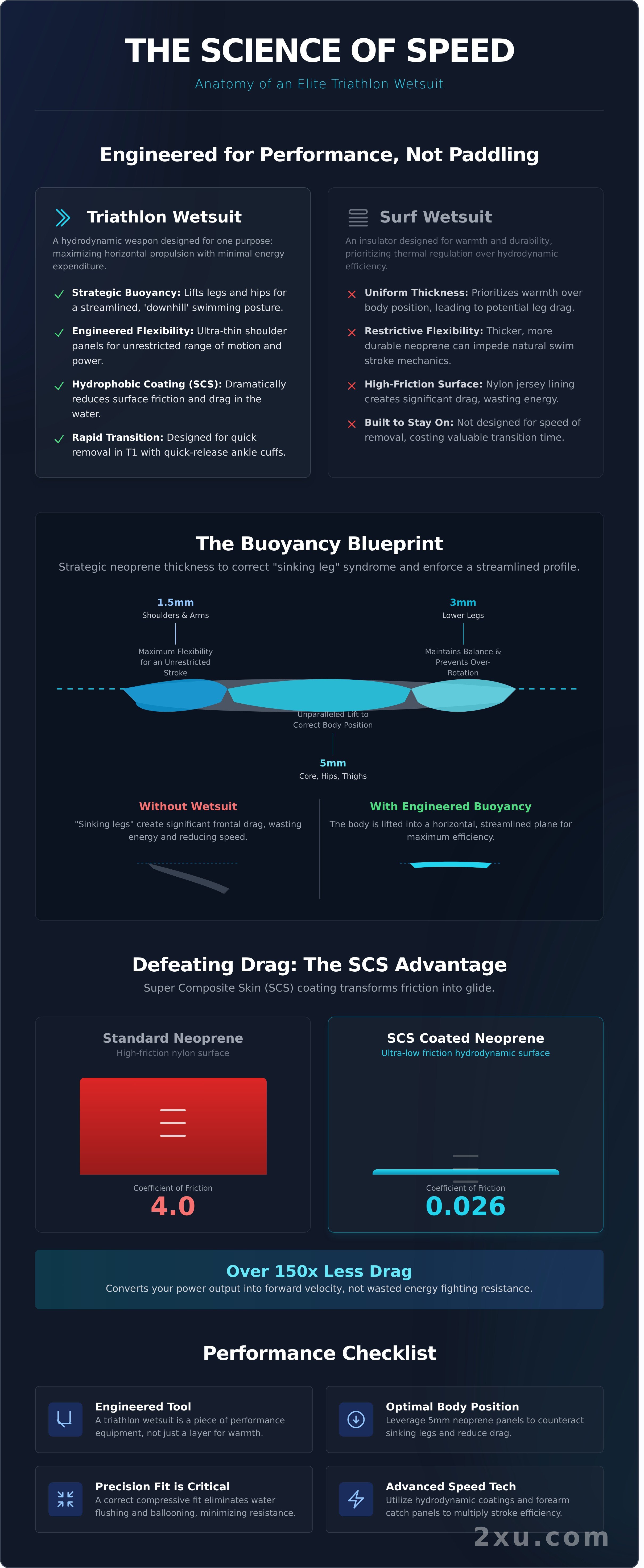
The core engineering principle of a triathlon wetsuit for men is strategic buoyancy. Advanced suits utilize panels of varying neoprene thickness-thicker in the legs and core, thinner in the shoulders-to elevate the swimmer's hips and feet. This creates an optimal, downhill swimming posture, drastically reducing frontal drag. In contrast, a surf suit prioritizes uniform thermal insulation and the vertical flexibility required for paddling. While both rely on the same basic principles outlined in The Science of Wetsuits, their application is divergent. The performance-grade neoprene in elite triathlon suits also delivers a measurable "energy return," snapping back into shape to assist in the propulsive phase of your stroke.
Surface Friction and the SCS Coating
A standard surf suit, with its nylon jersey lining, creates significant surface friction. This is drag, and drag is the enemy of speed. Elite triathlon wetsuits are treated with a proprietary coating, such as Super Composite Skin (SCS), a specialized layer applied to the smooth-skin neoprene. This technology dramatically reduces the coefficient of friction. The drag coefficient of SCS in water is a mere 0.026, compared to 4.0 for standard neoprene. This scientific advantage means your power output is more efficiently converted into forward velocity, not wasted overcoming resistance.
Finally, consider the element of speed beyond the swim. Every second counts in transition. Triathlon suits are engineered with quick-release ankle cuffs and high-stretch linings, designed for rapid removal over a timing chip. A surf suit is built to stay on. Choosing the correct suit is not a matter of preference; it is a calculated decision for superior performance.
Anatomy of Performance: Neoprene Thickness, Buoyancy, and Body Position
An elite wetsuit is not merely a layer of rubber; it is an engineered system designed to manipulate hydrodynamics in your favor. Achieving the perfect fit is only the first variable. Understanding the science of neoprene thickness and placement is what separates a personal best from the middle of the pack. The primary objective is to create the most efficient swimming position possible, reducing drag and conserving critical energy output.
For many triathletes and swimmers, the most significant barrier to speed is the "sinking leg" syndrome-a poor body position where the legs and hips drop, creating immense drag. This is a direct drain on power and endurance. Advanced wetsuit design directly counteracts this inefficiency. By integrating panels of varying thickness, a modern wetsuit for men lifts the lower body into a horizontal, streamlined plane. This is not theory; extensive research on wetsuit performance validates that optimized buoyancy directly correlates to reduced drag and increased swim velocity. The trade-off is engineered with scientific precision: maximum buoyancy in the core and legs must be balanced with absolute flexibility in the shoulders to ensure an unrestricted, powerful stroke.
The 5:3:1 Rule: Strategic Panel Placement
The distribution of buoyancy is a calculated science. Our proprietary paneling follows an engineered formula to optimize your position in the water. This is the blueprint for speed.
- 5mm Panels: Deployed through the core, hips, and upper legs, these maximum-buoyancy panels provide unparalleled lift, stabilizing your core and correcting sinking legs for a streamlined profile.
- 3mm Panels: Used in the lower legs to maintain a balanced position, preventing over-rotation and ensuring an efficient, powerful kick.
- 1mm to 1.5mm Panels: Engineered for the shoulders and underarms, this ultra-thin neoprene offers minimal resistance and maximum flexibility, allowing for complete rotational freedom and power transfer through every stroke.
Yamamoto Neoprene: The Science of Air Cells
The material itself dictates performance potential. Yamamoto neoprene, specifically the #39 and #40 cell grades, represents the pinnacle of wetsuit technology. Unlike petroleum-based alternatives, this limestone-derived neoprene possesses a closed-cell structure with an exceptionally high density of nitrogen-infused air pockets. This advanced composition results in a superior buoyancy-to-weight ratio, meaning it provides more lift with less material. The result is a lighter, more flexible, and warmer wetsuit for men that absorbs less water, reduces fatigue, and multiplies your performance potential from the starting gun to T1.
Engineered for Speed: Hydrodynamic Coatings and Stroke Efficiency
A superior wetsuit for men is not merely assembled; it is engineered. Where generic suits utilize flat, uniform neoprene panels, 2XU employs a multi-faceted approach to construction, viewing the suit as a piece of high-performance hydrodynamic equipment. Every panel, seam, and liner is meticulously designed to reduce drag, enhance power output, and multiply your performance in the water. A key innovation is the floating zip panel, which is engineered to move with the body. By de-coupling the zipper from the large latissimus dorsi muscle, it eliminates the restriction common in inferior suits and allows for unparalleled reach and extension during every stroke.
Maximizing the Catch and Pull
The initial phase of the swim stroke-the catch and pull-is where races are won. To maximize propulsion, 2XU wetsuits feature proprietary Embossed Concave Water Entrapment Zone (CWEZ) panels on the forearms. These textured panels are engineered to disrupt water flow, creating turbulence that allows you to "grip" the water more effectively than with bare skin or smooth neoprene. This advanced surface engineering, validated by findings in a systematic review of wetsuit hydrodynamics, translates directly into increased distance per stroke. This technology also provides critical neurological feedback, enhancing your proprioceptive awareness of forearm position for a stronger, more efficient pull. The result is a quantifiable reduction in energy expenditure, enabling a lower heart rate and sustained power when it matters most.
Internal Engineering: The Power of Stretch
The internal mechanics of a performance wetsuit are just as critical as its external surfaces. Our proprietary internal liners are engineered with an industry-leading 520% stretch capability. This extreme flexibility works in harmony with your body, minimizing restriction across the shoulders and back to significantly reduce muscle fatigue over long distances. Unlike restrictive liners that fight your natural biomechanics, our advanced fabrics allow for maximum muscular elongation. This uninhibited movement is fundamental to our design philosophy and complements the benefits of graduated pressure. Explore The Science of Compression: Unlock Peak Performance to understand how our technologies work in unison. Furthermore, these technical fabrics are designed to prevent chafing by creating a smooth, seamless barrier against the skin while maintaining the perfect watertight seal.
The Precision Fit: How to Size Your Wetsuit for Zero Resistance
A performance wetsuit is not an article of clothing; it is a piece of engineered equipment. Its primary function is to create a second skin, eliminating drag for maximum hydrodynamic efficiency. A loose fit that allows water to flush through the neck or "balloon" at the ankles is a critical failure. This ingress of water creates resistance, cools the body, and negates the performance benefits of the suit. A precision fit is non-negotiable.
To prevent damage and ensure an optimal fit, follow this donning protocol:
- Begin completely dry. Fold the suit's top half down over the waist.
- Ease your legs in, meticulously adjusting the neoprene over your calves and quads with your fingertips-never your nails.
- Pull the suit high into the crotch and up over your torso.
- Introduce each arm, smoothing the material to eliminate any bunching in the armpit or shoulder.
- Secure the zipper and fasten the neck closure.
Sizing for the Male Physique
The athletic male form, often characterized by a significant chest-to-waist drop, demands a specific sizing methodology. Your core metrics are height, chest circumference, and, most critically, weight. Weight is the primary indicator of your body's volume, directly impacting buoyancy and how the suit contours to your frame. Get the weight wrong, and you compromise your entire hydrodynamic profile.
The "On-Body" Checklist
Once on, conduct a final systems check to validate the fit. An elite wetsuit for men must pass this assessment:
- Zero Gaps: Press the suit against your lower back and check under your armpits. There should be no air pockets; the material must be in complete contact with your skin.
- Neck Seal Integrity: The seal should be snug, preventing water ingress without constricting your airway. A deep, diaphragmatic breath should be possible without choking.
- Mobility Verification: Execute the "arm-swing test." Perform several full, powerful forward and backward arm circles. You should feel compression and tension-the suit engaging your lats and shoulders-but not painful restriction. This is the sweet spot between power and mobility.
On land, the correct fit will feel tight. This is by design. That compression translates to unparalleled performance in the water, reducing muscle oscillation and creating a seamless profile that cuts through the water with zero resistance. For a scientifically engineered fit designed to multiply your performance, explore the 2XU wetsuit range.
2XU Wetsuit Technology: Multiply Your Human Performance
A perfect fit is the foundation, but superior technology is what multiplies performance. 2XU wetsuits are not merely designed; they are engineered for a single purpose: to make you faster. Our range, including the pinnacle Propel series and the performance-driven P:1 and P:2 models, is built on a framework of scientifically validated hydrodynamic advantages. Every 2XU wetsuit for men is a piece of technical equipment designed to overcome the limits of human ability.
At the core of our suits are proprietary innovations meticulously engineered for maximum output:
- Yamamoto Neoprene: We utilize premium Japanese Yamamoto neoprene, with 39-cell front buoyancy panels to elevate the body and ultra-flexible 40-cell panels in key areas for unparalleled freedom of movement, minimizing restriction and fatigue.
- Concave Water Entrapment Zone (CWEZ): Engineered on the forearm, this proprietary technology enhances the catch phase of your stroke. By increasing the surface area, it improves your feel for the water and amplifies power output.
- Rollbar Technology: A core innovation that improves body position and hip rotation for a more efficient freestyle stroke, providing crucial core stability to maintain power when fatigue sets in.
Propel Series: The Pinnacle of Hydrodynamics
The Propel P:2 exemplifies this technological fusion. Its 39-cell neoprene panels provide maximum buoyancy, while our Rollbar technology prevents the inefficient side-to-side "snaking" motion, translating wasted energy into forward momentum. This is the advantage you need on race day. Ensure your equipment gives you every legal advantage by understanding the IRONMAN Wetsuit Rules: Are You Race-Legal?
The 2XU Guarantee: Prepare, Perform, Recover
Our commitment extends beyond the water. The 2XU philosophy covers the entire athletic lifecycle: Prepare, Perform, and Recover. A perfectly fitted, technologically advanced wetsuit is a critical component of the "Perform" phase. We invite you to explore the equipment engineered to help you shatter your personal bests.
Dominate your next race. Shop the 2XU Mens Wetsuit Collection.
Engineer Your Advantage: The Final Analysis
The science is conclusive. Peak triathlon performance is not accidental; it is engineered. As we've detailed, the critical interplay between hydrodynamics, variable neoprene buoyancy for optimal body positioning, and a precision fit separates elite equipment from the pack. These are not just features-they are the scientific formula for reducing drag, conserving energy, and maximizing your power output from the cannon to T1. Understanding this is the first step to unlocking your potential.
The second step is choosing the right equipment. World Champion triathletes trust 2XU for a reason. By leveraging superior materials like Yamamoto #39 and #40 Grade Neoprene and proprietary innovations such as Rollbar and CWEZ technology, we have created the definitive wetsuit for men who are obsessed with performance. This is the gear scientifically validated to translate your training into race-day results.
Mediocrity is a choice. Choose to multiply your human performance instead. Explore the 2XU Men’s Wetsuit Collection and arm yourself with the technology to dominate your next race.
Frequently Asked Questions
Is a 3mm or 5mm wetsuit better for triathlon swimming?
The optimal thickness is dictated by water temperature and its impact on performance. A 5mm suit offers maximum buoyancy and thermal protection, ideal for colder waters (below 65°F/18°C) to prevent energy loss from shivering. A 3mm suit provides superior flexibility and a more natural feel, engineered for warmer conditions (above 65°F/18°C) where maximum range of motion is the priority. Choose based on race-day conditions to multiply your performance.
Can I use a surfing wetsuit for an Ironman or triathlon race?
This is not recommended for any serious athlete. Surfing wetsuits are engineered for durability, not hydrodynamic efficiency. They severely restrict shoulder rotation, increasing fatigue and reducing power output. A triathlon-specific wetsuit is scientifically designed with advanced neoprene panels and a hydrophobic coating to minimize drag and maximize flexibility, providing a distinct competitive advantage. Using a surfing suit compromises your performance potential from the start.
How tight should a mens triathlon wetsuit feel on land?
On land, a correctly sized triathlon wetsuit should feel uncomfortably restrictive, particularly across the chest and shoulders. This is by design. The fit must be compressive, like a second skin, with no significant gaps or folds in the armpits, crotch, or lower back. While movement may feel limited on land, the suit will expand and conform to your body in the water, creating the optimal hydrodynamic profile for peak performance.
How do I prevent neck chafing in my performance wetsuit?
Neck chafing is a preventable drag on performance. The primary solution is applying an anti-chafe balm or lubricant specifically designed for wetsuits to the back and sides of your neck before every swim. Ensure the suit’s neck closure is snug but not overly tight. A proper fit is critical; a collar that is too loose will scoop water and move excessively, creating friction. Execute proper technique to minimize head rotation that exacerbates the issue.
How many seasons will a high-quality triathlon wetsuit last?
The lifespan of a high-performance triathlon wetsuit is a function of use and meticulous care. For a competitive athlete training and racing frequently, a suit will maintain its peak performance characteristics for approximately 2-4 seasons. After this period, the neoprene's elasticity and glued seams can degrade, reducing buoyancy and flexibility. Proper rinsing, drying, and storage are non-negotiable to maximize the suit's effective lifespan and protect your investment in performance equipment.
What is the best way to clean and store my Yamamoto neoprene suit?
Preserve the integrity of your advanced Yamamoto neoprene. After every use, rinse the suit thoroughly inside and out with fresh, cold water. Never use hot water, detergents, or solvents, as they degrade the material and seam tape. To dry, hang it inside out on a wide-shouldered wetsuit hanger, away from direct sunlight or heat sources. Once the interior is dry, reverse it. Store it flat or on the same wide hanger to prevent permanent creasing.
What happens if my wetsuit is too big?
An oversized wetsuit is a direct threat to your race-day performance. Gaps in the fit allow water to "flush" through the suit, creating significant drag and destroying the thermal barrier. This forces your body to expend critical energy heating new water instead of powering your swim. An ill-fitting wetsuit for men negates the technological advantages you invested in and will actively slow you down, compromising your final result.
Do I need a sleeveless or full-sleeve wetsuit for my first race?
The choice depends on water temperature and your swimming background. A full-sleeve wetsuit for men offers superior buoyancy and warmth, a significant advantage for most new triathletes, especially in colder water. It improves body position and hydrodynamics. A sleeveless suit provides an unrestricted feel in the shoulders, which some athletes prefer, but sacrifices warmth and buoyancy. For a first race, the performance benefits of a full-sleeve model are almost always the superior strategic choice.